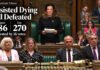
MPs have backed a motion calling for the upcoming cut in Universal Credit to be scrapped, with nearly all Conservative MPs abstaining.
The non-binding Labour motion calling for the universal credit top-up to be kept in place beyond 31 March passed by 278 votes to none after a Commons debate.
Boris Johnson ordered his MPs to abstain, which means not voting for or against the motion.
The motion, which will not automatically lead to a change in policy, was put forward by Labour as a way to put additional pressure on the government to continue the increase of £20 a week universal credit boost, worth £1,000 a year.
While the vote is not binding, and will not lead to a change in policy, it will increase pressure on the government to keep the increase or come up with an alternative.
Six billion pounds of the benefits bill – the difference between poverty or not for 1.2 million families.
The Treasury is now considering a partial climbdown over plans to end the boost to universal credit amid pressure from the work and pensions secretary, Thérèse Coffey, and after six Conservative MPs defied a call to abstain on a non-binding vote in the Commons.
Boris Johnson also hinted at a rethink over the £20-a-week uplift, which is due to end in April, saying the government wanted to ensure “people don’t suffer as a result of the economic consequences of the pandemic”.
The welfare minister, Will Quince, said a decision would be made closer to the 3 March budget because of the uncertain economic outlook. But the Institute for Fiscal Studies thinktank said the government must make the decision much sooner.
Former Work and Pensions Secretary Stephen Crabb was among six Conservative MPs to rebel, along with Peter Aldous, Robert Halfon, Jason McCartney, Anne Marie Morris and Matthew Offord.
Ahead of the vote, Mr Crabb told the BBC that although there were “difficult pressures on the chancellor” extending the increase for 12 months was “the right thing to do”.
Rishi Sunak, the chancellor, is understood to be reticent to make the uplift permanent, which Treasury sources said would cost £6bn a year.
Coffey, who met Sunak last week, is understood to be keen to find a compromise to stop the cut, and the Treasury is considering a range of options as a potential sweetener for Conservative MPs which stop short of extending the uplift.
One Tory source said MPs had been badly burnt by the rows over the campaign lead by Marcus Rashford for free school meals, including cabinet ministers who blamed Sunak for holding back extra funding, and they did not want to see a repeat of public outcry.
The 65 Conservatives that make up the Northern Research Group have said scrapping the increase would be “devastating” for families.
Addressing the debate, Treasury minister Steve Barclay said the government was “acutely aware” of the hit to the finances of many people during the pandemic.
“It’s clear that there is a heartfelt desire shared across all sides of the House to support constituents impacted by the economic consequences of COVID,” he said.
“As a government, we are acutely aware of the harm caused by the crisis to people’s finances including the most vulnerable in our society.
“At every stage of the pandemic, we have striven to support those who have found themselves at the sharp end.”
Seeking alternatives.
Options being considered by the Treasury include a temporary extension of the £20-a-week uplift for six months, though there are concerns that any extension would prolong calls for the rise to be made permanent.
Another reported option under consideration is a one-off lump sum of £500 to all UC claimants, a significantly cheaper policy than extending the uplift – costing about £3bn, according to the IFS.
Richard Burgon MP stated: “Britain is the sixth richest country in the world. So why are 14m people living in poverty? This endemic poverty is the result of a rotten system.”
Britain is the sixth richest country in the world. So why are 14m people living in poverty?
— Richard Burgon MP (@RichardBurgon) January 18, 2021
This endemic poverty is the result of a rotten system.
My speech to parliament tonight ? pic.twitter.com/rpDPXzRc8l
Charities and anti-poverty campaigners are pleading with the government to keep the support in place, describing it as a lifeline for more than 5.5 million families who receive the standard universal credit allowance.
Food poverty campaigner and chef Jack Monroe stated that the £20 increase “has been a lifeline” for millions of people who have needed to top up their income or rely on universal credit payments in order to get by.
Labour said the Conservatives’ decision to abstain created “unnecessary uncertainty” but minister Nadhim Zahawi described the vote as “a political stunt”.