The Price of Blood and Iron: How War Became Britain’s Industrial Strategy
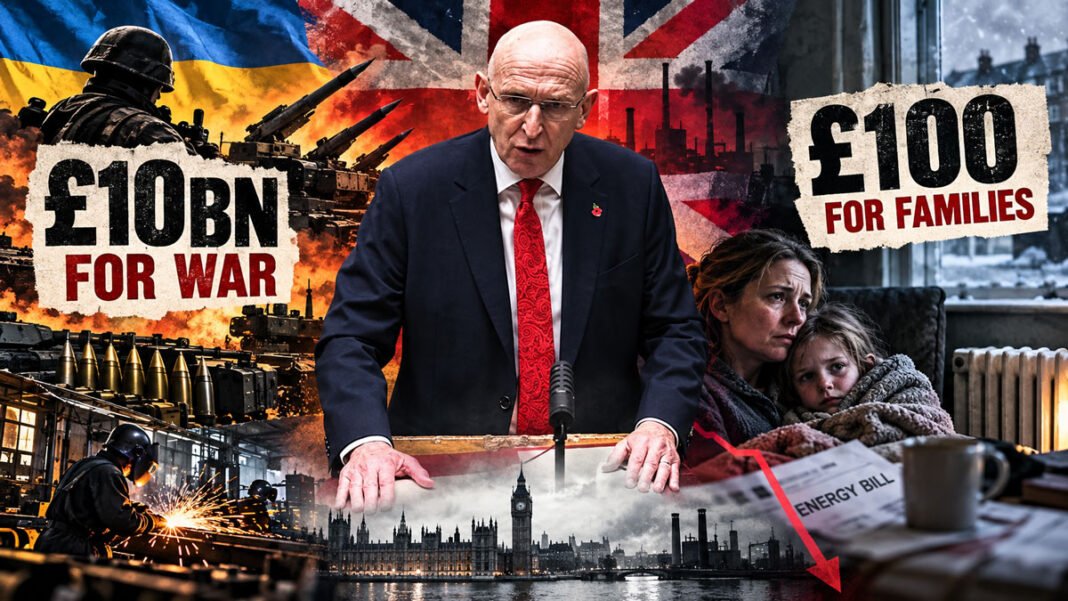
Ten billion pounds for a foreign war was settled by telephone before the Cabinet had even sat down. For twenty million households facing another cold winter, the Chancellor offered a one-off hundred pounds. George Orwell saw where this road leads.
There is a deadening monotony that comes with sounding an alarm in an empty square. You shout the warning, the sirens wail, and the crowd merely turns up its collars against the chill, content to carry on toward the precipice. It feels uncomfortably like being permanently cast as Dr Stockmann in Henrik Ibsen’s An Enemy of the People: condemned to tell a self-satisfied town that the spa waters are poisoned, only to be branded an enemy for daring to point at the pipe.
Today the pipe burst across the floor of the House of Commons.
£10bn Settled by Telephone, £100 by Despatch Box
Before the Cabinet met this morning, Prime Minister Andy Burnham and his Chancellor, John Healey, picked up the telephone to Kyiv. They told Volodymyr Zelenskyy that Britain would commit an additional £10 billion to Ukraine in today’s Budget, bringing total assistance over the last four years past the £35 billion mark. It is the largest single financial package this country has ever pledged to the conflict. Standing at the despatch box a few hours later, Mr Healey recounted the exchange with palpable self-congratulation. “We called him this morning,” the Chancellor announced:
“He told us we made his day.”
A minister delivers a line like that with an easy glow of moral superiority. Keep it firmly in mind, because the domestic ledger tells an entirely different story.
For the twenty million households in council tax bands A to D who must underwrite these grand gestures, the Chancellor produced a one-off Household Energy Payment of £100. That single payout will cost £2.6 billion this winter. Mr Healey added, with an air of benevolence, that standing charges on domestic gas bills will be scrapped from next year. The relief vanishes the moment you inspect the arithmetic. The charge is not being abolished; it is simply being loaded directly onto the unit rate of every therm of gas a family burns. Mr Healey assured MPs that iron fiscal discipline remains his primary duty. He neglected to explain why that discipline binds domestic hardship with chains of steel while slackening into open-ended generosity the instant the subject turns to artillery.
Put the two choices side by side. A single payment, roughly sufficient to keep a modest radiator lukewarm for three weeks in January, set against an enduring, multi-year pipeline of state capital. This is not a clerical mishap. It is a deliberate hierarchy of values, and the rest of the Budget elevates it to an economic doctrine.
The Export Credit Scam
Strip away the Westminster rhetoric of solidarity, and the £10 billion package resolves into three component parts. There is £500 million from the Ministry of Defence to patch Ukrainian air defences this winter. There is £7 billion of economic support promised across three years. And there is £3 billion of expanded capacity for UK Export Finance, the government’s credit agency, which Downing Street says will be “prioritised for military support”.
That last part deserves the closest attention. UK Export Finance does not exist to give money away. Its job is to support British exports by putting the public balance sheet behind deals that the private market will not back on its own. When its capacity is earmarked for military support, public money stands behind the contracts that keep weapons production lines running. Much of this “ten billion” is not a gift at all. It is credit, and a good share of it is designed to come home as orders for arms manufacturers.
The story does not end at Ukraine’s border. Today’s Budget commits Britain to spending 3 per cent of national income on defence by 2030, and it reaffirms the NATO target of 3.5 per cent by 2035. The National Wealth Fund and the British Business Bank were sold to us as engines of industrial renewal. They will now put up to £5 billion over four years into defence and “dual-use” technology. A new Innovative Defence Finance taskforce will look for ways to raise money for the military alongside private investors. Mr Healey told the Commons that the defence industrial base would be expanded and that local areas would be transformed by it.
There is an established economic term for this system: military Keynesianism. When a ruling class loses the political will to invest directly in housing, energy, or human welfare, it uses the production of weaponry to maintain factory output and prop up aggregate demand. It sustained the post-war American economy until Dwight Eisenhower, a Republican soldier who knew the trade intimately, felt compelled in 1961 to warn his citizens against the unwarranted influence of the complex they had created. Britain, having spent four decades systematically shuttering its civilian industries, has stumbled into the same trap. This administration insists it cannot nationalise water, cannot build council homes at scale, and cannot preserve a domestic steelworks without a crisis. Yet it can organise, plan, and subsidise the production of munitions with seamless efficiency. It cannot plan for life, but it plans for war with genuine passion.
Military Keynesianism and the Permanent War Economy
The Labour movement has walked this miserable ground before. In April 1951, Hugh Gaitskell produced a Budget to finance a rearmament drive for the Korean War. To pay the bill, he introduced prescription charges on NHS teeth and spectacles. Aneurin Bevan, who had built the health service with his own hands, resigned from the Cabinet in disgust, accompanied by Harold Wilson. Bevan’s insight was unassailable: the moment armaments spending is elevated to an unquestioned priority, the social wage of the working class becomes the slush fund raided to pay for it.
George Orwell, writing Nineteen Eighty-Four in those very same years, grasped the underlying economics with absolute clarity. In Emmanuel Goldstein’s forbidden book, Orwell explained the structural necessity of perpetual conflict. The primary object of modern war, he wrote, is to consume the surplus products of the machine without raising the general standard of living. Factories run, labour is extracted, and goods are manufactured only to be consumed by destruction. The abundance that industrial efficiency ought to grant ordinary families is deliberately dissipated. The war is not meant to be won; it is designed to be continuous.
Britain in 2026 is not Oceania, and the war in Ukraine is not a fiction staged to keep a population docile. But Orwell’s insight was never really about propaganda. It was about what happens to a society when destroying goods becomes its most reliable source of industrial demand.
An economy that depends on war will always find a war, and sometimes it will make war too.
And here is that monotony returning. Here am I shouting: “The water is poison.” The Tribune’s argument has always been a simple one. An economy that depends on war will always find a war, and sometimes it will make war too. That is not paranoia. It is the record. In 1935, Major General Smedley Butler, holder of two Medals of Honour, published War Is a Racket. In it he looked back on his three decades in the Marine Corps as service to American business interests from Central America to China. In August 1964 the United States escalated in Vietnam after a second attack in the Gulf of Tonkin that, as the National Security Agency’s own historians later admitted, never happened. In 2003 Britain followed Washington into Iraq. Sir John Chilcot’s inquiry found that the intelligence had been presented with a certainty it did not justify, and that Britain joined the war before the peaceful options had been exhausted. Each time, the industry that profited was already waiting with its order book open.
Nobody needs to claim that Britain manufactured the war in Ukraine to see the danger. The real question is what a country does once its factories, its public investment funds and its regional economies are tied to the demand that war creates. It does not need to start the next war. It only needs to lose interest in ending this one, and to discover threats wherever the next contract needs them.
The Government’s Two Claims, Separated
The government’s case rests on two claims, and they need to be separated rather than accepted together.
The first is that Russia’s invasion in February 2022 broke international law. It did. The UN Charter forbids any state from using force against the territory of another. In March 2022, the General Assembly condemned the invasion by 141 votes to five. No account of how this war began changes that, and this paper will not pretend otherwise.
But Westminster likes to start the story in 2022 because that is where it is most comfortable to start. The war began in 2014, when Viktor Yanukovych’s elected government turned from Brussels to a Moscow loan, the Maidan protests drove him out, Russia seized Crimea and war came to the Donbas. Behind all of it lay a decision taken in Bucharest in 2008, when NATO declared that Ukraine and Georgia “will become members” of the alliance. William Burns, then America’s ambassador in Moscow and later director of the CIA, had warned Washington that Ukrainian membership was the brightest of all Russia’s red lines, and not only for Putin. A decade before that, George Kennan, the architect of Cold War containment, had called NATO’s eastward expansion a tragic mistake that would start a new cold war. None of this excuses an invasion. All of it helps explain one. A political class that refuses even to discuss it is not serious about ending the war.
The second claim does far more work in today’s Budget. It is the claim that if Putin is not stopped in Ukraine, his tanks will roll on into Poland and the Baltic states. This is the domino theory, and it deserves scepticism. The army we are told threatens Berlin has spent years grinding forward a few miles at a time in eastern Ukraine. Europe’s NATO members together outspend Russia on defence several times over. Threat inflation is not a side issue here. It is the fuel. Every ministerial warning of Russian armour at the Brandenburg Gate justifies another percentage point of national income for the arms industry. It justifies another year in which the money for warm homes cannot be found.
There is a stronger argument for today’s spending, and this publication should take it seriously. Defence manufacturing provides skilled, unionised, decently paid jobs in exactly the towns that deindustrialisation left behind. A welder at Barrow or a machinist at Belfast is not a war profiteer. For many working-class families, the arms industry is one of the few places left where a trade still leads to a mortgage or paying the rent on time.
£31.7bn of Defence Contracts Went to Foreign Firms
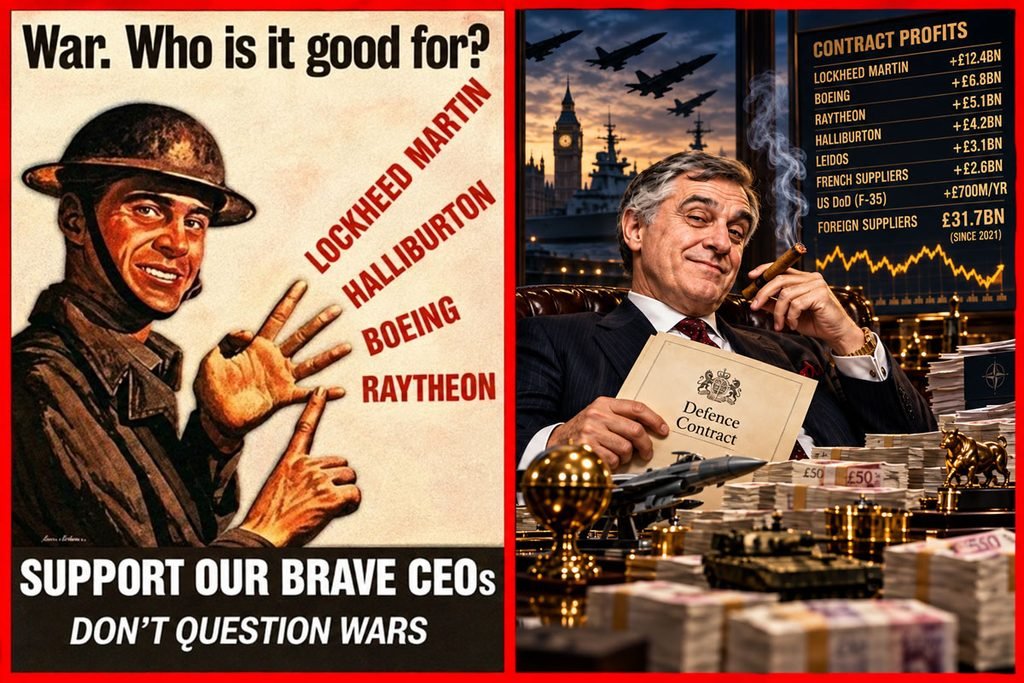
That argument leans on a word ministers use constantly: British. The order book is less British than it sounds. Under Ministry of Defence rules, a company qualifies as British if it keeps a subsidiary or an office here. Figures released to The Telegraph under freedom of information law show that since 2021, £31.7 billion in defence contracts has gone to foreign-controlled businesses with a UK presence. A further £3.5 billion went to overseas suppliers with no presence here at all. The procurement analysts Tussell, working from the MoD’s own published spending, find that only around 40 to 45 per cent of the department’s spending with private contractors since 2019 has gone to firms headquartered in Britain. Much of the rest has gone to Anglo-foreign joint ventures and to American giants such as Leidos, Boeing and Lockheed Martin, though the balance has lately tilted towards French and other European suppliers. On top of that, the US Department of Defense itself has been invoicing the MoD roughly £700 million a year since 2022, for the F-35 programme among other things.
Foreign ownership does not mean foreign workers. Plenty of those contracts pay wages in British towns, and those jobs are real. But the profits, the intellectual property and the final say over investment and closure sit in Paris, Rome or Virginia. Britain is building a war economy it does not own. The public carries the cost, the state underwrites the risk, and the returns flow to shareholders abroad. It is the same model that gave us foreign-owned energy companies and foreign-owned water. When the order book thins, the decision about whether a British plant survives will be taken in a boardroom that answers to no British voter.
That is not an investment in British security. It is dependence wearing a Union Jack. In March 2025 Donald Trump showed what that dependence means when he paused American military aid and intelligence-sharing to Ukraine overnight. A country whose defence runs on foreign-owned firms and American software is one decision in Washington away from finding out how sovereign it really is.
Yet even a British-owned arms industry would not answer the real question. Why is the only manufacturing the British state will plan, fund and protect the kind whose products are built to be blown up? It took an emergency Saturday sitting of Parliament in April 2025 to stop the last blast furnaces at Scunthorpe going cold, after their Chinese owner moved to shut them. The National Wealth Fund was launched to finance clean energy and industrial renewal; today part of it is being pointed at defence instead. Orwell imagined a warship that locked up the labour which could have built hundreds of cargo ships. That is not a fantasy. It is a choice about what skilled hands are for.
Examine the official summary of the Prime Minister’s call to Kyiv this morning. The word “peace” occurs only once, framed as something that punitive sanctions will eventually compel. There is no diplomatic strategy, no peace envoy, and no proposal for negotiations. Instead, the leaders agreed to spend the upcoming European summit pressing other nations for more military hardware. When a nation’s regional industries and public institutions become completely dependent on armaments orders, peace is no longer treated as a relief; it is feared as a loss of industrial demand.
£100 Against a Decade of Falling Incomes
On Budget day, the only recorded verdict of delight came from Kyiv. Nobody in Britain’s own households had much reason to share it.
When Mr Healey announced his £100 payment, he explained why bills are rising. “With the conflict in the Middle East,” he said, “rising energy bills are a real worry.” War, in other words, is pushing up the cost of keeping warm. The government answers the damage war does to working-class households with a one-off payment. It answers war itself with a ten-year spending commitment.
The Chancellor’s own watchdog spelled out the damage. The Office for Budget Responsibility described Britain’s economic and fiscal position as very challenging. It cut its growth forecast for next year from 1.6 per cent to 1 per cent, and named the war in the Middle East as the main reason. It expects no real growth in earnings in 2027, inflation rising to 3.75 per cent early that year and unemployment climbing above 5 per cent. Government borrowing is now £11 billion a year higher than the OBR forecast in March, driven by interest rates and inflation. Most damning of all, the watchdog found that real household income has barely grown in a decade, something Professor David Miles of the OBR said was practically unheard of in this country’s history. “It has been a dismal period in British economic history,” he said.
The independent verdicts were no kinder. The Joseph Rowntree Foundation projects that average household disposable incomes will fall by £450 by 2029 once inflation is counted. It warned that the Budget’s help with living costs, energy support included, does not make up for the hit from rising energy prices. Had incomes grown at their normal rate between 1961 and the pandemic, the foundation calculates, households would be on course to be around £5,000 better off in 2029 than they were in 2024. Chris Belfield, its chief economist, called for bolder action to give families the solid foundation of better living standards. Helen Miller, director of the Institute for Fiscal Studies, delivered the crispest judgement of all: the Budget had “a raft of fiddly measures but very little that will move the dial on growth.”
So this is the shape of the decade. Incomes falling, wages frozen in real terms, and a war overseas driving up the price of gas. Into that, the state pours its ambition and its credit into arms, and offers the household a hundred pounds.
The bills are high for reasons that go deeper than any single conflict. Britain sold its gas in 1986 and its electricity in 1990. We have paid ever since for a system that hands the profits to shareholders and the risk to households. The state will now use the public balance sheet to underwrite arms exports, yet it treats public ownership of energy as unthinkable. Shifting gas standing charges onto unit rates will help some low-use homes. It will also load more onto those who need heat most: the elderly, the disabled, and the family with a newborn who cannot ration the radiator. The government’s own consultation last year acknowledged that households with high energy needs carry more of the cost when charges move to the unit rate.
The working class pays twice. It pays through its taxes for the machinery of a war economy, and it pays again through the energy bills that war drives up. The people came last today, and they were told to be grateful for the hundred pounds.
Publish the Contracts, Plan for Peace
And again, in this monotonous task, I find myself shouting into the square: the water of the spa is poison.
None of this requires abandoning Ukraine to its fate. It requires refusing the foundational lie of modern British governance: that the Treasury can effortlessly conjure billions for foreign battlefields while pleading insolvency before the legitimate needs of its own citizens.
Parliament must assert itself and demand a full, published accounting of where every single pound of the UK Export Finance military allocation actually terminates, which corporations pocket the contracts, and what profit margins they extract from public credit. The Ministry of Defence rule that generously counts any multinational with a brass nameplate in London as British should be scrapped immediately. Productive industrial capacity built with British public money belongs in Britain, under genuine public ownership wherever possible. The National Wealth Fund must be torn away from weapons procurement and anchored back to the purpose for which it was created: re-industrialising our neglected heartlands, rebuilding our broken infrastructure, and taking control of our energy system. If the British state can plan an armaments boom within hours, it can plan a public steel industry with the same resolve.
Most urgently, British military aid cannot remain an open-ended subscription to slaughter. A government that can conjure an Innovative Defence Finance taskforce in a single Budget has a duty to produce a diplomatic exit strategy with the exact same seriousness. British aid must arrive with strict conditions and explicit political goals attached. Those conditions must start with creating a negotiated settlement to end this war, bringing the parties to the conference table rather than leaving the word “negotiating” stranded at the end of a sentence about economic sanctions. An exit strategy is not surrender; it is the only course that stops the relentless destruction of Ukrainian and Russian lives alike, curbs the lethal cycle of escalation, and removes the darkening risk of a nuclear confrontation that earlier generations laboured for decades to avoid.
Andy Burnham and John Healey must answer to the public that pays their wages, not merely to the cheer on the other end of an overseas telephone call.
Mr Healey made a president’s day this morning. His own watchdog called the last ten years a dismal period for the people he governs, yet he found billions for the arms industry’s order books and loose change for them. He might ask himself whose winter he actually warmed.
Orwell warned of war that existed to keep the factories busy and the people poor. A country whose economy depends on war will always find one, and sometimes it will make one. Today Britain started building that economy, and handed the people who will pay for it a hundred pounds.
Andy Burnham and John Healey have made their choice. A government that can discover endless billions for the battlefield while rationing warmth at home is not defending democracy; it is mortgaging its own people to feed the guns.
Enjoyed this read? I’m committed to keeping this space 100% ad-free so you can enjoy a clean, focused reading experience. Crafting these articles takes a significant amount of research and heart. If you found this helpful, please consider a “small donation” via PayPal or GoCardless to help keep the lights on and the content flowing. Every bit of support makes a huge difference.

Support The Tribune
INDEPENDENT. READER-FUNDED. AD-FREE.
If you value this article, help keep The Heartlands Tribune publishing independent journalism without intrusive advertising or corporate sponsors.
Choose your monthly amount
Secure payment via GoCardless