THE RITUAL OF CONSENT
First they make you participate. Then they ask you to sacrifice.
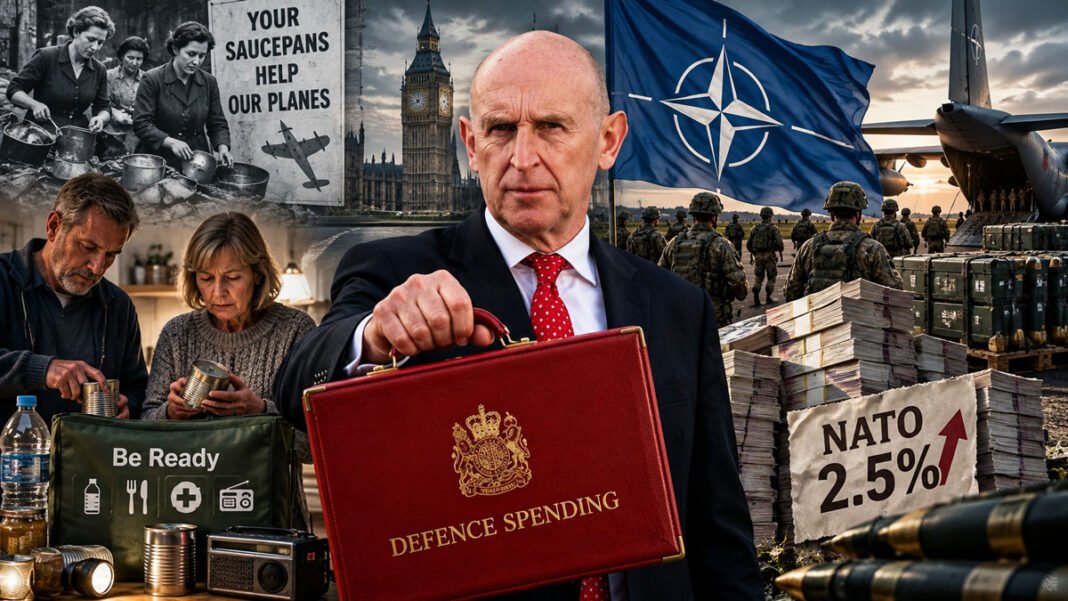
In 1940, British families handed over their saucepans and garden railings, convinced they were doing their bit for the war effort. In 2026, the head of the British Army says citizens must “consent to sacrifices”, while the Prime Minister tells households to stock up on three days of tinned food.
Different generations. Different props. The same principle: make people feel part of the national effort, and they become more willing to accept its demands.
From saucepans to soup tins, the ritual of participation is back. Only this time, the sacrifice is being demanded for a defence spending commitment the government has yet to explain, cost or turn into a credible plan.
Walk down almost any Victorian terrace in Sheffield and look at the low garden walls. You will find small iron stumps set into the stone, sawn flat more than eighty years ago. The railings were cut under Regulation 50 of the Defence (General) Regulations 1939, and you can still see the stumps outside houses across the city.
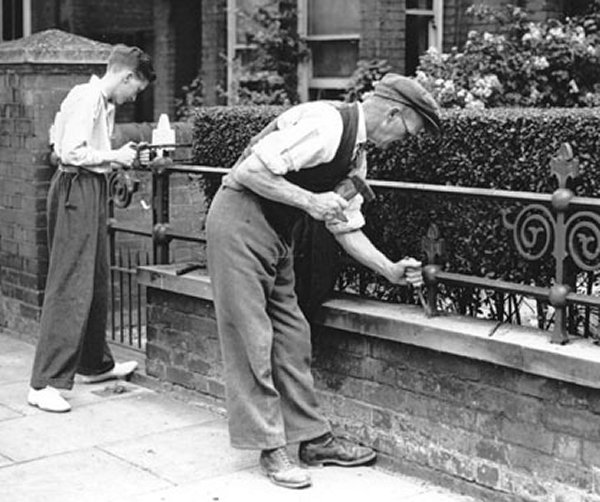
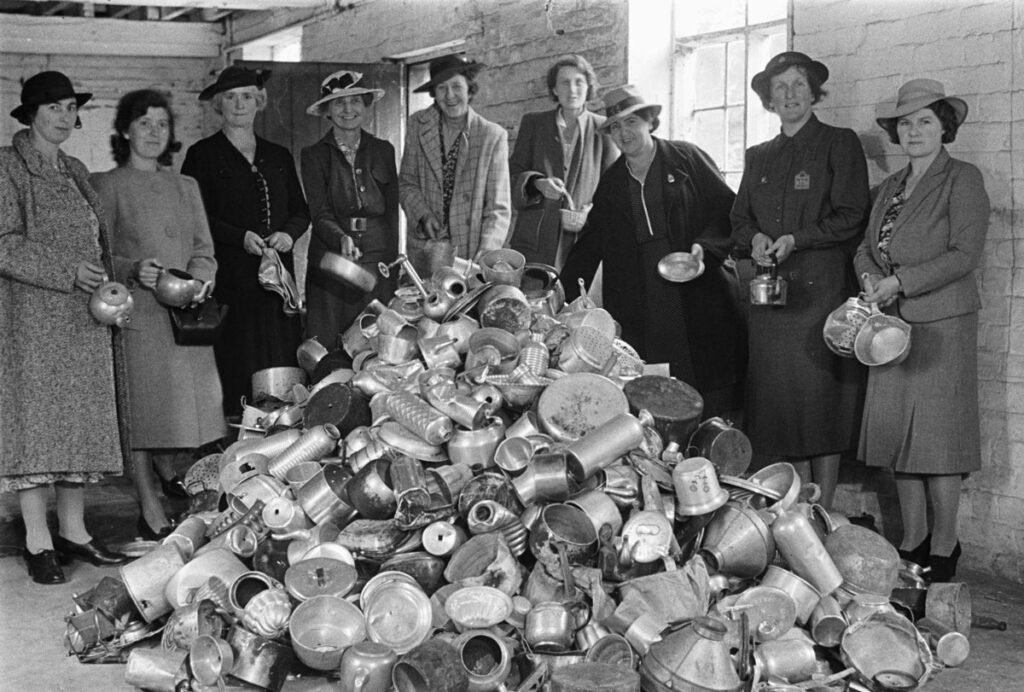
The railings did not go alone. In the summer of 1940 Britain’s housewives were asked to give up their aluminium for aircraft, and they did. Saucepans, kettles and colanders were piled high at collection points in every town on the promise that they would come back as Spitfires and Hurricanes. The iron gates and railings followed: more than a million tons of ironwork by September 1944.
Historians have long doubted how much of it ever flew or fired. But the metal was never really the point. The drive did its real work on the people who gave. A comfortable household could spare a gate.
A working-class family handing over one of its two good pans and making do was giving away something it would have to scrape together the money to replace, on wages that left nothing spare. They gave it gladly, because they were told it was their part. To a family like that, the pan was worth every penny. To the government, it was scrap that bought something more valuable than aluminium.
That something was participation. A government that needs a nation to accept sacrifice first needs the nation to feel it is already doing its bit. Nothing secures consent quite like having given something yourself. Once your saucepan is on the pile, you are not inclined to ask whether the war is being run well. You are in it.
Hold that thought, because today the Prime Minister went shopping in our cupboards.
Why the “Be Ready” emergency food campaign is political theatre
Andy Burnham used a wildfire and resilience summit to promote the government’s new “Be Ready” campaign. It advises households to keep three days of bottled water and non-perishable food, a battery or wind-up radio, and some cash in case card payments fail. He told BBC Radio 5 Live he favoured baked beans and soup, and admitted to a weakness for Twiglets.
Let nobody pretend the advice is foolish. A torch, a few bottles of water, some emergency cash and a cupboard of tins are common sense. But they have precious little to do with Moscow. Britain has quite enough trouble keeping its essential services running without the Russians lending a hand.
The Victorians dug sewers and laid water mains because they understood that clean water was the foundation of a civilised city, and cholera and typhoid retreated as a result. A hundred and fifty years later, parts of Britain cannot reliably keep the taps running.
In January, Storm Goretti and a hard freeze left up to 30,000 customers across Kent and Sussex without water or with low pressure, some of them for almost a week. People queued at bottled water stations in Tunbridge Wells and Maidstone. It was not a freak event. The same company had left Tunbridge Wells dry only weeks earlier. In July, Ofwat concluded its investigations with a £30.5 million redress package and an independent monitor. The regulator found that South East Water had “failed to plan sufficiently, maintain key infrastructure or learn from previous incidents.”
Nor is it a southern problem. In August, two mains burst in quick succession in south Holderness, during a spell of warm weather. That left Preston, Patrington, Bilton and surrounding villages east of Hull with low or no water. Yorkshire Water delivered bottled supplies to care homes and vulnerable customers, local shops ran short, and Withernsea Sands Holiday Park closed its facilities.
No Russian saboteur was required. No enemy cyber attack. Just old pipes, thin resilience and another water company apologising for failing to deliver a service its customers had already paid for.

The power network tells the same story. When a substation fire shut Heathrow in March 2025, the subsequent investigation found that a fault in the equipment had been flagged years earlier and never fixed. Electricity is the service everything else depends on. Lose it and the broadband goes, the card machines stop and the pumps that move our water fall silent.
And the banks are no steadier. On Tuesday, a “power event” in one zone of Google’s London cloud took down Revolut’s card payments and cash withdrawals. It hit Lloyds, Halifax and HSBC customers, and knocked out the video platform the courts in England and Wales use for remote hearings. One of the largest technology companies on earth had a power failure in a single zone, and the damage spread across the country.
Often there is not even a power cut to blame. Just the code. In March, a botched overnight software update at Lloyds Banking Group let customers of Lloyds, Halifax and Bank of Scotland see strangers’ transactions. Up to 447,936 people may have seen other customers’ payment lists. The bank is still reviewing how the defect got past its own testing. The Treasury Committee found that nine of the largest banks and building societies had clocked up the equivalent of 33 days of unplanned outages in two years. Banks blame third-party suppliers, botched system changes and creaking legacy systems, stitched together through decades of mergers and never properly replaced.
Again, no Russian hackers. A bad update. An old system. A single point of failure.
The immediate danger to British households is not a Russian hacker bringing the country to its knees. It is that ordinary failures in infrastructure we have neglected, fragmented or sold off can already produce much the same disruption.
That is the honest argument for keeping a stocked cupboard. It is not that war with Russia is coming. It is that too many of the services we depend on have become disturbingly fragile. Keep bottled water because the supply might fail. Keep cash because the banks might go offline. Keep a radio because the networks might go down. All sensible. But what happened to the expectation that the state should make these systems work in the first place?
In the 1970s, water, electricity and telecommunications were publicly owned. That did not mean they never failed; anyone who remembers the power cuts of that decade knows otherwise. But the infrastructure was a public responsibility, and governments answered directly for its performance and investment. Today water in England is in private hands. The energy system is divided among private generators, suppliers and network owners. Much of our digital life runs on a handful of multinational cloud companies whose decisions are made far beyond the reach of Britain’s democratic control.
Privatisation did not create every burst pipe or every crashed app. But successive governments gave up direct ownership of essential infrastructure on the promise that private capital, competition and regulation would deliver secure, dependable services. The public is entitled to judge that promise against the bottled water stations, the frozen payment screens and the dark substations.
Of course hostile states can exploit those weaknesses. Sabotage and cyber attacks are real threats. But that makes the neglect more serious, not less. A country that cannot keep its water flowing or its payments working has vulnerabilities an enemy would be foolish to ignore. If ministers believed their own warnings, investment in pipes, cables, substations and the systems that run our money would sit at the heart of the defence argument. Instead, they have chosen another stage.

The campaign was not born at a wildfire summit. It was announced in July with very different packaging. Darren Jones unveiled it alongside a national home defence exercise, the largest in decades, to test how Whitehall would cope with a hostile “hybrid” attack.
At the same time the Armed Forces Minister, Louise Sandher-Jones, told the country that Russia was a direct threat to the British homeland. She said the exercises and the rewriting of the “war books” would help prepare for it, “as well as showing the British public how seriously we are taking it.”
Read that last clause again. By the minister’s own account, part of the purpose was the audience. The exercise was not only about preparing institutions for an emergency. It was about making sure the public saw the government preparing for one.
That is where practical advice becomes political theatre. A household stocking bottled water because the local supplier cannot keep the taps running is protecting itself. Present the same act as part of national defence against a hostile power, and it takes on a different meaning. The citizen is no longer preparing for the next failure of a privatised utility. The people are doing their bit.
The timing is everything. A week before the budget, a manufactured consent…
That is the machinery of manufactured consent. Take an everyday necessity, dress it in the language of national emergency, and turn private preparation into public participation.
The government gets its demonstration of resolve. The companies responsible for the pipes, the cables and the servers slip out of the centre of the argument. And the public is left responsible for preparing to live without services it has already paid for.
Before asking the British people to prepare for the Russians turning off the lights, the government might explain why we cannot always keep them on ourselves.
Manufactured Consent and Britain’s Defence Debate
The phrase is older than its most famous users. Walter Lippmann wrote of “the manufacture of consent” in 1922, and he meant it approvingly: a complicated world, he thought, needed an expert class to shape what the public believed. Edward Herman and Noam Chomsky borrowed the phrase in 1988 and turned it round.
Their argument was never that a shadowy committee writes the news. It was subtler and more durable. When official sources set the terms, when fear supplies the frame and when dissent is treated as disloyalty, the range of acceptable debate narrows on its own. Nobody needs to censor the question if nobody thinks to ask it.
We no longer need to infer any of this. Last week the head of the British Army said it out loud.
Filmed by BFBS at Catterick Garrison, General Sir Roly Walker told soldiers that politicians had to explain to the British people “that our citizens have got to consent to sacrifices to prioritise defence and security.” Kemi Badenoch praised it as a powerful intervention. On Thursday the Defence Secretary, Wes Streeting, said he fully endorsed it. He went further, saying the heads of the armed forces should be in front of the microphones and not just in front of the troops, as part of a “national conversation” about the nation coming together to fight and win.
“Our citizens have got to consent to sacrifices to prioritise defence and security.” General Sir Roly Walker, Chief of the General Staff
Read those two statements side by side. The general wants consent to sacrifice. The minister wants the generals on the airwaves to secure it. Herman and Chomsky spent a book describing how official sources come to set the terms of public debate. They could hardly have asked for a cleaner illustration than a Cabinet minister calling uniformed chiefs credible message-carriers and sending them out to explain why we must go without.
Notice what neither of them said. Neither told us what the sacrifice would buy: which threat, which capability, at what cost. The conversation they want is about how much we give up, not about what we get. It is the same narrowing as ever.
We argue over whether to reach 3 per cent by 2030 or a few years later, almost never over what the money is for. The threat, meanwhile, is fixed permanently a few years over the horizon. That is close enough to justify a budget and distant enough never to be tested.
Of course Russia is a threat. Britain is pouring money, aid and weapons into the country Russia invaded, and those weapons are used to kill Russian soldiers. Nobody should expect Moscow to regard us as a bystander, and I don’t suppose it does. Those of us who served through the Cold War learned not to be sentimental about the Kremlin, and the sabotage and the cyber attacks are real. The point is narrower and harder. A real threat is precisely what makes manufactured consent so effective, because it allows a government to skip the step where it explains what it intends to do about it.
NATO’s 5% Spending Target: Where Is the Plan?
That missing step is the scandal. Britain’s defence policy is no longer expressed as a strategy. It is expressed as a percentage, and the percentage was set in Washington.
Orwell understood how a number can be made to stand in for a reality. In Nineteen Eighty-Four, part of Winston Smith’s work at the Ministry of Truth is correcting the Ministry of Plenty’s production figures, so that every forecast turns out to have been met. Rewriting a forecast for boots, he reflects that the figures were fantasy in both their original and their corrected versions: “Very likely no boots had been produced at all.” The point was never the boots. It was the figure, and the public’s willingness to cheer it.
Britain’s defence target works the same way. When Keir Starmer promised 2.5 per cent of GDP by 2027, his government then counted spending on the intelligence agencies) to call it 2.6. At the NATO summit in The Hague in June 2025, under pressure from Donald Trump, members pledged to reach 5 per cent. That means 3.5 per cent on core military spending and a further 1.5 per cent on matters that “benefit” defence, a category that includes civil preparedness and resilience. Your three days of tinned soup, in other words, sit inside the same accounting envelope as the warships. Resilience is something the state counts towards its NATO target while handing the actual work of it to you. The number can always be met. It is only a question of what you agree to count.
The government’s own Defence Investment Plan, published this summer, is candid about how little lies behind the headline. It commits £298 billion over four years, reaching 2.7 per cent of GDP by the end of the decade. For the years between 2030 and 2035 it simply leaves the spending unallocated. The money is promised. What it will buy is not.
Even the near-term numbers do not add up. John Healey resigned as Defence Secretary after failing to secure the money to reach 3 per cent by 2030, a departure that contributed to Keir Starmer’s fall. He is now Chancellor. He faces a £4.7 billion hole in the existing plan and, by the Office for Budget Responsibility’s estimate, a further £17.3 billion bill to reach the interim 3 per cent. Burnham has committed to the 2035 target, but his government has yet to publish a timeline or a plan for meeting it. Earlier this month he was reported to be considering delaying the roadmap altogether.
So the order of events is this. First the target. Then the fear. Then the call for sacrifice. Then, perhaps, at some later spending review, the plan. A nation that buys its defence this way is not defending itself. It is meeting a quota.
Could Britain Build Its Own Missile Defence?

In June last year this publication argued that if Britain was going to spend 5 per cent of its national income on “defence”, it should at least spend it defending Britain. That meant layered air and missile defence over our cities and infrastructure, rather than more power projection in distant seas. It was not a fashionable view on the left. It still seems to us the only honest starting point, because it begins with what is being protected and from what.
This month the Conservatives arrived at something similar, and promptly lost their nerve. Kemi Badenoch announced a £10 billion “Britannia Shield” over ten years in The Sun, describing it as modelled on Israel’s Iron Dome, and party officials called it “in essence, a British Iron Dome”. Within a day she was telling the BBC, “We are not building the Iron Dome.” The money is also nowhere near enough. General Sir Richard Barrons, a co-author of last year’s Strategic Defence Review, estimates an entry-level system would cost around £80 billion over a decade.
The Tories deserve the ridicule. Fourteen years of their government left the armed forces hollowed out, and this plan is underfunded and muddled. But look at how the Prime Minister answered it. At PMQs Burnham mocked Badenoch over the confusion, and offered nothing in its place. The only proposal in British politics that starts from the question “what are we defending, and against what?” was laughed out of the chamber. It was laughed out by a government that cannot yet say how it will spend the money it has already promised.
THE BANK BALANCE
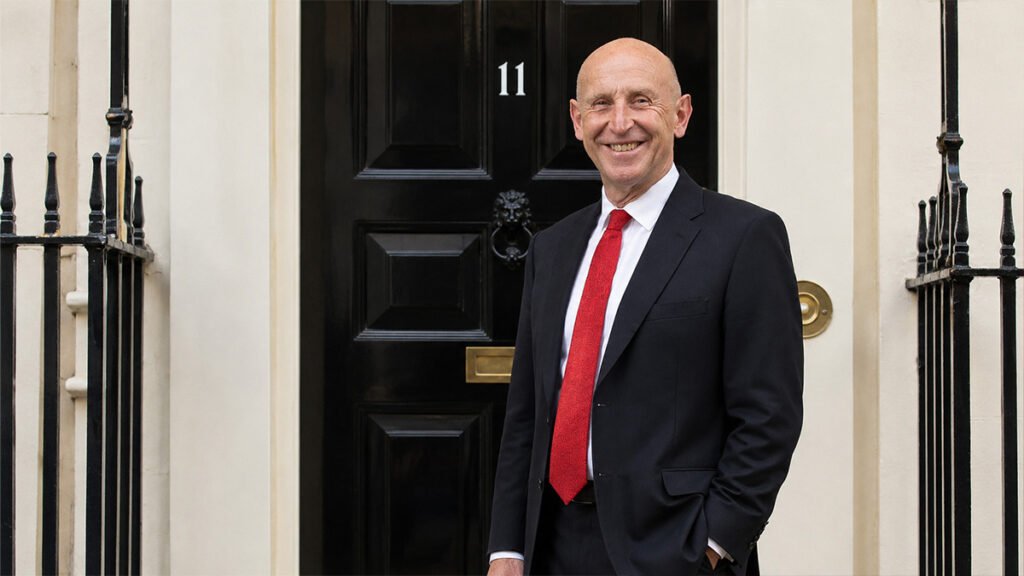
Next Wednesday John Healey delivers his first Budget, and there is a grim irony in who is delivering it. The man who walked out of the Ministry of Defence because the Treasury would not fund the target now holds the Treasury’s purse.
Strip away the language and the choice in front of him is simple. Unless taxes rise or the borrowing rules change, every extra pound found for the target is a pound not spent on the councils going bust, the hospitals with buckets under the leaks and the bus routes that no longer run. Defence spending or public spending. That is the balance, whatever the speeches say.
It is not a new choice, and the most eloquent warning about it came from a soldier. In April 1953 Dwight Eisenhower, the general who had commanded the Allied invasion of Europe, told American newspaper editors that “every gun that is made, every warship launched, every rocket fired signifies, in the final sense, a theft from those who hunger and are not fed, those who are cold and are not clothed.” Eight years later, in his televised Farewell Address of 17 January 1961, he gave the danger its name: “In the councils of government, we must guard against the acquisition of unwarranted influence, whether sought or unsought, by the military-industrial complex.”
“In the councils of government, we must guard against the acquisition of unwarranted influence, whether sought or unsought, by the military-industrial complex.” Dwight D. Eisenhower, 17 January 1961
Millions of us will look at the cupboard, the tins and the torch and the bottled water, and feel we are doing our bit. It is the saucepan on the pile all over again. This time, though, there is less mystery about where the metal goes. Follow the money and it does not vanish into an estuary. It lands on a balance sheet.
Across Europe the rearmament has been, in large part, a buying spree in America. SIPRI found that European NATO states more than doubled their arms imports between 2015-19 and 2020-24. Sixty-four per cent of those imports came from the United States, up from 52 per cent five years earlier. It was the largest US share of any five-year period in two decades. Combat aircraft did most of the lifting, with almost 500 still on order. Britain was among the biggest buyers. In the same week it signed up to NATO’s 5 per cent, it announced the purchase of twelve American F-35As.
Now look at who is building the real thing across the Atlantic. In March, Washington raised the cost estimate for Trump’s Golden Dome to $185 billion. It confirmed Lockheed Martin, RTX and Northrop Grumman as prime contractors, the same names that fill European order books. Golden Dome is a layered shield of sensors, satellites and interceptors designed to protect the American homeland from ballistic, cruise and hypersonic missiles.
Even the setting for Streeting’s endorsement told its own story. He gave it at the opening of a Rheinmetall factory, which will make large-calibre gun barrels in Britain for the first time in twenty years. That is one rare piece of homegrown capacity, and it is run by a German arms giant. The sacrifice is asked of the citizen. The factory, the order book and the profit belong to someone else.
So Europe sends its orders west, and those orders keep the production lines warm for the firms building America’s dome. America gets a shield over its cities. We get a percentage, a cupboard of tins, and a Prime Minister who laughs when anyone suggests a shield of our own. Eisenhower would have recognised the arrangement at once.
That is what this Budget will ask us to pay for. A plan would ask what Britain needs and buy it. A target asks only how much, and the answer is always more. Watch on Wednesday which column grows and which one shrinks. Then remember who was told to stock the cupboard, and who was never asked.
Britain Needs a Costed Defence Plan Before Sacrifice

None of this requires pacifism. It requires the ordinary disciplines of democracy that are being skipped. Before another pound is committed to the 2035 target, the government should publish a defence plan that names the threats, the capabilities needed to meet them and the cost of each, and Parliament should vote on it. Ministers should publish exactly what Britain is counting towards NATO’s 1.5 per cent resilience category, so we know whether our own emergency tins are being used to pad a target. The question of home air and missile defence deserves a costed answer from the government, not a joke at the dispatch box. And if the generals are to be sent before the microphones to ask for our sacrifice, they should be made to answer the question that comes first: for what?
The saucepans went onto the pile because people believed they were needed. The railings came down because families believed they were doing their bit. Eighty years later the iron stumps remain in garden walls, a permanent reminder of what a nation will willingly surrender when it believes the cause is just.
Now the government wants us stocking cupboards, preparing for emergencies and accepting sacrifices in the name of national defence. But there is a difference between preparing a country for danger and preparing its people to accept whatever comes next.
That is how consent is manufactured. First, make people feel part of the effort. Then make them responsible for the sacrifice. By the time anyone asks what we are actually defending, or where the money is going, the public has already been enlisted.
And for all the talk of new threats, one brutal reality has not changed since the Cold War. A war between nuclear powers will not end with the Union Jack flying over the Kremlin, or the red flag raised above Westminster. There will be no victory parade and no grateful nation welcoming its soldiers home. There will be cities reduced to ash and human shadows burnt into stone, the legacy of Hiroshima repeated on a scale the world has never seen.
We understood that forty years ago. It was called Mutually Assured Destruction, and the whole point was to make certain nobody ever tested it. MAD is still MAD. No amount of military spending, patriotic theatre or tins of baked beans will change that.
In 1940, they asked for our saucepans. In 2026, they want our consent.
And once again, the sacrifice comes before the explanation, and the bill arrives before the plan.
Enjoyed this read? I’m committed to keeping this space 100% ad-free so you can enjoy a clean, focused reading experience. Crafting these articles takes a significant amount of research and heart. If you found this helpful, please consider a “small donation” via PayPal or GoCardless to help keep the lights on and the content flowing. Every bit of support makes a huge difference.

Support The Tribune
INDEPENDENT. READER-FUNDED. AD-FREE.
If you value this article, help keep The Heartlands Tribune publishing independent journalism without intrusive advertising or corporate sponsors.
Choose your monthly amount
Secure payment via GoCardless