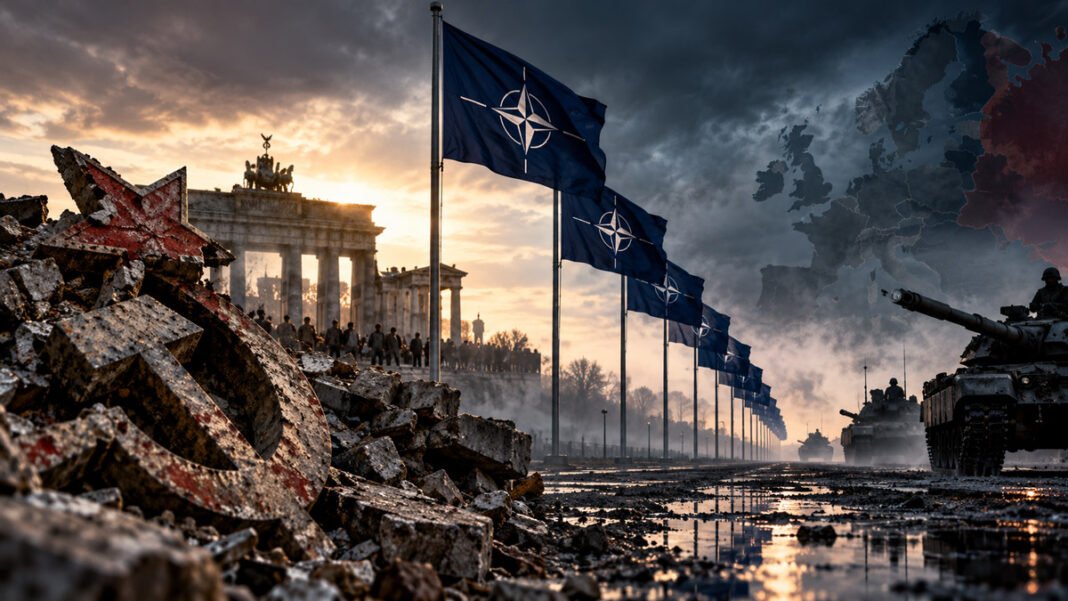
“Expand or Die”: Biden’s 1997 Plan to Save NATO And The Consequences
The Soviet Union collapsed, and NATO’s job was done. Instead, the alliance went looking for customers, and Joe Biden read out the prospectus in 1997.
I served in the British Army during the Cold War, in a regiment whose entire purpose rested on the darkest calculation of that age: that the final line against nuclear escalation was the absolute certainty of what would follow it. Mutually assured destruction. MAD. A terrible doctrine, but one designed to prevent an even more terrible reality. Our purpose was never to win a nuclear war. It was to ensure nobody dared start one.
We trained for a war that must never happen. And it didn’t.

The Warsaw Pact dissolved. The Soviet Union ceased to exist. The Third Shock Army, which we had spent our working lives preparing to confront, folded up and went home. And when the Cold War was over, our regiment was disbanded. Its job was done.
There is something in that transition which our political and military institutions seem to have forgotten: when the threat that justifies an institution’s existence disappears, its continued existence ought to be questioned. We had spent years preparing for the worst, but when the worst never came, we stood down.
That was the victory. Not the destruction of an enemy on some European battlefield, but the fact that the battlefield never materialised. I have never been sentimental about the Cold War, but we had won something worth having: the prospect of a peace dividend.
Not another parade or another defence contract. Schools. Hospitals. Housing people could afford. Universities that didn’t bury young people in debt. Sports centres in towns that have since lost theirs. The wealth spent preparing for a European war could finally be directed toward building a better country for the people who had paid for those preparations.
The man who understood this best was no pacifist. He was a five-star general who had commanded the Allied forces in Europe. In April 1953, President Dwight Eisenhower told American newspaper editors that every gun made and every warship launched represented a theft from those who were hungry and cold. He called it The Chance for Peace. He understood what happens when a war economy outlives the war it was built to fight.
We had that chance. We squandered it.
An Alliance in Search of a Reason

NATO had sixteen members when the Soviet Union collapsed. Today it has thirty-two.
While regiments like mine were disbanded because the Cold War had ended, the military alliance created to confront the Soviet Union chose a different path. Rather than asking whether its original mission had been accomplished, it expanded eastwards.
In June 1997, Senator Joe Biden addressed an audience of admirals, generals, and committed Atlanticists in Washington. He was not exposing a secret conspiracy; he was explaining a policy he supported. What makes the video remarkable today is how openly he laid out the prospectus: the product, the territory, the price list, and the terms.
The product was the enlargement of NATO into the former Eastern bloc. The territory was everything between Germany and Russia, with the Baltic states to follow once the ground had been prepared. The price list came from a Pentagon study of February 1997: nine to twelve billion dollars in direct costs over twelve years, of which Washington would carry fifteen per cent, the new members thirty-five, and the existing European allies half. And the terms were these, in his own words to the room: candidates for membership must assume the financial burden of making their armed forces interoperable with NATO’s, on top of modernising their militaries.
Interoperability is not a security policy. It is a purchase order.
Read that sentence again. Every former Warsaw Pact air force flew Soviet aircraft, fired Soviet calibres and spoke to Soviet radios. Interoperability meant replacing all of it, with Western kit, over decades, on borrowed money. Biden told the room he had asked one military leader how he intended to pay. If you want to fly first class, he told him, you have to buy a first class ticket. “This is not a charity operation.”
Nobody in that room needed the hint explained.
The honest question of that moment was never seriously put in public: what is a military alliance for once the army it was built to fight has gone home and gone bankrupt? Biden answered it with unusual frankness. The Senate, he said, divided into three camps, and his own camp held that the issue was not whether NATO stayed the same or grew, but “does it expand or does it die”. He said it plainly. The alternative to expansion was not a smaller alliance. It was no alliance, no budget, no command structure, no seat at the table, and no reason for an American general to be headquartered in Belgium.
Biden was equally frank about what did not justify it. He told the room that nobody mildly informed believed the Russian army was poised to pour through the Fulda Gap, and that the Russian army was in such a state it could not subdue Chechnya. He said he had met Russian politicians across the spectrum, communists, liberals and nationalists, and had not found one who believed enlargement constituted a military threat to their country. He put Moscow’s objections down to lost empire and wounded pride. And asked about the candidate countries themselves, he said that not one of the four he had visited, Poland, Hungary, the Czech Republic and Slovenia, felt the least bit threatened at that moment.
So here is the architecture, stated by one of its architects. No military threat. No frightened applicants. An alliance that must grow or dissolve. And a bill running into billions, to be met by the publics of countries that had just emerged from forty years of command economies.
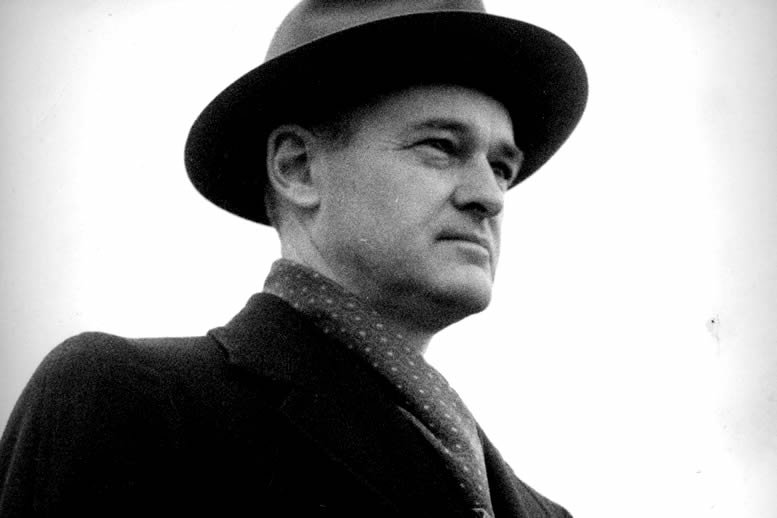
George Kennan, the architect of Cold War containment, warned in the New York Times that expanding NATO would be “the most fateful error of American policy in the post-Cold War era,” predicting it would inflame Russian nationalism and recreate European divisions. Biden knew Kennan’s argument, cited it directly, and set it aside. Washington gambled that Russia was too weak to resist, and that the long-term strategic consequences could be managed indefinitely... Biden named Kennan’s argument from the podium. Then he set it aside.
That is the real charge against the room, and it is worse than the one usually made. Nobody in it was predicting war, and I am not going to pretend otherwise. They were doing something more dangerous: deciding, on the basis of a weak Russian army and a wounded Russian mood, how much provocation the other side would absorb.
Biden even named the expiry date on his own assessment. Never is a long time, he told them, and Russia’s current weakened condition is sure to improve. He knew the army would recover. He assumed the politics would be settled before it did. Wars rarely begin because somebody planned one. They begin when men who are certain they have the measure of the other side discover, years later and with the budget already spent, that they never had it at all.
The Market and the Machine

Within weeks of that speech, the New York Times published an investigation by Jeff Gerth and Tim Weiner under a headline that has aged into prophecy: “Arms Makers See Bonanza in Selling NATO Expansion”. American defence contractors, it reported, were travelling central Europe like diplomats, because every new member would have to re-equip, and because the companies that made the equipment had just lost their Cold War market.
At the centre of the lobbying sat Bruce Jackson, president of the US Committee to Expand NATO, the outfit that wined, dined and whipped the Senate towards ratification. His day job, as documented at length since, was vice president for strategy and planning at Lockheed Martin. He did not conceal it. Nobody treated it as disqualifying. A man whose employer stood to profit from a strategic decision ran the campaign to secure that decision, and the arrangement was published in the newspaper of record and then absorbed without consequence.
What followed shows how the circuit worked. In December 2002 Poland chose Lockheed Martin’s F-16 over the Swedish Gripen and the French Mirage, and in April 2003 signed for forty-eight aircraft at three and a half billion dollars, the largest arms contract ever placed by a former Soviet bloc country. It was financed by a United States government loan of three point eight billion dollars, interest only for the first eight years. Poland’s then finance minister, Grzegorz Kolodko, estimated the servicing cost alone at around one point two billion. Paris complained that Warsaw had bypassed European industry entirely.
Follow the money around that loop. Washington creates the requirement through enlargement. Washington lends the money. An American corporation takes the contract. The Polish taxpayer repays the debt with interest, for fifteen years, out of a budget squeezed to meet EU convergence targets. That is not a trading relationship between equals; it is the financial anatomy of a client state.
Ninety years ago, Major General Smedley Butler boiled American foreign policy down to four words: war is a racket. In post-Cold War Europe, they didn’t even need the war. The threat alone was enough to run the business.
The All-American Sales Team
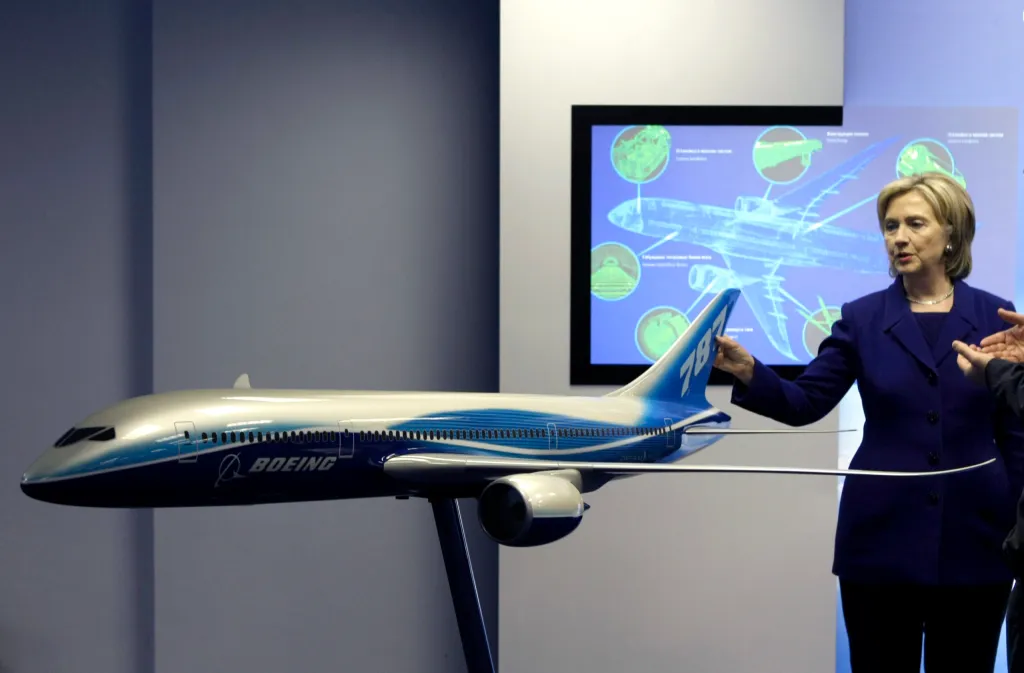
This was never a party matter. The selling was institutional, carried out by Democrats and Republicans alike, running directly through the State Department. It is a century-old American mechanism for projecting power through procurement. During the First and Second World Wars, the United States built the massive industrial apparatus that supplied and financed European armies, first the Russians and British, and eventually its own forces, leaving its allies bound by decades of debt. In the post-Cold War era, that same machinery was simply recalibrated for peacetime expansion.
In October 2009, on a visit to Moscow, Secretary of State Hillary Clinton toured a Boeing facility and pressed Russian officials to buy American aircraft for a new state airline. She described her own intervention as a shameless pitch. In 2010 Boeing landed the contract, worth three point seven billion dollars. Two months later, as Fox News reported during her 2016 campaign launch, the company donated nine hundred thousand dollars to the Clinton Foundation, earmarked for rebuilding schools in Haiti. In 2012 Boeing paid Bill Clinton two hundred and fifty thousand dollars for a speech. The Washington Post reported that the State Department had set aside its own ethics guidelines, which first barred soliciting Boeing and then capped any gift at a million dollars, to accommodate a two million dollar Boeing contribution to the American pavilion at the Shanghai Expo. Boeing and the Foundation have consistently denied any connection between the donations and the diplomacy, and no finding of wrongdoing has ever been made.
No finding is needed to see the shape of the thing. What the record establishes is that the American state treats its industries and arms manufacturers as a branch of foreign policy, and its foreign policy as a branch of sales, and that the people running it see nothing remarkable in the arrangement.
Note the detail that ought to stop every reader dead. The customer Hillary Clinton was working hardest to win, in 2009, was Russia.
The Machine Requires The Threat
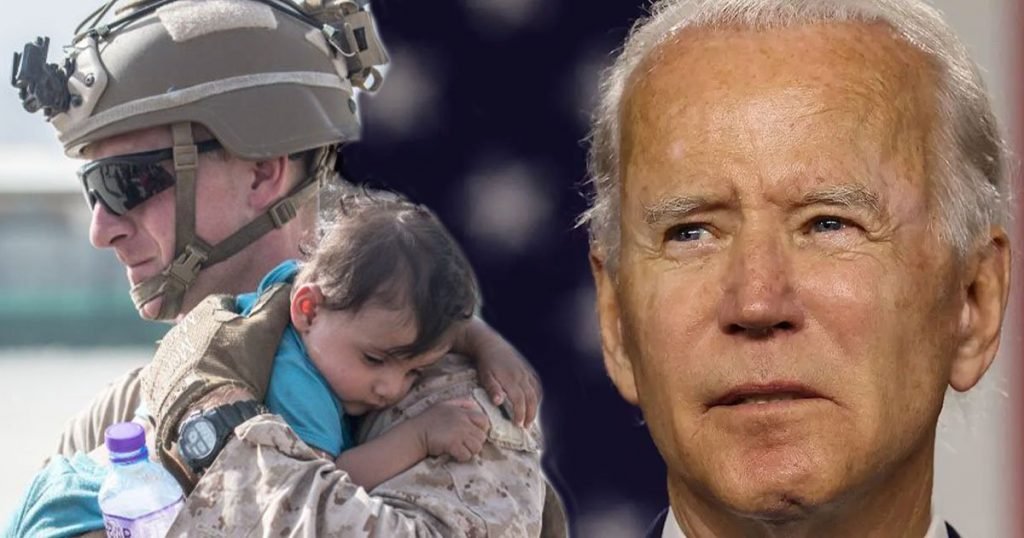
“The Party told you to reject the evidence of your eyes and ears. It was their final, most essential command.” ― George Orwell, 1984
Here I move from documented fact to political judgement, and it is right to say so.
Look at what happened after the Cold War, because the sequence tells us something important about how military institutions survive.
NATO has invoked Article 5, its collective-defence clause, only once in its history: on 12 September 2001, following the terrorist attacks on the United States. Those attacks were carried out by al-Qaeda, not by Moscow or any successor to the Warsaw Pact. Yet they provided NATO with a new mission, one that would take the alliance far beyond the European territory it was originally established to defend.
Afghanistan followed. Twenty years of war, thousands of lives lost and an extraordinary financial cost. Brown University’s Costs of War project estimated the American bill at 2.3 trillion dollars. Britain’s own military operations cost £22.7 billion to the end of 2019/20, according to the Ministry of Defence, and more than 450 British service personnel lost their lives.
In August 2021, the Western withdrawal ended with the Taliban back in Kabul. After two decades of military intervention, the government NATO and its allies had spent billions supporting collapsed in a matter of days.
Six months later, Russia invaded Ukraine. Six days before, Ukraine violated the ceasefire in the self-declared regions of the Donbas.
I cannot show you an instruction to manufacture a Russian threat, and I will not pretend one exists. What the record shows is something less theatrical and more durable: an alliance that had already concluded it must expand or die, an industry that needed a market, and a political class in which the two were the same people in different chairs. Institutions of that kind do not need a conspiracy. They need only a direction of travel, and every incentive in the structure pointed east.
The decision to invade was made in Moscow. Responsibility for it rests with the Kremlin. But the invasion also transformed NATO’s political position. An alliance whose post-Cold War purpose had repeatedly been debated once again had a powerful adversary, an urgent mission and governments prepared to fund a dramatic expansion of military spending.
There was a history behind that decision, and the West likes to conveniently forget that history…

At Bucharest in 2008, NATO declared that Ukraine and Georgia would become members. It gave no timetable, no roadmap and no protection. It is difficult to design a policy better calculated to provoke Moscow while leaving Kyiv exposed, and the alliance adopted it anyway.
What followed is the part now routinely deleted from the record. In November 2013 an elected Ukrainian government suspended its association agreement with the European Union, and a political crisis followed in which outside powers pursued their own interests with no great subtlety. Three weeks before President Yanukovych fled, a telephone call between Victoria Nuland, the US Assistant Secretary of State, and Geoffrey Pyatt, the American ambassador in Kyiv, was leaked. On it, the two of them discuss which Ukrainian opposition figures should be in the next government. Nuland’s verdict on her preferred candidate, Arseniy Yatsenyuk, was that “Yats is the guy”. Washington never disputed the recording’s authenticity, and Yatsenyuk became prime minister on 27 February 2014. Whatever else that is, it is not the conduct of a disinterested bystander, and the Ukrainians who were told their revolution was entirely their own were entitled to better.
Then Crimea, then the Donbas, then eight years of trench war that Europe agreed to stop noticing. By September 2021, before a single Russian tank crossed in the invasion we now treat as the beginning, the United Nations human rights office had verified at least 3,393 civilian deaths in that conflict, and the total toll including combatants was commonly put at around fourteen thousand. The Minsk agreements that were supposed to end it were never implemented by either side, Kyiv never legislating the special status, Moscow never returning control of the border. Angela Merkel told Die Zeit in December 2022 that Minsk had bought Ukraine time to grow stronger, a remark the Kremlin has quoted ever since and which her critics read as retrospective positioning. In April 2019 Ukrainians elected Volodymyr Zelenskyy with 73 per cent of the run-off vote, on a platform of ending that war. He was not given the chance, and the capitals now lecturing us about resolve were not conspicuous in helping him take it.
So when February 2022 arrives, it arrives into a country already eight years into a war, and the honest left has two things to say rather than one. The first is that the decision to launch a full-scale invasion was taken in the Kremlin, that it is a crime under international law, and that tens of thousands of Ukrainians have been killed for it. Context explains a war. It does not absolve the man who started one. The second is that Western governments do not get to erase their own decisions from the record and present the catastrophe as though it fell out of a clear sky. Bucharest was theirs. The leaked call was theirs. The eight years of shrugging at the Donbas were theirs. A reckoning that begins on 24 February 2022 is not a reckoning. It is an alibi with a date on it. The room in 1997 had been assured there was no military threat and no prospect of a military reaction. It took twenty-five years for that assurance to be tested, and it failed in the only way such assurances ever fail, all at once and at somebody else’s expense.
Notice what that invasion did to the structure. Within two years, Finland and Sweden had joined, the alliance stood at thirty-two members, and the question Biden was wrestling with in 1997, whether NATO could survive without an enemy, was answered permanently.
Vladimir Putin delivered what thirty years of lobbying could not buy. If you built your career selling the proposition that Europe needs an armed bloc, 2022 was not a catastrophe. It was a product launch.
There is a bleak symmetry here. In October 2022, the senator who had told that Washington room the alliance must expand or die was President of the United States, telling a fundraising audience that the world had not faced the prospect of Armageddon since Kennedy and the Cuban missile crisis. He spent a quarter of a century helping to build the architecture, then stood at the top of it and described where it had arrived.
The invoice

The 1997 Pentagon estimate was nine to twelve billion dollars across twelve years. Hold it next to what Europe is now paying.
At The Hague in June 2025, NATO members committed to five per cent of GDP on defence and related security by 2035, of which three and a half per cent on core military spending. The Secretary General’s annual report, published this March, records that European allies and Canada spent 574 billion dollars on defence in 2025 alone, a real-terms increase of twenty per cent in a single year, with total allied spending on core defence above 1.4 trillion dollars. At the Ankara summit in July, governments and industry announced more than fifty billion euros of new procurement deals at the summit’s own industry forum, plus a drones programme worth forty billion dollars over five years.
The European Union, an organisation sold to its members as a peace project and a customs union, now runs the financing. Its ReArm Europe plan, rebranded Readiness 2030, aims to mobilise up to 800 billion euros. Its SAFE instrument offered 150 billion euros in cheap long-dated loans and was oversubscribed by nineteen member states before a single euro was drawn, with the first thirty-eight billion cleared for eight governments at the start of this year. Romania alone took more than sixteen billion. These are debts, not grants, carried on national books. And when EU leaders needed ninety billion euros for Ukraine last December, the plan to fund it from frozen Russian assets collapsed against Belgian legal objections, so they borrowed it on the capital markets instead. European taxpayers are now servicing debt that was supposed to be paid by Moscow.
What it costs in Barnsley

In Britain, the invoice has an address, and it is not the Ministry of Defence.
On 30 June this year the government published its Defence Investment Plan: an extra fifteen billion pounds over four years, taking total planned spending to 298 billion by 2029/30. The Treasury has identified where ten point three billion of that extra money comes from. Four billion is a one per cent levy on the capital budgets of every other government department. Two billion comes from the Department for Energy Security and Net Zero. Up to seven hundred million comes out of roads funding. Around a billion comes from selling off the military estate. The remaining four point seven billion will be confirmed at the Budget.
The government’s own explainer says this is achieved “without taking resources away from day-to-day spending on frontline services”. Read it twice. Capital budgets are the money that builds the school, the hospital wing, the social housing, the grid connection. The claim is technically accurate and politically dishonest, and it follows the method already used in February 2025, when the rise to 2.5 per cent of GDP was paid for by cutting overseas development aid from 0.5 to 0.3 per cent of national income. Meanwhile, 63 billion pounds goes to the defence nuclear programme over four years, ringfenced, consuming between a fifth and a quarter of the entire MOD budget.
Britain reaches 2.7 per cent of GDP by 2027/28, and then the plan goes quiet. There is no indication whatever of how the country travels from there to the three and a half per cent it has promised NATO by 2035. That is not an oversight. That is the bill falling due after the next general election, which is precisely when no voter will be asked about it. Two ministers, John Healey and Al Carns, resigned in June over the settlement behind an earlier draft of the plan.
Which brings us back to the man in the Washington function room. Biden ended that evening by invoking Vietnam, and said that no foreign policy, however well fashioned, can be sustained without the informed consent of the American people. Thus far, he added, the American people had neither been asked for their consent nor informed of the costs.
Thirty years on, the policy has been sustained magnificently. It is the consent that was never collected, on either side of the Atlantic.
Jeffrey Sachs, in remarks published this month, calls the European turn Keynesian militarism and puts the objection in nine words: quality of life does not come from building missiles. Eisenhower got there seventy-three years earlier, and he had the advantage of having commanded the armies of the West when he said it. A missile is fired or it rusts. It does not insulate a house, generate power, treat a patient or carry freight. Rearmament does make real jobs in Barrow and Filton and Glasgow, and I will not pretend otherwise. But it is the only major public spending in Britain that currently requires no business case the public is allowed to read, and the only industrial strategy our political class will fund without an argument.
The argument against me
The strongest case for the other side is not made in Washington. It is made in Warsaw, Vilnius and Tallinn, and it deserves better than caricature.
Poland was carved up in 1939 by agreement between Berlin and Moscow, then abandoned by its guarantors. The Baltic republics were annexed in 1940 and their people deported in their tens of thousands. Budapest was crushed in 1956, Prague in 1968. These nations did not join NATO because a Lockheed executive bought their foreign ministers dinner. They joined because they had read their own history and drawn a settled conclusion about what happens to small countries between great powers without a hard guarantee. Russia’s conduct since 2014 has, in their eyes, vindicated that judgement entirely. Any left politics that cannot say so plainly is not serious.
But their fear was real and the market was real at the same time, and the honest charge is not that the fear was invented. It is that the fear was monetised, that the one solution ever placed on the table was the solution that also generated the largest contracts, and that alternatives built around the OSCE, neutrality guarantees or European Union accession without the military bloc were never seriously tested, because nobody stood to profit from testing them.
And whatever one concludes about 1999, nothing in that history licenses the settlement now being imposed. Those countries made their choice in their own parliaments and referendums. Nobody voted for five per cent of GDP until 2035. It was agreed by heads of government at a summit and handed down as a fact of nature. It is not one. Spain has declined the target, capped its spending at around two per cent, cited its welfare commitments, and remains a member in good standing.
The machine will not be controlled. It has a life of its own.

It feeds the banks that underwrite the borrowing and collect on the coupon. It feeds the energy companies that did very well out of the crisis while our constituents sat in cold rooms. It feeds the manufacturers, the executives whose bonuses track an order book rather than a national interest, and the politicians who pass between all three without ever once having to explain themselves. And at the far end of it, where the money finally turns back into something real, it feeds the meat grinder. Young men, in numbers no government on either side of this war will publish honestly, fed into trenches by people who will never see one. That is the thing we are being asked to fund until 2035. Not security. Appetite.
So the demands are modest, and they are democratic. Parliament should vote explicitly on the path to three and a half per cent, with the departmental losers named in the division lobby rather than buried in a funding explainer. The Ministry of Defence should publish, contract by contract, how much of this money leaves the country and which foreign shareholders receive it. The revolving door between ministers, procurement officials and arms manufacturers should be shut by statute, not guidance. And since the OSCE still exists and diplomacy still works when anyone bothers to attempt it, ministers should account in public for what they have actually proposed to end the war now being used to justify all of this.
The Cold War ended in 1991. The institutions built to fight it never stopped growing, and the industry that armed it never stopped selling. In that Washington room in 1997, a senator told a foreign officer that if he wanted to fly first class, he would have to buy a first class ticket. Europe has been flying first class ever since, and the working class has been paying for the seat.
I was there for the end of it, and I can tell you what the victory was worth, because I watched what was done with it. We won the Cold War. The peace was the prize, and it was sold before any of us got home.
Enjoyed this read? I’m committed to keeping this space 100% ad-free so you can enjoy a clean, focused reading experience. Crafting these articles takes a significant amount of research and heart. If you found this helpful, please consider a “small donation” via PayPal or GoCardless to help keep the lights on and the content flowing. Every bit of support makes a huge difference.

Support The Tribune
INDEPENDENT. READER-FUNDED. AD-FREE.
If you value this article, help keep The Heartlands Tribune publishing independent journalism without intrusive advertising or corporate sponsors.
Choose your monthly amount
Secure payment via GoCardless