Four Months Ago At Makerfield: Andy Burnham Asked Leave Voters For Their Trust, Then at Liverpool He Put Brussels Back on the Table
Four months after ruling out consideration of EU membership, Andy Burnham has reopened the debate. His new EU options raise questions about Brexit, public ownership and the promises he made to Makerfield voters.
On 18 May, a month before the Makerfield by-election, Andy Burnham stood at the Great North summit in Leeds and made a promise aimed squarely at the Leave-voting seat he needed to win. “I am not proposing that the UK considers rejoining the EU,” he said. He went further: “I respect the decision that was made at the referendum”, adding that failing to respect that vote would undermine everything he had said about strengthening democracy.
It was a good promise. It had the ring of a man who had spent ten years watching Westminster treat the largest democratic vote in British history as a clerical error awaiting correction, and had decided he wanted no part of it.
It lasted a little over four months then Any picked off the Brexit Scab.
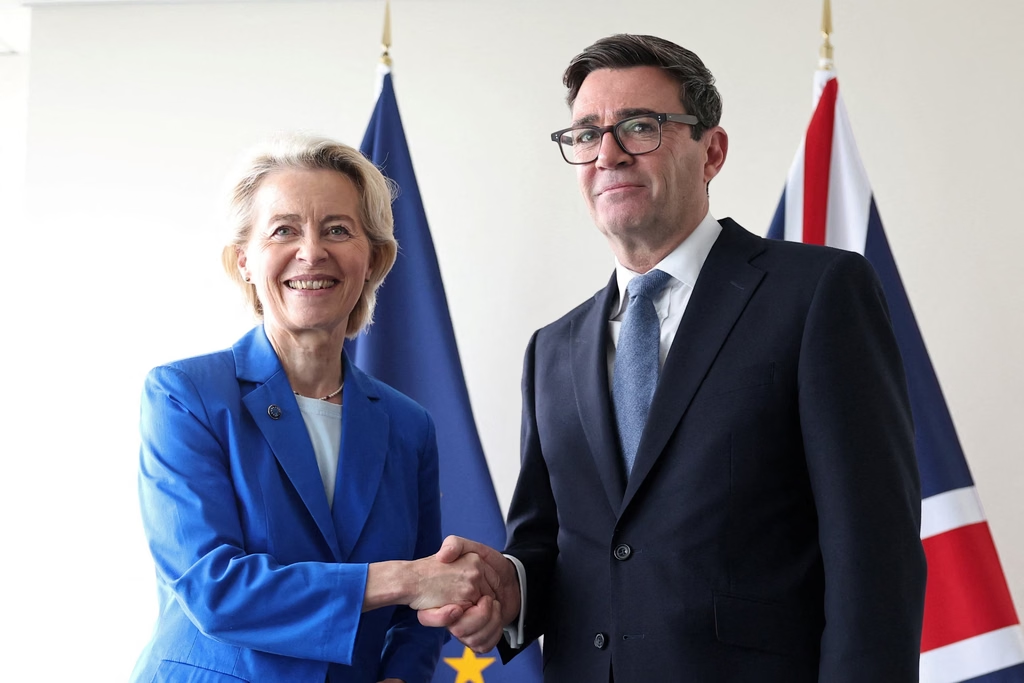
On Tuesday in Liverpool, the Prime Minister told conference that “Brexit has done more harm than good” and promised to lay out “the different options” for Britain’s long-term relationship with Europe. On Wednesday morning, Radio 4’s Today programme asked him plainly whether he wanted Britain to rejoin. He would not say. He listed the choices instead: stay as we are, a customs union, the single market, “or we could go all the way.” Asked whether an in-out referendum could appear in Labour’s next manifesto, he said it would not be right now, then added: “Yes, things are possible.”
So what changed between Leeds and Liverpool? Not the referendum. Not the people of Makerfield, who live where they lived in May. Not Europe’s economy, which has not improved. What changed is that their votes are banked. Burnham won the seat with 24,927 votes; four days later Keir Starmer resigned, and Burnham was elected unopposed to the Labour leadership.
In his speech, Burnham praised the working-class aspiration of his own family, a desire “to get on and give back, never pulling up the ladder.” Makerfield was his ladder. Nobody there should be surprised to hear it creaking as it is hauled up behind him.
Nor was the May promise a conviction suddenly abandoned. It was a pause. At the previous year’s conference, he had told a Guardian podcast that he hoped to see Britain rejoin the European Union in his lifetime. The Makerfield pledge was not a change of heart. It was a change of audience.
THE BEST SPEECH IN YEARS, WITH THE WRONG ENDING
Be fair to what came before the Brexit passage, because most of it was the most serious socialist programme a Labour leader has put to conference in a generation.
Burnham promised to repeal Margaret Thatcher’s ban on public ownership of water companies. He announced a publicly owned Great British Grid to take on the private operators. He pledged the biggest council house programme since the post-war era, with Right to Buy stripped from new homes so they stay public for good. He promised councils the power to seize empty homes and those left to rot by absent landlords living off housing benefit. He promised to change government procurement “so that it backs British business, as our trade unions have rightly pushed us to do,” and spoke of “the re-industrialisation of our regions.”
He also delivered the best line of the week: “The British Right talk about ‘taking back control’. Never let them forget, they are the ones that gave it away in the first place.”
He was right, and more right than he knew. Water, energy, rail, housing: all sold, and all under Conservative governments that preached national sovereignty while auctioning off the nation. But the Right gave control away twice over. It was Edward Heath’s Conservative government that took Britain into the Common Market on 1 January 1973. Labour opposed it, although 69 Labour rebels led by Roy Jenkins trooped through the lobby with Heath. It was Margaret Thatcher who signed the Single European Act that built the single market. And it was John Major who signed the Maastricht Treaty that turned the Common Market into the European Union in 1993.
Each time, the Labour left said no. Tony Benn, Michael Foot, Barbara Castle, Peter Shore and Dennis Skinner fought the 1975 referendum on the side of Out. When Maastricht came before the Commons, Benn, Shore and Skinner voted against it. They were not little Englanders. They were the people who built the welfare state, ran the nationalised industries and understood something the modern party has forgotten: the privatisations at home and the treaties abroad were two halves of the same project, moving economic decisions beyond the reach of the voter. This publication was founded on their argument. Burnham has quoted the first half of it to conference. He has yet to learn the second.
Every promise in his speech rests on one assumption: that a British Parliament, answerable to British voters, is free to make it. Free to own, to subsidise, to plan, to favour home production, to tell a failing monopoly it has had its chance. Burnham spent most of an hour making the case for that freedom. Then, in the final minutes, he put it on the table.
THE CASE FOR GOING BACK, STATED FAIRLY

The Rejoin argument deserves a fair hearing, because parts of it are true.
The frictions are real. Small exporters who once traded easily with Europe now face paperwork, border checks and qualifications no longer automatically recognised. That was the complaint put by a Liberal Democrat panellist on BBC Question Time, who cited Frontier Economics estimates that closer ties could return £20 billion to £27 billion a year to the economy. The Office for Budget Responsibility still assumes Brexit will leave productivity around 4 per cent lower in the long run. And the deal Boris Johnson signed was a Tory Brexit, deregulatory and careless, not the Brexit the North voted for.
Burnham adds immigration, claiming that control weakened when Britain lost its collaboration with European partners. Of course, no one seems to remember the boats started crossing while we were in the EU, just after improvements ended the illegal entry via lorries.
But let’s grant much of this. Then look at what the remedies actually require…
Trade frictions can be eased by agreement: a veterinary deal, mutual recognition of qualifications, cooperation on energy and research. None of it requires surrendering the right to make our own laws. And on immigration, Burnham’s own speech demolishes his argument. He told conference that small boat arrivals are down 40 per cent on last year and that net migration has fallen by more than 80 per cent since the peak of the Johnson era. That fall happened outside the European Union, through decisions taken by a British government. The surge before it was also a British decision, taken in Whitehall under Johnson’s points-based system.
Control was never lost. It was misused, and then it was used again. That is what sovereignty is: the power to get things wrong, and the power to put them right, both answerable at the ballot box.
THE EUROPE WE WOULD BE REJOINING
On Question Time, Andrew Neil put the point the Westminster class keeps dodging. British politicians, he said, talk as if the Europe we left in 2016 were the Europe of today. It is not. In 2016, François Hollande was president of France, Angela Merkel was chancellor of Germany and Matteo Renzi was prime minister of Italy. “That’s a different Europe,” Neil said, and he was right.
Italy has been governed since 2022 by Giorgia Meloni’s Brothers of Italy. In Germany, the AfD remains the strongest party in YouGov’s September poll on 29 per cent, while the CDU/CSU has fallen to a historic low of 18 per cent. In France, the National Rally leads the race for next spring’s presidential election; Ifop polling put Marine Le Pen on 32 per cent in the first round and Jordan Bardella on 35 to 37 per cent.
Neil overstated the economics. The year-by-year record is patchier than he suggested, and the euro area as a whole, carried by Spain and others, has grown a little faster than Britain since the pandemic. UK GDP in the second quarter of 2026 was 6.3 per cent above its pre-pandemic level, against 7.6 per cent for the eurozone. But his central point holds where it matters. Germany, the industrial engine Burnham wants us hitched to, is just 1.9 per cent above its pre-pandemic level, the lowest in the G7. For 2026, the OECD forecasts UK growth of 1.1 per cent, equal with Germany, with France lowest in the G7 at 0.4 per cent. Whatever is holding Britain back, it is not a shortage of access to a German economy that has barely grown in six years.
Since the referendum, real GDP growth has been:
- UK +13.2%
- France +12.8%
- Italy +10.7%
- Germany +7.8%
- Spain +21.5%
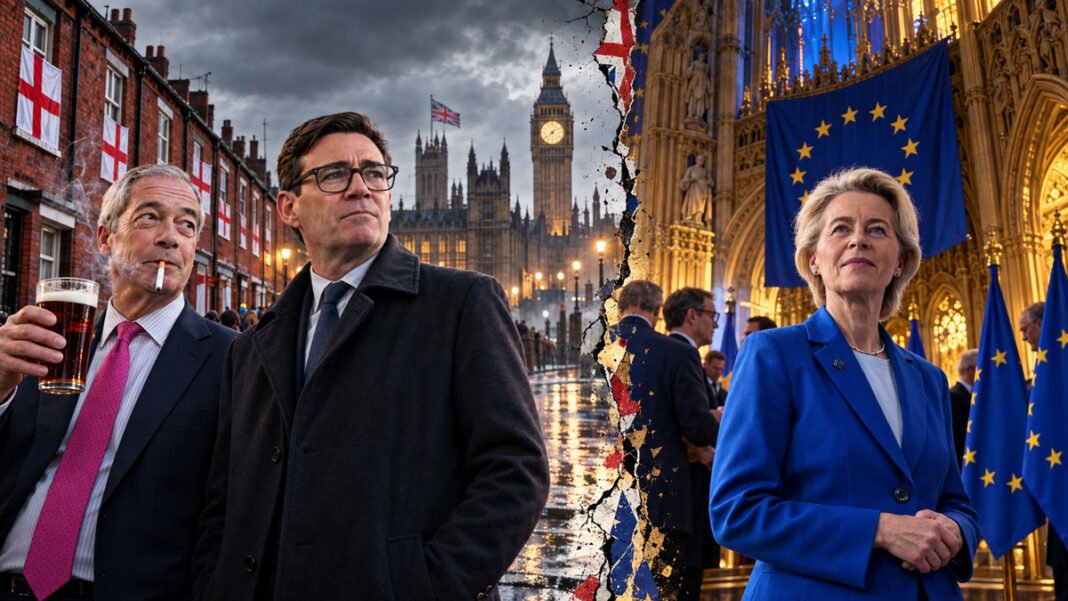
Some will say Britain has its own insurgent right, and it does. Reform leads many of our polls. But that is exactly the point. Whatever you think of Nigel Farage, British voters can remove him. They cannot remove a government in Berlin, Paris or Rome that helps write the laws Britain would live under.
Tony Benn put five questions to anyone who holds power. What power have you got? Where did you get it from? In whose interests do you use it? To whom are you accountable? How do we get rid of you? Michael Foot made the same argument in 1975. You could vote out the government here, he warned, but you would not be voting out all the governments that meet in Brussels to decide what happens to us. The people who fought for the vote, for the unions and for an elected Commons did not do it so that the Commons could become one voice among twenty-eight.
Whatever you think of Nigel Farage, British voters can remove him. They cannot remove a government in Berlin, Paris or Rome that helps write the laws Britain would live under.
THE LEVERS LABOUR WOULD GIVE AWAY

On the Today programme, Burnham read out his options like a man reading a menu with the prices torn off. Each option costs something, and each costs something different.
A customs union means accepting the EU’s common external tariff and giving up the freedom to strike trade deals elsewhere, without regaining the vote Britain once had over EU trade policy. Single market membership means aligning with a vast body of rules on goods, services, subsidies and procurement, written in rooms where Britain no longer sits. Full membership restores a seat at the table, but a seat is not a veto. Most single market law is decided by majority, so Britain would be bound by decisions it voted against, along with the Common Agricultural Policy and a trade policy run from Brussels.
Every option trades market access, national discretion and shared decision-making against one another. For a Prime Minister who has made restoring public control the centrepiece of his programme, that trade-off should have been the first thing he explained. He did not mention it.
Rejoiner will reply that EU law does not forbid public ownership, and in the narrow sense they are right. The treaties are neutral on who owns a company. What they are not neutral about is what a publicly owned company may do. Single market law exists to keep markets open to private competitors, and a public enterprise that closes one is a problem to be corrected.
France learned this with EDF, the public electricity giant built in 1946 from 1,700 private firms. From 1999, Brussels directives forced its monopoly open in stages until the whole market was liberalised in 2007. When private rivals still could not compete with the price of nuclear power the French public had already paid for, France was pressed into a law forcing EDF to sell up to 100 TWh a year, around a quarter of its nuclear output, to rival suppliers at a regulated price. In the 2022 energy crisis that cap was raised to 120 TWh while nuclear output collapsed, forcing EDF to buy power at up to €1,000 per megawatt hour to supply its own competitors. The public owner carried the losses. The private rivals kept the cheap power. Paris renationalised EDF in 2023 and it made no difference: the scheme ran to the end of 2025.

Rail is worse. Under the EU’s Fourth Railway Package, the option to directly award public service rail contracts ended in December 2023, with competitive tendering becoming the norm, and the Commission is now taking the Netherlands to the Court of Justice for handing its core network to the state operator, NS, without a tender. Labour’s Great British Railways is doing exactly what the Dutch did: bringing services back into public hands as contracts expire. Inside the Union, that would be an infringement case waiting to happen. In energy, the EU’s unbundling rules separate ownership of the grid from generation and supply, so a Great British Grid that generated its own power to undercut the private suppliers would be fighting its own regulator. Water is the exception, because Brussels never liberalised it. Everything else Burnham promised runs into the same wall.
The state may own. It may not prefer.
The same logic reaches into the procurement promise Burnham credited to the unions. In 2008, the European Court of Justice ruled on a prison built for the German state of Lower Saxony. The state’s law required contractors on public works to pay at least the local collectively agreed building wage. The contractor engaged a Polish sub-contractor, which paid below that rate. When the state cancelled the contract, the court found it had not been entitled to impose the collective-agreement wage on contractors from other member states. That judgment followed the court’s rulings in the Viking and Laval cases months earlier, which set limits on unions’ right to strike against employers moving work across borders. Freedom to provide services outranked the rate for the job. The single market was built for the market, not the public.
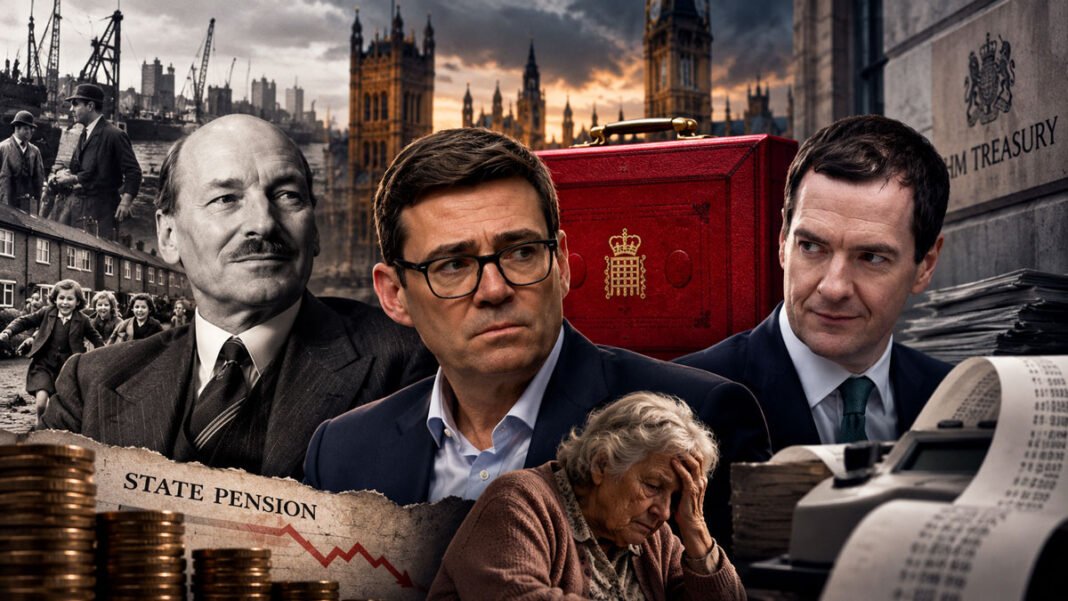
Brussels itself has lately discovered the virtue of buying local. In March, the Commission presented its Industrial Accelerator Act, introducing “Made in EU” procurement preferences, faster permitting and new investment controls for strategic sectors. Inside the Union, Britain would get a preference for European goods, not British ones, under rules shaped by the bloc’s dominant economies. Clement Attlee, whom Labour invokes so readily, warned the House of Lords in August 1962 that by marrying into Europe we would be marrying “a whole family of ancient prejudices and ancient troubles.” He would rather, he said, work for an Atlantic organisation, or a world one. He was the man who built the welfare state, and he understood that you cannot plan an economy whose rules are written elsewhere.
Re-industrialisation, which Burnham rightly calls for, means building here the things we use here. For forty years we have been told that cheap imports are a gift to the consumer. They are cheap for the retailer and the importer, who pocket the margin, while the making is done by poorly paid workers abroad and the bill is paid in towns like Ashton-in-Makerfield and Hindley, where the factories used to be. Reversing that takes a state willing to favour home production, to plan, and to hold its nerve. It does not take permission.
Aneurin Bevan saw the trap in 1957. He described the Common Market as an escapist conception, one in which the play of market forces would take the place of political responsibility. Rejoining is the modern version of that escape: reaching for Brussels rules as a substitute for the political will to plan at home.
Nye Bevan: A political malaise following upon the failure of Socialists to use the sovereign power of their parliaments to plan their economic life
And the terms would not be the old ones. Even the Liberal Democrats’ own Europe spokesperson, Al Pinkerton, conceded last week that Britain would be treated as a fresh entrant. No rebate. No opt-outs. The euro is a treaty obligation for every state that has joined since Maastricht; only Denmark has a formal exemption, and Britain’s died the day we left. Sweden avoids it by never quite meeting the criteria. That is the best a rejoining Britain could hope for: a currency it does not want, deferred by fudge.
FOM
Then there is freedom of movement, which no customs union or single market deal comes without. The people who miss it most are the people it cost least. For the professional classes it meant a cosmopolitan Europe of easy weekends and cheap au pairs.

For the North of England it meant something else: a labour market where a builder in Wigan, a van driver in Leigh or a waiter in Ashton was put in open competition with workers from countries where wages were a fraction of ours, and told to celebrate it. The Bank of England’s own research found the effect on pay was small overall and fell hardest on semi-skilled and unskilled service jobs. That is a polite way of saying it fell on the people who were not asked. The Polish builder was never the enemy. The system that set him and the Wigan builder racing each other to the bottom was, and the people who built that system called anyone who objected a bigot.
Whose definition of a woman?

Equality Act rights vs CJEU gender recognition rulings…
There is one more divergence that the middle-class Remain campaign never mentions, because it embarrasses them. On 16 April 2025, the Supreme Court ruled unanimously in For Women Scotland that the words “sex”, “woman” and “man” in the Equality Act mean biological sex. A woman is an adult human female. A refuge, a changing room, a hospital ward or a prison wing marked “women” can once again mean what it says. That judgment was the fruit of years of work by women, many of them Labour and trade union women, who were vilified by their own parties for saying what every one of their grandmothers knew.
Brussels has gone the other way. On 11 February this year, the European Parliament adopted a resolution by 340 votes to 141, with 68 abstentions, which among other things urged the Council to “emphasise the importance of the full recognition of trans women as women”, describing their inclusion as essential to any gender equality or anti-violence policy. A month later, the Court of Justice of the European Union ruled that member states cannot refuse to amend a citizen’s recorded gender where doing so interferes with free movement rights, and trans campaigners hailed it as a precedent that recognising gender identity is a fundamental right within the EU. Legal scholars at Bristol have since argued that the understanding of sex in the Equality Act, as a binary biological characteristic, is diametrically opposed to the approach adopted under EU law, and that the Court’s rulings can be read as its answer to our Supreme Court. european parliament passes resolution affirming trans women are women +4
The Parliament’s resolution is not binding, and Remainers will say so. But that misses how the Union works. EU equality law is supreme over national law wherever it applies, and the Court of Justice, not the Supreme Court, would have the final word on what “sex” means in the directives that govern pay, work and access to goods and services. A Labour government that took Britain back inside would be asking the women who fought and won at the Supreme Court to submit their victory to a court in Luxembourg and a parliament in Strasbourg that have already told them they lost.
The Tribune has never hedged on this. Women’s rights and dignity rest on biological sex, and the women who defended that principle inside the Labour movement, against their own leadership, their own executive committees and in some cases their own unions, deserve better than to have the ground taken from under them by a treaty. They are still fighting. The Supreme Court did not end the argument in the party; it only proved the women were right. Rejoining would reopen it with the other side holding the whip hand.
REOPENING THE WOUND

Burnham opened his speech with a promise: “Today we draw a line on a decade of division.” In May, he warned that Britain would be stuck in a permanent rut if politicians kept rerunning the old arguments. He was right both times. He has now done the opposite of what he promised.
He has not proposed rejoining, which would at least be honest. He has proposed an options paper, a search for a “consensus” he has not defined, and a referendum that is not right now but possibly later. It is the worst of every world. Business gets the years of uncertainty he warned against. Leave voters get proof that their vote was only ever provisional.
And Nigel Farage gets the gift of a lifetime. He will have felt the sense of betrayal rippling through the Labour constituencies of the North the moment Burnham said “all the way,” because he has built a career on it. These are seats that voted Leave by margins Westminster still cannot fathom, and they did not do it out of nostalgia. They did it because forty years of membership had failed them, and they knew it. Wigan, Barnsley, Doncaster, Hartlepool, Mansfield: the mines, the steelworks and the mills closed while Britain was inside the Common Market and the single market, and neither stopped a single closure. Regional grants arrived with the EU flag on them, and the towns still emptied. When those voters were finally asked, in 2016, whether the arrangement had worked for them, they answered honestly. Burnham, who represents one of those seats, has just told them the question is open again. Farage will not need to write a leaflet. Burnham has written it for him.
There is a better path, and it runs through the rest of Burnham’s own speech. Take back the water. Build the grid. Build the council homes. Rewrite procurement so that public money builds British industry and pays the rate for the job. Negotiate practical cooperation with Europe on trade frictions, energy and research, on its merits, as a sovereign neighbour rather than an applicant. And if the Prime Minister truly believes Britain should rejoin, he should say so plainly, put it in a manifesto, and go back to Makerfield to explain why the promise he made there no longer holds.
Labour MPs in Leave seats should be asking him that now. So should the trade unions that fought for a procurement system that backs British workers, because that is exactly the power this debate puts at risk.
Burnham told conference that the Right gave control away, and he was right. The test of a socialist is not whether he can say so. It is whether, having finally won that control back, he can resist the urge to give it away again.
Makerfield kept its side of the bargain. Four months on, it is entitled to ask whether Burnham ever meant to keep his.