The Evidence of Your Eyes: Burnham’s War on the “Narrative of Decline”
The Prime Minister went to the United Nations to announce a new front against Russian lies. Read the speech in order, though, and the target moves from the Kremlin to the kitchen table.
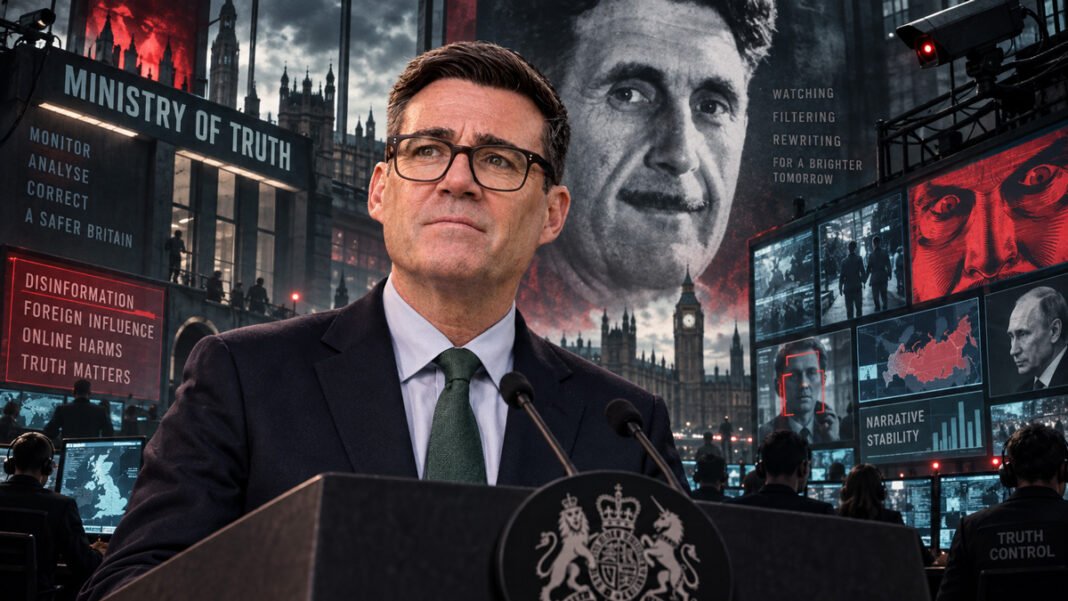
In the seventh chapter of Nineteen Eighty-Four, Winston Smith arrives at the thought that sits at the centre of the whole book. “The Party told you to reject the evidence of your eyes and ears,” he reflects. “It was their final, most essential command.”
Orwell did not think tyranny began with the burning of books. He thought it began when ordinary people were persuaded that what they could see for themselves was not really there: the thin ration, the broken lift, the promise that had quietly become its opposite. The Party did not need everyone to love Big Brother. It needed them to doubt their own experience.
On Tuesday night in New York, Prime Minister Andy Burnham stood before the United Nations General Assembly and told the world that “over the last decade we have given too much ground to those who want to run a negative, corrosive narrative about life in Britain, which bears no resemblance to reality.” Then he announced a new National Centre for Information Defence.
Before going any further, I want to be fair to him, because the threat he described is real.
THE ENEMY IS REAL. SO IS THE MIRROR.
Russia runs an information war against this country. Burnham listed the tools: bots, fake websites, falsified newspaper articles and the forged branding of 28 British organisations, including universities and the BBC. These are not harmless internet pranks. They are deliberate attempts to manufacture credibility, disguise the source of information and exploit existing divisions inside another country. That is information warfare, and Britain has every right to defend itself against it. Nothing that follows excuses Moscow.
But we would be treating our readers as fools if we pretended Britain comes to this fight with clean hands. Britain did not learn information warfare from the Kremlin. In a good many respects, it was the teacher.
In 1948, Clement Attlee’s Labour government set up the Information Research Department inside the Foreign Office to counter Soviet propaganda. It was not an MI5 outfit or some shadowy Conservative plot. It was ours, created by the most radical government this country has ever had. And it was secret. It operated for nearly three decades before it was wound up in 1977.
What began as counter-propaganda did not stay there. In 2021, the Observer revealed that during the Indonesian massacres of 1965, the IRD had produced pamphlets posing as the work of Indonesian patriots and urging them to eliminate the communist party. Hundreds of thousands were killed. Declassified files later studied by the historian Rory Cormac showed the department forging statements in the names of Soviet bodies: at least eleven fake statements from the Soviet news agency Novosti between 1965 and 1972. In 1963 it forged a statement from a Soviet front organisation denouncing Africans as “primitive” and morally weak, then watched it spread through the African press.
Set that beside the charge Burnham laid against Russia at the United Nations: forging the branding of other people’s institutions to deceive a foreign public. Britain did it first. In Indonesia, it did it while people were being slaughtered.
Britain did not learn information warfare from the Kremlin. In a good many respects, it paved the way.
Nor was the BBC’s overseas broadcasting ever as detached from the state as its reputation suggests. In August 1953, as MI6 and the CIA moved against Iran’s elected prime minister, Mohammad Mossadegh, the BBC Persian service is reported to have altered its routine midnight time announcement as a pre-arranged signal to the plotters. The World Service’s credibility abroad has always been an asset of British foreign policy, which is precisely why the state has valued it.
The pattern did not end with the Cold War. In 2011, the public was told that bombing Libya was necessary to protect the people of Benghazi. Five years later the Commons Foreign Affairs Committee concluded that the threat to civilians had been overstated, and that the mission had “drifted into an opportunist policy of regime change.” Libya collapsed into civil war. The claims that took Britain into that war did not come from St Petersburg.
Then, in 2018, came the case that should hang over every word Burnham said on Tuesday. The Integrity Initiative, a Foreign Office-funded project set up to counter Russian disinformation, was found to have shared articles on its Twitter account calling the Leader of the Opposition, Jeremy Corbyn, a “useful idiot” who “helped the Kremlin cause”. Money voted by Parliament to defend democracy from Moscow had been spent, in part, amplifying attacks on the Labour Party. Richard Burgon put it plainly at the time: the government “shouldn’t be using public funds or the state to undermine or attack the official opposition.” The Initiative’s founder later apologised to Corbyn.

Today, Britain works openly inside other countries’ information environments. Burnham told the Assembly that “we have already supported Moldova to protect its elections from Russian interference.” Perhaps that support was entirely benign. But Moscow describes its own operations in the language of protection too. The only thing that separates a democracy’s information work from an autocracy’s is accountability: open rules, independent oversight, and a firm wall between foreign threats and domestic argument. That wall is exactly what Britain has failed to build at home.
Orwell understood all of this from the inside. He spent the war at the BBC, producing broadcasts for India, and drew on its grim offices for the Ministry of Truth. In 1949, gravely ill, he handed the IRD a list of writers he considered unreliable as anti-Stalinist propagandists. His critics have spent decades calling that hypocrisy. They misread him. Orwell believed Stalinist lies had to be fought, and believed just as fiercely that any state entrusted with that fight would be tempted to turn its weapons on its own people. He saw no contradiction in holding both convictions. Neither should we.
So if the new centre does only what the Prime Minister’s own words say it will do, “to detect, attribute and disrupt these kinds of hostile state information attacks”, few of us would object. The trouble is that the speech does not stay there.
HOW THE TARGET MOVED
Read the passage as Burnham delivered it, in sequence, and watch the enemy change shape.
It begins with the Kremlin: its bots, its forgeries, its roughly £1.3 billion a year. It then describes what that money buys, “an insidious campaign that reaches into people’s homes and twists what they feel about their own country and community”, which is “creating a narrative of decline, stoking division and sowing despair.”
Then comes the sentence that should have stopped every civil libertarian in the country at breakfast. “We have given too much ground to those who want to run a negative, corrosive narrative about life in Britain, which bears no resemblance to reality.”
Those. Not “the Kremlin”, not “hostile states”, but a word left open. Perhaps he meant Moscow alone; several broadcasters reported it that way. But a head of government choosing his words for the world’s largest diplomatic stage knows the difference between naming an enemy and describing a mood. He described a mood.
He then told the Assembly who is most at risk from that mood. “If you’re struggling with the cost of living and your life is not improving”, he said, or if you are young and “not in employment, education or training”, then “you are going to be much more vulnerable to this kind of influence.”
So in the space of a few paragraphs we travel from a foreign intelligence operation, to a feeling of national decline, to the people who are poorest and the young who have been left without work. The sense that things are getting worse is presented as something done to Britain from outside. The people most likely to feel it are presented as the weak point in the nation’s defences.
This is the part Orwell would have recognised. The danger is not that a government fights Russian propaganda. The danger is that a government comes to treat discontent itself as a security threat, and then builds an institution to manage it.
WE HAVE SEEN THIS MACHINE BEFORE

The Integrity Initiative was an outsourced project, and ministers could plead ignorance of what it did. The state’s own in-house machine tells the same story, and here there is no one else to blame.
In 2019 the government set up the Counter Disinformation Unit, supposedly to tackle false information spread by foreign states. During the pandemic its remit spread outwards. Investigations by the civil-liberties group Big Brother Watch found that it had been logging the online speech of MPs, academics, journalists and campaigners who disagreed with government policy. Posts by senior Conservative, Labour and Green politicians that criticised government policy, and contained no factual errors, were among those flagged to social media companies.
When the story broke, the government did not close the unit. It renamed it. In November 2023 the Counter Disinformation Unit became the National Security Online Information Team, and ministers began to stress its security role. Big Brother Watch then obtained the team’s internal policy, which it said contained almost no references to national security and described the unit’s function as building “a picture of mis/disinformation threats”, with a remit that also covers “public safety”.
Parliament has tried twice to bring the team under proper scrutiny. In March 2024 the Culture, Media and Sport Committee called for an independent review of its activities. After the 2024 election, the new Labour government ruled that out and said ministerial oversight was sufficient. In July 2025 the Science, Innovation and Technology Committee went further, recommending that the government “place NSOIT on a statutory footing and bring it under the remit of the Intelligence and Security Committee.” The government’s reply that October pointed to privacy notices, Freedom of Information requests and ministerial oversight. It did not accept the recommendation.
When a Liberal Democrat peer asked in early 2024 why the team escaped the Intelligence and Security Committee, the minister, Viscount Camrose, told the Lords that the government had “a strong preference for not allowing it openly to share national security information”. The logic runs in a circle. The unit is called a security body, so it cannot be scrutinised; it cannot be scrutinised, so nobody can check whether it deserves to be called a security body.
Against that record, the morning after the speech, Defence Secretary Wes Streeting went on GB News to reassure the country. “We’re not interested in policing domestic political dissent,” he said.
He may mean it sincerely. But assurances from ministers are exactly what we were given last time. No one has yet told Parliament whether the new centre will absorb NSOIT, stand alongside it or replace it. No one has said what law it will operate under, which committee will oversee it, or what it may refer to the platforms it will work with. A Prime Minister who was serious about the difference between foreign attack and domestic argument would have answered those questions in the same breath as the announcement. He did not.
WHO VERIFIES THE VERIFIERS?

There is a further, quieter problem, and Burnham handed it to us himself by naming the BBC as a victim of Russian forgery.
The BBC is a victim of that forgery. It is also, at home as well as abroad, an institution that gets things wrong. In November 2025 its Director-General, Tim Davie, and the head of BBC News, Deborah Turness, resigned after a Panorama programme was found to have spliced together separate passages of a Donald Trump speech, so that viewers heard him say something he had not said in that form.
None of this makes the BBC a Russian asset, and none of it makes Moscow’s lies harmless. Foreign propaganda does not become innocent because domestic broadcasters make mistakes. But domestic institutions do not become the custodians of truth simply because foreign propaganda exists. Every body that will sit around the new centre’s table (government departments, the security services, the platforms, the trusted broadcasters) has its own interests, its own blind spots and its own record of error.
Then there is the Prime Minister’s own number. The Kremlin, he said, spends “around £1.3 billion each year on manipulating information.” It is a striking figure, and it may be right. But no methodology was published with it, and UN News rendered it in dollars without any source either. Figures of that size that have circulated in the past referred to the entire budget of Russian state media, rather than covert disinformation. In a speech about the dangers of unsourced claims, the most quotable statistic arrived unsourced. It is a small thing. Small things are how trust is lost.
DECLINE IS NOT A NARRATIVE IN THE HEARTLANDS
Here is what troubles me most, and it is not really about Russia at all.
For much of the past decade, Andy Burnham was the most prominent politician in England making a simple argument: that the North had been failed. As Mayor of Greater Manchester he stood on the steps of the Town Hall in 2020 and fought Downing Street over support for workers during lockdown. He built a political identity out of telling Westminster that people in towns like Wigan, Oldham and Bolton were not imagining their decline. They were living it.
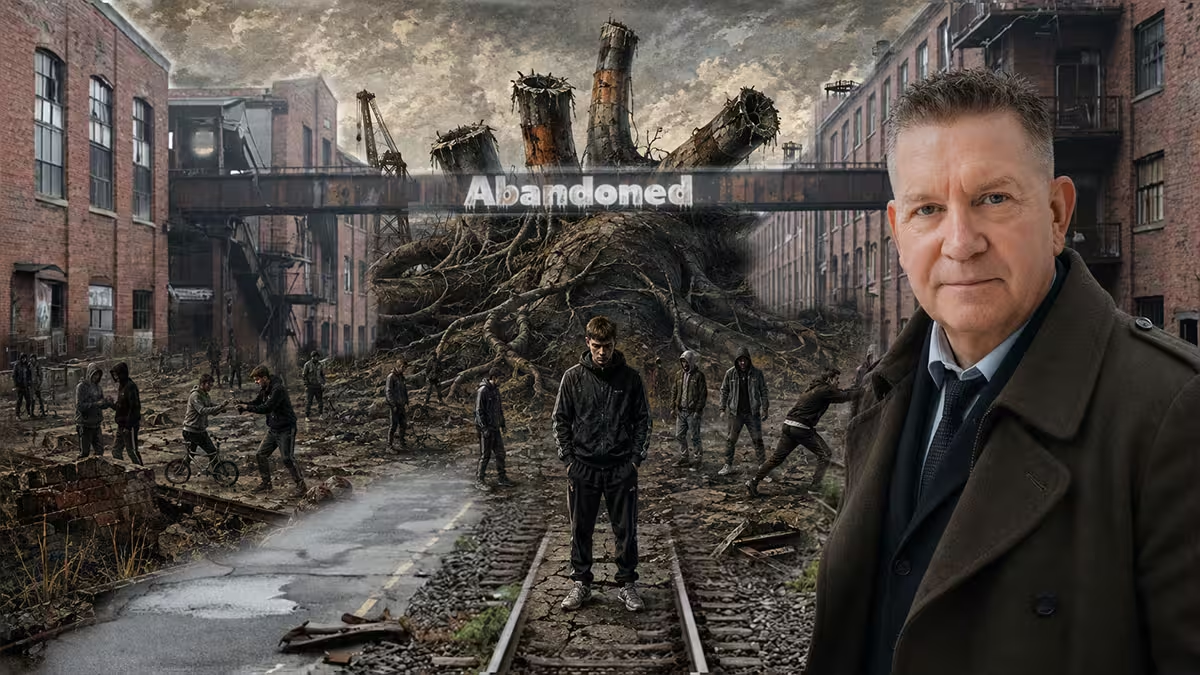
In the places this newspaper writes for, decline is not a story someone planted. It is the bus route that stopped running, the high street of charity shops and vapes, the GP appointment three weeks away, and the young man with no work, no training and nowhere to go. No bot farm in St Petersburg closed the pits or sold off the buses. Russia exploits these wounds; it did not inflict them. And the people who feel them are not a vulnerability in the national information system. They are witnesses.
The people who feel these wounds are not a vulnerability in the national information system. They are witnesses.
Burnham half-knows this, and to his credit he said so at the UN. “Part of the challenge is to lift our people up and create the opportunities they need,” he told the Assembly. “When inequalities grow too wide, our societies are at greater risk.” That is the right diagnosis. But notice the order of events. The security chiefs were tasked with building the information centre “today”. The 10-year Plan for Britain, which is meant to address the conditions that make people angry, will be brought forward “later in the year”.
The contradiction deepens further on. Near the close of the speech, Burnham described the statue of Abraham Lincoln outside his new No10 North office in Manchester, which commemorates the mill workers who refused to handle slave-picked cotton during the American Civil War. He praised them as people “with little power” who used it for others, and called theirs “bottom-up change led by people.” He is right to honour them. But those workers were not repeating an approved narrative about life in Britain in 1862. They were hungry, they were angry and they were right, and the respectable opinion of their day told them otherwise.
WHAT MUST HAPPEN NOW
If the government means what it says about defending democracy, it can prove it before the new centre opens its doors.
The National Centre for Information Defence should be established in statute, with a remit written into law that is confined to hostile state activity and expressly excludes lawful speech by people in this country, however gloomy, angry or wrong. It should come under the oversight of the Intelligence and Security Committee, as Parliament’s own Science Committee has already recommended for NSOIT. It should publish an annual report listing every request it makes to a social media platform to remove or restrict content, with the reasons. It should carry a sunset clause, so that Parliament must actively vote to renew it. And ministers should tell the country now whether NSOIT is being folded into it, and what becomes of that unit’s files.
None of this weakens the fight against Russia. A centre that exposes Kremlin forgeries in public, with its methods open to scrutiny, is more credible and therefore more effective than one that works in the dark. Britain’s own history shows what happens when information work is left to operate in secret: it drifts from the enemy abroad to the awkward voice at home. Secrecy is not strength. It is simply the condition under which mission creep goes unnoticed.
Orwell’s Party asked people to reject the evidence of their eyes and ears. A democratic government should ask the opposite: to look hard, to report honestly and to keep asking awkward questions, above all about the government itself.
Russia did not close the pits, sell the buses or empty the high street. A government that cannot tell the difference between a foreign lie and a domestic grievance will end up policing the grievance.