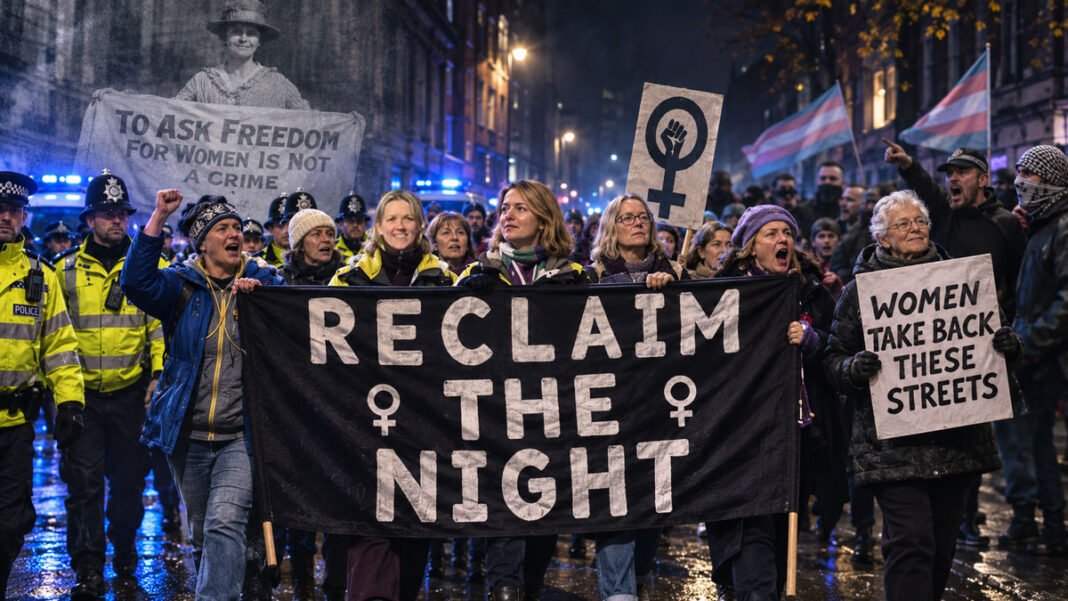
Reclaim the Night Nottingham: Men Blocked the March
When a women’s march against male violence needs a police escort to cross a British city, the people screaming abuse at it are not fighting fascism. They are proving why the march was necessary.
On a cold November night in Nottingham, a small group of women gathered at Sneinton Market to walk through their own city. They carried banners against male violence, domestic abuse and street harassment, under an old and honourable name: Reclaim the Night. Among them, the organisers say, were survivors of abuse in the home. They were asking for nothing more radical than the unmolested use of the pavement.
Before the march could find its stride, the pavement was blocked.
It was not blocked by drunks stumbling from pub doorways, or by the casual street harassers whose entitlement has poisoned city centres after dark for generations. It was blocked by a counter-demonstration called by the Revolutionary Communist Group. Footage of the evening shows a crowd made up largely of men bearing down on the march. Marchers say they were called “genocidal murderers” and “fascist scum”, and told, “you’re not feminists.” Scuffles broke out as protesters tried to stop the procession, and police officers had to put their own bodies between the two groups and escort the women through the city. Several women, facing that kind of hostility for the first time, were left shaking.
The provocation was two words: female-only.
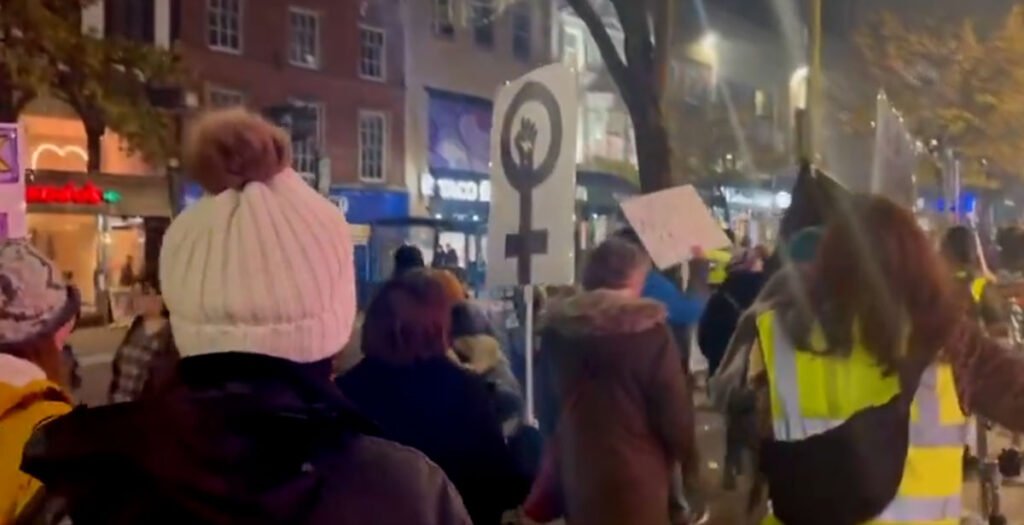
The march was organised by Nottingham Reclaim the Night, a grassroots group of sex-based rights campaigners, and joined by members of the Women’s Rights Network from Derbyshire and Staffordshire. It was open to women and girls, defined by sex.
For the RCG, that was enough. In its call to arms before the march, it said the organisers had “co-opted Nottingham’s Reclaim the Night women’s march and turned a historically trans inclusive event into a hate march.” It urged supporters to make sure Sneinton Market “remains TERF free”, and to bring flags, megaphones and drums. It added, without apparent irony, that “people of all genders are welcome.”
Read that again. A women’s march against male violence was announced, and a revolutionary party sent out a public invitation for men to come and stop it.
It also helps to check the word “co-opted”. Nottingham’s march had been run for years by Nottingham Women’s Centre and its partners, and in recent years it was explicitly trans-inclusive. That much of the RCG’s claim is true. The truth is no one could stop any man claiming to be a woman from marching; that was before the Supreme Court judgment. This year those organisations cancelled it. The women who marched last Saturday did not hijack anyone’s event. They picked up a banner the city’s own institutions had put down, and walked with it.
The RCG should look further back before it lectures anyone on history.
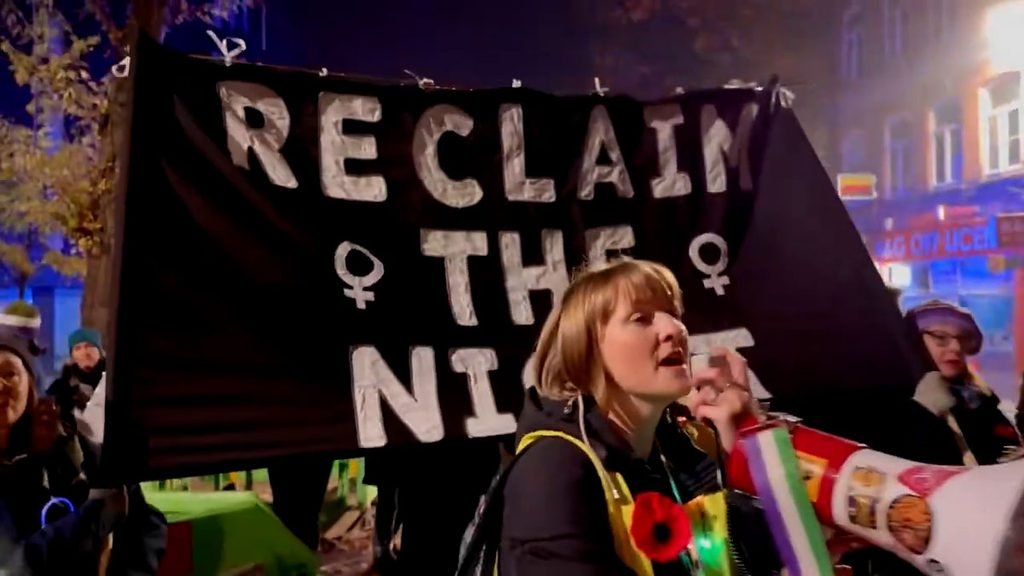
Reclaim the Night was not born as an exercise in gender theory. It began in Leeds in November 1977, organised by women for women, while the man later unmasked as Peter Sutcliffe was murdering women across Yorkshire.
It was a furious reply to police advice that women should stay indoors after dark, a de facto curfew on the hunted while the hunter owned the night. Women marched with placards demanding a curfew on men instead. Their point was plain: public space belonged to them by right, and male violence was a physical fact that could not be solved by locking women in their homes.
A decade of one charity’s admissions policy is not the history of a movement. The founders of Reclaim the Night were not marching against a state of mind. They marched against violence done by male bodies to female bodies. That boundary is not an abstraction; women’s safety has been organised around it for half a century.
The RCG’s Argument That Collapses on the Pavement
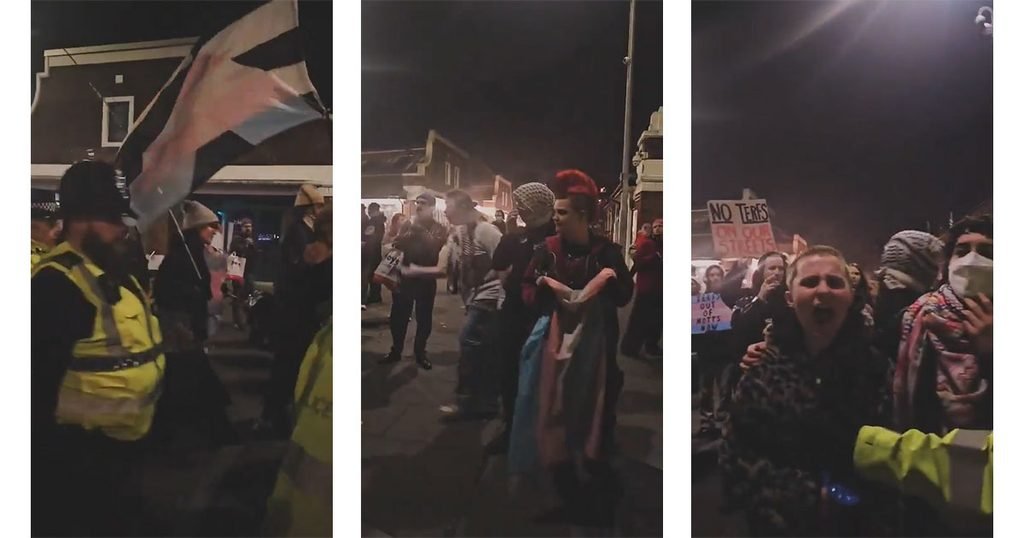
The counter-argument deserves a fair hearing, because knocking down a straw man persuades nobody. The counter-protesters would say that trans people face real harassment and violence in public, that street safety is not one group’s property, and that a march defined by sex in 2026 divides people when solidarity against bigotry is badly needed. They believe any line drawn on biological sex is a refusal of human dignity.
The danger trans people face is real, and no socialist worth the name wants any vulnerable minority harassed. But the argument collapses the moment it reaches the pavement. One group’s need for safety cannot be met by abolishing the right of another to organise as itself. The Supreme Court ruled unanimously in April 2025 that “sex” in the Equality Act means biological sex. The reason that matters is concrete: you cannot fight the oppression of a group you are forbidden to name.
And what kind of socialism shows its solidarity by bullying women on a dark street?
There is something grotesque about watching men draped in revolutionary slogans shout down a women’s march as fascist. That spectacle does not belong to the history of the labour movement. It belongs to the long history of male entitlement dressed in moral righteousness. A woman who asks for a space, a meeting or one march a year for her own sex is not attacking anyone. She is drawing a boundary. The man who cannot tolerate that boundary, who insists that his presence or his blessing is required before women may assemble, is not a radical. He is an authoritarian who cannot stand an event that is not about him.
A movement that talks of liberation ought to understand the meaning of the word ‘no’.
Nor does the RCG speak for the communist left…it is a fringe organisation at best…
When the Supreme Court ruled, Britain’s Communist Party and the Young Communist League issued a joint statement welcoming it. They said the judgment upheld women’s right to single-sex spaces, and they commended For Women Scotland for bringing the case. That is the materialist tradition: politics grounded in bodies, wages, housing and physical safety. The RCG attacked that position as incompatible with socialism. On Saturday night we saw what its alternative looks like in practice: a left that spends its energy screaming at working-class women outside a market in Sneinton while the people who run Britain’s broken services sleep soundly.
And let’s be honest, the RCG is in a curious position to lecture women on what feminism requires. In October 2017, it announced on its own website that it had suspended a member over “a historic allegation of sexual harassment” and opened an internal inquiry. Within three months he was back. The group’s update said he had been reinstated from 1 January 2018, that he understood his actions were “unacceptable for a communist”, and that his consciousness and behaviour had changed. Nothing suggests that man was in Nottingham on Saturday, and the Tribune does not say he was. But an organisation that judged a harassment complaint against its own comrade in-house, and readmitted him within weeks, now claims the authority to decide which women may march against male violence. It has drawn its own lines rather differently.
The deeper problem is not one sect disgracing itself; fringe groups have embarrassed themselves on street corners for decades. The problem is a wider progressive culture that has let this intimidation become normal. When political parties, trade union leaderships and women’s charities will not defend the principle that women are a sex with the right to organise as one, the street enforcers take the hint. They decide the women are fair game.
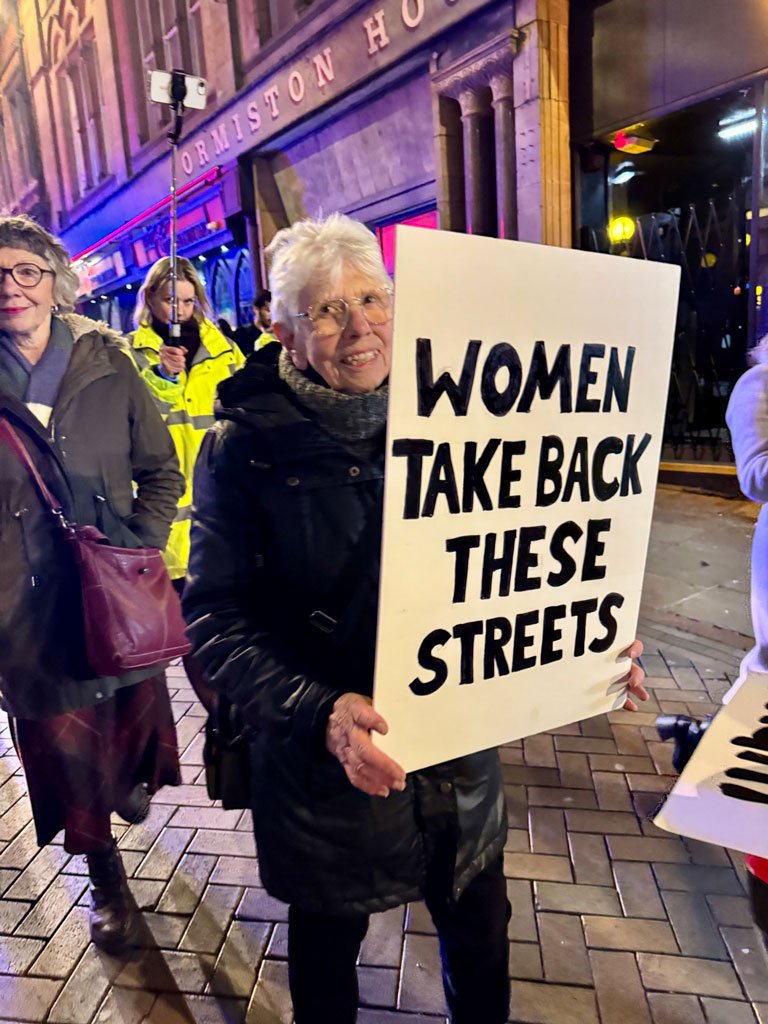
Yet the marchers did not disperse. Despite a frightening start, they held together, leaned on each other and finished their route. By the end, the organisers say, fear had given way to elation. Courage in defence of a plain truth outlasts the performative fury of a crowd.
The officers who stood between the marchers and their tormentors did their duty that night. But women’s civic freedom cannot depend on a permanent police line. The Home Secretary and Nottingham’s civic leaders should say clearly that a peaceful, lawful women’s march is protected by the right of assembly, and that no counter-protest has a right to stop it. Anyone who uses physical intimidation to shut one down should expect to answer for it.
A society that cannot guarantee women the right to walk down a street without male harassment has failed in its first duty. A movement that screams at women in the dark to prove its purity has given up any claim to the name of the left.
Reclaiming the night was never about asking men for permission to walk. It was about taking the street anyway, and no chorus of shouting men is going to push women off it now.
Enjoyed this read? I’m committed to keeping this space 100% ad-free so you can enjoy a clean, focused reading experience. Crafting these articles takes a significant amount of research and heart. If you found this helpful, please consider a “small donation” via PayPal or GoCardless to help keep the lights on and the content flowing. Every bit of support makes a huge difference.

Support The Tribune
INDEPENDENT. READER-FUNDED. AD-FREE.
If you value this article, help keep The Heartlands Tribune publishing independent journalism without intrusive advertising or corporate sponsors.
Choose your monthly amount
Secure payment via GoCardless