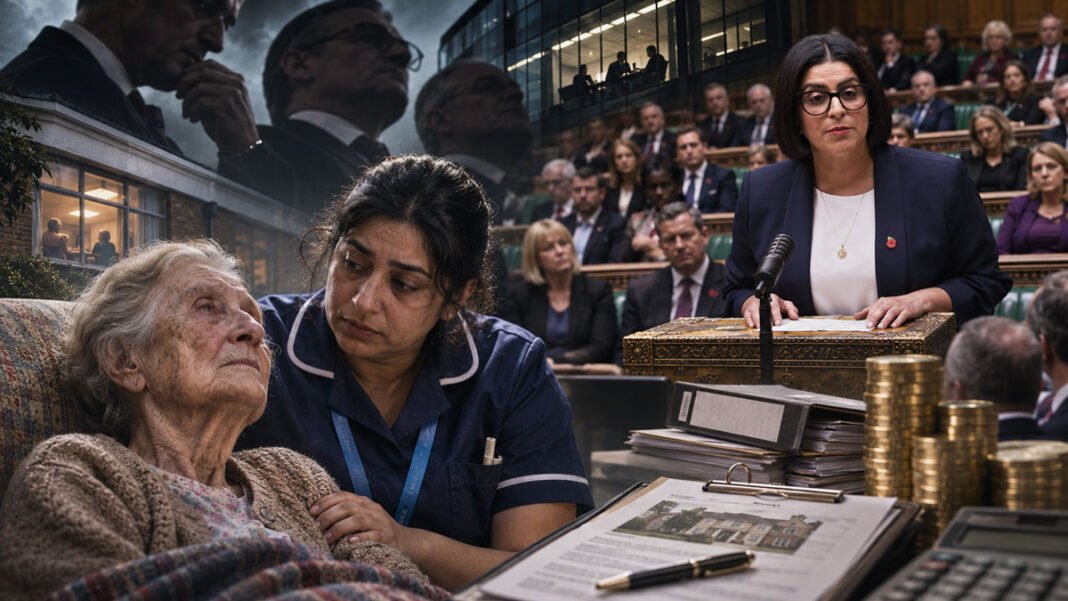
Shabana Mahmood’s climbdown on migrant care workers is being sold as a £10 billion giveaway. The real bill was run up long before, by the people who turned the last years of our parents’ lives into an investment.
Care Home Privatisation: £1,300 a Week, £12.71 an Hour
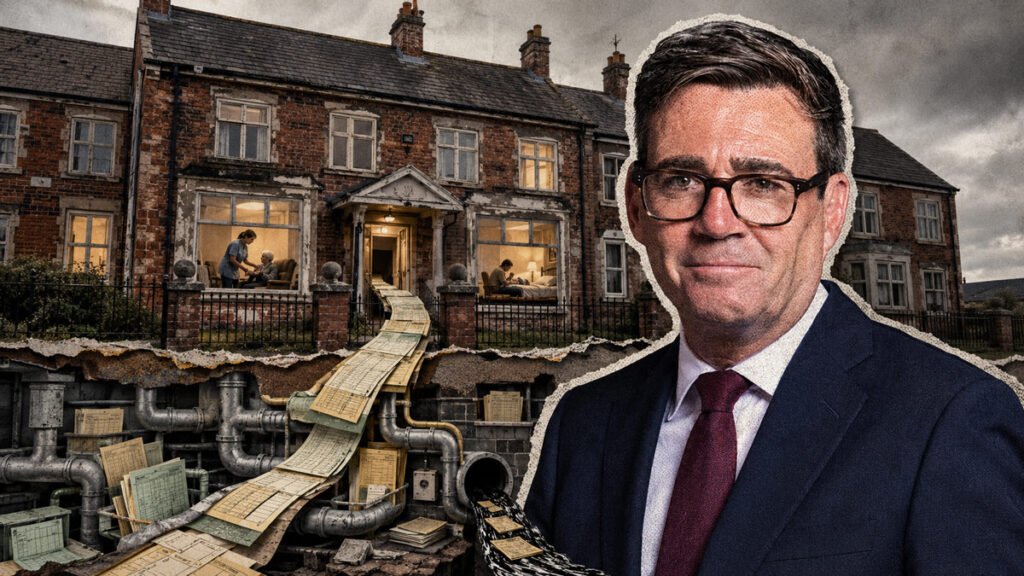
A bed in a British care home now costs a family about £1,300 a week. The woman who washes, feeds and turns the person in it earns £12.71 an hour. Somewhere between those two numbers sits the owner. The last time anyone forced the books open, the biggest private equity chains were paying £102 a week on every bed just to service their debts, much of it owed to their own related companies offshore. That is not a care system. It is a toll booth on the last years of our parents’ lives.
On Monday the Home Secretary told the Commons that overseas care workers who have met their visa conditions will keep their five-year route to settlement. She praised those who “worked hard and answered our call when we needed them.”
In March, Shabana Mahmood told the Institute for Public Policy Research that unless she rewrote the settlement rules, Britain would “see a £10 billion drain on our public finances”. On Monday, in the Commons, she rewrote them the other way.
The Tories called it a surrender…
What the £10 billion actually measures
The figure comes from a Home Office research note published on 5 March. It takes the Migration Advisory Committee’s estimates of the lifetime fiscal impact of care workers who arrived in 2022/23. That works out at roughly £36,000 net cost per worker and £67,000 per adult dependant. The note then multiplies those figures by the number expected to settle between 2026 and 2030: about 117,000 care workers and 79,000 adult dependants. The result is £9.5 billion, spread across the rest of their lives.
That is not the price of Monday’s decision. The Liberal Democrat MP Max Wilkinson asked the UK Statistics Authority to examine the claim. The Authority confirmed with the Home Office that it is the lifetime cost of this group under the existing rules. It added that a clearer statement would have shown the figure is not an estimate of the fiscal savings associated with delaying settlement. To be fair to the Home Secretary, the Authority also concluded that her speech met its standards.
In plain terms, the £9.5 billion compares these people settling with these people not being here at all. A 15-year wait would never have saved that sum. At most it would have postponed some entitlements, and only for workers still in the country after a decade and a half of insecurity. The Commons needed one number: the cost difference between the five-year route and the 15-year one. Nobody has published it.
The estimate is also lopsided over time. According to the Migration Observatory, health and care workers become a net fiscal cost only after about 30 years. The bill arrives in old age, as pensions and NHS treatment, as it does for anyone. When the IPPR applied the Home Office’s own method to all skilled workers due to settle in the same period, it found they will put £115 billion more into the public finances than they take out.
For a day Westminster argued about the carers. Nobody mentioned the Care Home owners…
That silence is the story. Britain didn’t stumble into dependence on overseas care workers. It sold its care homes, starved the people working in them, imported a cheaper and more compliant workforce to fill the gap, and has now sent the public the bill. Every step was a political choice, and both main parties made them.
Care Home Privatisation: How the State Walked Out

In 1979 councils and the NHS provided nearly two-thirds of Britain’s residential and nursing home beds. By 2012, according to research drawn together by SOAS, the state’s share had fallen to around 6 per cent. The turning point was Margaret Thatcher’s NHS and Community Care Act 1990, which made councils buyers of care rather than providers. Labour and the coalition both kept the model running.
Once care became a market, finance followed. Southern Cross grew by selling its homes and leasing them back. In 2011 it collapsed with 752 homes, 44,000 staff and 31,000 residents, whose fate passed to its landlords. Nobody went to prison, and the model didn’t die. It grew.
The Centre for Health and the Public Interest examined the accounts of more than 830 care home companies. It found that the five largest chains backed by private equity had borrowed £35,072 for every bed they owned, often from related companies in Jersey, Guernsey and Luxembourg, at interest rates that turned public fees into tax-deductible payments to their owners. Across the whole independent sector, the CHPI estimated that £1.5 billion a year leaked out as rent, interest, profit and directors’ pay.
“That is not a care system. It is a toll booth on the last years of our parents’ lives.”
Now the buyers are bigger still. In October 2025 the American property trust Welltower bought Barchester’s care home portfolio for £5.2 billion, the largest care home deal in history, alongside the whole of HC-One for £1.2 billion. The Barchester homes are rented back to their operator on a lease with rent rising 3.5 per cent every year. A British investment minister welcomed it.
Migrant Care Workers: How the Sector Came to Depend on Them
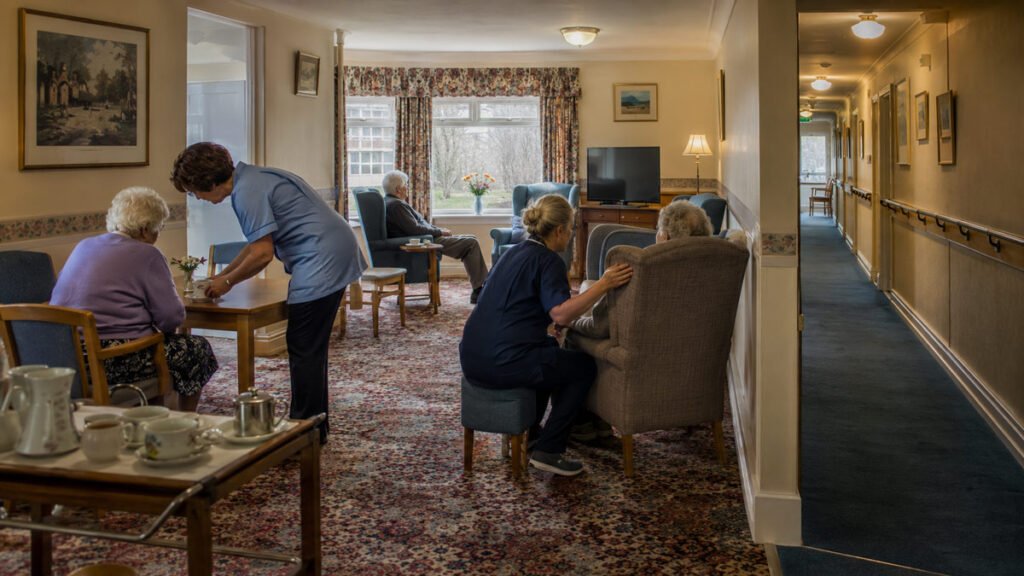
Something had to give, and it was the wages. Councils pay providers below cost, and families paying their own way cover the gap: the competition watchdog found self-funders paid 41 per cent more than councils for the same bed. Owners collect their rent and interest whatever happens. The squeeze falls on the payroll. A care worker with five years’ experience now earns, on average, 10p an hour more than someone who started last week.
British workers did the sensible thing and left. Last year there were 140,000 new British starters in the sector, down from 255,000 five years earlier, while 175,000 people walked out.
The government’s answer wasn’t to raise pay. In 2022 Boris Johnson’s government opened the health and care visa to care workers. Between March 2022 and March 2024, around 185,000 people started direct care jobs after arriving from abroad, and another 50,000 followed in 2024/25. Each visa was tied to a sponsoring employer. A worker who complained could lose the right to stay. The Home Secretary says about 1,800 employers have since lost their licences for exploiting the people they recruited. Cheap labour and compliant labour went together.
In 2025 the door was closed to new recruits. The workers already here were left as a political problem, and on Monday Mahmood decided what to do with them.
How They Sent Us The Bill
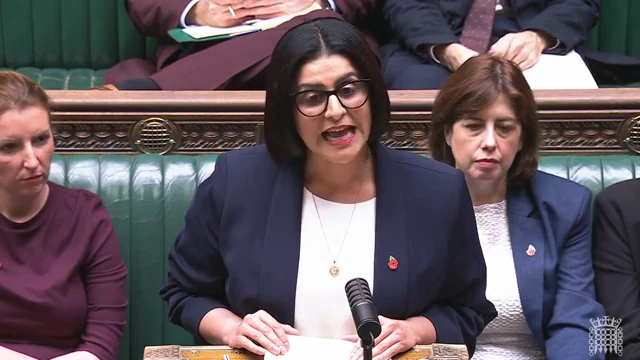
Shabana Mahmood’s Care Visa Climbdown and the £10bn Bill…
She made the right call on the people. These workers kept their side of a bargain the British state offered them. Moving the goalposts years after they arrived would have been shameful, and this paper says so plainly.
But the decision deals with the workers and leaves the business model untouched. That’s why the public is paying again, and in more ways than one.
We pay at the front door. Families sell homes to meet fees that rise faster than pensions, and in doing so subsidise the council-funded residents next door. Councils pay from council tax and grants. In just three English regions, the North East, South Yorkshire and the West Midlands, private care providers took £256 million in profit between 2021 and 2024, including £45 million in dividends and £33.6 million in interest. Up to 60 per cent of that interest went to private equity and tax-haven owners.
We pay for the clean-up. Under Monday’s plan, the state will help workers abandoned by rogue sponsors find “a legitimate provider”, and run the extra visas and checks needed to do it. The private failure is tidied up at public expense.
And we pay at the end. The Home Office’s own £9.5 billion figure, which the Tories are waving about, is not the cost of Monday’s decision. The UK Statistics Authority has confirmed it is the lifetime cost of this group settling under the existing rules. Most of it is the pension and NHS care of people who spent their working lives on the legal minimum wage. It isn’t the price of migration. It’s the price of poverty pay, collected decades after the owners banked the savings.
Against all that, the government has promised a Fair Pay Agreement backed by £500 million in 2028/29. Spread across the workforce, analysts estimate it comes to roughly 20p an hour. One American property trust spent ten times that on a single British care chain.
Look at who is asked to give something up. The workers wait for their settlement. Families pay their fees. Councils make cuts. The owners give up nothing: no clawback from failed sponsors, no levy on extraction, no duty even to say where the money goes.
This is the model, and care homes are only the end of it. The post-war settlement promised the working class security from the cradle to the grave. The market has kept the phrase and changed its meaning. Nine of the ten largest childcare providers are now backed by private equity. The competition watchdog has warned that the companies running children’s homes are carrying heavy debts while charging councils high fees. At the other end of life, the same financial engineering runs through the care home. From the nursery to the deathbed, every stage at which a human being needs looking after has been turned into a revenue stream, and every vulnerable person into a yield.
Somehow we must find a way of taking the care of people back out of the market, and of saying that some things are not for sale: the raising of a child, the comfort of the dying, and the dignity of the people who do that work. That isn’t sentiment. It’s a choice about who owns the places where we begin and end our lives, and it can be made again.
Public Ownership Is Cheaper: The Case Stated
The defenders of the market will say private capital built the beds when councils couldn’t, and that many small family-run homes operate honestly on thin margins. Both points are true, and neither answers the charge. Private capital came because the state was forbidden to build. Private equity borrows at interest rates far above what the state pays on its own debt, then charges the public for the difference. Public ownership isn’t nostalgia. It’s cheaper.
So start where the case is strongest. When an operator fails or is caught extracting, its homes should pass to councils or to not-for-profit ownership, not to the next fund in line. Councils should be given back the capital to build and run homes of their own. Any provider taking public money should open its books, and related-party loans charged against care beds should be outlawed. And caring should be paid as the profession it is, with a national pay scale that rewards experience and training paid for by the state. If we call it a vocation, we should pay it like one.
We built council homes and a national health service when this country was poorer than it is now. Looking after the generation whose shoulders we stand on is not too hard for us. We simply sold it.
We let the market take our care homes and then imported the people to work them. Now the carers stay, the owners walk away, and the bill comes home to us.
Enjoyed this read? I’m committed to keeping this space 100% ad-free so you can enjoy a clean, focused reading experience. Crafting these articles takes a significant amount of research and heart. If you found this helpful, please consider a “small donation” via PayPal or GoCardless to help keep the lights on and the content flowing. Every bit of support makes a huge difference.

Support The Tribune
INDEPENDENT. READER-FUNDED. AD-FREE.
If you value this article, help keep The Heartlands Tribune publishing independent journalism without intrusive advertising or corporate sponsors.
Choose your monthly amount
Secure payment via GoCardless