The EU crisis of 2026 has brought protests, budget deadlock and a fierce argument over rearmament. As European workers challenge cuts, Westminster looks to Brussels for defence deals and political direction.
2026 EU in Crisis: Brussels Rearms, Britain Wants In
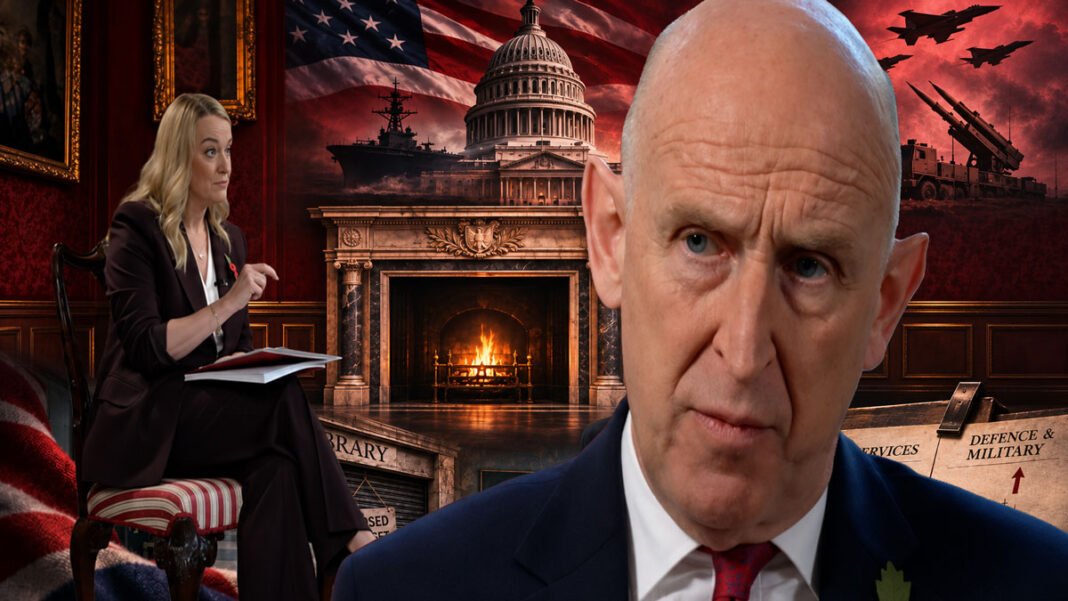
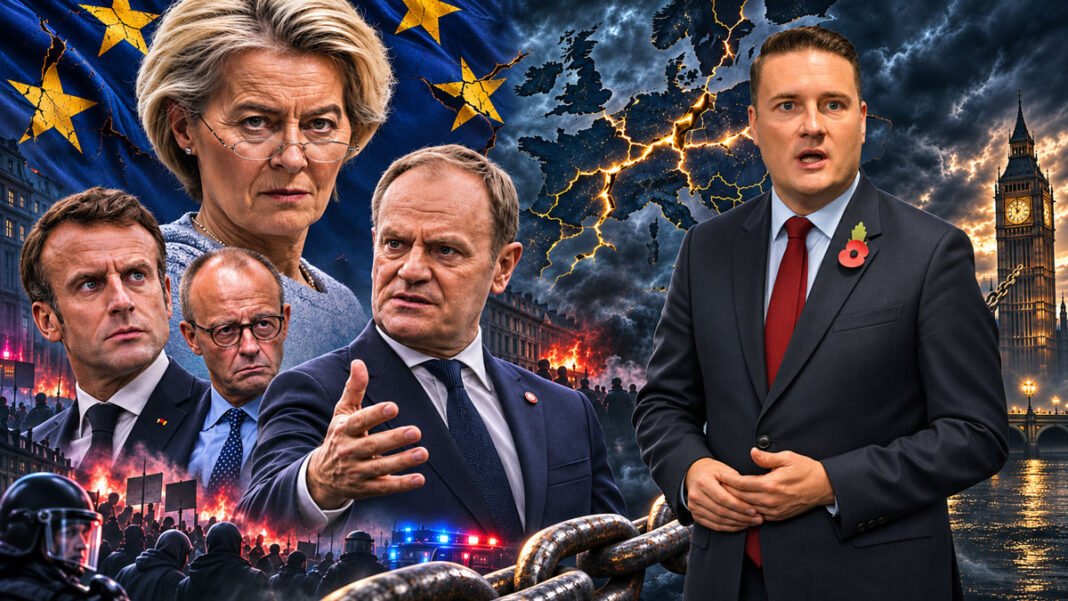
On Monday morning, two scenes played out across the same city. At the Royal Palace in Brussels, Belgium’s Prime Minister, Bart De Wever, handed King Philippe his resignation because his five-party coalition could not agree how to balance the books. Across town, at the glass-and-steel headquarters of the European Union, Britain’s Defence Secretary, Wes Streeting, was making his first official visit, talking up “deepening security and defence cooperation” ahead of a UK-EU summit on 20 November.
One government was buckling under the weight of the European fiscal order. The other had come to knock on its door.
Look across the English Channel this autumn, and you will not see the orderly, rational commonwealth that British liberal orthodoxy has spent half a century worshipping. You will see an empire of technocrats coming apart at the joints.
It began, as so much does in France, in the schools. When term opened in September, sixth-formers walked out of lycées that had too few teachers and too little of everything else, just as the government laid out tens of billions in fresh spending cuts. By early October, their union said some 1,800 high schools were blockaded or shut for the day. Then the anger spread beyond the school gates. Trade unionists of the CGT joined in, and so did a revived gilets jaunes movement furious at fuel prices. On 17 October more than half a million people marched and France saw some of its worst rioting in years; on Saturday came a third weekend of protest.
In Germany, once hailed as the unshakeable engine of the Continent, a youth movement calling itself Gen Z regelt marched the same Saturday in 34 cities, demanding money for schools and homes, protesting against budget cuts and rising defence spending, and refusing any return of conscription. By nightfall, shops were being looted in Frankfurt, the city that houses the European Central Bank. The day before, Italy came to a halt for its second general strike in a month, as workers and students marched for higher wages and public services and against military spending.
Nor does it stop there. In Spain the fury is over housing, and it has spilled across the border into Portugal, where police broke up a protest camp in Lisbon and arrested dozens. In Athens, students pitched tents in Syntagma Square over the cost of rooms they cannot afford, and teachers and pupils marched on parliament chanting that from Greece to France they wanted public, free education. Belgian students have rallied in Brussels and Liège over crumbling schools; in Vienna, thousands marched against cuts to the universities. This is not one country’s bad autumn. It is a continent’s young people discovering, all at once, that the system has nothing left to offer them.
Different countries, different triggers, the same complaint. Prices rise, schools decay, services fall, and governments announce that there is no money.
Yet these are the same governments that, at The Hague in June 2025, signed up to Donald Trump’s demand that NATO members spend 5 per cent of national output on defence and security by 2035: 3.5 per cent on the military itself and 1.5 per cent on everything around it. Spain’s Pedro Sánchez alone dug in, calling the target unreasonable and counterproductive, and secured wording he says lets Madrid spend far less; Trump threatened him with tariffs. Britain signed without a murmur.
Trump hailed the pledge as a monumental win, and for the arms industry it was. The leaders who lecture their own people about sovereignty let their defence budgets be set in Washington, and the bill was sent to the classroom. Europe is not at war. Its schools are being made to pay as though it were.
POLAND: WHO RULES?
Then there is Poland, where the crisis has stopped being a matter of budgets and become a matter of who rules.
Last Thursday, Jarosław Kaczyński, leader of the opposition Law and Justice party, gave a speech about Poland’s future terms with Brussels. Within hours Donald Tusk had told the country that Kaczyński wanted to lead Poland out of the European Union, and that next year’s election would decide whether Poland stays or goes. Kaczyński insists he wants to reform the Union, not leave it. The next day, the police arrived at the Constitutional Tribunal, and the words coup d’état echoed across the air.
A judge elected by Tusk’s parliamentary majority suspended the tribunal’s PiS-appointed president and his deputy, and riot police sealed the building. President Karol Nawrocki turned his plane round on the way to Senegal, flew back to Warsaw and pushed his way inside in the small hours. The ousted president of the court called it a coup d’état. So did Kaczyński, who stood outside and urged his supporters to topple Tusk. Night after night since, crowds have faced lines of police on Szucha Avenue, with rosaries hanging from the fence.
Tusk’s reply, delivered in a televised address to the nation, was that the court PiS built had never been a genuine court, that no politician may enter a courtroom to give orders to judges, and that the campaign against him enjoyed the support of pro-Russian forces. He had a point of sorts: Dmitry Medvedev had obligingly declared that Tusk’s liberals were “protected by Brussels”.
And Brussels? The European Commission, which spent years freezing Poland’s money over PiS’s capture of the judiciary, said it was following events closely. Then it reminded everyone that appointing the new judges lies within the powers of the Polish parliament, and that the tribunal must respect the case law of the EU’s own Court of Justice. Police around a constitutional court drew no such reminder.
None of this makes Kaczyński a democrat. His party spent eight years bending the tribunal to its will; PiS taught Poland that the constitutional court was a prize to be captured. But that is exactly the point. Marcin Matczak, a liberal law professor and no friend of PiS, has warned that a future government could now point to these scenes as proof that sending police into the constitutional court is an acceptable way to settle a legal argument. A rule of law enforced by riot police, and applauded from Brussels when the approved side wins, is not the rule of law. It is the rule of the winning faction, with a European stamp on it.
Older readers will hear an echo. In the autumn of 1993, Boris Yeltsin, the West’s favourite democrat, found Russia’s Constitutional Court ruling against him. When the shooting in Moscow was over, he suspended the court, and Western governments stood by their reformer. Warsaw is not Moscow; there are no tanks and no dead. But the shape is familiar: an executive that has decided a court is an obstacle, a foreign patron that has decided the executive is on the right side of history, and a population told that the forcible solution is the democratic one.
Poland is also where the politics and the money meet. It took the largest single share of the EU’s new SAFE defence-loan scheme, almost €44 billion. In March, Nawrocki vetoed the law to implement it, arguing that it would load decades of debt onto Poles and give Brussels a hand in Polish defence. Tusk simply routed around the veto, and the first billions arrived in May. Whatever one thinks of Nawrocki, he asked the question most European leaders will not: who is this rearmament really for?
BREAD, AND GUNS
Which brings us back to Brussels, where the machinery has seized up on its own doorstep. De Wever’s government wants €10 billion of savings by 2029 to bring down a deficit running above five per cent of national output. Its plan leans mainly on cuts to public spending, healthcare included, topped up with a rise in VAT. The talks broke down over the VAT rise, which the French-speaking liberals of the MR refused to accept. On the reported account, the cuts to healthcare were not what stopped the talks. The argument was over which regressive measure the public would be made to swallow, while the unions, who have been mobilising against austerity for months, waited outside. And in October, the same government banked the first €1.2 billion of an €8.34 billion EU loan for weapons.
Eurostat’s own figures show the sickness is structural: eleven member states ran deficits at or above the bloc’s sacred 3 per cent ceiling in 2025, with Romania, Poland, Belgium and France the worst. When the books fail to balance, the response from the European ruling class is always identical: the working class is handed the bill.
Here is the heart of it. Europe’s rulers have discovered that there is money after all, but only for one thing. Alongside the Hague pledge sits the Commission’s own plan, unveiled in March 2025, to mobilise up to €800 billion for defence, including €150 billion in SAFE loans. Brussels relaxed its own fiscal rules so that extra military spending would not count against governments the way spending on hospitals and schools does. In October, EU leaders told the Commission to find a further €70 billion for Ukraine in 2027 and began pressing Britain, Canada and Japan to help. The beneficiaries are not hard to find. Rheinmetall, Germany’s largest arms maker, reported an operating profit of €1.84 billion last year and a record order backlog of almost €64 billion.
We are told that none of this may be questioned, because of Russia. But a continent that can find €800 billion for arms, yet cannot find €10 billion for Belgian healthcare without a government offering its resignation, has made a choice, and it is not a choice about Russia. Rearmament has become the only industrial policy Brussels permits itself: public money channelled to private arms makers and their shareholders, exempted from the austerity imposed on everything else. Guns for the shareholders, cuts for everyone else. The young Germans who marched against conscription and the Italian strikers who marched against military spending understand this perfectly well.
“A rule of law enforced by riot police, and applauded from Brussels when the approved side wins, is not the rule of law.”
Fairness demands the counterargument be stated plainly. Not every national grievance from Paris to Warsaw can be laid at the door of the Berlaymont. The European Union is an established geopolitical reality that will not vanish overnight. Nor should any serious socialist pretend that leaving the bloc came without real trade friction, supply chain disruption, and administrative burdens. There remain sensible, practical reasons to trade closely, cooperate across borders, and share scientific research with our European neighbours.
Yet trade does not require political vassalage, and the economic costs of our departure do not absolve the European project of its fatal flaw. The European Union was never an internationalist project for the working class; it was an enclosure of democracy. It steadily moved crucial levers of economic power out of the reach of sovereign electorates and lodged them with unelected commissioners and remote courtrooms. Poland shows where that road ends: a national constitutional court whose legitimacy is now measured against the rulings of Luxembourg. The Union adopted a flag, an anthem, and an institutional vanity, constructing an aggressive supranational nationalism while congratulating itself on having abolished nations altogether.
WESTMINSTER AT THE DOOR

Which makes this morning’s visit so telling. Streeting went to Brussels, by the Financial Times’s account, partly to press for British arms firms to share in Europe’s procurement boom. The government will say this is cooperation, not membership, and on the narrow facts that is true. But it tells you everything about the limits of Westminster’s imagination that the one European project it is eager to join is the arms bazaar. Behind the ministers stands an entire class of comfortable British politicians and commentators who look at this gathering continental crisis and conclude that our greatest mistake was walking away from the fire. They watch our own governments fail to build homes, fail to invest in industry, and fail to rebuild our public sector, and their only instinct is to plead for Brussels to govern us again.
Britain’s own Chief of the General Staff has told the country that its citizens “have got to consent to sacrifices to prioritise defence and security”. He did not say which sacrifices. He did not need to. The schools of France and Belgium have already shown us.
What a wretched poverty of political imagination.
The real issue rests within this paragraph: “We do not lack the money to rebuild this country. We lack politicians with the vision and the political will to do it. They would sooner outsource their responsibilities to the EU than exercise the democratic authority entrusted to them by the British people.”
Britain urgently needs massive industrial renewal, water and railways returned to public ownership, decent municipal housing, and wages that allow families to live with dignity. If it spends more on defence, that money should defend these islands, not buy a seat at someone else’s procurement table. Not a single one of those policies requires the permission of Brussels. The refusal of our domestic political class to exercise sovereign democratic power is an indictment of Westminster, not an argument for handing that power back. We did not throw off one unaccountable bureaucracy merely to crawl back into its arms because our own leaders lack the nerve to govern.
A country that cannot find politicians willing to wield its democracy does not need less democracy; it needs better politicians.
Enjoyed this read? I’m committed to keeping this space 100% ad-free so you can enjoy a clean, focused reading experience. Crafting these articles takes a significant amount of research and heart. If you found this helpful, please consider a “small donation” via PayPal or GoCardless to help keep the lights on and the content flowing. Every bit of support makes a huge difference.

Support The Tribune
INDEPENDENT. READER-FUNDED. AD-FREE.
If you value this article, help keep The Heartlands Tribune publishing independent journalism without intrusive advertising or corporate sponsors.
Choose your monthly amount
Secure payment via GoCardless