Seventeen Million Bots…
Russian bots, the Brexit referendum and a Prime Minister’s disputed claim have revived an old political habit: blaming foreign interference rather than confronting why 17.4 million people voted Leave.
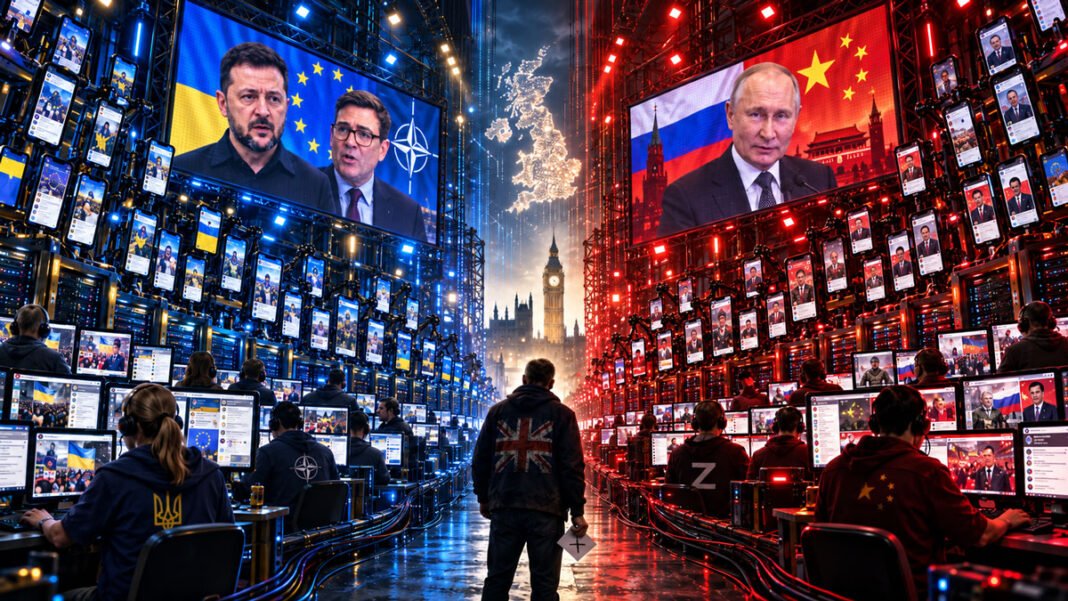
Earlier this month, Volodymyr Zelenskyy told the Warsaw Security Forum that Ukrainian strikes on the data centres of the Russian technology company Yandex had made the internet a calmer place. Fewer bots, he said, and so less hate and fewer provocations. The story travelled at the speed of wish fulfilment. A Polish political scientist posted that support for the AfD online had collapsed by 56 per cent. A Czech politician observed that German patriotism had gone quiet the moment the Russian connection went down. Millions of people saw it. It felt like the first good news in a decade of bad news about the internet.
It was not true… The traffic that fell was web crawler traffic, the automated indexing that keeps search engines fed, and Cloudflare’s own public data showed exactly that. The researchers who actually track Kremlin information operations said so at once. Antibot4Navalny reported no drop in the activity of the Russian troll networks it has monitored for years. The Vatnik Soup account said plainly that nobody had demonstrated any effect with solid data. A Scandinavian consultancy, Common Consultancy, took 76 AfD politicians and 136 MAGA accounts and compared each post against that account’s own normal for the same weekday and hour. The variation was a few percentage points either way. Ordinary noise.
Renée DiResta of Georgetown University explained to Mother Jones why the fiction flew. A strike that silences the fakes is a victory over a shared enemy, and it feeds a far more comfortable belief: that your political enemies aren’t even real. Hold that sentence. It explains almost everything that happened in British politics this week, and a good deal of what has happened to our public argument over the last ten years.
Burnham’s Brexit Russia Claim and His Commons Retreat
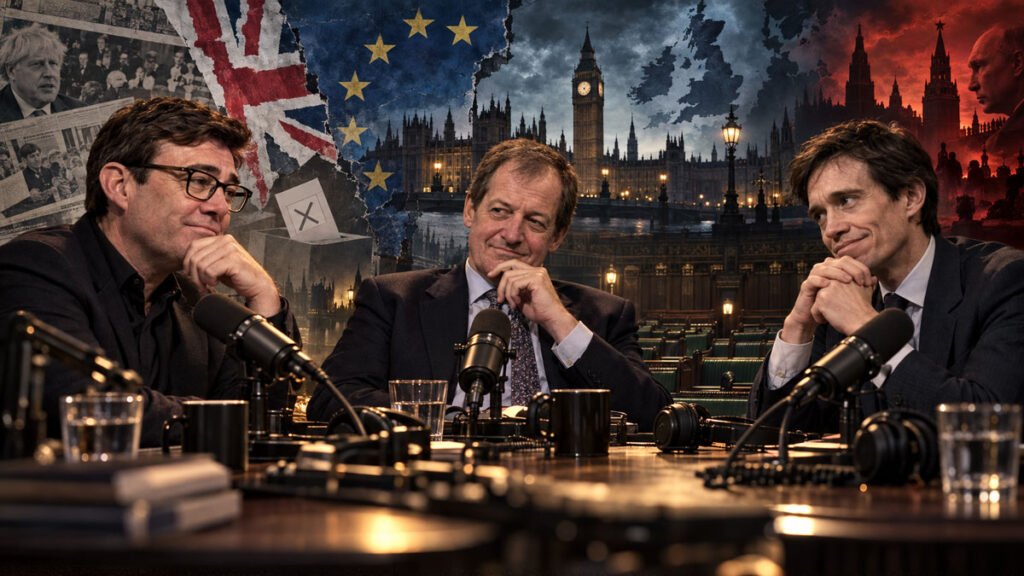
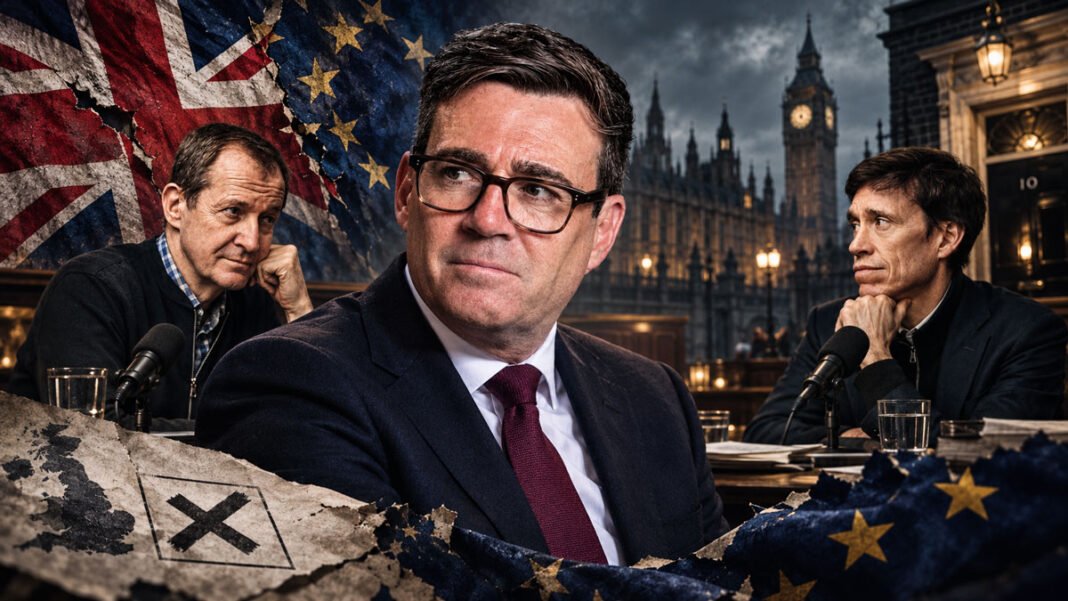
On Sunday, in an interview with Alastair Campbell and Rory Stewart for The Rest Is Politics, Andy Burnham became the first serving Prime Minister to say that Russia interfered in the 2016 referendum. He had asked the question on arriving in Downing Street in July, he said, and had been given the clear answer that yes, there was. He named nobody. He cited no assessment, no document, no date, no finding. He added that it mattered to put this on the record so that voters in France and Germany would understand that some of their politics is instigated by our enemies, a remark that follows his meeting in Berlin with Friedrich Merz about the AfD.
By Monday morning the government was reversing at speed. The Foreign Office minister Stephen Doughty spent a round of broadcast interviews avoiding the question before conceding the only thing that mattered: nothing Russia attempted had succeeded. The Prime Minister’s own spokesman told reporters it was inconceivable that Moscow had not tried to turn the referendum to its advantage, agreed that it had not worked, and stressed that Burnham accepts the result. Nigel Farage, at a press conference in Dover, called the Prime Minister a liar. Boris Johnson surfaced to say he had asked the same question as Foreign Secretary and been told there was no evidence of any successful interference.
Then came the Commons. Kemi Badenoch asked Burnham to publish the evidence that Russia swung the result of the 2016 referendum, reminding the House that the head of MI5 had said in 2018 he had seen nothing to show Russia influenced the outcome. The Prime Minister replied that he had implied no such thing, told her to go back and look again, said he was not reopening the referendum and respected the result, and moved the conversation on to Russian activity around the 2019 general election.
Thirty hours. That is the whole life cycle, from revelation to disavowal. And the disavowal is the tell. A Prime Minister who believed he held intelligence that a hostile state had corrupted the largest democratic exercise in British history would not retreat from it under questioning from Kemi Badenoch. He would publish. He did not publish because there is nothing to publish, and he knew that when he said it.
Russian Bots and Brexit: The 17.4 Million Voters Smeared

Strip away the theatre and almost everyone in this row agrees on the facts. Russia runs influence operations against this country. It did so in 2016, as it does every year, because that is what it does. Because that is what we do and that is what they all do…
Burnham’s own speech to the UN General Assembly on 22 September set out the government’s case in more detail than anything he has said since: bots, fake websites, falsified newspaper articles, the forged branding of 28 British institutions including universities and the BBC, far right narratives amplified from abroad, and evidence of attempted interference in the 2019 election. None of that is in dispute between the front benches.
What is in dispute is a single adverb. In Moscow in December 2017, standing beside Sergei Lavrov as the Russian Foreign Minister claimed Britain had conceded there was no interference, Johnson cut in with two words: not successfully. That has been the official British position ever since, under four prime ministers. Burnham has not contradicted it. He simply dropped the adverb on a podcast, let the louder version run for a day, and picked it back up at the despatch box.
“YOU’RE A RUSSIAN BOT”
Russian Bots: When Political Dissent Becomes Propaganda
Here is why that one dropped adverb matters more than a Westminster scuffle, and why this publication is not prepared to treat it as a gaffe. The remainers were fed their line, and they are using it.
Whatever the Prime Minister did or did not imply, the formulation he reached for has a life of its own out in the country, and it has had for years. It is no longer an allegation about foreign intelligence services. It is the cheapest available method of refusing an argument.
Question the wisdom of arming one more war and you are a Russian bot. Say the quiet thing about energy prices, about NATO expansion, about why the yards closed, about why your town has three vape shops and no bank, and somebody will tell you which troll farm you work for.
The accusation requires no evidence and survives any amount of contradiction, because it is not really a claim about the world. It is a permission slip. It allows a person to feel they have won an exchange they never entered.
“If every criticism of government policy can be dismissed as propaganda from a Russian Bot.
Those in power have found themselves a very convenient escape from accountability.“
The irony, which the political class never quite reaches, is how much of this is done by people who imagine themselves the defenders of truth. They are not countering astroturf. They are producing it. And there are a great many people on this side of the propaganda line who have found that withdrawal extremely comfortable.
We know this is not theoretical, because the British state has done it and been caught. In April 2018, after Salisbury and after Douma, Whitehall briefed the press that there had been a 4,000 per cent rise in Russian bot activity. Newspapers ran the figure and named accounts. One of them, @Ian56789, turned out to belong to Ian Shilling, a man in Yorkshire with a borrowed photograph for an avatar and strong opinions about chemical weapons, several of them wrong and some of them actively Kremlin friendly.
He went on Sky News and said so himself. Another named account, @Partisangirl, was verified by Twitter as a real identity, and its owner posted a video stating that she was not a robot but a human being. Channel 4’s FactCheck went through the claims and found the accounts had been wrongly labelled; government sources then conceded that their analysts had been monitoring a broad range of accounts, not merely automated ones. Say what you like about the views of either person, and this publication would say a good deal.
They were British civilians, and the state told the national press they were machines operated by Moscow.

That same year brought the Integrity Initiative. The Institute for Statecraft, a charity working out of a mill in Fife, was found through leaked documents to have received around £2.2 million from the Foreign Office to counter Russian disinformation, while its associated Twitter account circulated material attacking the leader of the Opposition, including the charge that Jeremy Corbyn was a useful idiot for the Kremlin.
The then Foreign Office minister Sir Alan Duncan ordered an investigation on the Today programme. Chris Williamson, then a Labour MP, called for a public inquiry. There never was one. Public money, routed through a charity, aimed at domestic politics, under the banner of defending us from exactly that.

None of this means Russian operations are imaginary. It means the label has never been applied carefully, and that the people with the most power to apply it have the least incentive to be careful. Researchers at Indiana University found in 2023 that people routinely overestimate how many bots there are and believe everyone else is more gullible than they are, and that the word had become a way of dismissing accounts holding opposing views. We are now watching that habit scaled up from a timeline to a country, with a Prime Minister doing the labelling.
“The Party told you to reject the evidence of your eyes and ears. It was their final, most essential command.”
― George Orwell, 1984
Orwell understood the mechanism exactly, and put it in Winston Smith’s mouth in 1984. The Party’s demand was not that you believe a particular falsehood. It was that you reject what your own eyes and ears had told you. It was their final, most essential command. Set that beside a man in Leigh being informed that his vote was a Russian output, or a man in Yorkshire reading in the national press that he is a machine, and the distance between the fiction and the practice is not as great as we would like.
The 2020 Russia Report and the Inquiry Britain Never Had

There is a genuine outrage buried in this story, and it is not the one either front bench is shouting about.
In July 2020, Parliament’s Intelligence and Security Committee published its Russia report. Its central finding was not that Russia swung the referendum. It was that no British government had ever bothered to find out. No assessment of Russian attempts to interfere in the 2016 campaign was ever commissioned. When the committee asked MI5 for written evidence on the question, it received six lines. The report was completed in March 2019, handed to Johnson that October, and kept from the public until after the general election. The absence of evidence had been manufactured by a refusal to look.
Two governments, one shared interest in not knowing.
Six years on, nothing has changed except the party in office. Johnson would not look because the answer might have embarrassed him. Burnham will not publish because vagueness suits him better than any finding could. If the Prime Minister truly received a clear answer in July, a document exists, and the Intelligence and Security Committee exists precisely to see it. Send it. Let them report to Parliament. Anything less is not candour about the last decade, it is the management of an impression.
How the Russian Bot Narrative Dismisses Leave Voters: But that’s the Aim
This publication campaigned to leave the European Union, and did so from the left. Not from Moscow, and not from Mississippi. From the Bennite argument that those who make the laws must be removable by those who live under them, and that a treaty structure locking in competition policy, state aid rules and the free movement of capital is not a neutral referee but a constitution for neoliberalism. That case was made here for forty years, by Benn, by Shore, by Castle, by Skinner, in pit villages and union halls, long before anyone in St Petersburg had a troll farm.
So when a Labour Prime Minister suggests the referendum was shaped by hostile foreign actors, he is not only insulting 17.4 million people. He is telling his own party something far more dangerous, which is that it need not account for why it lost them.
If Leigh and Grimsby and Stoke voted as they did because of bots, there is no reckoning to be had over Iraq, over the pits, over the yards, over thirteen years in office that left wages flat and the heartlands hollow. If Reform’s rise is a Kremlin operation rather than a bill coming due, nobody in Labour has to read the bill.
The timing is not subtle either. This arrives as the Prime Minister prepares a difficult argument for closer alignment with Brussels, a month after he mused that Britain could one day consider rejoining, while Emily Thornberry floats the idea that a manifesto line could do the work of a second referendum. If the vote was tainted, the vote is lighter. Nobody has to say the result was illegitimate. The impression does the work, and the retraction keeps the fingerprints clean.
QUANTIFY IT
Set the question of whether Russia tried to one side, and grant the Prime Minister everything he implied. Then answer the question that follows at once. How much?
Influence has never been a quantity anyone has learned to measure. There is no unit for it, no baseline to measure against, and no way of separating a mind changed by a foreign account from a mind changed by a neighbour, a newspaper, a closed factory or thirty years of being ignored. The researchers who do this work for a living are candid about it. That is why Common Consultancy had to build a control from each account’s own posting history before it could say anything at all about the AfD, and why the honest finding was that nothing measurable had happened.
Then look at who actually decided it. Lord Ashcroft’s referendum-day polling found 73 per cent of 18 to 24 year olds voting Remain, a majority of every age group over 45 voting Leave, and 60 per cent of the over-65s. The vote was carried by the oldest cohort in the country. These were people who had been arguing about Europe since the 1975 referendum, through Maastricht, through the ERM, through the Lisbon Treaty that no one was permitted to vote on. Their position was thirty years in the making, and they were the group least present on the platform where the troll farms are said to live. The suggestion is that a reply from a fake account changed minds that four decades of British politics had failed to change.
Suppose, though, that it could be counted, and the answer came back at three per cent, or half of one. What then? There is no mechanism in British law that subtracts foreign influence from a result. The only coherent remedy is to annul the vote and hold it again, which is precisely the thing that nobody who raises this will say out loud. The claim is not made in order to be acted upon. It is made in order to hang there.
And when a case does come with the receipts attached, the picture is not the one Westminster expects. In October 2020, Twitter under its former ownership blocked the New York Post’s story about Hunter Biden’s laptop, locked the newspaper’s account and stopped the link being shared in private messages. Jack Dorsey later accepted the decision was wrong. The internal exchanges published as the Twitter Files showed staff could find no evidence the material had been hacked, which was the stated ground for suppressing it. Fifty-one former intelligence officials signed a letter saying the affair carried the marks of a Russian information operation. Michael Morell, the former acting CIA director who organised that letter, later told the House Judiciary Committee that the idea had been prompted by Antony Blinken, then an adviser to the Biden campaign. The material was authentic. The Russian operation was the letter.
That is as documented as information control ever gets: named people, dated emails, a public apology. And still nobody can tell you what it was worth in votes. Not its authors, not its critics, not this paper. If the best evidenced case of suppression in the social media era cannot be converted into a margin, the ghost in the 2016 machine certainly cannot.
Influence is the one charge that can never be disproved. That is exactly why it appeals to people who have lost an argument.
WHAT FOLLOWS THE STORY

At the UN, Burnham announced a National Centre for Information Defence, a new state body to counter hostile information attacks. Be clear about the sequence. An unevidenced claim about the last referendum, abandoned by its author within two days, forms part of the public case for permanent machinery to police the information space before the next one. Nobody has explained who decides what counts as a hostile narrative, who audits that judgement, or what happens when the people being defended from disinformation turn out to be the people the government finds inconvenient. Ask Ian Shilling. Ask the Institute for Statecraft. Those are not technical questions. They are the whole question.
Russia does real harm to this country, and a serious government would fight it with published evidence, named findings and institutions that can be held to account. Burnham had that chance on Sunday. Instead he offered a rumour with a red box around it, and when the country asked to see the working, he told Parliament he had never meant it.
Publish the assessment or withdraw the claim. Send it to the Intelligence and Security Committee, where it belongs, and let them tell Parliament what the security services actually said in July. Until then this was not a revelation about Moscow. It was an alibi for Westminster, and a licence for every lazy partisan in the country to answer an argument they cannot win by telling a working man he does not exist.
They would sooner you believe that the heartlands were hacked than admit that they were abandoned.
Enjoyed this read? I’m committed to keeping this space 100% ad-free so you can enjoy a clean, focused reading experience. Crafting these articles takes a significant amount of research and heart. If you found this helpful, please consider a “small donation” via PayPal or GoCardless to help keep the lights on and the content flowing. Every bit of support makes a huge difference.

Support The Tribune
INDEPENDENT. READER-FUNDED. AD-FREE.
If you value this article, help keep The Heartlands Tribune publishing independent journalism without intrusive advertising or corporate sponsors.
Choose your monthly amount
Secure payment via GoCardless