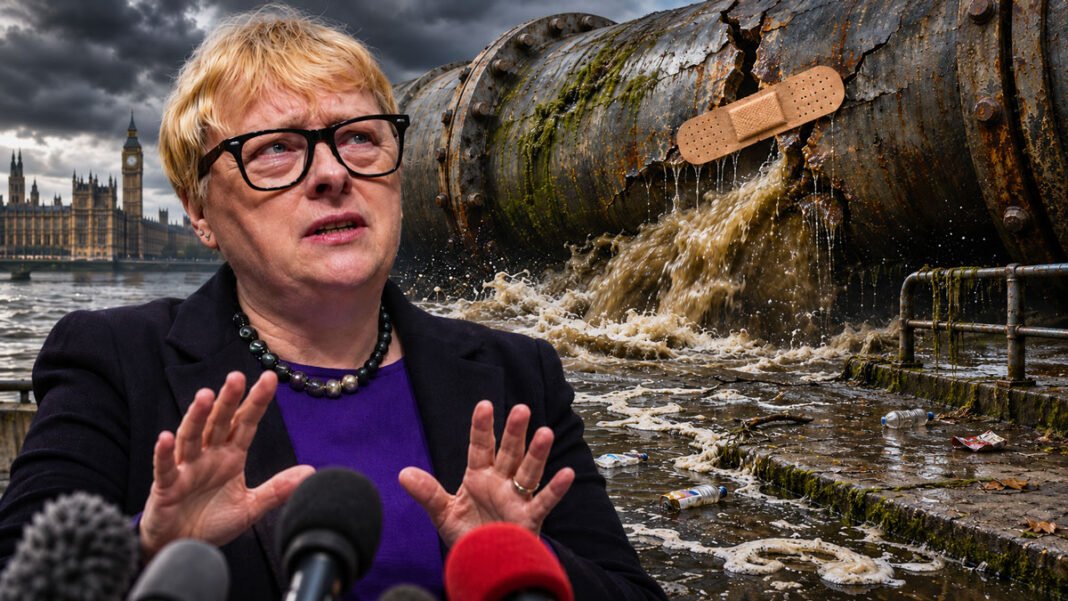
Labour admits privatised water has failed. Its answer is eight regional water councils with no legal basis, no opening date and no powers the Environment Secretary could name.
A Sticking Plaster on the Sewage Pipe
Thursday morning on Times Radio, Stig Abell asked Angela Eagle the question every bill-payer in England wanted answered. What new powers would her eight regional water councils have to hold the water companies to account?
The councils, she said, would “hold to account water companies for their prioritisation and their investment decisions.” Abell asked whether they could fine a company or sack a chief executive. “Well, there’ll be a whole range of other issues as well,” she replied, “which will hold companies to account and come up with other ways of holding them to account for their performance as well.” He asked what they were. “I think you’ll have to wait to see the Water Bill when we publish it.” When he pressed again, she said: “I’m not publishing the Water Bill this morning.”
This was the government’s main announcement of the day, and the minister fronting it could not describe a single thing it would let anyone do.
The clip that went round afterwards was a different one. Abell asked whether closer alignment with the EU might mean banning smoky bacon crisps. Eagle said: “Oh Stig, I mean really we’ve had EU straight bananas and now we’re talking about banning smoky bacon crisps. I think you should get a life.” His co-presenter Kate McCann wrote that she had never heard an interview like it.
The crisps question was less silly than it sounded: Britain is negotiating to follow EU food law as Brussels writes it, and Brussels has banned eight smoke flavourings. A Europhile that has no idea about the EU is common practice, but the real damage had been done ten minutes earlier, when a cabinet minister with a press release in front of her could not explain it.
Eight Councils, Fifteen People, No Legal Basis
She announced eight regional water councils. Asked what they could do, she said: “I’m not publishing the Water Bill this morning.”
The government’s own words don’t help her. The eight councils will bring together up to fifteen people each, from mayors and council leaders to farmers, customers and business, to “set the priorities for their region” and draw up a plan. Local leaders have until the end of the year to propose how the councils should even be run. There is no opening date and no legal basis. The only powers mentioned are new powers for mayors, not for the councils, and those are promised in a Water Bill nobody has seen. Richard Benwell of Wildlife and Countryside Link, one of the scheme’s supporters, still warned that the councils “must have the powers and funding to deliver.” Even its friends are asking where the teeth are.
So the public is being offered a body that can set priorities for companies with no obligation to meet them.
“On Thursday, the councils’ strongest power was the right to draw up a plan.”
Eagle Admits Privatisation Failed. Then Offers a Committee

What makes this worse is that the government understands exactly what has gone wrong. Between the evasions, Eagle said so herself: “People are angry because water companies and the whole privatised system has failed them. And it’s failed our rivers as well.” Under privatisation, she said, customers had “no influence whatsoever” and were “just seen as people to pay bills.”
That is a cabinet minister confirming, thirty-seven years on, what this paper and millions of households have known for a long time. Margaret Thatcher sold the regional water authorities in 1989, cleared their debts and threw in a cash “green dowry” from the public purse to tempt the City in. What followed is still flowing into the rivers.
Andy Burnham’s explanation in the press release is that “decisions about their local areas are taken miles away.” It’s an odd complaint from a government that is negotiating to take Britain’s food law from Brussels, where no British voter has a say. On water, though, the government’s own examples point the other way. The sewage damaging Windermere is not discharged because someone in Whitehall cannot find the Lake District on a map. It is discharged by a company run for its shareholders, which has had every chance to spend the money and chose not to. The problem is not that decisions are too far from home. It is that they are made by the wrong people, for the wrong reasons. A committee in Kendal won’t change that, any more than a committee in London did.
This is the sticking plaster. The wound is private ownership of a natural monopoly. The plaster is a public meeting where angry residents can tell United Utilities what they want while United Utilities keeps the right to say no. Meanwhile, Ofwat, which this government has condemned and promised to abolish, carries on regulating until its replacement exists. Communities get a voice, the regulator is on its way out, and the companies keep every power that matters.
Water Nationalisation: Permission Is Not Ownership
In Liverpool in September, Burnham promised to repeal what he called “Margaret Thatcher’s ideological ban on public ownership of water companies”, the Water Act 1989’s limits on how many shares government can hold. Eagle told the same conference that “the priorities of people in our communities, not shareholders of water companies” would now decide where the investment goes. Five weeks later “decide” had become “a voice to begin with.”
Repealing the ban is worth doing. But it only gives the state permission; it doesn’t bring anything back into public hands. In June, as a by-election candidate in Makerfield, Burnham said public ownership of Thames Water “is what should be done.” Thames is still in its creditors’ hands, and the government already has the tool it needs. The special administration regime in the Water Industry Act 1991 lets the Secretary of State put a failing water company under public control. No new bill is needed to use it.
Water falls as rain on all of us, gathers in shared rivers and comes through every tap in the country. Nobody can switch supplier when their river is full of sewage. The same reasoning applies to the gas under the North Sea, the wind off our coasts and the grid that carries both. These are common resources and natural monopolies, and handing them to private owners means accepting that something everyone depends on will be run for somebody else’s profit. The working class has paid for that arrangement with every bill since 1989.
Thames Water Special Administration: What Should Happen Now
The demand on the Environment Secretary is simple. Put Thames Water into special administration and keep it in public hands, not as a waiting room before it is sold back to the market. Publish the Water Bill, and make public ownership the destination rather than a theoretical option. If the councils are to exist at all, give them powers in law: to block bonuses, to stop dividends while pollution targets are missed, and to require ministers to consider special administration for a failing company. Then answer, in Parliament, the question she could not answer on Thursday: what can these councils make a water company do?
You don’t put a plaster on a burst sewer and call it repaired. You dig it up and replace it. Until this government is willing to take water back, its councils will be eight more places to complain about the smell.
Enjoyed this read? I’m committed to keeping this space 100% ad-free so you can enjoy a clean, focused reading experience. Crafting these articles takes a significant amount of research and heart. If you found this helpful, please consider a “small donation” via PayPal or GoCardless to help keep the lights on and the content flowing. Every bit of support makes a huge difference.

Support The Tribune
INDEPENDENT. READER-FUNDED. AD-FREE.
If you value this article, help keep The Heartlands Tribune publishing independent journalism without intrusive advertising or corporate sponsors.
Choose your monthly amount
Secure payment via GoCardless