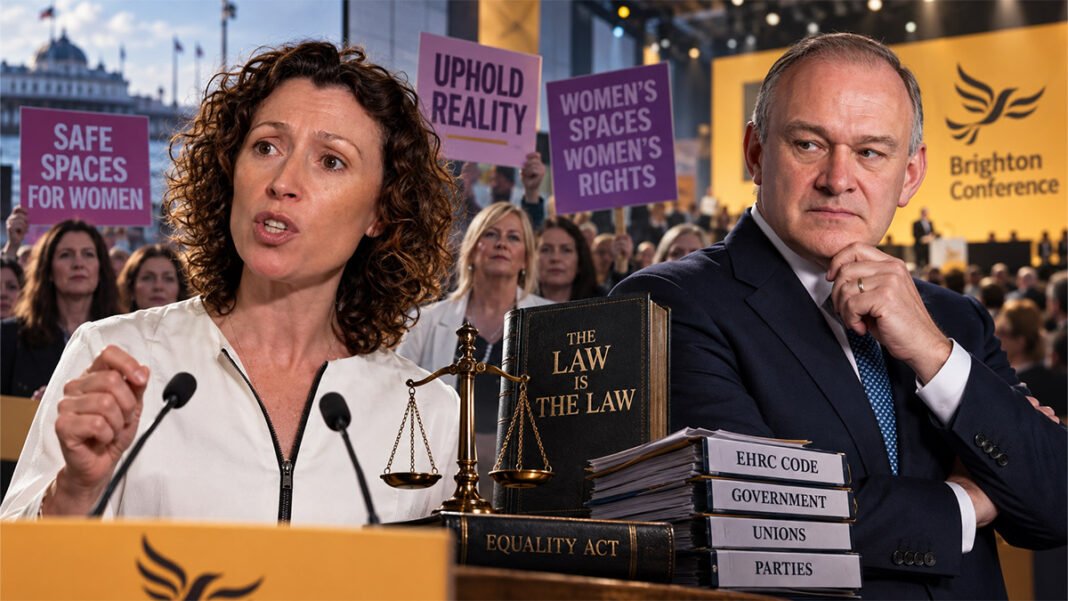
Labour Drags Its Feet as Lib Dems Challenge EHRC Code
A minister recites the ruling and will not enforce it. Unions pledge to fight employers who comply. And on Monday night a whole political party voted, clearly, to have it rewritten.
Seventeen months ago the Supreme Court told the country what the Equality Act means. Since then a Government, the largest unions in Britain and now an entire political party have decided that the ruling is a suggestion. On Monday night the Liberal Democrats made it official, and the woman who stood up to tell them what they were doing was answered from the chair with “that motion is clearly carried”.
Start where the law is supposed to bite: a hospital changing room. Last week two of the Darlington nurses who beat their NHS trust at tribunal sat down with Health Minister Karin Smyth. Bethany Hutchison and Annice Grundy asked for a date for national NHS guidance on single-sex facilities, and whether it would bind trusts or merely advise them. According to the Express, Smyth gave no date when asked twice, questioned what difference guidance would make, and told them “the law is the law”. The Department denies she said anything inconsistent with her line to MPs, which is that guidance is drafted and coming “imminently”. It has been imminent since Wes Streeting promised it “within weeks” in April 2025.

Take the minister at her word. The law is the law. The Supreme Court ruled unanimously on 16 April 2025 that “sex”, “woman” and “man” in the Equality Act mean biological sex. Smyth herself told Parliament on 30 April 2025, in a written answer quoted in the Lords: “This is the law, and we expect all public service bodies to comply.” Seventeen months on, the NHS’s own guidance from 2019, which tells trusts to accommodate people by their presentation rather than their sex, still sits under review with no publication date. The Government agrees with the law, states the law, and will not write it down for the 1.5 million people who work in the NHS.
That is how Darlington happened. The nurses raised concerns in July 2023. Twenty-six signed a letter in March 2024. The Trust told them to change elsewhere. In January a tribunal found it had created a hostile, humiliating and degrading environment for them: not through any conduct by their transgender colleague, who was cleared of personal wrongdoing, but through the Trust’s policy and its contempt for women who complained. It paid seven nurses £187,000 and spent a reported £603,000 of public money losing. Hutchison’s verdict on the meeting with Smyth was blunt: “It shouldn’t be our responsibility or fight. We don’t get paid enough to do that, and nobody is taking any responsibility for it.”
Nobody is. And this week we learned why.
REPEAL BY MOTION

On Monday evening in Brighton, Liberal Democrat conference passed motion F33a, “Restoring Trans Rights”, submitted by LGBT+ Lib Dems, moved by Artie Khovanov and summed up by Jennie Rigg. It is now party policy. Read what it says. Conference “believes” that “trans women are women, trans men are men”. It declares the EHRC’s statutory code of practice, in force since 5 August, to be “discriminatory and unworkable”. It calls for a cross-party committee to propose “amendments to legislation where necessary”, a new code that is “inclusive”, and a veto for the Women and Equalities Committee over who chairs the regulator, whose current chair the motion complains was appointed against that committee’s advice.
Start with the title, because the sleight of hand begins there. “Restoring” implies that something was taken. Nothing was. The Supreme Court did not change the Equality Act; it ruled on what the Act had meant since 2010. In the same judgment it said, in terms, that trans people keep their full protection from discrimination and harassment under the characteristic of gender reassignment. No trans person lost a legal right on 16 April 2025. The only rights the ruling touched were women’s, and it upheld them. Hollowood put it in five words from the floor: “They have lost none.” A motion to “restore” trans rights is therefore a motion to take women’s rights back, under a title chosen so that nobody has to say so.
The court ruled, the regulator explained the ruling, so change the regulator, change the code, and if that fails change the Act.
Sir Ed Davey told Radio 4 he wanted the motion to pass and would vote for it. A year ago he accepted the Supreme Court judgment. Now he says it “created something that we didn’t expect”. Zoe Hollowood, who chairs Liberal Voice for Women inside his own party, stood up in the hall and told delegates what they were about to do. “This motion is a Trojan horse,” she said. “It is not about restoring trans rights. They have lost none. It is about ripping out rights from women and destroying the clarity of the Supreme Court ruling. Taking aim at the guidance that supports the ruling is just smoke and mirrors, a pretext to amend the law.” Earlier, on GB News, she had said of her leader: “He’s dragging us backwards and I’m not clear who has been at him.”
Then she told them about Karen Danson. Danson was one of the Darlington nurses, a survivor of child sexual abuse. She told the tribunal that Rose Henderson, the male colleague who identified as a woman, repeatedly asked her why she was not getting changed, and that when she complained she was told to broaden her mindset. When she later needed a hysterectomy and found Henderson was due to assist, she explained her history and asked for a woman. The theatre manager, she said, replied:
“You are not my concern. My concern is Rose.” Hollowood let it land. “Let that sink in. You are not my concern, to a victim of child sexual abuse asking for female intimate care.” Then she set out the choice: “On the one hand, you have women’s rights, including victims of sexual abuse. Our privacy, dignity, our safety, our right to say no. And on the other hand, you have the feelings of some men and maybe an awkward conversation at the gym. If we pass this motion, we are telling women we think they are second-class citizens.” The chair checked the online vote. “That motion is clearly carried.”
Hollowood also saw the politics. Twenty years ago, she said, Europe was nobody’s priority, “and then along came a man called Nigel”. Reform, she noted, has been handed £72 million and a leaflet that writes itself: nurses who could not get undressed without a man in the room, and a party that voted to make it harder to stop. The people who will pay for that are not in the conference hall.
But the clearest takeaway from the day was Hollowood herself. She stood in her own party’s conference, faced down its leadership and put the case in plain English when it would have been far easier to stay quiet. She spoke about women’s privacy, dignity and safety, tied the argument to the Darlington nurses and challenged her own leader directly. Whatever anyone thinks of the wider politics, that takes courage. In an age when too many politicians wait to see which way the room is leaning before deciding what they believe, it matters that there are still women prepared to stand up, say no, and refuse to be bullied into silence.
“He’s dragging the party backwards. I’m not sure who has been at him.”
NOT ONLY THE LIB DEMS
The Lib Dems are not the loudest, nor are they the only ones. The Greens are beating this drum louder than the Clarion call for the environment. Carla Denyer and Adrian Ramsay, then Green co-leaders, demanded last year that the EHRC withdraw its interim guidance. On 14 September, delegates at the TUC carried Motion 17 opposing the code without, as The Tribune noted, once using the word “woman”. Unison’s Andrea Egan has pledged to “take the fight to every workplace” against employers who comply. And the Royal College of Nursing, whose members are overwhelmingly women, is in a Dundee tribunal this week facing Sandie Peggie, suspended by NHS Fife for objecting to a male doctor in the women’s changing room. She won her central claim, has been off sick for eighteen months, and says of the union she paid for nearly thirty years: “They’re blinded by trans activists just now.” The Darlington nurses formed their own union because the ones they belonged to would not fight for them.

Here is the question none of them will answer. Since when did political parties, trade unions and government departments get to pick which laws apply? The EHRC did not invent the code. Its statutory job is to describe the Act as the courts read it, and the courts have read it. The High Court threw out the Good Law Project’s challenge to the interim guidance in February. The code was laid before Parliament for forty days; more than 160 MPs backed a motion to reject it, and it went nowhere. Every legitimate route has been tried and lost. What remains is refusal dressed as principle: a minister who recites the law and will not enforce it, unions that pledge to fight employers for obeying it, and a party that resolves to rewrite the regulator until it says something else.
So here is the position of the British state and the parties that claim to be its progressive conscience. The court has ruled. The regulator has codified. Ministers agree in principle and act on nothing. And the Lib Dems, the Greens and the largest unions in the country are campaigning to have the ruling reversed, while the women who enforced it through the courts, alone and at their own expense, are told the matter is unclear.
It is not unclear. A man who declares himself a woman does not stop being a man, and no policy built on pretending otherwise can protect women, because the pretence is exactly what a predator needs. Anyone who doubts that should read what happened in a McDonald’s toilet in Bavaria in August 2025. A 55-year-old German federal police officer, a biological male identifying as a woman, befriended a teenage girl through her mother, took her on a motorcycle ride, followed her into a cubicle and locked the door. The officer has now confessed at Traunstein Regional Court under a plea arrangement, after child abuse material and a Kalashnikov were found at home and at the police station. On arrest, that officer was placed in the women’s section of a prison. Nobody is arguing that this is typical. The point is simpler and worse: a system that takes self-declaration at face value has no way to tell the difference until it is too late, and the people who pay for the experiment are girls and women.

That is what the Darlington nurses meant when they said they were fighting for every woman and girl in the country. That is why Peggie says she is fighting an ideology, not a person. And it is why the metropolitan left’s continuing deference to the loudest activist voices is not kindness. It is a betrayal of the working women who clean the wards, lift the patients and change at the end of a twelve-hour shift, and whose goodwill has been spent, in their name, on their own dignity.
It is a betrayal of every woman and feminist who fought for what this generation inherited: equality, safety, dignity, and the right to gather as women, for women, without asking anyone’s permission. Hollowood opened her speech in Brighton with the question every delegate who voted the other way should have to answer: “In 2026, are women allowed rights? Rights to dignity. Rights to safety. The right to say no.” Of her own leader she said that his support showed “Ed does not care about our rights and is wholly unwilling to fight for them.” The last time a Liberal leadership decided that women’s objections could wait, it was Asquith’s, and the women were in Holloway.
WHERE THE TRIBUNE STANDS

The Tribune’s position is not complicated and never has been. Women have a right to single-sex spaces. The law says so. The court says so. The regulator says so. A right that women must sue to enforce, one hospital at a time, at their own expense, while ministers say “imminently” and parties vote to repeal it by motion, is not a right. It is a privilege extended to those who can find a KC.
Publish the NHS guidance, date it and make it binding. Tell every trust that a policy allowing access by self-identification cannot survive the Supreme Court judgment, because Darlington has already shown what happens when one tries. Tell the unions that their duty is to their female members, not to a campaign against a ruling.
The Greens, Sir Ed Davey and the Liberal Democrats remain perfectly entitled to argue that Parliament should change the Equality Act. Trade unions are entitled to campaign for the same thing. That is democracy. Until Parliament changes the statute, however, organisations governed by it do not acquire an exemption because they dislike the judgment interpreting it. You may campaign to change the law. You may not pretend it is not there.
The law is the law. Women had to win it in the highest court in the land. They should not have to win it again in every changing room in Britain.