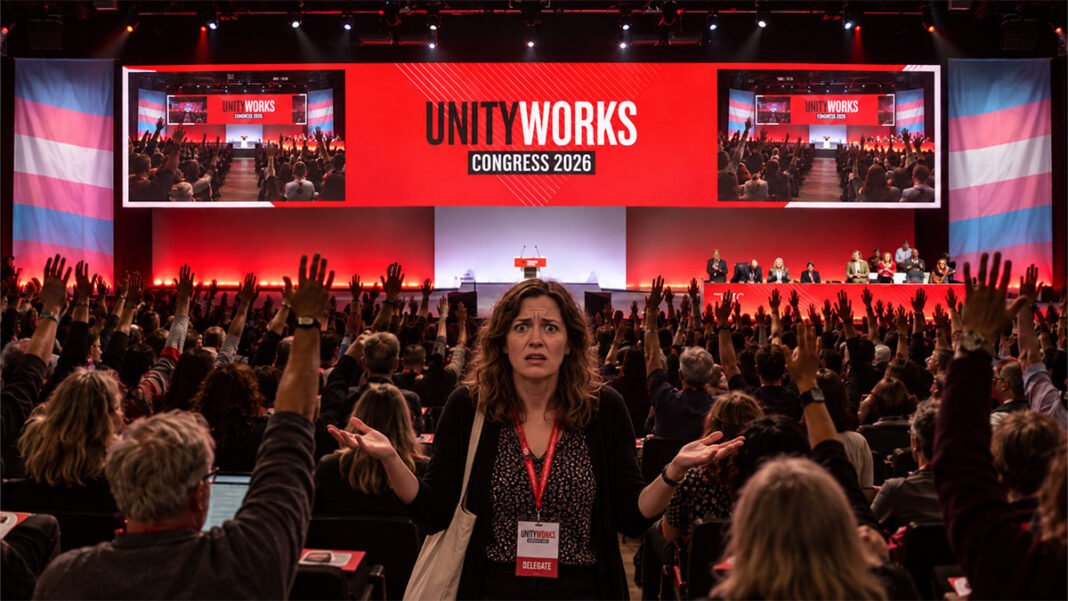
TUC Motion 17 commits 5.3 million trade unionists to campaign for gender self-declaration. It never once uses the word “woman”. This is how a movement legislates over women’s rights while pretending not to see them.
Motion 17, gender self-declaration and the missing word… “woman”
Read Motion 17 as many times as you like. Count every line, every clause, every one of its two hundred-odd words. You will not find the word “woman” anywhere in it. Not once. Not “women,” not “sex,” not “female,” not “girls.” A motion built entirely around reversing the practical effect of a Supreme Court judgment about the meaning of sex under British equality law manages, across five resolutions and four sub-clauses of condemnation, never to mention the people that judgment was about.
That is not an oversight. It is the whole story.
On Monday 14 September, delegates at the TUC Congress in Brighton carried Motion 17, “Oppose the EHRC Code of Practice (Services, Public Functions and Associations),” without a recorded opposing speaker and without, as far as any published account shows, a card vote. It came from the TUC’s LGBT+ Conference, was moved on the floor by Maria Exall of the Communication Workers’ Union, and was endorsed for the General Council by the TUC’s Assistant General Secretary, Kate Bell. It commits the entire trade union movement, nearly five and a half million working people, to campaign for the reintroduction of gender self-declaration into UK law. And it does so while treating the women whose legal protections are actually at stake as a subject too awkward to name.

The text itself is worth reading closely, because the ambiguity is built into its architecture. Conference “unequivocally condemns” the EHRC’s Code as “a direct attack on LGBT+ equality.” It resolves that “the law must be changed.” It calls on the TUC “to campaign to introduce a process of gender self-declaration in the UK.”
Every one of these is a direct, practical challenge to the effect of For Women Scotland v The Scottish Ministers, the April 2025 Supreme Court ruling that “sex” in the Equality Act 2010 means biological sex. Self-declaration would make legal recognition of acquired gender easier, but the Supreme Court held that even possession of a Gender Recognition Certificate does not alter a person’s sex for the purposes of the Equality Act 2010. Campaigning to make self-declared gender determine who counts as a woman or man under that Act is therefore not a question of better guidance or a fairer interpretation: it would require Parliament to change the law the Court interpreted. That is a legitimate position for a trade union conference to hold. What is not legitimate is holding it while pretending the other half of the equation, the women whose sex-based rights the ruling upheld, simply do not exist as a relevant consideration.
Kate Bell’s own words on the floor gave the game away. “While challenging this guidance,” she told Congress, “the TUC will comply with the law.” Sit with that sentence. It is an admission, dressed as reassurance, that the TUC knows exactly what the law currently says and intends to spend its political capital getting it changed. It is the trade union equivalent of a company that tells you it will obey the speed limit while lobbying furiously to have it raised. You are not meant to notice that the lobbying is the point.
The union movement women built

There is a bitter irony in a movement that owes so much of its modern legitimacy to women workers now organising to legislate around their protections without saying so out loud. It was women sewing machinists at Ford’s Dagenham plant who walked out in 1968 over unequal pay and forced the Equal Pay Act through Parliament two years later. It was women cleaners, care workers, dinner ladies and shop staff who built the base of unions like UNISON and USDAW into the mass movements they are today. Nearly half of TUC-affiliated unions are led by women. And yet when it came to a motion that touches directly on whether women can rely on single-sex spaces, services and sport being defined by sex rather than declaration, the platform found room for dignity, humiliation and exclusion, but not for the word describing the class of people the ruling was actually about.
This is worth being fair about, because the argument the TUC is not making explicitly deserves to be made explicitly. Trans people do face real hostility, and a trade union movement that ignored that would be failing a vulnerable group of its members. The EHRC’s own past research found that six in ten trans people report having experienced transphobic harassment from strangers in public. It is also true, though less convenient for either side of this argument, that the Home Office’s most recent figures show police-recorded transgender hate crime falling for the second year running, down 11 per cent to 3,809 offences in the year to March 2025, albeit still well above the 2,510 recorded five years earlier. Maria Exall’s charge that the guidance is impractical in places, and that its application to workplace facilities remains genuinely unresolved, is not a frivolous complaint. Even Community, one of the more cautious unions on this question, has said the EHRC needs to be “clear, legally sound” in how it applies the Code. These are real problems, honestly held.
Set that against the same period’s figures for women. Police-recorded sexual offences in England and Wales reached 209,079 in the year to March 2025, part of what the Office for National Statistics itself describes as a decade-long upward trend, one driven in part by improved recording and a greater willingness among victims to come forward, but a trend nonetheless. If the instinct behind Motion 17 is that rising figures demand a union response, it is fair to ask why that instinct did not extend, anywhere in its text, to the women whose safety in single-sex spaces this Code was written to address.
But none of that requires erasing women from the sentence. You can defend trans dignity at work without pretending the Supreme Court ruled on nothing in particular. You can call for better, clearer guidance on how single-sex provision works in practice without resolving to campaign for the return of the very mechanism, self-declaration, that the court found incompatible with the Act as written. The TUC chose not to do this. It chose instead a motion that names its enemy (the EHRC), names its remedy (self-ID), and simply skips past the question of whose existing legal protections that remedy would unwind.
What “the law must be changed” would actually mean…

Motion 17 never mentions a toilet. It does not need to. The single-sex exceptions in the Equality Act that a restored self-declaration test would swallow are not a toilet law. They cover women-only domestic violence refuges. Single-sex hospital wards and intimate personal care. Female prison wings. Women-only associations and support groups that exist because some spaces have to be run by women, for women, without qualification. Competitive sport. The right to organise politically as women. If the campaign Motion 17 commits the TUC to actually succeeds, every one of those exceptions loses the sex-based footing the Supreme Court confirmed it still has. That is what “the law must be changed” means once you follow it past the door of a public lavatory. Not a different sign. A different legal test for who counts as a woman everywhere the law currently protects one.
The last of those exceptions, the right to organise as women, is not hypothetical. It is the same right that UNISON, ASLEF, USDAW and the Musicians’ Union tested in July, when they boycotted Labour’s Women’s Conference sooner than accept a conference floor reserved for women defined by sex rather than by identity. Four TUC-affiliated unions had already shown, months before Motion 17, exactly how far they would go rather than let a women’s conference remain a women’s conference. Motion 17 is that same instinct, generalised and put into a campaign platform.
Ask, too, what happens to a woman who finds herself where the Darlington nurses stood. Eight nurses at Darlington Memorial Hospital were required to share their female changing room with a male colleague who identified as a woman. A tribunal found in January that the trust had prioritised his perceived rights over theirs, and that the arrangement created a hostile, humiliating and degrading environment for the women. Seven of them later received a combined £187,000 in damages. Their union was not the organisation that won that case for them. One of the nurses raised a complaint and was met with silence, then discovered her union was representing the man she had complained about. The women ended up founding their own organisation, the Darlington Nursing Union, because the one they already paid into would not do the job. Set that history against a TUC that has now voted, on the public record, to campaign for the very legal change that produced the Darlington dispute in the first place. If it happens again, and a reinstated self-declaration test gives no reason to expect otherwise, the question is not rhetorical: will these unions defend the woman, or will they need time to consider the judgment?
Weigh that against the scale of what is actually being contested. The number of people holding a Gender Recognition Certificate, the legal instrument the Supreme Court ruling actually turned on, is not in dispute: 8,464 full certificates have been granted across the entire United Kingdom in the twenty-plus years since the scheme began. Not per year. In total, over two decades. Motion 17 commits a movement of 5.3 million members, well over half of them women, to campaign for a change in the law on behalf of a certificated population smaller than the crowd at a lower-league football match, and does so without once naming the many millions of women whose existing legal protections that change would unwind.
Darlington nurses, TUC Motion 17 and the question every union must answer

The TUC’s own site records Motion 17 only as “carried.” It does not publish how many hands went up against it, nor which affiliated unions, if any, held back. That opacity should not survive scrutiny. Every general secretary who backed this motion, or let it pass without a recorded objection, owes their women members a plain answer to a plain question: do you believe the Equality Act’s protection of sex-based rights for women is a settled matter, or a temporary inconvenience to be campaigned away? There is no third option that respects both groups of members honestly, and the attempt to sound as though there is, is precisely what makes this motion dishonest rather than merely one-sided.
Women in these unions pay the same subscriptions, staff the same picket lines, and built no small part of the movement’s moral authority. They are owed more than a motion that discusses their rights without ever naming them. If the TUC wants to campaign for trans self-declaration, it should have the courage to say so plainly, and the honesty to say plainly what that campaign would cost the women whose legal protections it is designed to reverse. Anything less is not solidarity. It is a movement that has learned to talk about half its members by pretending not to see them.
A trade union movement that cannot say the word “women” while legislating over their rights has not found a diplomatic form of words. It has found a way to stop being honest with itself.

SOURCES
- TUC Congress Motions: Motion 17, Oppose the EHRC Code of Practice (Services, Public Functions and Associations): primary source, full motion text and carried status
- LabourList: TUC Congress backs motion opposing EHRC guidance and calls for gender self-ID (14 Sept 2026): Maria Exall and Kate Bell quotes
- Left Foot Forward: TUC votes to condemn EHRC code of practice and back self-ID for trans people (14 Sept 2026)
- Community trade union: Statement on the EHRC’s updated Code of Practice: source of the “clear, legally sound” quote
- Home Office: Hate crime, England and Wales, year ending March 2025: transgender hate crime figures (Table 2.1)
- Office for National Statistics: Sexual offences prevalence and trends, England and Wales, year ending March 2025
- Wikipedia: Trades Union Congress: affiliated union count and membership figure (5.3 million, 2026)
- The Heartlands Tribune: The Empty Delegation: How Four Trade Unions Sold Out Their Female Members
- The Heartlands Tribune: Trans Rights: The Conjuring Trick At The Toilet Door
- The Heartlands Tribune: The UN Had To Tell Britain, Women Have Rights: source of the Darlington nurses account and the 8,464 GRC figure
- Judiciary UK: Hutchison and Others v County Durham and Darlington NHS Foundation Trust: reserved judgment (as cited in the Tribune’s own reporting; not independently re-fetched this pass)
- ITV News: Darlington nurses due £187,000 in damages over single-sex changing rooms row (as cited in the Tribune’s own reporting; not independently re-fetched this pass)
- Ministry of Justice GRC statistics as reported: 8,464 full certificates to March 2024 (as cited in the Tribune’s own reporting; not independently re-fetched this pass)