From Cradley Heath to Liverpool: The History of Unions Betraying Female Workers
UNISON, ASLEF, USDAW and the Musicians’ Union are boycotting Labour’s Women’s Conference because its formal proceedings are reserved for women.
The Oldest Story in the Labour Movement Has a New Chapter, and It Stinks…
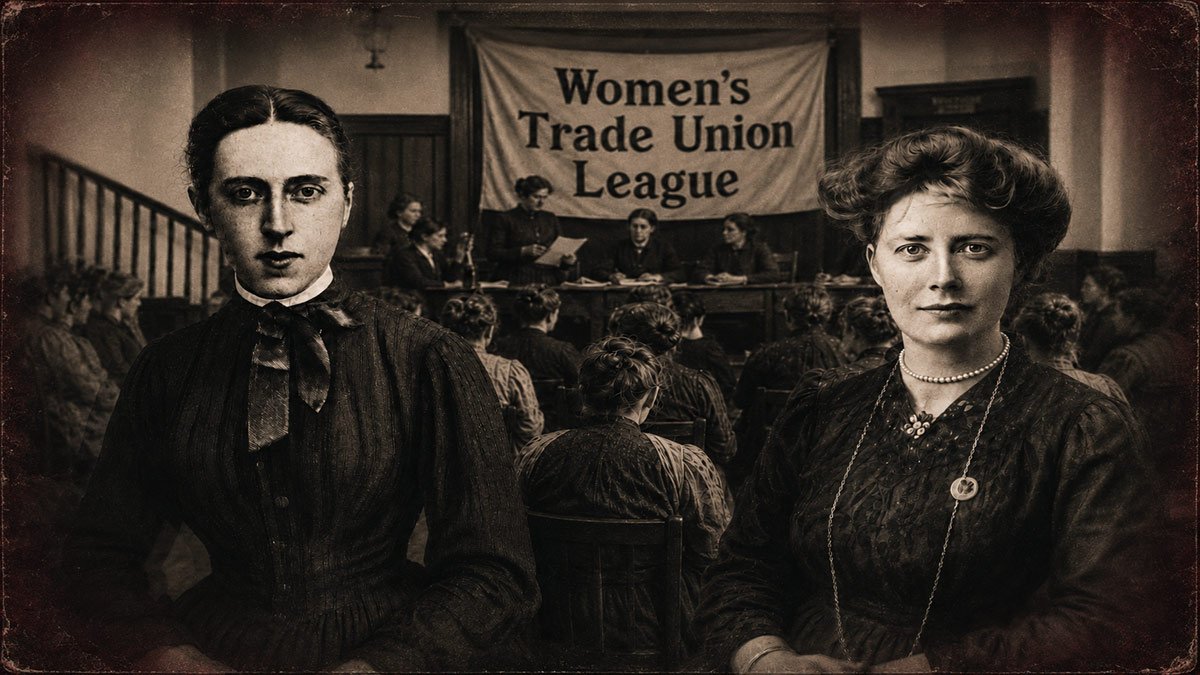
In 1874, a bookbinder named Emma Paterson founded the Women’s Trade Union League because the unions of her day would not organise women. This is not a new story. It is, if anything, the oldest story in modern history, and not only in the labour movement. Men shut the door. Women build their own room.
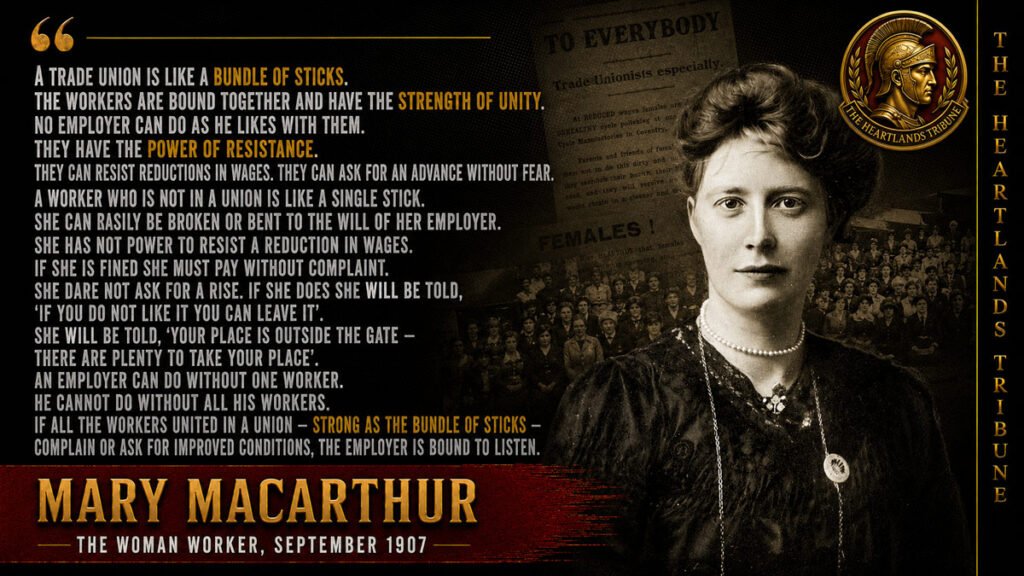
Those rooms worked. Mary Macarthur built the National Federation of Women Workers for the women the established unions would not take, and in 1910 the women chainmakers of Cradley Heath struck to force employers to honour a minimum wage the law had already granted them. They won. The movement absorbed their victory into its mythology and has been proud of it ever since. That is the pattern, and it repeats: women organise separately because the general movement has neglected them, they win something nobody else was fighting for, and afterwards the movement discovers it had always believed in equal pay. Women are welcomed as symbols, celebrated on anniversary posters and praised from conference platforms. The warmth disappears when they organise as women, identify their own interests and refuse to surrender control of the room.
It is disappearing again now, in the run-up to Liverpool…
UNISON, ASLEF, USDAW and the Musicians’ Union are boycotting Labour’s Women’s Conference because its formal proceedings are reserved for women. The seats they leave empty do not belong to four general secretaries, a policy committee or a press officer at union headquarters. They belong to the female members whose subscriptions paid for them.
That is the betrayal at the heart of this dispute. Union leaders have taken political representation purchased by women workers and thrown it away to make an ideological gesture against women organising as a sex.
Labour’s Women’s Conference will take place in Liverpool in September. Transgender members may attend fringe meetings, receptions and exhibition areas, but only women will participate in the main conference proceedings, debate policy, vote on motions and elect representatives to the National Women’s Committee. Labour says the arrangement reflects the Supreme Court judgment on the meaning of sex in the Equality Act and the party’s legal obligations. The four unions have responded by refusing to send delegations, while confirming that their attendance at Labour’s main annual conference will continue as normal.
Of every room available to them, they chose to empty the women’s room; it is an attack on women and women’s voices…
Of every room available to them, they chose to empty the women’s room; it is an attack on women and women’s voices.
Steelmanning
Recently, I have made a habit of steelmanning the arguments this column takes on: giving the other side its best case, stated fairly, before answering it. On this occasion, the word earns its own pun, because the case being steelmanned is, at bottom, the case of men. Here it is at its strongest. Trans women previously took part in Labour’s women’s structures, some transgender union members will experience the change as exclusion, and trade unions carry a duty to protect those members from harassment and discrimination. That duty remains. Trans people continue to possess legal protection under the protected characteristic of gender reassignment.
None of that abolishes sex, nor does it give trade union executives the right to confiscate women’s political representation. Strip away the language of inclusion and what remains is a choice: these unions have placed the concerns of men who identify as women above the material realities of women. That is the priority they have set, and they should be made to own it in those words.
The Supreme Court settled the legal meaning in April 2025. References to “woman”, “man” and “sex” in the Equality Act concern biological sex, while protections against discrimination for transgender people remain intact. The Government laid the revised EHRC code before Parliament on 21 May, its scrutiny period ended on 9 July without challenge, and the commencement order has been made: the code comes into force as statutory guidance on 5 August, days after these unions announced their boycott. They are not confronting an unlawful Labour exclusion. They are protesting because Labour has finally accepted that a women’s political structure must be capable of identifying the class of people it was established to represent.
The word “women” cannot perform any political work if it is forbidden from describing women…
The word ‘women’ cannot perform any political work if it is forbidden from describing women.
A women’s conference exists because women experience material conditions arising from their sex. Pregnancy discrimination is not allocated according to identity. Maternity penalties do not descend upon men who feel insufficiently represented. Women remain disproportionately responsible for unpaid care, more likely to work in low-paid public services and more vulnerable to particular forms of sexual violence and workplace harassment.
These are not abstractions assembled for a diversity seminar. They shape the wage packet, the pension, the night shift, the maternity meeting and the changing room. Women require the political freedom to discuss those conditions together and organise demands around them. That freedom is an exercise in collective assembly, the very principle on which trade unionism stands.
That history makes UNISON’s position particularly indefensible. The union describes itself as containing one million women, around 80 per cent of its membership, and has promoted the claim that without women there would be no UNISON. It also maintains a women members’ group whose stated purpose is to campaign against workplace inequality and advance women’s rights.
Yet when Labour provides a conference at which women can debate precisely those matters, UNISON refuses to represent them.
No publicly available statement from the union shows that its million women members were balloted on surrendering their delegation. UNISON’s explanation is a single sentence: restricting the conference floor to women conflicts with its policy on trans equality. ASLEF, USDAW and the Musicians’ Union have offered no publicly demonstrated mandate from their female membership either. A policy written elsewhere has simply been placed above the right of women members to participate.
That is not representation. It is substitution, the executive’s politics placed where the members’ voices should have been.

The Labour rulebook has allowed an affiliated organisation one delegate for every 10,000 members, up to a maximum of 25. Trade union delegates also elect representatives to Labour’s National Women’s Committee. Boycotting therefore means more than missing speeches and sandwiches in Liverpool. It removes votes, influence, committee representation and the ability to shape the policies later carried into Labour’s wider conference machinery.
Power does not disappear when a union walks out. It passes to those who remain, and if the unions won’t use it, then women must organise themselves.
The female cleaner, care worker, teaching assistant, shop worker, train driver or musician does not gain anything from this performance. Her union does not become more principled by silencing her. She simply loses a representative in the room while continuing to pay the subscription that funded the empty chair.
UNISON’s conduct in the Darlington nurses’ case shows that this boycott is not an isolated error. It belongs to an established political choice.
Eight nurses at Darlington Memorial Hospital brought employment tribunal claims after they were effectively required to share their female changing room with a biologically male colleague who identified as a woman. The tribunal found that the trust had prioritised the perceived rights of its transgender employee over those of the nurses, leaving the women with no genuine alternative changing provision. It concluded that the policy violated their dignity and created a hostile, humiliating and degrading environment.
Seven of the nurses later received a combined £187,000 in damages, together with an apology from the trust and a commitment to provide separate changing facilities for male and female staff.

UNISON was not the organisation standing beside them. The women had to secure outside legal support and establish the Darlington Nursing Union. Before the tribunal ruling, UNISON president Steve North accused the then health secretary of pandering to anti-trans bigotry, merely for meeting the nurses. After the judgment, UNISON issued a statement saying it needed time to consider the lengthy decision and reaffirming its existing policy on trans, non-binary and gender-diverse members. Its published statement did not offer solidarity to the women whose dignity the tribunal found had been violated.
That record matters. It tells female members what may happen when their rights collide with an ideology already adopted by the union hierarchy. Their union may decline to represent their position, condemn the politicians who listen to them and then issue a carefully sterilised statement after a court vindicates them.
Now the same hierarchy is applying that choice on a national scale.

The boycott also carries financial weight. UNISON gave Labour close to one and a half million pounds before the 2024 general election, USDAW more than half a million, ASLEF a hundred thousand. None of the four unions has publicly threatened to withdraw Labour’s funding over the conference. They do not need to spell out every implication. When several affiliated donors coordinate a public walkout, the party leadership knows which ledger is being placed on the table.
That makes the dispute a test of whether Labour will defend women’s lawful political organisation when organisations holding money and institutional influence demand otherwise. It is also a test for the trade union movement. A union exists to represent its members against concentrated power, not to use concentrated power against its own members.
The women paying subscriptions to these unions are entitled to ask who authorised the boycott, which governing body approved it, whether women members were consulted and what democratic process allows their conference representation to be surrendered. Those questions should be tabled in branches, recorded in minutes and directed to every executive member responsible. Where leaders refuse to answer, women should organise to replace them.
That is not an attack on trade unionism. It is trade unionism.
Emma Paterson did not wait for established organisations to discover their consciences. Mary Macarthur did not tell women chainmakers to accept that somebody else’s policy took precedence over their wages. The Darlington nurses did not remain quiet when their own union failed to defend them. Each generation of women has been forced to organise because institutions claiming to speak for everyone decided that women’s interests could be postponed, diluted or exchanged.
The executives of UNISON, ASLEF, USDAW and the Musicians’ Union have made that same decision. They have placed ideological conformity above female representation and called the resulting silence inclusion.
Women’s rights were never a man’s to grant. They are not a union’s to boycott or betray…
Enjoyed this read? I’m committed to keeping this space 100% ad-free so you can enjoy a clean, focused reading experience. Crafting these articles takes a significant amount of research and heart. If you found this helpful, please consider a “small donation” to help keep the lights on and the content flowing. Every bit of support makes a huge difference.

SOURCES
LabourList: Four unions announce boycott of Labour women’s conference
GOV.UK: Equality Act 2010 Code of Practice for services, public functions and associations, 2026
Left Foot Forward: Leading trade unions will not attend Labour Women’s Conference
ITV News: Darlington nurses to receive £187,000 in damages
Related reading: Trans Rights: The Conjuring Trick At The Toilet Door