The Means of Production Are For Sale
BP has put the largest oilfield in Western Europe on the open market. The only question left is who buys it, and who the profit belongs to once they do.
BP putting its North Sea operation up for sale is not a corporate triumph of “disciplined capital allocation,” no matter how many times the press release repeats the phrase. It is a retreat. A global giant drew decades of private profit from a national asset, and now that the fields are ageing and the easy money is gone, it is walking away.
For the British public, this should read as a historic door left open, not a crisis.
After all, have we not always cried out for the means of production? Not as a slogan chanted at a rally, but as a plain question any working household would recognise: who owns the machinery that powers a nation, and who profits when it changes hands?
Have we not always cried out for the means of production?
The instinct in Westminster and the City will be to let this pass to a private equity syndicate or a speculative operator, who will promise lean management and efficiency. Britain has watched this film before, in water, in rail, in the care sector. Sweat the ageing kit, thin the workforce, extract the cash, and leave the public to cover the clean up once the value is gone.
The alternative is not radical. It is a purchase…
Some on the left, and much of the Green movement, will recoil from any argument that keeps a drop more oil flowing, and the climate clock they point to is real. But there is a difference between opening a new field and deciding what happens to one already producing. BP is not asking anyone’s permission to drill somewhere new. It is asking someone to buy what already exists. The honest choice was never between extraction and abstinence. It sits between a private buyer who lifts what remains and banks the proceeds abroad, and a public one who lifts the same oil and spends the proceeds building the wind farms, the storage and the grid that replace it. Refusing the sale does not put a single barrel back in the seabed. It only decides, by default, who gets to spend the money.

And this is not a small find going begging. The Clair field, west of Shetland, is the largest oilfield on the UK continental shelf, the largest hydrocarbon accumulation in Western Europe: seven billion barrels in place. Only a fraction has ever been recovered, and BP has been working towards a third development phase. Whoever buys this business buys the door to that oil for decades to come.
“This really is in its own way exactly as significant as the first run of Stephenson’s Rocket or whatever other industrial event you may choose. It is a turning point.”
Britain has stood at this door before and closed it. In the 1970s Tony Benn built the British National Oil Corporation to give the public a direct stake in its own reserves, and wanted it to take over BP’s North Sea holdings outright. Harold Wilson refused him, judging it a step too far. Benn’s case was not sentiment; he argued plainly that public ownership meant more money for the country and more control of the oil. Wilson blinked, and the decade that followed sold Britoil and the government’s own BP shareholding, spending the tax windfall as fast as it arrived. A sovereign wealth fund started then would be worth over half a trillion pounds today.
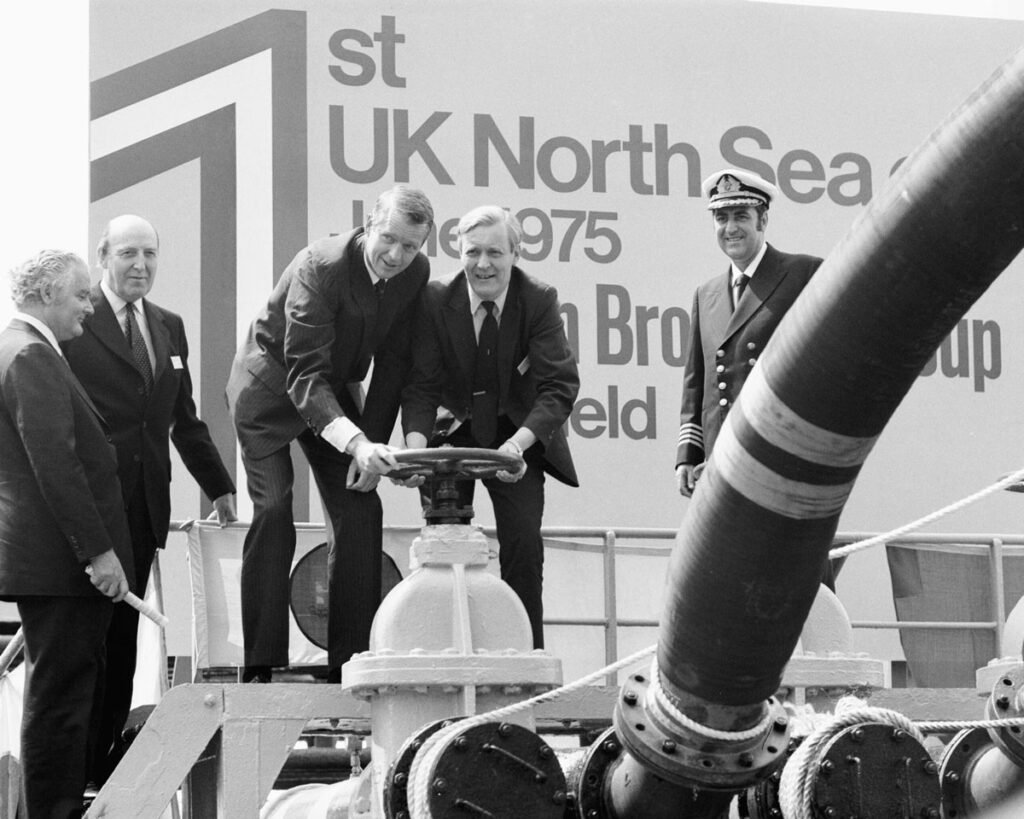
Half a century ago, almost to this same summer, Britain lived this exact moment once before. In June 1975 the first oil from the North Sea was pumped ashore, and Tony Benn, the energy secretary who stood and watched it land, understood immediately what he was looking at. He called it “exactly as significant as the first run of Stephenson’s Rocket… It is a turning point.” He was right, and Britain spent the following decade proving him right in the worst possible way, selling off the very company built to hold that turning point rather than using it. Opportunity on this scale does not knock twice. It knocked in 1975 and was shown the door. It is knocking again now, and the only question left is whether this generation answers it.
Norway ran the experiment we refused, on the same sea. The Norwegian state still owns two thirds of Equinor, and the fund built from the proceeds passed two trillion dollars this year, the largest in the world. Keir Starmer once understood the shape of that failure, promising Labour would not again “fritter away the wealth from our national resources.” That promise gave us Great British Energy, publicly owned and sat in Aberdeen. Widening its remit to hold oil and gas is paperwork next to what this government has already managed. Sixteen days ago it nationalised British Steel, from Act to ownership, inside nine weeks.
None of this should be dressed up as easy. The basin is old, and decommissioning the rest of it will cost the country an estimated forty four billion pounds. Any public bid needs BP’s books open first, every liability accounted for, before a penny changes hands. But look honestly at who carries that cost today. Decommissioning already comes with tax relief running to a third or more, so the public underwrites the clean up whoever owns the platform. Private ownership hands us the bill and hands someone else the oil money. Public ownership gives us the bill we already carry, and the oil money with it.
That choice sits with Andy Burnham now, because his own government has already loosened the ground beneath it. He told Donald Trump he would take a pragmatic line on the North Sea, adding “there is a resource there. When people are struggling we can’t ignore that.” His energy secretary calls the basin “a vital national asset”. Fine words, and true ones. But a vital national asset a country declines to own is only a slogan with a price tag on it.
For a hundred years we were told the means of production could never be ours. On a Friday morning in July, a corporation put them up for sale and proved that was always a choice, not a law of nature. If a country does not own its energy, it does not own its future or its security. If there is any lesson to be taken from Ukraine or Iran, it is that.
Enjoyed this read? I’m committed to keeping this space 100% ad-free so you can enjoy a clean, focused reading experience. Crafting these articles takes a significant amount of research and heart. If you found this helpful, please consider a “small donation” to help keep the lights on and the content flowing. Every bit of support makes a huge difference.