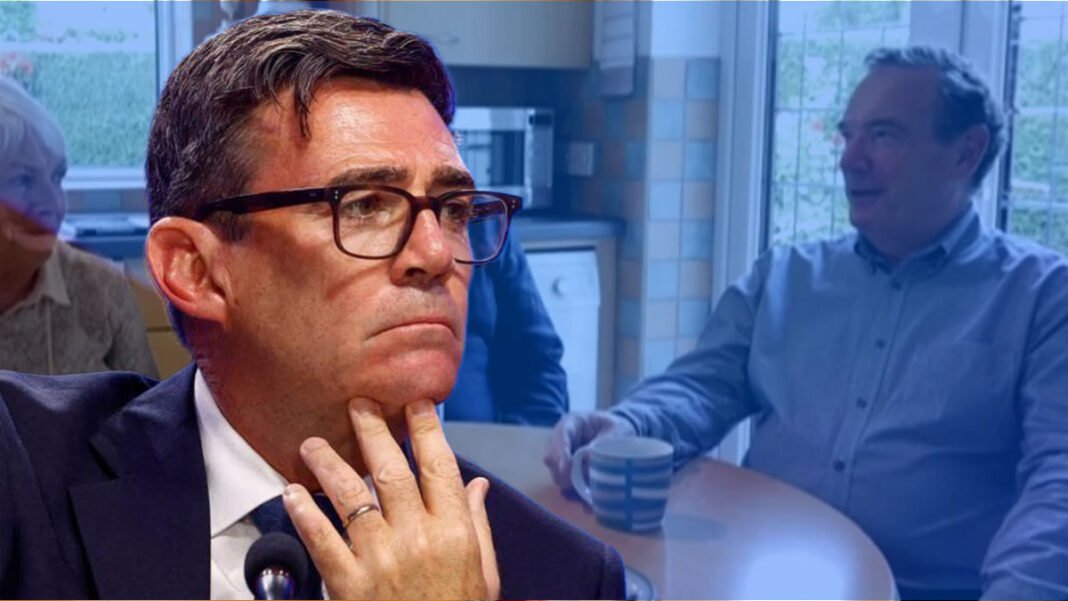
Prime Minister Andy Burnham has cancelled his official engagements for Monday and Tuesday following the death of his father, Roy, who had lived with Alzheimer’s disease. Kenneth Roy Burnham, known as Roy, was 86.
Burnham had been due to host a meeting of business leaders in Downing Street on Monday afternoon. That meeting will no longer go ahead. Downing Street confirmed the Prime Minister is taking the two days to be with his family.
Roy Burnham worked for decades as a telephone engineer for BT. He and his wife, Eileen, raised Andy and his two brothers in Culcheth, Cheshire, in a home the Prime Minister has described as full of “music, life, laughter, love and support.” In his 2024 book Look North, Burnham wrote that neither of his parents had gone to university, though both could have done “had they grown up in a different time and different place,” adding that their awareness of this seemed to make them “all the more determined that their three sons would go.”
Roy’s illness had already become part of the public story of his son’s premiership. Burnham entered Downing Street in July, and has said his father never knew that his son had become Prime Minister, because his Alzheimer’s had by then taken hold. Speaking to The Times before taking office, Burnham called this “a sadness, because he would be proud,” adding: “The way I look at it, it’s his achievement as well. A whole family achievement, although he doesn’t know it.” He later said staff at his father’s care home had shown Roy footage of his son walking into Number 10, an act Burnham described as “wonderful.”
That personal experience has fed directly into government policy. When Burnham set out his plans for adult social care reform in July, he framed the pledge explicitly around his father, saying he wanted to help “my dad and the millions like him.” He has also spoken of being “overwhelmed” by the professionalism of the care workers who looked after Roy in his final years, a point that campaigners will note as the government’s social care proposals move toward implementation.
Tributes have followed from across the political divide. Conservative leader Kemi Badenoch wrote on social media that “no matter how old you are, or how much you try to prepare, losing your father is a profoundly painful experience,” adding that “a part of your life that has always been there is suddenly gone forever and it can feel as though a part of you won’t ever be the same again.”
Burnham’s grief is, in that sense, not a private matter set apart from his public role but a continuation of it. He has spent the past year telling the country that the social care system fails families like his own. Now his own family is living through the ending of that story, in the full glare of the office he holds. The Tribune extends its condolences to the Prime Minister, his mother Eileen, and the whole Burnham family.