Andy Burnham’s devolution plan asks the towns to fund the cities, and proposes to repeal the law that lets them object
The King of The North Builds His Principalities
Nothing about how Andy Burnham took power was unlawful. That is precisely what should frighten you. And here’s why…
No law was broken. Sit with that sentence, because it is doing more work than it appears to.
No law was broken when a sitting MP resigned his seat in May so that a man outside Parliament could have it, the first time that manoeuvre had been performed in decades. No law was broken when the Labour leadership challenge quietly disappeared, and 379 Labour MPs nominated one candidate, resulting in the members’ ballot being quietly cancelled, the Labour Party crown passing at a special conference at the Manchester Fabian Hall on a Friday in July. No law was broken when the new Prime Minister kissed hands, formally taking up the position of Prime Minister four days into the summer recess, guaranteeing himself six clear weeks in office before a single question could be put to him in the House of Commons.
And no law was broken when, on 31 July, with the Commons chamber dark, his Cabinet published the deepest redrawing of English government the dissolution of the Ridings, tax powers attached, election dates fixed, delivery already underway.
Every step lawful. Every step procedurally immaculate. And at no point in the entire sequence was the public asked anything at all.

Our constitution was never built to stop kings. We have a King, and long may the arrangement confuse republicans. It was built to restrain them: to bind the Crown inside law, to make power answer to Parliament and Parliament answer to the people. That settlement, bought over centuries at Runnymede and Naseby and Peterloo, watches for the overmighty ruler crossing a line. It has no instinct at all for the administrator who never needs to cross one, because the administrator rewrites the lines first, patiently, statute by statute, and then walks through the gap where the line used to be.
Our constitution was never built to stop kings. It was built to restrain them.
That rewriting did not begin on 20 July. It began under Keir Starmer, and it has not ended. Only the salesman has changed.
THE INHERITANCE
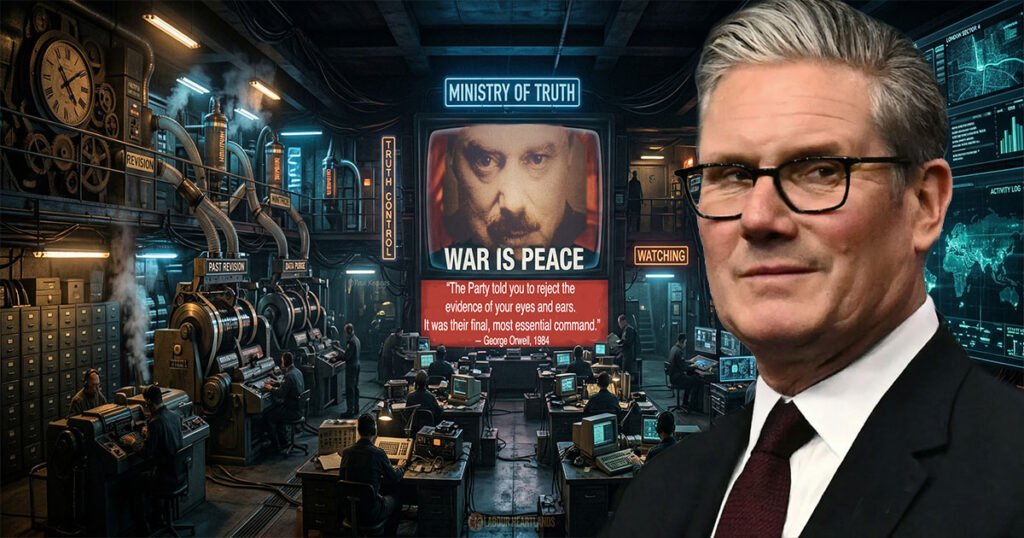
Be precise about what Starmer built, because the record is on the statute book and it does not care about anyone’s intentions.
He inherited the Tory architecture of restriction, the protest powers of the Police, Crime, Sentencing and Courts Act, the locking-on offences and suspicionless protest searches of the Public Order Act, voter ID, expanded citizenship stripping, the surveillance amendments of 2024, and he kept nearly all of it. Honesty requires the exceptions to be recorded: his government repealed the Rwanda Act and scrapped the Tory minimum service levels law that shackled strikes, and both were genuine restorations of liberty. They are also the only two of consequence. Everything else was retained, switched on, and then extended.
Then came the additions, and the pace of them is the story. An Act allowing banks to trawl the accounts of benefit claimants against DWP criteria and take money directly from accounts and wages, aimed at people whose only offence may be an administrative error. An Act weakening protection against decisions made about you by an algorithm, arriving precisely as government wires artificial intelligence through welfare, policing and immigration. An Act providing that a person stripped of citizenship stays stripped even after a court rules the stripping unlawful, so long as ministers keep appealing. Age verification switched on across the internet, the apparatus this publication called a Trojan horse for digital ID. A register of every child in England and a single identifier linking them across state databases. An Act rushed through in days, given Royal Assent on 8 July, letting the Home Secretary designate organisations by executive order and making it criminal to voice support for them.

And note one date. On 29 April 2026, the King gave Royal Assent to two Acts on the same day. One was the English Devolution and Community Empowerment Act, which draws the new map, creates the strategic authorities and abolishes district councils across six counties. The other was the Crime and Policing Act, Labour’s principal protest statute, with its civil-standard Respect Orders carrying criminal punishment, its face-covering offences, its warrantless entry powers. The new principalities and the new public order regime were signed with the same pen on the same day. Nobody planned the symbolism. That is what makes it perfect.
Still before Parliament sits the Courts and Tribunals Bill, which would remove a defendant’s right to elect trial by jury in the middle band of criminal cases, a right Labour’s manifesto never mentioned and nearly forty of Labour’s own MPs have refused to support. This publication has traced that fight from Lilburne through Bushell’s Case to a barrister now facing prison for reading twelve words from a plaque on the Old Bailey wall.
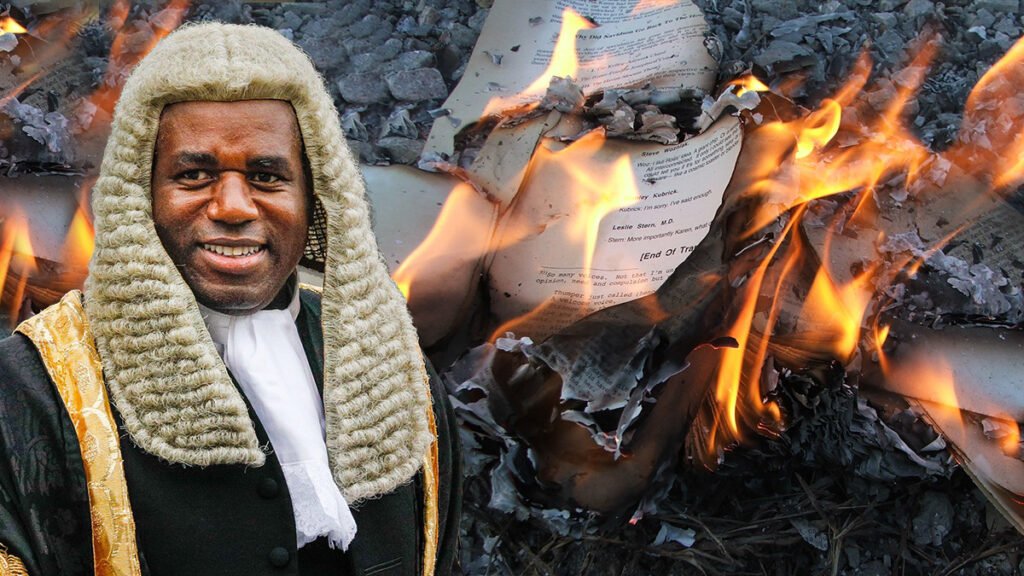
Set the whole ledger out and the pattern is unmistakable. Tory restrictions on protest became Labour restrictions on protest. Tory online regulation became Labour age verification. Tory citizenship stripping became citizenship stripping that survives a successful appeal. The governing principle of English liberty, that you are free unless the state proves restraint necessary, is being inverted clause by clause into its opposite: you are permitted, until the state decides otherwise.
Starmer’s problem was never this project. His problem was his face. The public would not warm to him and would no longer be pacified by him, and by May the party could read the ward results as well as anyone. So the machine did what machines do when a component fails: it swapped the component. The lawyer from north London gave way to the mayor from the north west, the frown became a smile, and every Act, every gate, every register and every power of entry passed from one man’s desk to the other’s without a comma being repealed.
The direction has not changed. The names on the ministry doors have.
THE NEW MAP
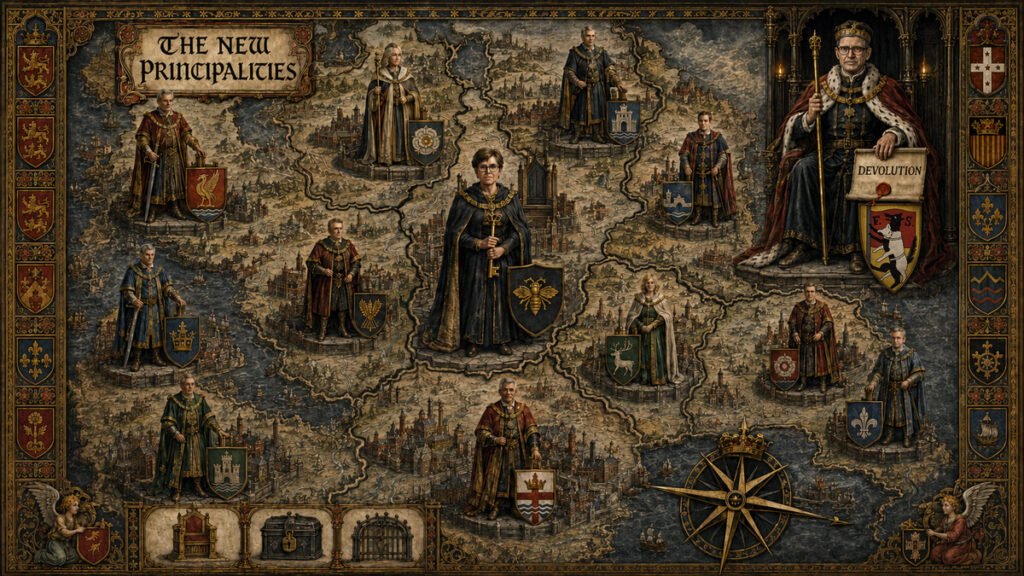
Now look at what the new man published in his second week, while the Commons stood empty.
England is to be covered in strategic authorities by the end of 2028, mayors above them wherever possible, with police forces, fire services and NHS commissioning boards redrawn to match the mayors’ boundaries. From next April the mayors keep a share of business rates. From April 2028 their Whitehall grant is replaced by a share of the income tax raised in their territory, so each region lives increasingly on what it can raise, and the towns whose industries were shut by governments they never elected discover that need no longer counts, only growth. New mayoral elections are already scheduled for Cumbria and for Cheshire and Warrington next May, a further wave the spring after, each one embedding the model deeper before any general election can render a verdict on it.
England has drawn and redrawn its map for over a thousand years. The shires are older than the Conquest. Yorkshire kept its ridings from the Danes until Whitehall abolished them in 1974. Those old units had their faults, but they had one virtue this new map lacks entirely: people knew where they lived, who governed them, and where to direct their anger. The new principalities are being drawn in a decade, by administrators, to boundaries that match no community anyone belongs to, and the anger will find no address.
Because ask the question that matters: who, in this new England, do you actually hold to account?
The mayor, in theory. And here the record has just delivered its own verdict, with timing no satirist would dare invent. On the very day the Cabinet published its document describing mayors as a single point of accountability, Greater Manchester declared the result of the by-election to replace Burnham himself. It was the biggest by-election ever held in Britain, more than two million people eligible, the first ever for one of the new strategic authority mayoralties, the model’s own showcase. Turnout was 25.14 per cent. One voter in four. The lowest in the mayoralty’s history, seven points below even 2024’s dismal showing, with Oldham managing just 22. Bev Craig is now the directly elected leader of 2.9 million people on the say-so of roughly one in seven of the register, and this is the flagship. Tees Valley managed 30.8 per cent at its last outing. In Cambridgeshire and Peterborough, one of four authorities upgraded to top-tier status the day the document was published, the mayor holds office on 28.4 per cent of the vote on a 33.1 per cent turnout, roughly nine voters in every hundred eligible.
This is the single point of accountability. The point is real. The accountability is not turning up.
Below the mayor, it gets darker. Deputy mayors for health, for policing, for public services: appointed, not elected. The accounting officer responsible for the public money: the mayor’s own chief executive. The scrutiny committee that is supposed to watch the mayor: council leaders who sit in the mayor’s own cabinet. At every level, the person checking the work reports to the person doing it.
We do not have to guess how that ends, because it has already been tested. On Teesside, an independent review of the mayoral development machine found no corruption and no illegality, and found alongside that verdict a culture of excessive confidentiality, decisions that failed the standards expected of public money, and twenty-eight recommendations for repair. A publicly owned regeneration site had passed, ninety per cent, into private hands; the private partners had put in no cash and taken out close to £45 million. The committee meant to scrutinise it had been advised it had no power to look. Nobody broke the law there either.
That is the governance model now being rolled out to every corner of England, with more money flowing through it than Teesside ever saw, and fewer people voting on it than ever before.
THE CONFESSION

If you doubt that management, not representation, is the design, the document confesses it in a single sentence.
Buried in the section on Whitehall reform, the Cabinet agrees to replace consultation by default with what it calls modern forms of public participation, and to consider where “performative statutory duties to consult can be revoked”.
Strip away the jargon and look at the bare legal reality. A statutory duty to consult is not decoration. It is the single hook on which an ordinary citizen’s judicial review hangs. It is the only law that forces a council or a mayor to pause before closing a library, cutting a bus route, or handing a green space to a developer.
Call that duty “performative” and you give away the whole game. To the managerial mind, your right to object was never a democratic principle; it was just bad theatre getting in the way of efficiency. Remove the duty, and you remove the breach; remove the breach, and you eliminate the legal challenge; eliminate the challenge, and you kill the public’s right to say no.
They looked at the machinery of English democracy, identified the only gear that allows the public to pull the emergency brake, and marked it for removal.
Some will say this is devolution and the left should cheer it. I would cheer devolution. Tony Benn spent his life arguing for it, and his five questions still cut deeper than any select committee: what power have you got, where did you get it, in whose interests do you use it, to whom are you accountable, how do we get rid of you? Real devolution passes power downward until it reaches hands that can be shaken or shown the door. Run this document through Benn’s questions and watch it fail everyone. Power acquired in recess, exercised in the interest of growth as defined by those who profit from it, accountable to a committee of its own appointees, removable once every four years by an electorate three quarters of which has stopped turning up.
Power here is not travelling downward to people. It is travelling sideways, from one managerial class in London to a new managerial class in the regional capitals, while the towns in between lose their councils, fund the cities from their shrinking tax base, and forfeit the right to object.
Karl Polanyi taught us, in a book this publication returned to not long ago, that the free market was never spontaneous. It was imposed, by statute, on a society that had to be broken open to receive it, and his evidence was the enclosures: the commons taken by Act of Parliament, the fences going up with the law’s full blessing, the village consulted only after the survey was complete. Every enclosure in English history was lawful. The land was lost all the same. Polanyi called it improvement, in the improvers’ own word, and noted that the people were expected to be grateful.
They are enclosing accountability now. The common right this time is your standing to be heard, and the fence is a clause on page six.
Parliament returns on the 1st of September. The first question put to this Prime Minister, before a word about growth or postcodes or engine rooms, should be the only one that matters: will you strike out the sentence that abolishes the public’s right to be asked?
Watch his answer carefully. Not the smile. The answer.
Because a government that has already decided your voice is performative has told you exactly what it thinks you are. Not citizens to be represented. Stock to be managed. And the flock is losing the last law that ever made the shepherd stop and listen.
Enjoyed this read? I’m committed to keeping this space 100% ad-free so you can enjoy a clean, focused reading experience. Crafting these articles takes a significant amount of research and heart. If you found this helpful, please consider a “small donation” to help keep the lights on and the content flowing. Every bit of support makes a huge difference.

SOURCES
· Rewiring the State: Cabinet Statement, 31 July 2026 (Cabinet Office)
· English Devolution and Community Empowerment Act 2026 (c. 23)
· Crime and Policing Act 2026, section 171
· Courts and Tribunals Bill: House of Commons Library briefing
· Bev Craig named Greater Manchester Mayor on record low turnout (ITV News)
· The Great Transformation by Karl Polanyi (The Heartlands Tribune)
· The Wolf and the Tribute: How Labour Chose Warfare Over Welfare
· Rajiv Menon KC Read Twelve Words From An Old Bailey Plaque
The Heartlands Tribune is independent, reader funded and carries no advertising. Working class journalism survives because readers keep it alive.