The Complicity of Words
Ed Miliband announced a trade ban on Israeli settlement goods and recognised “ethnic cleansing” in the West Bank. Israel retaliated by closing the British Consulate in Jerusalem and banning 12 UK nationals. But without structural enforcement, mandatory audits, financial sanctions, and real penalties the policy is moral theatre, not accountability.
Why Britain’s West Bank Sanctions Will Fail Without Structural Enforcement
There is a precise, sickening rhythm to the way the British diplomatic state manages its conscience.
First comes the long, deliberate period of curated inaction, during which the atrocities on the ground are allowed to harden into permanent realities. Then, when the moral horror becomes too loud to ignore, ministers step to the despatch box to unveil a carefully calibrated package of sanctions. Words hitherto strictly forbidden in polite parliamentary discourse are suddenly deployed with calculated drama.
When Foreign Secretary Ed Miliband rose in the House of Commons to announce trade restrictions on illegal Israeli settlements and formally acknowledge that Palestinians in the occupied West Bank are facing a campaign of ethnic cleansing, the political establishment expected a collective sigh of relief. Britain, we were told, was finally taking a stand.
Yet behind the high-minded denunciation lies a quieter, more devastating truth: without a total overhaul of how Whitehall enforces international law, these new sanctions are little more than moral theatre, a performative gesture designed to soothe domestic outrage while leaving the mechanical architecture of occupation entirely intact.
The Illusion of Action
For decades, the standard British line on the West Bank was a study in practised neutrality. While successive governments paid lip service to the two-state solution, Israeli settlement expansion continued unabated, transforming the geography of a prospective Palestinian state into an archipelago of isolated enclaves surrounded by militarised infrastructure, bypass roads and armed outposts.
Tuesday’s policy marks an explicit rhetorical break. Britain will ban imports of goods from the settlements and restrict services including financing, construction, infrastructure, real estate and advertising for them. It has adopted, for the first time, the International Court of Justice’s position that Israel’s occupation is unlawful in its entirety, not merely the settlements sitting on top of it. On paper, these are significant shifts. In practice, Miliband told MPs the comprehensive sanctions regime that will actually define and police the ban is expected to take six to nine months to draft into law. What happened this week was a declaration of intent, backed by one immediate step that Whitehall already knows how to take: further designations against a handful of extremist settlers under the existing Global Human Rights Sanctions Regulations, the same statute that has produced every incremental sanction since February 2024 without once touching the trade relationship itself.
Naming an atrocity is not the same as preventing it. Calling a campaign of displacement ethnic cleansing while leaving open the vast supply chains, financial corridors and corporate networks that sustain it is an exercise in political self-absolution. Consider the structural loophole at the heart of the trade ban. Settlement agricultural companies routinely export produce through Israeli parent corporations, blending raw materials before export or labelling goods simply “Product of Israel.” Without rigorous supply chain tracing, an origin verification scheme and punitive penalties for fraud, His Majesty’s Revenue and Customs is not currently equipped to stop settlement produce entering British markets under false paperwork. Reporters covering Tuesday’s statement noted that the government itself has offered no detail yet on how it intends to make that distinction.
Jerusalem Answers Back
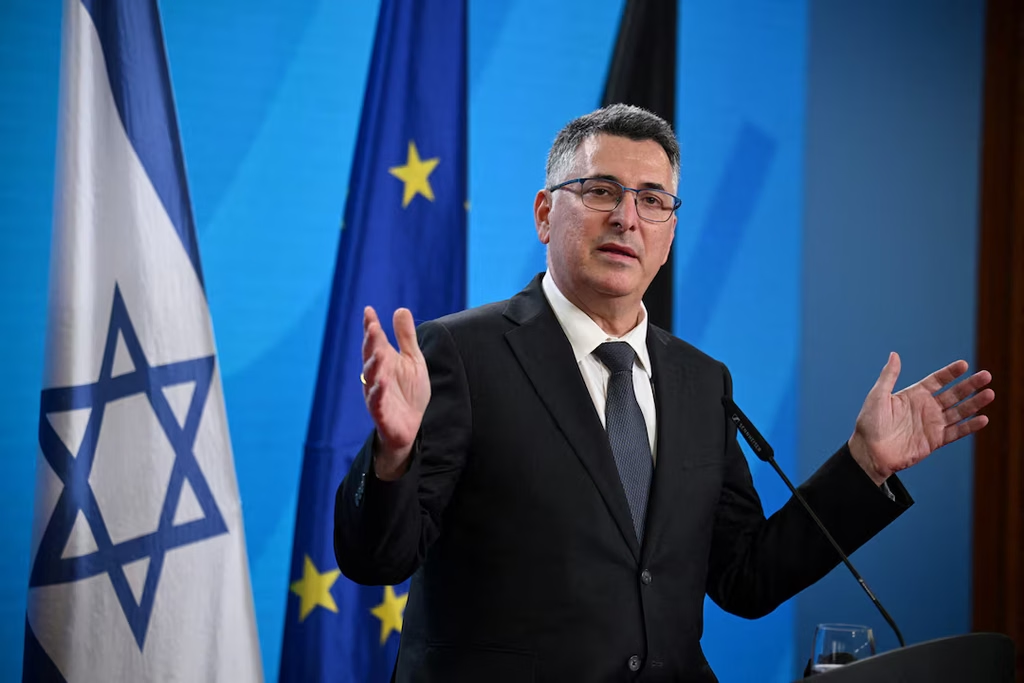
Israel closes the British Consulate, and bans 12 UK nationals…
Israel did not wait for the dust to settle. Within hours of Miliband’s statement, Israel’s foreign minister Gideon Saar stood before cameras in Jerusalem, first in Hebrew and then in English, and announced that Prime Minister Benjamin Netanyahu had personally signed off on a package of retaliatory measures against Britain.
The response was concrete rather than merely rhetorical. Israel will close the British Consulate General in Jerusalem, the office that has represented UK political, commercial and security interests across Jerusalem, the West Bank and Gaza for decades. It will remove British representatives from the International Gaza Support Center in Kiryat Gat, effectively excluding London from the American led coordination structure overseeing Gaza’s reconstruction. It will end British training of Palestinian Authority security forces in the West Bank, delivered until now through what is known as the British Support Team in Ramallah.
And it will bar entry to twelve British nationals Saar accused of antisemitic and anti-Israel activity or of denying Israel’s right to exist, a list reported by Israeli media to include figures such as Jeremy Corbyn, Zarah Sultana, Diane Abbott and John McDonnell, alongside Green politicians including Hannah Spencer, the newly elected MP for Gorton and Denton, though the full and final roster has not yet been officially confirmed by either government.
Saar did not stop at policy. He accused Miliband of lying outright, described the Labour government as hostile and claimed it was working systematically against Israel’s interests. He rejected Miliband’s claim that new construction at E1 had been approved, insisting no such decision had been taken, and reached for a piece of imperial history to make his point, arguing it was absurd for the government behind the 1917 Balfour Declaration, which had recognised the Jewish claim to the land, to now be sanctioning Israel over it.
Gideon Saar, Israel’s foreign minister: “Whoever acts against Israel, Israel will act against them.”
The politics cut in both directions. Saar accused the Labour government of interfering in Israel’s own general election, due at the end of October, and of timing its announcement for maximum insult, three days before Rosh Hashanah and three weeks before Labour’s own conference in Liverpool. Britain, he warned, was not the only country that would face consequences, promising the same treatment at Israel’s discretion for any other government that followed London’s lead. He then left the podium and took no questions.
There is a symmetry here worth sitting with. A government accused of dressing up an electoral calculation as a moral stand was answered, within hours, by another government doing precisely the same thing in reverse. Both sides have an audience to please and an election to fight. Neither has yet been asked, under questioning, how a shuttered consulate or a travel ban on backbench MPs does anything to protect a single Palestinian family in the West Bank, which was supposed to be what any of this was about.
The Ghost of Gorton

Statecraft rarely announces its own timing by accident, and this one did not. To understand why Ed Miliband chose this week, and not last year or next, you have to look past Jerusalem and back at Camden and Manchester, because the sanctions were unveiled seven days after Keir Starmer resigned the parliamentary seat he had held for eleven years, and one month before the fight to replace him.
Starmer’s Labour paid a heavy price for its handling of Gaza long before this week. In October 2023 he told LBC that Israel had the “right” to cut off power and water from Gaza, a remark the party later insisted had been misread but which never stopped being quoted back at Labour canvassers on doorsteps in Bradford, Blackburn and east London. A month later, 56 Labour MPs defied him to back a ceasefire amendment, costing him ten frontbenchers in a single night. By the 2024 general election, Labour had lost five normally safe seats to independent candidates standing explicitly on Gaza, including Jeremy Corbyn’s return to Parliament, while the Green Party’s representation quadrupled. Analysis of council wards with the largest Muslim populations found Labour’s support had fallen by an average of twenty five points.
Labour has lost 300,000 of the 550,000 members it held during the Corbyn era, according to analysis published by openDemocracy in April 2026.
Corbyn and the suspended MP Zarah Sultana went on to found Your Party with four of those pro-Gaza independents at a founding conference in Liverpool last November, though the project has since shrunk from roughly eight hundred thousand online sign ups to a reported fifty six thousand paying members amid infighting. The more durable beneficiary was never Your Party. It was the Green Party, now led by Zack Polanski, which took its first ever parliamentary by-election off the back of a Muslim vote swing in Gorton, sending the newly elected Hannah Spencer to Westminster, and which fed directly into the collapse that finished Starmer: in the local elections that triggered his fall in May, Labour lost more votes to the Greens than to Reform. Spencer is now one of the twelve people barred from Israel under Saar’s countermeasures, a small detail that captures the whole story rather neatly.
Andy Burnham did not become Labour leader by accident of geography alone. Ali Milani, chair of the Labour Muslim Network and a man reported to have been close to Burnham for years, organised promotional videos during Burnham’s own by-election campaign in Makerfield, having warned as early as 2024 that Labour’s relationship with Muslim voters would not survive its Gaza stance unchanged. Which brings us back to this week, and to Holborn and St Pancras, the seat Starmer vacated on the first of September. Polanski is standing there himself, in a contest polling models already show as competitive in what has been a Labour stronghold since 1983, with the by-election due on the eighth of October, exactly one month after Miliband’s statement. Even Labour’s own backbenchers noticed the arithmetic. Graham Stringer, the veteran Manchester MP, told GB News the sanctions could be “a cynical ploy” to claw back Muslim votes lost to the Greens in Gorton, and warned that principle abandoned for tactics cannot be un-abandoned when circumstances change. Commentators hostile to the policy reached the identical conclusion from the opposite direction, arguing in Spiked that Burnham “cannot afford to relax” with the Greens contesting his predecessor’s old seat.
None of this proves the sanctions are insincere, and it would be its own kind of dishonesty to pretend the moral case against ethnic cleansing evaporates because a government also has an electoral incentive to make it. Some Labour figures raised the opposite worry in good faith, fearing the move could hand Benjamin Netanyahu a boost ahead of Israel’s October election or, as backbencher Peter Prinsley warned Miliband directly, increase the threat to British Jews. Both concerns deserve to be taken seriously rather than waved away by either side of this argument. But a policy timed to the week a Green Party leader announces his candidacy for the foreign secretary’s own party leader’s old seat is not a policy whose sincerity can be assumed. It has to be earned in the drafting, not asserted in the chamber.
The Financial Corridors Left Unchecked
Sanctioning Settlers While Protecting the Banks that Finance them…
The limitations become starker when looking beyond tangible goods to the service and financial sectors. The settlement enterprise is not merely a collection of farms and hilltop outposts. It is a multi billion pound infrastructure project underwritten by global finance, commercial banks, technology providers and real estate networks. While ministers targeted construction firms and a named list of direct services, major banking operations, telecommunications and institutional investment remain largely untouched, dismissed by officials as matters of enforcement complexity.
Campaigners have already mapped what a serious version of this policy would need. Amnesty International wants the Office of Financial Sanctions Implementation handling the money side and the newer Office for Trade Sanctions Implementation, first tested against Russia, handling everything else, both backed by HMRC, Defra, the Financial Conduct Authority and the Pensions Regulator, with the same strict liability penalties already used since 2022 to catch firms quietly still trading with Moscow. None of that architecture is theoretical. It exists, it has been tested, and it currently sits unused against Jerusalem.
By focusing heavily on individual violent settlers while leaving corporate finance operational, the government treats settlement expansion as a problem of rogue actors rather than what it actually is: a deliberate state project. Sanctioning a handful of extremist outposts while allowing British financial institutions to maintain ties with Israeli banks that issue mortgages, finance infrastructure and provide municipal funding for those same settlements creates an absurdity. It punishes the hand holding the wire cutter while protecting the bank that financed the fence.
The Path to Real Accountability

If the British government genuinely intends to comply with its obligations under international law, it must move beyond partial restrictions, and it needs to do four concrete things rather than one performative one.
It must first make certificate of origin audits mandatory rather than aspirational, requiring HMRC to demand comprehensive supply chain tracing for every import from the region, using State of Palestine certification for legitimate Palestinian exports and rejecting anything that cannot prove its origin lies outside occupied territory, in the same way Britain already separates Ukrainian goods from goods that pass through Russian occupied territory. It must then extend sanctions properly into financial services, technology platforms and the corporate entities that fund, insure or otherwise operate the settlement economy, rather than exempting them as too complicated to touch. It must ban the promotion, marketing and sale of settlement properties inside the United Kingdom outright, shutting down the real estate expos and the online listings that trade quietly in occupied land. And it must close every remaining gap in arms and dual use export licensing to any entity that materially sustains the occupation’s infrastructure, not merely the narrower category the government has so far named.
Beyond Statements

Government policy should be judged not by the moral intensity of its press releases but by the physical reality it creates on the ground. Declaring that ethnic cleansing is taking place in the West Bank while leaving open the legal and economic channels that sustain it is an empty posture, whatever the private calculations behind its timing.
If Britain is to break with decades of quiet complicity, it must treat the settlement economy not as a diplomatic embarrassment to be managed but as an illegal enterprise to be shut down. Anything less is administrative paperwork laid over an ongoing tragedy, however useful that paperwork proves to be on the doorstep in Holborn.
When state sanctioned displacement is met with only partial sanctions, the state has not opposed the crime. It has simply negotiated the price of its own complicity.

Support The Tribune
INDEPENDENT. READER-FUNDED. AD-FREE.
If you value this article, help keep The Heartlands Tribune publishing independent journalism without intrusive advertising or corporate sponsors.
Choose your monthly amount
Secure payment via GoCardless
SOURCES
AP via NBC News: UK sanctions Israeli West Bank settlements, setting up clash with US: https://www.nbcnews.com/world/united-kingdom/uk-announces-trade-ban-israeli-west-bank-goods-burnham-huckabee-rcna596536
Middle East Eye: UK recognises ethnic cleansing in West Bank, sanctions settlements and declares Israeli occupation illegal: https://www.middleeasteye.net/news/uk-announce-trade-sanctions-israeli-settlements
Amnesty International UK: Israeli settlements: the devil is in the detail: https://www.amnesty.org.uk/latest/israeli-settlements-the-devil-is-in-the-detail-amnesty-sets-out-what-an-effective-uk-trade-ban-must-look-like/
The Times of Israel: UK announces import ban for West Bank settlements, other punitive measures: https://www.timesofisrael.com/liveblog_entry/uk-announces-import-ban-for-west-bank-settlements-other-punitive-measures-says-france-canada-to-follow-suit/
GB News: Ed Miliband handed stark warning by Labour MP after announcing sanctions: https://www.gbnews.com/politics/israel-sanctions-ed-miliband-handed-stark-warning-labour-mp
Spiked: Labour’s shameful surrender to the anti-Israel mob: https://www.spiked-online.com/2026/09/08/labours-shameful-surrender-to-the-anti-israel-mob/
Al Jazeera: Green Party leader Zack Polanski to stand in by-election for Starmer’s seat: https://www.aljazeera.com/news/2026/9/3/green-party-leader-zack-polanski-to-stand-in-by-election-for-starmers-seat
Middle East Eye: How Andy Burnham can win back the Muslim voters Labour has lost: https://www.middleeasteye.net/news/how-andy-burnham-win-back-muslim-voters-labour-lost
GOV.UK: Global human rights sanctions: statutory guidance: https://www.gov.uk/government/publications/global-human-rights-sanctions-guidance/global-human-rights-sanctions-guidance
Israel National News: Israel’s response to UK, closing British Consulate in Jerusalem: https://www.israelnationalnews.com/news/432903
Haaretz: live coverage of Gideon Sa’ar’s countermeasures announcement: https://www.haaretz.com/israel-news/israel-security/2026-09-08/ty-article-live/ben-gvir-urges-sanctions-against-u-k-over-occupation-of-falklands/000001a0-7ec8-d825-afb5-fefc444f0000
GB News: Israel closes UK consulate and bans British officials amid Andy Burnham sanctions row: https://www.gbnews.com/news/world/israel-uk-consulate-andy-burnham-sanctions-trade-war