“Don’t Come to Me With Free Speech”: Friedrich Merz and the Politics of Apathy
Friedrich Merz told a room of teenage scientists, “Nobody come to me with free speech.” The German Chancellor is a member of the Trilateral Commission, whose 1975 report warned of an “excess of democracy.” The pattern is older than Merz.
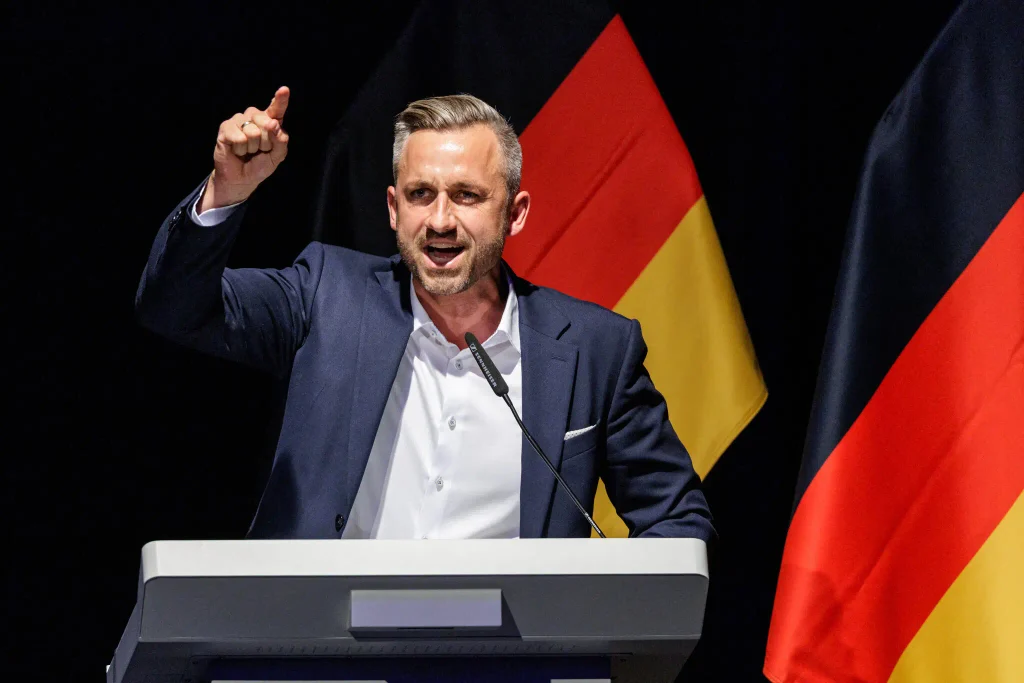
On Tuesday, in a reception room at the Chancellery in Berlin, Friedrich Merz stood in front of a group of teenagers who build things properly, and one of them asked him a question he did not want to answer.
The occasion was Jugend forscht, Germany’s national science competition for entrants aged fifteen to twenty-one. A year earlier, at the same event, Merz had told the assembled prodigies that Germany needed “clever minds” and “brave young people.” This year, one of those brave young people, a boy who had been researching quantum-secure telecommunications with his brother, took him at his word. He asked how a compulsory real-name requirement for internet users, the Klarnamenpflicht the Chancellor has been pushing, could be reconciled with the protection of whistleblowers and investigative journalists, who depend on the anonymity of their sources to do their jobs. It is the single most obvious objection to the policy, the kind of question a first-year law student learns to ask.
Merz did not answer it. He talked instead about bots, about the AfD’s result in Saxony-Anhalt nine days earlier, about how a public square in which nobody can be sure who they are talking to threatens democracy itself. Then he delivered the line that has since travelled across German media: “Bitte komme mir keiner mit Free Speech. Das hat mit Free Speech nichts mehr zu tun.” Please, nobody come to me with free speech. This has nothing to do with free speech any more.
It was not a slip. Merz went on to describe the American conception of untrammelled expression as a “libertarian” indulgence he personally does not share, and argued that a liberal society has a duty to protect its citizens from “false information, personal degradation, discrimination.” He reminded his audience that he had “grown up in the analogue world,” when a newspaper that printed lies could be sued, and that this, he said, had produced a certain “hygiene.” The implication was left hanging rather than spoken outright: the unregulated mess of the internet needs the same discipline, administered this time not by courts weighing individual claims but by a state that has already decided, in advance, what counts as false.
“Please, nobody come to me with free speech. This has nothing to do with free speech any more.”
Call it what it actually is. This is not consumer protection, and it is not really about hygiene. It is the oldest impulse in politics wearing the newest language: the state deciding, on your behalf, which thoughts you may safely hold in public, and calling that decision protection rather than control. Orwell gave the impulse its cleanest name seventy-seven years ago, in the three slogans inscribed on the face of the Ministry of Truth in Nineteen Eighty-Four: “War is peace. Freedom is slavery. Ignorance is strength.” Merz is not running a Ministry of Truth. But the reasoning he reached for at that podium, that citizens need protecting from information rather than trusted to weigh it themselves, is the same reasoning, scaled down to the size of a Klarnamenpflicht and a press conference.
Orwell noticed something else worth remembering here, about which freedoms a state actually leaves alone. “You are free to be a drunkard, an idler, a coward, a backbiter, a fornicator,” he wrote, “but you are not free to think for yourself.” Capital crosses the German border in milliseconds, unexamined and unbothered. Consumption, private vice, even the coarsest content Merz claims to worry about, all of it moves freely enough. What his government wants to attach a permanent, traceable name to is the one thing that has always frightened power more than any of that: a citizen thinking something the state has not pre-approved, and saying so where others can hear it.

None of this began with Merz. Fifty-one years ago, an organisation called the Trilateral Commission, founded in 1973 by the banker David Rockefeller and the strategist Zbigniew Brzezinski, commissioned a report titled The Crisis of Democracy: On the Governability of Democracies, written by the sociologist Michel Crozier, the political scientist Samuel Huntington and the Japanese scholar Joji Watanuki. Huntington’s section on the United States argued that the trouble with American government in the 1960s was not too little democracy but too much of it. His diagnosis: “some of the problems of governance in the United States today stem from an excess of democracy.” His prescription: “the effective operation of a democratic political system usually requires some measure of apathy and noninvolvement on the part of some individuals and groups.”
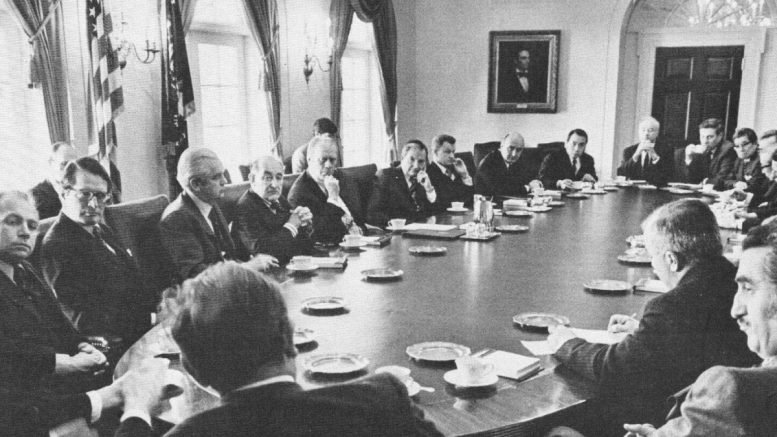
He was candid about which individuals and groups concerned him. The report singled out the political mobilisation of “blacks, Indians, Chicanos, white ethnic groups, students and women,” people who had “become organized and mobilized in new ways to achieve what they considered to be their appropriate share of the action and of the rewards,” and treated that mobilisation as a symptom of the disease rather than a sign of democratic health. Noam Chomsky, reading the same document decades later, called it exactly what it was: the authentic voice of liberal internationalism confronting a public that had started to take democracy seriously, and concluding that the public was the problem. The Commission did not file the report and forget it. Brzezinski became Jimmy Carter’s National Security Adviser and restated its conclusions in print, and Commission alumni filled out the upper ranks of the administration behind him.
Friedrich Merz is not an outside admirer of that tradition. He is a paid-up member of it. Since 2009 he has sat in the European group of the Trilateral Commission, a fact recorded in the Commission’s own published membership rolls and in German lobbying registers, alongside a decade as chairman of Atlantik-Brücke, the Berlin network built to cement German ties to Washington.
There is a wrinkle here worth understanding, because it recurs throughout this story. To preserve its standing as a non-governmental body, the Commission’s own rules require that any member who takes public office step back from active membership while they serve it. That is the mechanism, not principle, by which Merz’s own membership lapsed into inactive status the moment he was sworn in as Chancellor, and it is why Sir Keir Starmer’s name came off the active roster once he entered Downing Street. It does not mean the worldview absorbed across years of closed-door meetings is surrendered at the same moment a resignation form is filed. The stepping back is procedural, not intellectual. The membership roster functions, more than anything, like a waiting room: people cycling out to hold power, and in plenty of cases cycling back in once they no longer do.
The company that waiting room has kept over the decades is instructive. Henry Kissinger sat inside it for years, a fixture of the same North American group whose past chairs and directors read like a Cold War cabinet reunion. So did Jeffrey Epstein, described in an October 2002 profile in New York magazine, published while he still enjoyed the run of Manhattan and Palm Beach society, as “an enthusiastic member of the Trilateral Commission and the Council on Foreign Relations.” Nobody is suggesting Merz or Starmer ever met the man, and no evidence says they did.
The point is narrower and, in its way, more damning: an institution that vets its members by wealth, connections and a willingness to keep its proceedings off the record had no mechanism to notice, or no apparent interest in noticing, that one of its enthusiastic members was, at the very same time, running a trafficking operation for the rich and powerful. An organisation that comfortable admitting a man like that tells you something about what it actually screens for. Not virtue. Access. Readers who want to hear Epstein describe that access in his own words can judge for themselves from the footage accompanying this piece.
Britain has no grounds for smugness on the wider point either. Starmer joined the Trilateral Commission at some point between March 2017 and October 2018, while serving as Jeremy Corbyn’s shadow Brexit secretary, and the investigative outlet Declassified UK has established that Corbyn was never told. Starmer’s fellow members at the time included two former directors of the CIA, and he shared a platform at one of the Commission’s London gatherings with former heads of MI5 and GCHQ. He stepped back from active membership, by the Commission’s own rule, before entering Downing Street. The pattern that produced Merz’s contempt for free speech in a Berlin reception room is the same pattern that put a Trilateral alumnus in Number 10 without his own party leader knowing about it. This is not a German story. It is the house style of a network that spans both capitals, and readers wanting the fuller map of who sits where in it can find it in our earlier investigation, From Rockefeller to Starmer: Mapping the Trilateral Network in the Epstein Files.
Starmer did not have to wait long to see this pattern cost him something concrete. In early 2025 he appointed Peter Mandelson, who also appears on Trilateral Commission membership lists for its European group, to the most prestigious post in the British diplomatic service: ambassador to Washington. Mandelson lasted seven months. Newly surfaced emails showed a relationship with Jeffrey Epstein far deeper than had been disclosed at his appointment, including a letter calling Epstein his “best pal” and correspondence suggesting Epstein’s 2008 conviction was “wrongful and should be challenged.” On 11 September 2025 the Foreign Office withdrew him “with immediate effect.” As with Merz and Starmer themselves, taking up a government post should, by the Commission’s own rule, have meant stepping back from active membership; it evidently did nothing to interrupt the friendships formed inside it. A Prime Minister who was once a member himself lost his own ambassador to exactly the kind of undisclosed overlap this network is built to keep quiet. That is not proof of a conspiracy. It is a fair question about what this kind of network actually vets for.
None of that makes Germany’s anxieties fake. The AfD’s result in Saxony-Anhalt on 6 September, 43.8 per cent of the vote, more than double its 2021 showing, was a genuine rupture: no party of the far right has won a German state election so decisively since 1945. Merz’s own CDU collapsed to 17.2 per cent. Bot-amplified content and coordinated online abuse are real problems, and Germany’s history gives it particular reasons to fear where unchecked extremism can lead. The Network Enforcement Act of 2017, which obliges large platforms to remove “manifestly unlawful” content within twenty-four hours or face fines of up to fifty million euros, was passed with those fears in mind, and it has serious defenders as well as serious critics.
But none of that answers the question the boy at the Chancellery actually asked, and which Merz refused to answer. A compulsory real-name law does not primarily disarm the powerful. The powerful already speak under their own names, from platforms they own or control, backed by lawyers the rest of us cannot afford. What it disarms is the employee who wants to report fraud without losing their job, the source who wants to talk to a journalist without ending up in a government database, the citizen who wants to criticise a minister without their employer finding out by lunchtime. Strip away anonymity and you have not cleaned up the public square. You have simply ensured that everyone in it can be identified by whoever holds the power to act on that information, today Merz’s government, tomorrow whoever succeeds him. And the deeper question, the one he answered by refusing to answer it, is who decides what counts as false information once the state has the tools to trace every claim back to a name. He is proposing to be the judge in his own case.
It is worth remembering that the powerful elsewhere have discovered the same convenient elasticity in the idea of free speech. The day after Donald Trump’s 2024 election win was certified, Mark Zuckerberg announced that Meta would scrap its third-party fact-checking programme and loosen its rules on subjects such as immigration and gender, calling it a return to free expression. He made no equivalent promise for Europe, where Meta continues to operate under the tighter rules it has never offered to relax. Free speech, on this evidence, is not a principle either side actually holds. It is a resource deployed wherever it serves power and withdrawn wherever it does not. Merz decides that democracy needs less of it. Zuckerberg decides that his shareholders need more of it, but only in the market that rewards him for saying so. In both cases, the public is the object of the decision, not a party to it.

That is the thread running from a memorandum written for bankers and statesmen in 1975 to a Berlin reception room fifty-one years later. The vocabulary changes. Apathy becomes hygiene. Excess of democracy becomes false information. The marginal groups of the 1960s become the anonymous accounts of 2026. The underlying claim does not change at all: democracy is fine, so long as it produces outcomes the people running it can live with, and when it does not, the fault lies with too much participation rather than too little accountability.
The remedy is not to trust the next polished formulation from the next member of that network, whether he sits in the Chancellery, in Downing Street, or steps back onto the roster once he leaves both. It is the Bundestag and Westminster alike doing the unglamorous work of forcing every real-name and online-safety proposal through genuine scrutiny, with the whistleblower and press-protection question answered before a single clause is drafted, not waved away at a podium. It is journalists asking the people who write these laws to answer the questions a fifteen-year-old already knew to ask. And it is voters remembering that when a Chancellor tells you a policy has nothing to do with free speech, he has, for once, told you the exact truth. It has everything to do with power, and nothing at all to do with you.
Merz got one thing right at that podium, without meaning to. This was never about free speech. It was about who gets to decide what you are allowed to say, and who, fifty years after that first quiet memorandum, still thinks the answer should be them.

SOURCES
- Merz’s “Bitte komme mir keiner mit Free Speech” remarks, Jugend forscht reception, Berlin, 15 to 16 September 2026: corroborated across Junge Freiheit, Nius, Tichys Einblick and Apollo News.
- AfD Saxony-Anhalt result, 6 September 2026 (43.8 per cent; CDU 17.2 per cent): Chatham House, Al Jazeera, AP/Britannica live coverage, Wikipedia.
- Netzwerkdurchsetzungsgesetz (NetzDG), 2017, 24-hour removal rule and €50m fines: Center for Democracy & Technology; Wikipedia.
- The Crisis of Democracy (Crozier, Huntington, Watanuki, 1975), Trilateral Commission: quotations cross-checked against multiple academic citations of the Huntington section.
- Trilateral Commission bylaws on public officials (“must rotate off the commission” on taking government position): Study.com summary of Commission structure; Wikipedia (citing the Commission’s own 2011 FAQ).
- Merz’s Trilateral Commission membership since 2009 and Atlantik-Brücke chairmanship: Lobbypedia; Commission’s own 2011 published membership list.
- Starmer’s Trilateral Commission membership (2017/18 to 2021/22), fellow members, and non-disclosure to Corbyn: Declassified UK investigation.
- Jeffrey Epstein, “an enthusiastic member of the Trilateral Commission and the Council on Foreign Relations”: Landon Thomas Jr., “Jeffrey Epstein: International Moneyman of Mystery,” New York magazine, 28 October 2002.
- Meta/Zuckerberg content-moderation announcement, 7 January 2025, and non-extension to the EU/UK: Foreign Policy; Brussels Signal; Tech Policy Press.
- George Orwell, Nineteen Eighty-Four (1949) and Burmese Days (1934): both now in the public domain in the UK (life plus 70 years).
- Peter Mandelson’s appointment as UK Ambassador to the US (early 2025) and his sacking on 11 September 2025 over Epstein correspondence (“best pal” letter, “wrongful conviction” remark): ITV News, NBC News, TIME, Bloomberg, Reuters (via CBC), Euronews, Global News, Gulf News, all corroborating the Foreign Office statement.
- Peter Mandelson’s Trilateral Commission membership, European Group (United Kingdom), listed alongside his House of Lords and Global Counsel roles: Association of Accredited Public Policy Advocates to the EU (AALEP), “The Trilateral Commission European Group Who’s Who,” a professional lobbying-register listing independent of this outlet’s own reporting.