“Total Solidarity” Without Women Is Not Solidarity: It’s Just Another Betrayal
On the morning Labour’s women gathered in Liverpool, all eleven of the party’s affiliated unions found one voice to defend trans rights, and their chair declared that the law must change. The law they want changed is the one that vindicated their own female members.
At 9.13 on Saturday morning, as women from across the Labour Party travelled to Liverpool for their own national conference, the account of Labour Unions posted what it called “a clear message from our Chair”. It read: “Just because something is the law, does not mean it is right. Laws can be wrong. Section 28 was the law, and it was wrong. And you know what the Labour government did? It changed the law. It can be done. It must be done.”
Alongside it came a joint statement from National TULO, the body that speaks for the unions inside the party. “Labour’s 11 affiliated trade unions stand in total solidarity with the trans and non-binary community,” it began. “Trans rights are human rights, and trans rights are workers’ rights.” The unions promised to “do all we can” to protect trans members “from persecution, harassment and attack”, and demanded that the government ensure trans rights are “protected, expanded and upheld in our workplaces and communities.”
Read it twice. It is a statement released on the day of the Women’s Conference, by a movement whose largest affiliates are made up overwhelmingly of low-paid women. The word “women” does not appear in it once.
We will return to that hyperbole, and to what it obscures below…
In July, this was a boycott by a handful of unions. UNISON, ASLEF, USDAW and the Musicians’ Union said they would not attend Women’s Conference in protest at the decision to limit formal proceedings to women. ASLEF declared on social media that it “has a proud history of championing the rights of trans women and non-binary people” and that its delegates had voted to boycott “due to trans women being excluded from attending.” Today the position belongs to all eleven. What began as a faction’s protest is now the collective voice of the affiliated trade union movement.
UNISON’s position deserves particular attention, because its leadership has been unusually candid. Explaining its boycott, the union said the party’s restrictions on access “run counter to UNISON’s policy on trans equality”. In August it went further, committing itself to campaigning to change the law to reflect its understanding that trans women are women. That campaign sits awkwardly with the union’s own rulebook. UNISON’s founders built sex-based representation into its constitution, including seats on the national executive reserved for women, one of them for a disabled woman. In 2025, the union allowed a trans woman who is biologically male to stand for that seat. In August, the Certification Officer, the statutory regulator for trade unions, upheld a complaint brought by a member, Stephen Flaherty, and ruled that UNISON had broken its own rules. UNISON has said it has a responsibility to comply with the law and will not challenge the judgment.
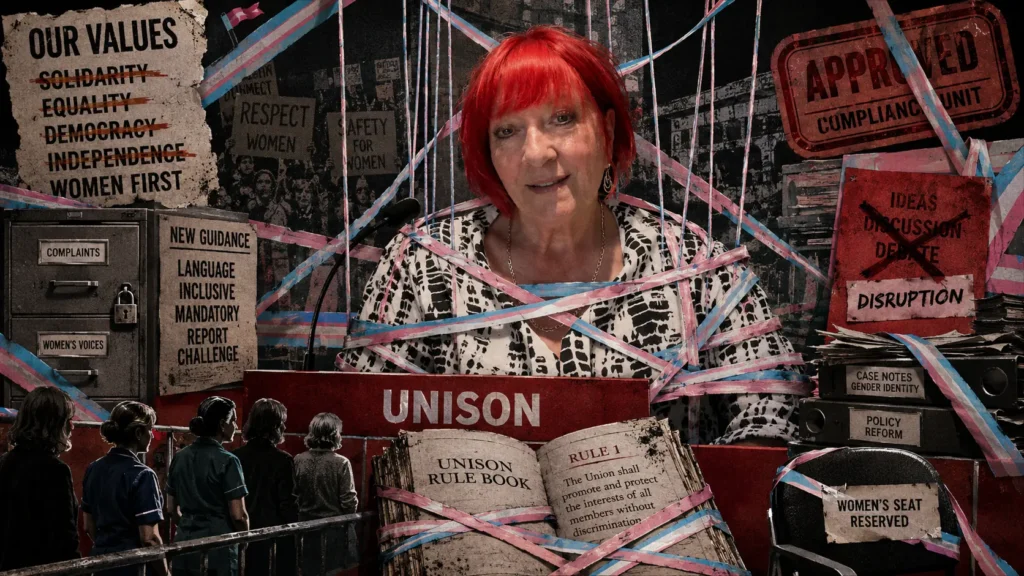
And in the paperwork for its own women’s conference next February, the union now tells members that a reserved women’s seat is open only to members who are biologically female. So the largest union in Britain has conceded, in its own documents, that women’s representation belongs to women as a sex, while boycotting the Labour Party for applying the same principle to its conference floor. The rulebook, the regulator and the Labour Party all agree. It is UNISON’s leadership that is out of step with all three.
The rulebook, the regulator and the Labour Party all agree. It is UNISON’s leadership that is out of step with all three.
So it is worth asking, plainly, what the unions’ single voice actually wants.
The Women’s Rights Law the Unions Want Changed

The chair’s message leaves no room for doubt that the goal is legislative. The word “expanded” in the joint statement tells us the direction. We need not guess at the detail, because a fortnight ago the Trades Union Congress spelled it out. Congress backed a motion condemning the Equality and Human Rights Commission’s updated guidance on single-sex provision as “effectively excluding trans people from swathes of public life”, and calling on the TUC to campaign for gender self-declaration. The motion called on all affiliates to defend trans rights “publicly, actively” and “without compromise.”
It is worth being precise about what the unions are condemning. The EHRC’s updated code of practice, in force since 5 August, is statutory guidance. By the regulator’s own account, it does not make new law or create any new legal obligations; it explains the law as the Supreme Court has found it to be. It does not remove a single protection from trans people. Gender reassignment remains a protected characteristic under section 7 of the Equality Act, and the code confirms that trans people, with or without a gender recognition certificate, remain protected from discrimination, harassment and victimisation. What the code will not do is pretend that “sex” means something the highest court in the land has ruled it does not. The unions’ quarrel, then, is not with a quango’s guidance. It is with the Equality Act itself, and with the women it protects.
Without compromise. Hold that phrase up against a hospital changing room at the start of a night shift, a prison cell at lock-up, a women’s refuge at two in the morning. That is where the slogan ends and the consequences begin, and it is never the general secretaries who have to live with them.
Equality law in this country is not a single right handed to one group. It is a settlement between protected characteristics, and where two of them meet, somebody has to strike a balance. When the Supreme Court ruled in For Women Scotland that “sex” in the Equality Act means biological sex, it did not strip trans people of protection. Gender reassignment remains a protected characteristic. Discrimination against trans people remains unlawful. What the judgment did was confirm that women, as a sex, retain the right to certain spaces and associations of their own. A movement that rejects compromise on that settlement has decided in advance whose rights give way. It is not the trans members.
Section 28 Comparison is the Wrong Ghost to Summon
The chair reached for Section 28 because it is sacred ground on the left, and rightly so. It was a law that told councils and schools they could not “promote” homosexuality, a law that told gay teenagers their families were “pretended”, and the labour movement’s fight against it is one of its finest chapters. Alliances such as Lesbians and Gays Support the Miners helped win a 1985 Labour conference resolution against discrimination, carried with the block vote of the National Union of Mineworkers.
But look at what Section 28 actually did. It took something from gay people and gave nothing to anyone else. It protected no one’s privacy, no one’s dignity, no one’s safety. It existed only to silence.
The law the unions now want rewritten does something entirely different. It keeps protection for trans people against discrimination while preserving women’s ability to undress, sleep, recover and organise without the presence of men. There is a bitter irony, too. Among the groups whose rights the Supreme Court judgment clarified were lesbians, whose ability to form associations of their own depends on sex meaning sex. Reaching for Section 28 to argue that lesbians should lose the right to meet without men is not solidarity with the history of gay liberation. It is a misreading of it.
And there is a more immediate problem with the chair’s argument. When the chair says the law is wrong, we know exactly whom that law has already protected.
What Happened to the Darlington Nurses?

In 2023, female nurses in the day surgery unit at Darlington Memorial Hospital were told, without consultation, that they would be sharing their changing room with a male colleague who identifies as a woman. They objected. They were, in Bethany Hutchison’s words, “ignored, labelled, and subjected to pressure and intimidation.”
They did not get their union. They got their own. When the nurses met the then health secretary, UNISON’s president Steve North accused him of “pandering to transphobic bigotry”, and the nurses went on to establish the Darlington Nursing Union. Think about what that means. Low-paid NHS workers, facing their employer over their conditions at work, concluded that the only way to be represented was to build a trade union from nothing.
They were right. In January 2026, an Employment Tribunal concluded that the trust had harassed and discriminated against the nurses by requiring them to share a changing room with a trans woman and by not taking their concerns seriously. The trust was ordered to pay £187,000 in compensation in June, having reportedly spent more than £600,000 defending its changing room policy. It apologised to each nurse in writing, acknowledging that the tribunal’s findings made clear it “did not get this right for you.”
Now read the joint statement again. The unions pledge to protect their members from “harassment”. A tribunal has found that seven women were harassed at work. Where was the joint statement for them? Where was the declaration of total solidarity, the promise to “do all we can”, when female nurses said they did not want to undress in front of a man? And after a judge found that their treatment was unlawful, where was the reckoning from a movement that had stood aside?
A tribunal has found that seven women were harassed at work. Where was the joint statement for them?
Who Represented Women When the Unions Did Not?

Here is the part the left should find hardest to swallow. When the unions stepped back, somebody else stepped in. The Darlington nurses’ case was supported by the Christian Legal Centre, which provided legal, media and pastoral support from the start. The nurses went on to meet Kemi Badenoch, the shadow equalities minister Claire Coutinho, and multiple MPs and peers. In Fife, when Sandie Peggie felt let down by her union, her MP Neale Hanvey connected her with Sex Matters and For Women Scotland. And when a UNISON member wanted the union’s own rules on women’s seats enforced, he too had to find a lawyer outside the movement to do it.
Working-class women in public-sector jobs are precisely the people the labour movement was built to defend. The unions handed them to evangelical lawyers and the Conservative front bench, then wondered aloud why the right claims to speak for ordinary women. That is not a culture war victory for anyone on the left. It is an organising failure of the first order.
Sandie Peggie’s Case Against the RCN

This week, the same question is being tested under oath. Sandie Peggie is suing the Royal College of Nursing, her union of about 30 years, for allegedly refusing her legal support after NHS Fife suspended her in 2024. She claims the RCN failed to advise her in January 2024 about a potential claim against her employer, refused her request for legal support in January 2025, and did not adequately advocate for her over single-sex changing facilities. Among the witnesses still to be heard on Monday are Bethany Hutchison of the Darlington nurses and Jennifer Melle, a senior nurse at St Helier Hospital who has brought her own case against the RCN.
These are allegations, and nothing has been found. The RCN denies every one of them, and its associate director of employment relations, Norman Provan, has told the tribunal that its decisions followed its ordinary rules. An RCN spokesperson said it is “an anti-discrimination organisation” that supports and represents the rights of all its members. The tribunal will decide. But whatever it concludes, the image will not fade: a nurse of three decades’ membership, sitting in an employment tribunal in Dundee, facing the organisation she paid to stand beside her.
Women’s Rights and the Limits of Union Solidarity
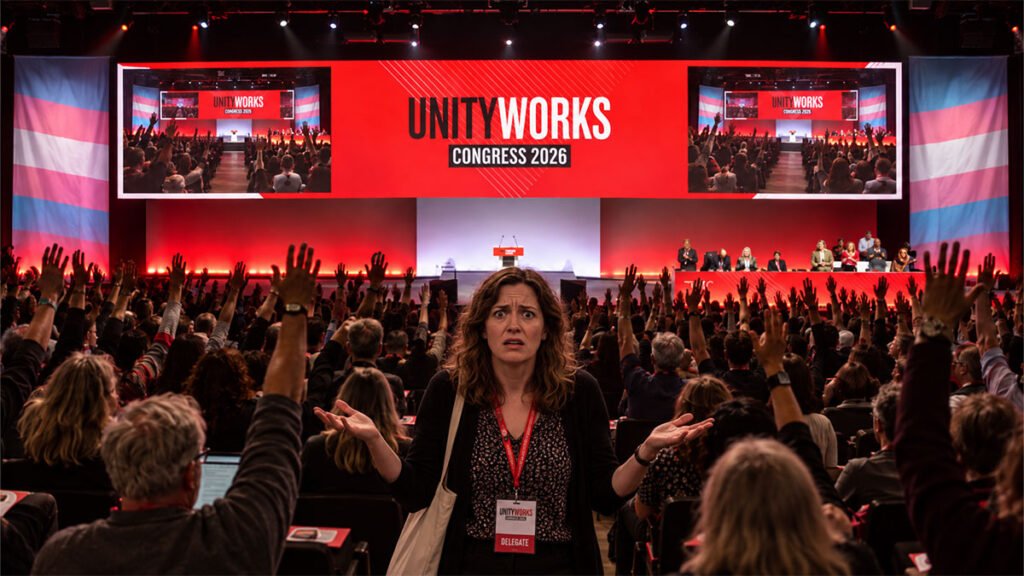
The unions will say they represent every member, and many individual reps no doubt do. They will say trans workers face real hostility, and some do. The pledge to protect trans members from harassment and attack is one this publication supports without reservation. Every worker who is abused at work deserves a union that turns up.
But that is exactly the point. The principle is universal or it is nothing. A trade union exists because a single worker facing an employer has almost no power, and the bargain is simple: you pay your subs, and when trouble comes, you do not face it alone. That bargain does not come with a political test. It does not ask whether your case is fashionable at head office. The moment it does, solidarity has become patronage.
The principle is universal or it is nothing. The moment it asks your politics, solidarity has become patronage.
So the eleven unions owe their members some straight answers. Which part of the Equality Act do they want repealed? Do they believe the Darlington tribunal got it wrong? If Parliament did as they ask, what protection would remain for a woman who does not want to undress in front of a male colleague? Will UNISON bring its practice back into line with its own rulebook, as the regulator has required, or campaign to change that too? And have their female members, the care workers, shop workers and nurses who fill their ranks, ever been asked?
They should put it to a vote. They should publish exactly what legal change they seek. They should bargain for single-sex facilities alongside good unisex provision, as the Darlington trust itself has now committed to do. And someone at UNISON should find the decency to apologise to seven nurses who were right.
Eleven unions found one voice this morning to say that trans rights are workers’ rights. They are. There is one more sentence the movement needs to say just as clearly, and today, on the day of the Women’s Conference, not one of them could bring themselves to say it.
Women’s rights are workers’ rights too.