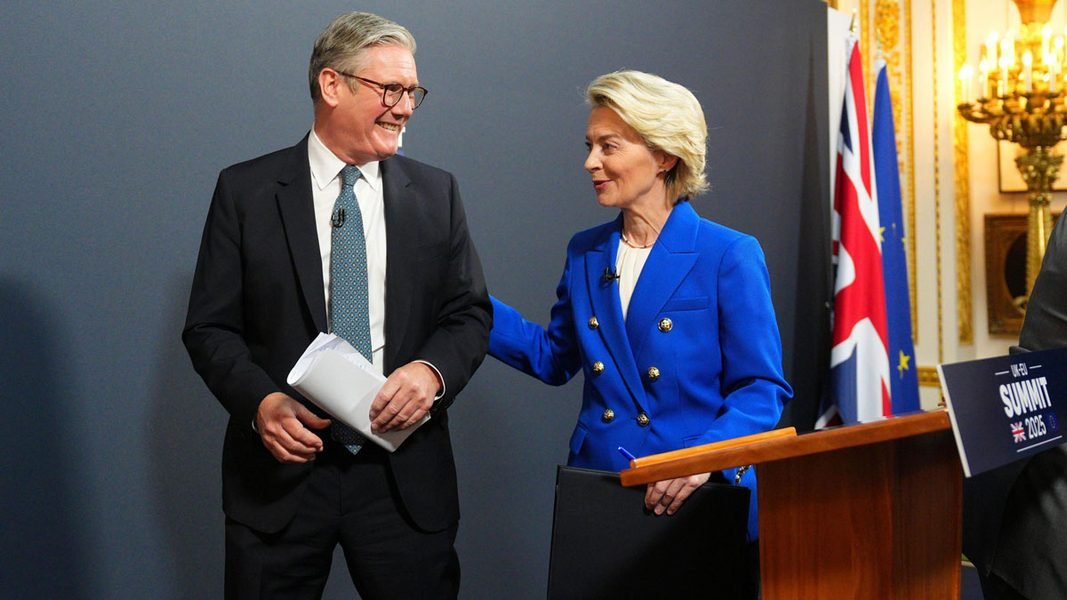
The Prime Minister told the City of London that Brexit has failed. His own Chancellor has spent the year boasting that Britain leads the G7. On Friday, Andy Burnham expects to sign Britain up to laws it will have no vote on, to fix an economy his own government says is outgrowing Europe’s. He has no mandate for it, and the evidence does not support it.
On Monday night, Andy Burnham stood in the Guildhall, the oldest dining room of the City of London, and delivered his verdict on ten years of British independence. “The hard Brexit we were given is not good enough for Britain,” he told the bankers, and we had “lost more than we have gained in the last 10 years”. He compared the country’s post-Brexit settlement to the emperor’s new clothes, a truth everyone could see and nobody dared to say.
It was a striking choice of fable, because the Prime Minister’s case is the one with nothing on.
THE GOVERNMENT’S OWN FIGURES
Begin with the government’s own numbers, not those of its critics. In August, the Chancellor, John Healey, greeted the latest growth figures with something close to triumph: “We’ve seen the fastest growth in the G7 this year”. The Office for National Statistics confirmed that Britain was the fastest-growing economy in the G7 in the first half of 2026.
The pace did not slacken over the summer. The economy grew by 0.7 per cent between July and September, the second-fastest rate in the G7, just behind the United States. Over the same three months, Germany grew by 0.2 per cent, Italy stood still and France contracted by 0.1 per cent. The eurozone as a whole managed 0.4 per cent.
So Britain, outside the European Union, outgrew Europe’s three largest economies and the eurozone average. That is not a Leave campaign leaflet. It is the official record.
“Either Britain can prosper outside the European Union, as the Chancellor says, or it cannot, as the Prime Minister says.”
No government can sustain both stories at once. It cannot claim the credit for leading the G7 in the summer, then tell the City in the autumn that the country is failing because it left the EU. Burnham has picked the version that justifies the agreement he wants to sign on Friday.
Honesty requires a caveat, and this one strengthens our argument rather than weakening it. One good year proves little on its own, and GDP per head remains 6.6 per cent below its pre-pandemic trend, a reminder of how much ground was lost after 2008 and the pandemic. Nor is this year’s growth evenly spread. In the third quarter, services grew by 0.9 per cent, led by a 4.4 per cent jump in computer programming and consultancy, while production barely moved and construction fell. The boom is in AI investment and business services. It has not reached Barnsley, Middlesbrough or Wigan.
That is exactly where Burnham’s diagnosis goes wrong. The towns being left behind are not being held back by customs paperwork at Calais. They are being held back by forty years of British governments deciding that the money was in the Square Mile and not in the workshop. Brussels did not cause that, and Brussels will not cure it.
DECLINE INSIDE THE CLUB
The Prime Minister’s case rests on the idea that closer ties with the European Union will revive British industry. The history of our membership says otherwise.
The Office for National Statistics records it without sentiment: the number of workers in Britain’s production sector fell from 8.6 million in 1970 to 3.0 million in 2016, a fall of 65 per cent. The pits closed, the steelworks went cold and the shipyards fell silent while Britain was a full member of the European Community and then the Union. The single market did nothing to stop it.
By the end of membership, Britain’s former industrial regions were among the poorest in north-west Europe. Checking the claim against EU data, Full Fact found that in 2016 the UK had six of the ten regions with the lowest GDP per person among its nearby neighbours. Over the same decades, the City of London grew rich on financial passporting, drew capital away from productive industry and was rescued by the taxpayer when its gambling brought the banking system down in 2008.
That was membership’s settlement for Britain: a gilded capital and a hollowed-out industrial heartland. It was fitting, then, that the Prime Minister delivered his verdict on Brexit to the one part of the country that did best out of the arrangement.
Nor has Europe escaped the decline Burnham blames on Brexit. Germany, the continent’s industrial engine, is shedding manufacturing jobs year on year. According to its own statistics office, German manufacturing employment fell by 2.7 per cent in a year, while its car industry lost 42,300 workers and now employs fewer people than at any time since 2005. If membership protected industry, the EU’s strongest manufacturing nation would not be in retreat.
A PROMISE TO MAKERFIELD

None of this would carry the same weight if Burnham had asked the country’s permission. He has not.
In May, campaigning in Makerfield, a constituency that voted 65 per cent to leave, he said Brexit had been damaging but that “the last thing we should do right now is re-run those arguments”. Makerfield believed him and returned him to Parliament. He then entered Downing Street through a Labour leadership contest, not a general election. Not one voter in this country has put Andy Burnham into Number 10 on a promise to reopen Brexit. The only voters who were asked were told it was closed.
The retreat began almost at once. By September he was telling his party conference that “Brexit has done more harm than good”. This month he accused his opponents of “misreading the public mood” and said Friday’s summit “doesn’t need to be the end of our ambition”.
On Monday he went further still. Brexit, he told the City, was “exactly what our enemies wanted”. Seventeen million people cast their votes in 2016, many of them in towns like Makerfield, and their Prime Minister now tells a banqueting hall that they handed Britain’s adversaries a victory.
“Brexit is not being reversed in a single dramatic act. It is being hollowed out one regulation at a time.”
That is the language of a politician who has decided he knows better than the electorate, and who means to get his way through a run of technical agreements rather than an honest vote.
His own constituents do not appear to share his confidence. A Survation poll of Makerfield, commissioned by the campaign group Britain Unbound, found that 74 per cent believe Britain alone should decide its food standards, the very powers Friday’s agreement hands to Brussels. Some polling suggests opinion on Brexit itself has softened in Makerfield, as it has across the country. But souring on how Brexit was handled is not the same as asking for laws to be written elsewhere. Even voters with regrets still want those decisions made here.
VOICE, BUT NO VOTE
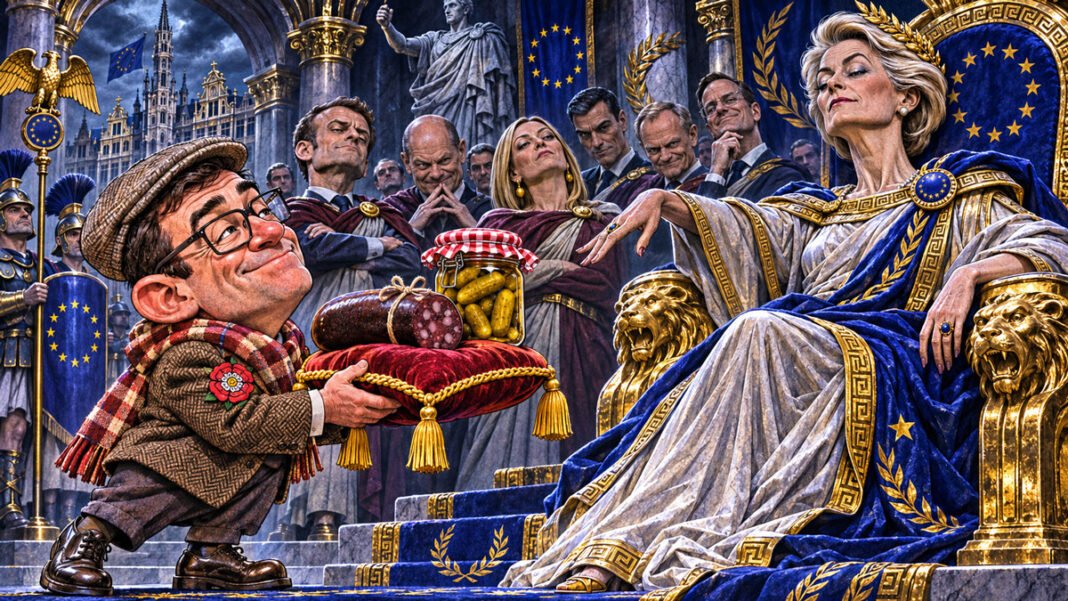
Friday’s food agreement shows how. It rests on dynamic alignment: when Brussels changes its food, plant and animal health rules, Britain changes its own to match. The House of Lords European Affairs Committee warned last week that this will make for a fundamental change in the UK-EU relationship. Its chair, Lord Stirrup, said that the food agreement alone might generate at least 780 pieces of in-scope EU law a year. Many are amendments and technical updates, but that is still roughly two a day, written in a parliament no British voter elects.
What Britain gets in return is a seat at the side of the room. It would have a part in EU “decision shaping” but not decision-making, and would be bound by rules without a vote on their adoption. These rules become British food law, so they bind the butcher in Ashton and the farm shop in Wigan as firmly as the exporter at Dover, even if neither ever sends a product to the continent. Parliament, meanwhile, has been kept away from the detail. The Lords committee recorded that the Government declined to provide a Minister to appear before it until after the summit.
The Prime Minister has already said the agreement “will mean presenting legislation to Parliament next week”. MPs will be asked to approve the machinery after the deal is done, not before. Ministers call this administrative housekeeping. It is not. It is political authority being handed over without an honest account of what is being given away.
THE PRICE OF GOING BACK
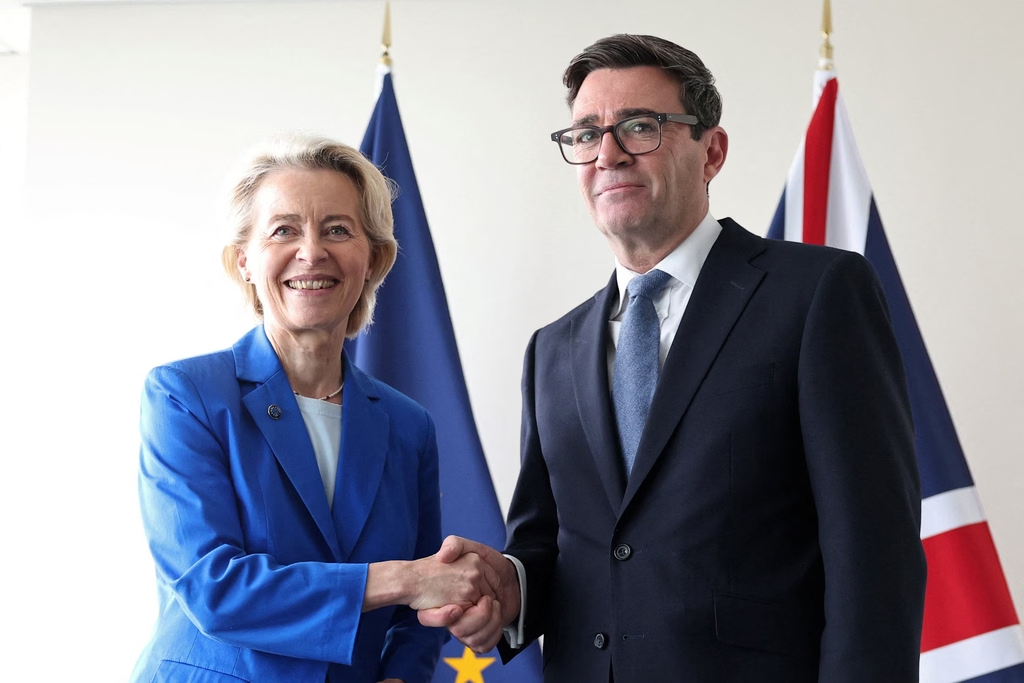
Burnham insists he will not cross Labour’s red lines before the next election. But he has said he hopes to see Britain rejoin in his lifetime, so the public is entitled to know what rejoining would cost.
Before we left, the Treasury put Britain’s net contribution to the EU budget in 2018 at £8.9 billion. That bill was kept down by Margaret Thatcher’s rebate, worth £4.5 billion in 2018. The rebate is gone and would not return automatically. New member states are also bound by the treaties to adopt the euro in time, and Britain’s old opt-out went when we left. No minister has explained how putting sterling on the table would rebuild a single steelworks, factory or shipyard.
Even the smaller agreements carry a bill. A Commons Library briefing records that both the food and emissions trading agreements involve a UK financial contribution, and a draft electricity text concedes that participation in parts of the EU’s internal market “requires an appropriate level of financial contribution”. None of these payments has been costed in public, and none will be put to a vote.
FREE MOVEMENT AND WAGES
Then there is free movement, the issue that decided the referendum in towns like Makerfield.
Ten years ago, Andy Burnham understood it. He attacked a system of free movement “used by multi-nationals to undermine wages”, and he was right. Cheap, mobile labour suited employers who wanted to hold down pay and avoid training anyone locally.
Last month, as Prime Minister, he said the country needs an “honest discussion” about returning to the EU’s free movement rules. Friday’s package already includes a youth mobility scheme for young people to study, work and travel in each other’s countries, with annual numbers in each direction expected to be between 80,000 and 100,000. He has not explained how the rules that undercut working class wages in 2016 have become a remedy for working class towns in 2026.
THE COST OF LIVING ALIBI
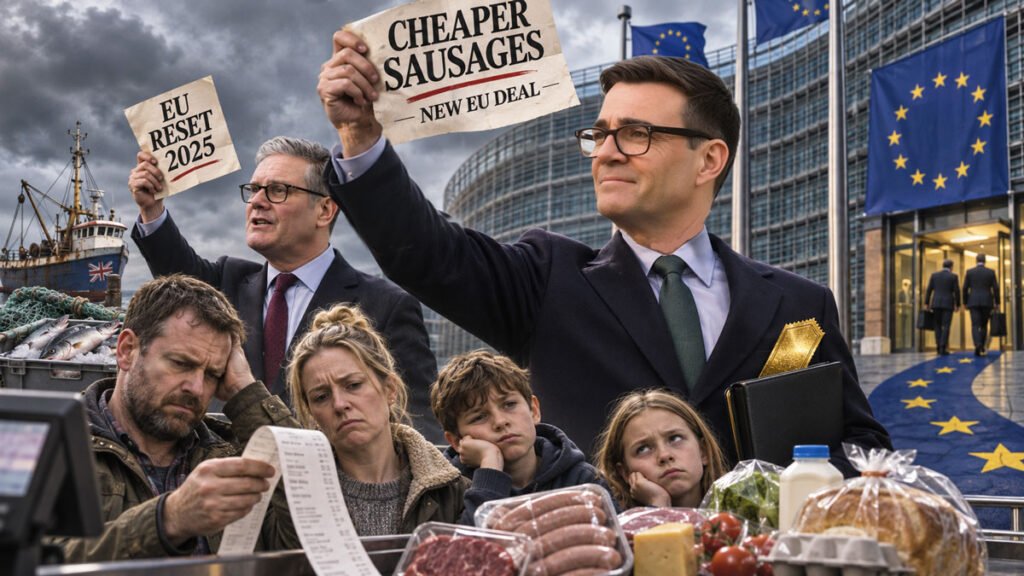
Every step back towards Brussels is sold as relief for the weekly shop. Burnham says the food deal will “get food prices down”, and on Monday he promised progress on “bringing down electricity bills” too. Keir Starmer promised exactly the same in May 2025, when even Brussels warned that the effects could take years to reach consumers. Eighteen months on, the deal is still not in force; the government intends it to take effect in mid-2027. The fresh-produce importers who supply half the country’s fruit and vegetables warn that it will add £300 million to the nation’s food bills “for no measurable benefit”.
WHAT BREXIT WAS FOR
The Tribune has never pretended that leaving the European Union would rebuild Britain by itself. We campaigned to leave as democratic socialists in the tradition of Tony Benn, because we believed the people who make the laws should be answerable to, and removable by, the people who live under them. Brexit was never an industrial strategy. It was the return of the power to have one.
What it did not supply was the nerve to use that power. Successive governments, Conservative and Labour, inherited the freedom to back British industry with public investment, to take energy and water into public ownership, to buy British for public contracts and to direct capital towards the towns the City forgot. Almost none of it was attempted. The failure belongs to Westminster, not to the referendum.
That work can still be done, and it can be done here. Britain can trade with Europe, co-operate with Europe and be a good neighbour to Europe without surrendering the right to choose its own direction. What it needs is a government willing to rebuild the country it governs, not one looking for a parliament overseas to take the decisions and the blame.
Makerfield was promised in May that the argument was over. On Friday, the Prime Minister expects to sign it away in a room where Makerfield has no vote.
Brexit did not fail the heartlands. Westminster did, and now it wants to send the power, and the bill, to Brussels.
Enjoyed this read? I’m committed to keeping this space 100% ad-free so you can enjoy a clean, focused reading experience. Crafting these articles takes a significant amount of research and heart. If you found this helpful, please consider a “small donation” via PayPal or GoCardless to help keep the lights on and the content flowing. Every bit of support makes a huge difference.

[heartlands_support]