Why the Darlington Nurses Ended Up at Reform
When trade unions and the liberal left decided that defending biological sex was something to be resisted, they created a political vacuum. Reform UK is filling it. This is the story of what happens when women stop waiting to be represented and start representing themselves.
There was a small moment at Reform UK’s conference in Birmingham this weekend that deserves considerably more attention than it received.
At a Christian Fellowship for Reform fringe meeting on Friday, 4 September, Andrea Williams of Christian Concern told the audience that Bethany Hutchison, the lead nurse in the Darlington nurses’ case, was sitting in the room. Williams told delegates that the established unions had failed Hutchison and her colleagues, leading them to establish their own organisation, the Darlington Nursing Union.
It would be very easy for the left to dismiss that scene. Another feminist has wandered off to Reform. Another woman has been seduced by the right. Another supposed example of some inexplicable rightward drift.
That explanation is not just convenient. It is lazy, and it insults every woman who has ever had to build something for herself because the people paid to build it for her would not lift a finger.
The more honest question is this: where exactly did people expect these women to go?
Seven nurses, one tribunal, and a union that looked away

The Darlington nurses are not Reform activists, nor did they begin as activists of any sort. They began as NHS nurses who objected to being required to share a female changing room at Darlington Memorial Hospital with a transgender colleague who was born male. They raised it with management. They were told, in effect, to reconsider their attitude. They took it to an employment tribunal, and on 16 January this year, they won.
Employment Judge Seamus Sweeney found that requiring the women to share the changing room amounted to unwanted conduct related to sex and gender reassignment that violated their dignity and created a hostile, humiliating and degrading environment. The case succeeded on indirect sex discrimination as well as harassment. The trust apologised, paid seven of the nurses a combined £187,000, and committed to separate facilities.
Readers of this publication will recognise the pattern underneath it, because it is the oldest one in the movement. Emma Paterson founded the Women’s Protective and Provident League in 1874, at a time when the established unions frequently refused to organise women at all. Mary Macarthur founded the National Federation of Women Workers in 1906, then helped organise the women chainmakers of Cradley Heath into their famous victory four years later. Each generation of working women has, at some point, discovered that the room built to represent them has quietly locked its door, and has gone and built another room rather than wait for someone to unlock it. Nobody granted these women that right. They took it, because the alternative was to keep asking politely for something that was never coming.
This is what trade unionism looked like before it forgot itself, and what it looks like again the moment women decide to stop waiting for permission. The Darlington nurses asked Unison for representation and were ignored. Before the tribunal had even ruled, Unison’s own president accused the health secretary of pandering to anti-trans bigotry, for the offence of agreeing to meet them. When the judgment came down finding unlawful discrimination against seven working women, Unison’s public statement ran to a single paragraph confirming its policy remained unchanged.
UNISON would argue that it is defending another group of workers it believes is vulnerable to discrimination, and it has every democratic right to campaign for the law to change. The question its female members are entitled to ask is why that campaigning has so often seemed to leave their own sex-based interests without an advocate, and why a statement responding to a tribunal finding of unlawful discrimination against seven of its own members found no room for a single word of solidarity.
Four of the nurses, having already been vindicated in a courtroom, still face investigation by the Nursing and Midwifery Council for having spoken publicly about the case.
Let that stand as its own sentence for a moment. Women who won in a court of law can still find their professional registration under scrutiny for speaking publicly about the dispute in which that court ultimately vindicated them.
So they built the Darlington Nursing Union, the first of its kind, and they carried on.
The Moment They Stopped Asking and Started Demanding
Bethany Hutchison stood in front of Nigel Farage and asked for a commitment…
On the Saturday of the same conference, Bethany Hutchison stood in front of Nigel Farage himself, on camera, and did the thing every good organiser eventually learns to do. She stopped hoping for sympathy and asked for a commitment she could hold him to.
What will Reform do, she asked, to ensure single sex spaces are lawfully enforced, not only across the NHS but across every institution in the country. And what will Reform do to protect a nurse who loses her career for defending biological reality in her own workplace.
Farage did not deflect. He told her there was a Supreme Court ruling on this, and that it was simply not being enforced, whether in the civil service, the public sector or the NHS. Women deserved their own single sex spaces, he said, and he would fight for that. When Hutchison told him she was currently under NMC investigation despite having already been vindicated in court, and asked him to hold the regulator to account, his answer came without a beat of hesitation. “All right. We will.”
Watch that clip and understand what actually happened in it. A working nurse from Darlington stood in front of a man who may be the next prime minister of this country and made him say, on the record, in front of a room full of cameras, words that no health secretary has managed to put into enforceable guidance in over a year. Call it what it actually is: a woman doing precisely what her own union should have been doing for her since 2023, doing it herself because nobody else would.
She deserves to be told that plainly, by us, before anything else is said about what happens next.
What She Deserves Next Is the Truth, Not Applause
Because she does deserve the truth, and the truth is this. The Supreme Court ruling Farage invoked was not a freestanding statement about biology floating above the law. It was an interpretation of the Equality Act 2010, the statute that defines what sex means in British law, the statute that contains the single sex exceptions the Darlington nurses actually won under, and the statute that creates the harassment and indirect discrimination provisions their tribunal victory rests on.
That Act did not appear from nowhere. It consolidated fifty five years of legislation built specifically to give working women a legal remedy, running from the Equal Pay Act of 1970 through the Sex Discrimination Act of 1975 and everything Parliament added to protect women in the decades that followed.
Reform UK’s stated policy, announced by Suella Braverman in February and repeated since by Farage himself, is to repeal that Act entirely. In its place, Reform has proposed a Women and Motherhood Protection Act, promising to keep equal pay, sex discrimination protection and maternity rights intact.
What it has not done, in the seven months since it was announced, is publish that promise in the kind of clause by clause detail that a solicitor rather than a press officer could actually rely on in front of a tribunal. Nobody has said what happens to the indirect discrimination test. Nobody has said what happens to the harassment provisions. Nobody has said what happens to the single sex exceptions that won the Darlington case in the first place.
Which means the man who told Bethany Hutchison the law simply needs enforcing leads the party whose published policy is to abolish that law. He did not say this to her, and to be fair, nobody in that room demanded he reconcile it. That reconciliation does not disappear because it went undemanded on the day. Somebody has to raise it now, before a single vote is cast on the strength of four words spoken from a stage, and it should be raised by people who are on her side, not by people looking for a reason to sneer at her for asking the question at all.
A promise made from a stage costs nothing to make. The cost only appears afterwards, and by then it is someone else who pays it.
There is a case for Farage’s answer that deserves to be made honestly, because dismissing it entirely would be its own kind of dishonesty. For three years, the only public figures willing to say the word biological about this case out loud have sat somewhere to the right of the Labour front bench. Wes Streeting told the nurses something had gone wrong in our society, then took more than a year to produce guidance that still has not arrived. James Murray, his successor, has been accused of quietly dropping the meeting his predecessor promised. Against that record, a man willing to say the law simply needs enforcing, unprompted, in front of a camera, is offering something these women have not had from anyone claiming to stand with them. That matters. Acknowledgement is not nothing.
But acknowledgement is not legislation, and warmth from a stage has never once amended a statute book.
A Political Promise Is Not a Legal Right
This is not a hypothetical risk. It has already run its full course, on a different group of women, over a different injustice, within living memory.
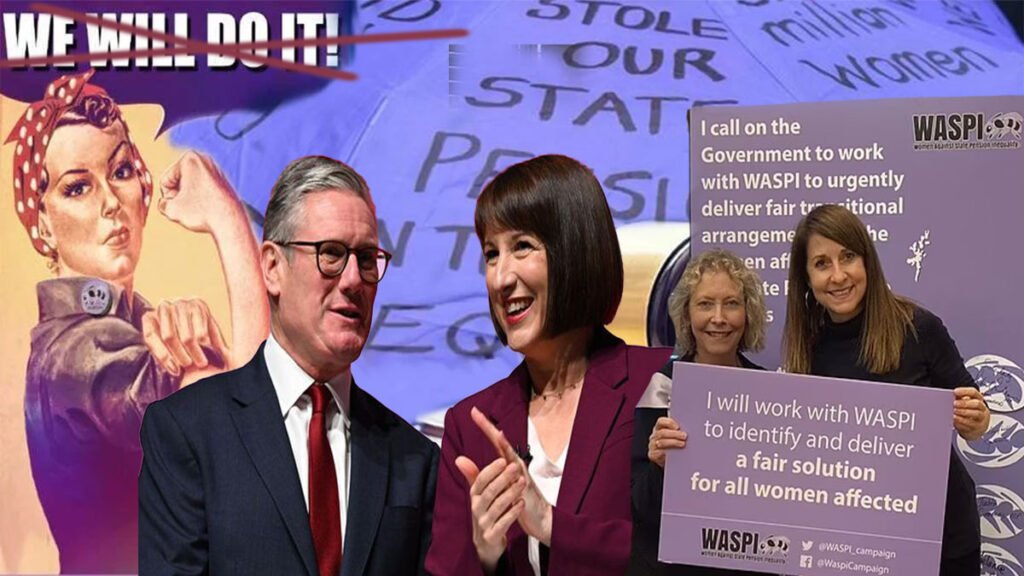
In 2019, Labour promised the WASPI women, born in the 1950s and given almost no warning that their state pension age was rising, a compensation scheme John McDonnell called “a historic debt of honour,” costed at fifty eight billion pounds. Labour won power in 2024 and rejected compensation that December. Legal action forced ministers to reconsider, and on 29 January this year, they rejected it again. WASPI is now back in the courts pursuing a further judicial review. The debt of honour survived opposition rather better than it survived office.
Labour promised WASPI women compensation… and rejected it twice
A survey of nearly eleven thousand WASPI women, not a national poll, but a fair reading of how the campaign’s own membership felt, found support for Labour had collapsed to seven per cent, down from thirty per cent at the last election, while support for Reform had climbed to twenty four per cent, up from fifteen. Farage did not win those women with a promise. Asked directly by Talk Radio where Reform stood on compensation, he said: “I’ve never made any false promises to WASPI women. It’s done, it’s over.” He told them plainly that nothing would change, and they moved to him anyway, because a government that had broken its word twice had no patience left to spend.
Every union official who called these women bigots built the road to Reform
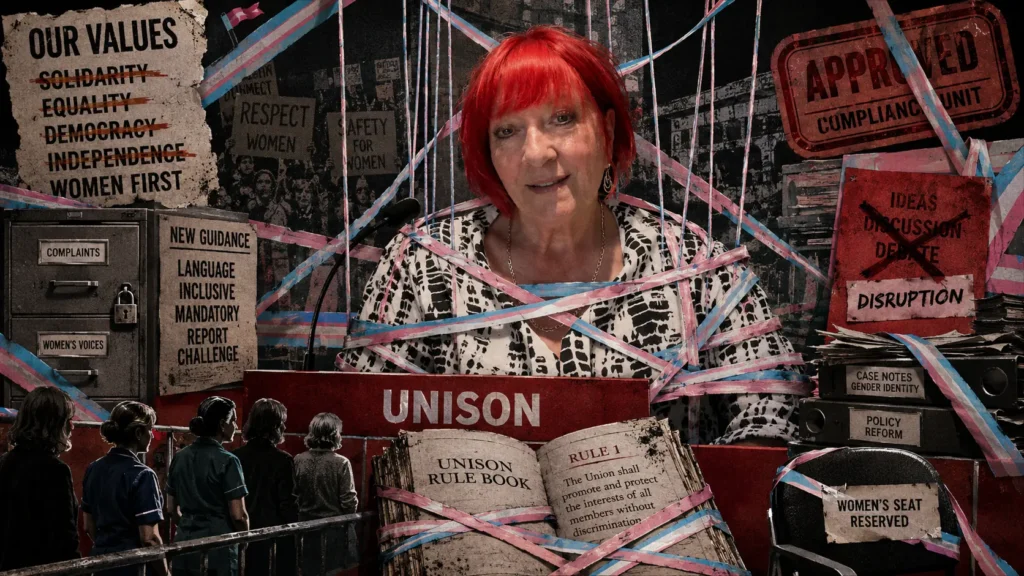
None of this is a case for the institutional left to feel vindicated. It is the opposite. Every union official who called these women bigots, every general secretary who wrote a single paragraph where solidarity should have been, every liberal commentator who decided that defending biological sex made a woman disreputable, built the road that led Bethany Hutchison to that microphone in Birmingham. She did not wander off. She was walked to the door by people who called it progress.
But the lesson she has already taught, in a tribunal room and in a changing room and now on a conference stage, is bigger than which party currently has the manners to say the word woman out loud. Nobody handed the Darlington nurses their tribunal win, their union, or four words from a future prime minister. They built each of those things themselves, one refusal at a time, because waiting for someone else to grant them their rights had already cost them three years.
If Reform wants to keep what it was handed in that clip, it can publish the single sex exceptions, the harassment provisions and the indirect discrimination protections that actually won the Darlington case, in a bill, in public, where a lawyer can hold it up against the Act it intends to replace. Until that exists, what Bethany Hutchison walked away with is not yet support. It is a receipt for a debt that has not been paid.
She built her own room when nobody else would let her into theirs. She is not about to hand the deed to whoever finally noticed she was standing outside.

Support The Tribune
INDEPENDENT. READER-FUNDED. AD-FREE.
If you value this article, help keep The Heartlands Tribune publishing independent journalism without intrusive advertising or corporate sponsors.
Choose your monthly amount
Secure payment via GoCardless
SOURCES AND FURTHER READING
– Christian Concern: settlement announcement and trust apology
– Christian Concern: Kemi Badenoch’s letter on the NMC investigations
– CrowdJustice: Support the Darlington Nurses
– Equality Act 2010, full text
– Equality and Human Rights Commission: what the Equality Act consolidated
– Personnel Today: Reform UK would repeal the Equality Act, 17 February 2026
– GB News: WASPI women swarm to Farage’s Reform UK
– GB News: Farage on WASPI compensation, Talk Radio
– MoneySavingExpert: WASPI compensation rejected for a second time, January 2026
– CrowdJustice: WASPI judicial review fighting fund