Farage’s Prescription Is Worse Than the Disease
There is a ritual to British party conferences now, shared alike by the establishment and the insurgents who claim to despise it, though nobody standing at the lectern will ever admit as much. The hall fills and the delegates cheer on cue, so that for a fortnight the party looks larger and more formidable than it really is. Then the cameras leave. The pollsters return to their spreadsheets. The number shrinks.
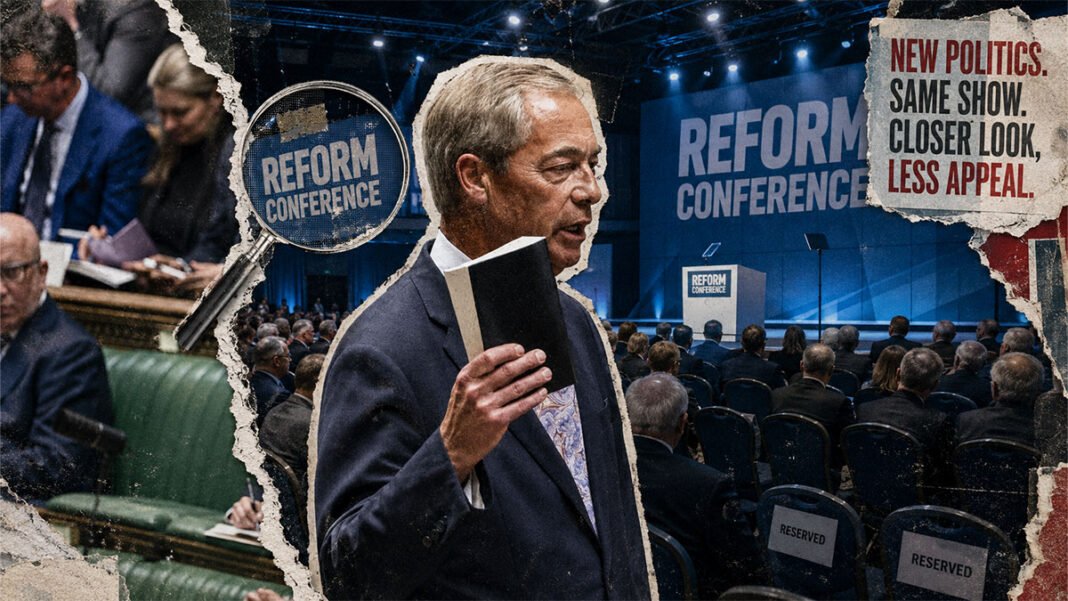
It happened to Keir Starmer’s Labour, whose collapse in public confidence eventually cost him the keys to Downing Street. It happened to Zack Polanski’s Greens, whose favourability has never recovered from his own ill-judged retweet about the police response to the Golders Green terror attack. It has been happening so quietly, for so long, to the Liberal Democrats that the title they currently hold, Britain’s least disliked party, describes indifference rather than affection. This week it is Reform UK’s turn to test the rule, as Nigel Farage arrives at the National Exhibition Centre in Birmingham determined to prove that raw defiance can outrun arithmetic. It cannot. In British politics, the closer you look, the less you tend to like what you see, and Farage’s conference is about to demonstrate why.
Reform’s three day gathering, running from Thursday to Saturday, has been billed by the party itself as a dress rehearsal for government, a preview of the first hundred days of a Farage premiership. He is due to tell delegates on Friday that a Reform government would declare a “national emergency” on its first morning in Downing Street, forcing Parliament to sit through the summer “seven days a week” until a backlog of legislation is cleared. Ministers who miss their own hundred day targets will be sacked without ceremony. And to the judges, peers and civil servants who might stand in the way of any of it, the message from the platform will be blunt: obstruct Reform, and you will “discover just how determined we are.”
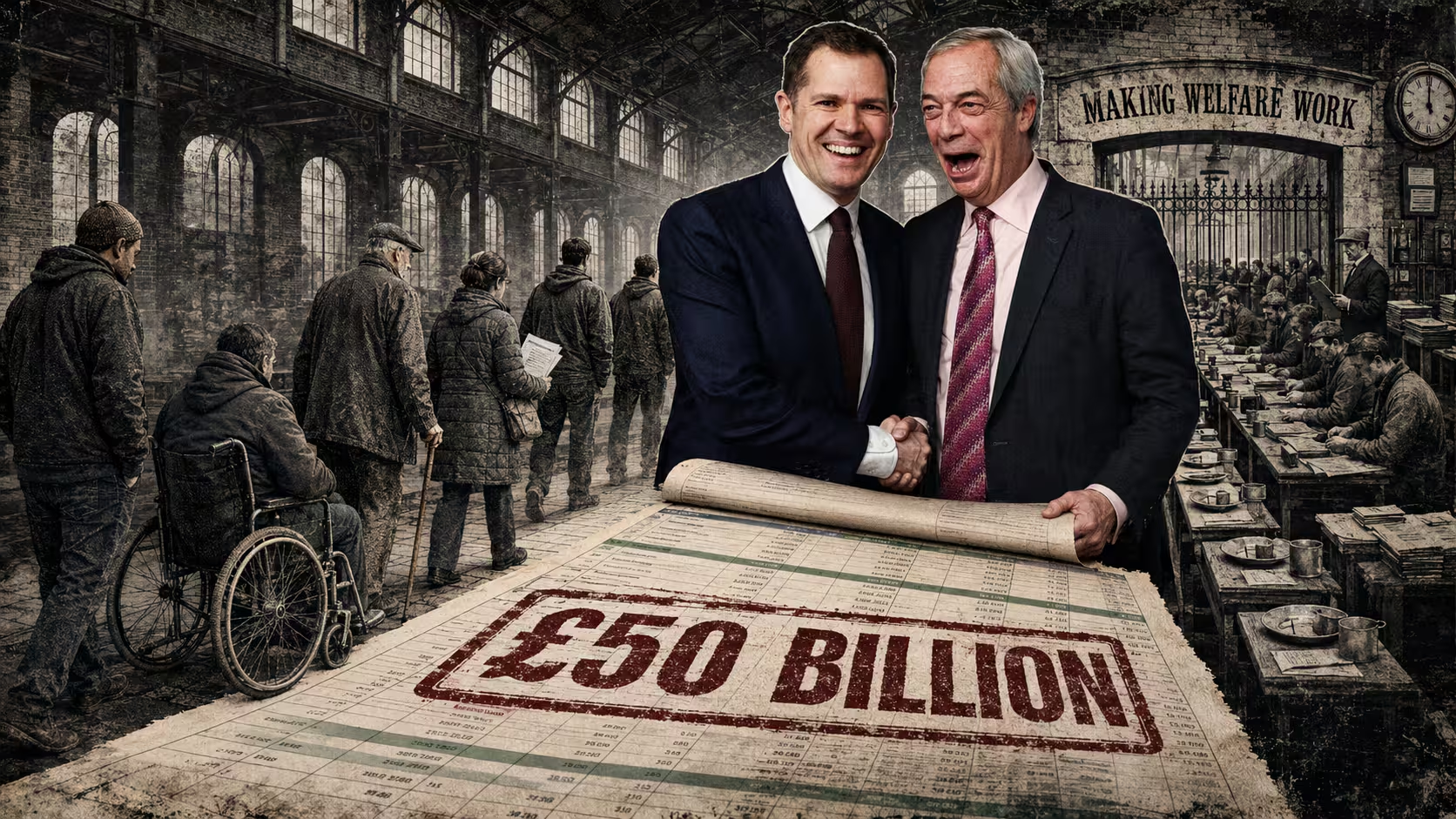
None of this is simply a pledge to build more homes or clear NHS waiting lists, though Reform will offer plenty of that too. Robert Jenrick, the party’s economic spokesman, wants a budget within a hundred days that cuts £80 billion a year from public spending. Richard Tice says he can strip £250 off household energy bills by scrapping carbon levies on generators, and describes Britain’s high streets as being in “a state of national crisis.” What Farage proposes on top of all that is something else entirely: the suspension of the ordinary machinery that stops any government, of any colour, from simply doing whatever it likes. The late Tony Benn used to say there were five questions worth putting to anyone who wields power. What power have you got. Where did you get it. In whose interests do you exercise it. To whom are you accountable. And how can we get rid of you. Farage’s Birmingham pledges fail the fourth question by design, and in failing it, they quietly answer the fifth as well. A prime minister who can force Parliament to sit on his own timetable, sack ministers on his own say so, and warn off judges and civil servants who resist him, has spent his first hundred days dismantling the very mechanisms the public would need to get rid of him.
The diagnosis is sound enough. The prescription is where the danger lies.
Farage has his reasons for reaching so hard for the theatrical. This has been a wretched summer for Reform. YouGov’s voting intention poll of 30 and 31 August put Labour and Reform level at 23 points apiece, a dead heat that would have seemed fanciful to Reform’s own strategists twelve months ago. The underlying numbers are worse. The proportion of Britons who say they would even consider voting Reform has fallen six points over the year to 24 per cent, while those naming it as their first choice are down five points to 16 per cent, both figures back to where they stood before the party’s breakthrough in the 2025 council elections.
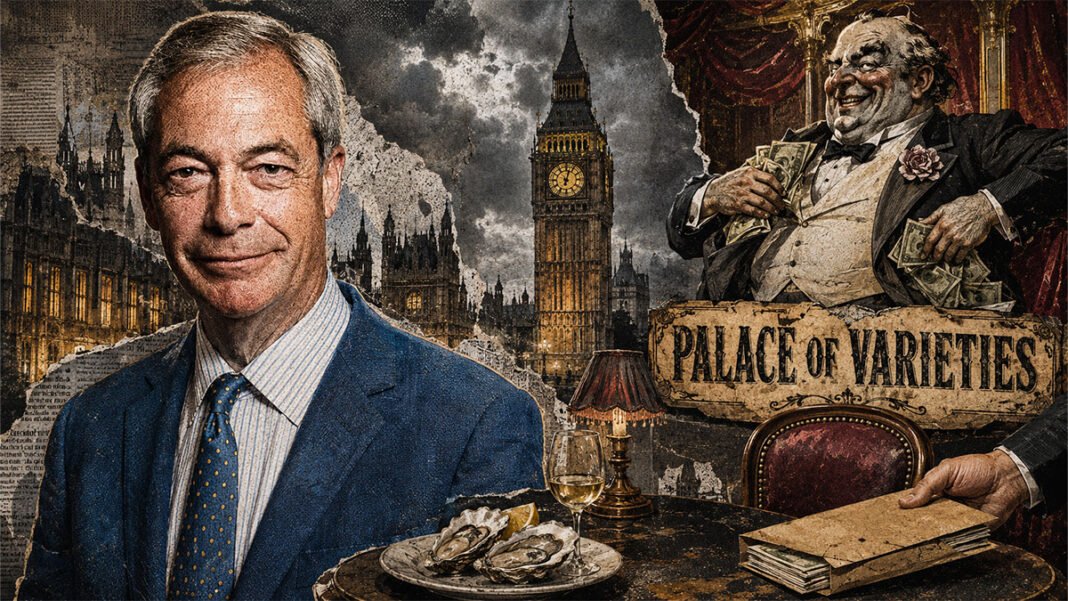
Farage personally has fared no better. His net favourability rating now stands at minus 44, down sharply from a peak of minus 27 last summer, and the proportion of Britons who think he is doing a good job leading his own party has collapsed by 51 points in a year, from plus 18 to minus 33. Only 19 per cent of the public now see him as a prime minister in waiting, down seven points since June, and for the first time since YouGov began asking the question, he trails Kemi Badenoch on the same measure. Much of the damage is self inflicted. Farage has spent the summer fending off questions over an undeclared £5 million gift from the Thailand based cryptocurrency entrepreneur Christopher Harborne, and over donations linked to George Cottrell, a former aide and convicted fraudster who served eight months in an American federal prison, and Cottrell’s mother Fiona. Farage denies any wrongdoing and has dismissed the reporting as an “establishment hit job,” but the affair was serious enough that he resigned his Clacton seat and fought a by-election over it, a move most voters told YouGov they opposed. Even inside his own coalition he is under pressure. Rupert Lowe’s breakaway Restore Britain is viewed favourably by 44 per cent of Reform’s own voters, a genuine threat on Farage’s right flank that Richard Tice waved off at conference with a dismissive “Rupert who.”
None of this means Farage’s underlying complaint about Britain is baseless. When he says fourteen years of Conservative government left the country’s basic institutions broken, he is telling the truth. Courts are gridlocked. Councils totter on the edge of bankruptcy. Working class communities have endured a decade in which wages barely moved while public services were stripped to the bone. Parliament often does feel maddeningly slow, weighed down by its own procedure. The diagnosis is sound enough. The prescription is where the danger lies. Paralysis in British public life was not caused by MPs taking weekends off or civil servants secretly plotting against the popular will. It was caused by four decades of deregulation, chronic underinvestment and the steady hollowing out of democratic accountability, and stripping away judicial oversight and parliamentary scrutiny in the name of an emergency will not build a single house or fund a single hospital bed. It will simply hand unchecked power to whoever is standing at the despatch box, and history offers vanishingly few examples of governments that, having acquired such power, ever handed it back.
Farage’s prediction that Andy Burnham “wants 10 more” years of Labour misrule lands at an awkward moment for the Prime Minister, whose own honeymoon shows the first hints of the same disease. Burnham took office on 20 July, succeeding Keir Starmer after two exhausting years in which Starmer’s premiership unravelled amid policy reversals and the row over Peter Mandelson’s appointment as ambassador to Washington. His personal ratings since have been extraordinary. YouGov’s tracker, running for a decade, has recorded only one higher favourability score for a serving prime minister than Burnham’s latest figure. Yet even his own side is beginning to ask what lies beneath the popularity. At his first Prime Minister’s Questions on 2 September, it was not Kemi Badenoch who landed the sharpest blow but his own backbencher, the Labour MP Tan Dhesi, who told him bluntly that “vibes alone just isn’t going to be enough.”
Dhesi could have been talking about most of Burnham’s programme so far. The Prime Minister speaks often of “public control” while carefully avoiding the words public ownership. His flagship early policy, a return to the £2 bus fare cap from January, undoing the £3 fare Rachel Reeves imposed in her first Budget, is a genuinely popular move for the millions who depend on buses. But roughly £400 million of its £500 million cost is being met by converting international climate finance from grants into loans, a switch the charity Debt Justice has condemned as “a slap in the face” to countries such as Malawi and Zambia, already burdened with debt and facing a climate crisis they did little to cause. Burnham’s regional charm has been sold to the country as economic transformation. What it delivers, on this evidence, is corporate management with a Manchester accent: careful never to threaten the interests that hollowed out the country’s wealth in the first place, content to manage the decline more gently and with a friendlier face, funded where necessary by quietly moving the bill somewhere the British public will not think to look.
A leader arrives promising to be different, is applauded from a safe distance, and is found wanting the moment anyone dares to look closely.
It is precisely this gap, between the scale of Britain’s crisis and the smallness of what mainstream politics is willing to offer, that gives Farage his oxygen. When Labour governs as though public ownership were an embarrassing word rather than a serious policy, when the Greens implode over their own leader’s misjudgements, when the Liberal Democrats settle for being the least objectionable name on the ballot paper, something has to fill the space, and lately that something has been a man promising to rule by decree. Examined honestly and up close, none of these parties survives the encounter with much credit. That is not cause for despair so much as clarity. The trouble runs deeper than any single rotten party. A governing class across the whole spectrum has confused presentation for substance, and the public, given enough time to look properly, keeps noticing.
Britain does not need a prime minister who claims the right to bypass courts and Parliament the moment they become inconvenient. Nor does it need a government content to hand back a pound on the bus fare while the ownership of water, energy and rail stays exactly where the last forty years left it. Real renewal means breaking up the corporate monopolies still extracting wealth from working class communities that have already given everything they have to give. It means returning core utilities to genuine public hands, and subjecting economic power, not only political power, to democratic oversight. Anything less simply adds another chapter to a story British voters already know by heart: a leader arrives promising to be different, is applauded from a safe distance, and is found wanting the moment anyone dares to look closely.
When a politician tells the country he must smash the machinery of accountability in order to save it, ask a simpler question: who is actually being rescued. Not the country. Almost never the country. Just a diminishing man, chasing his own diminishing returns.

Support The Tribune
INDEPENDENT. READER-FUNDED. AD-FREE.
If you value this article, help keep The Heartlands Tribune publishing independent journalism without intrusive advertising or corporate sponsors.
Choose your monthly amount
Secure payment via GoCardless