
Inside Reform UK’s Making Welfare Work: The Sick, the Foreign-Born, and the Return of Compulsory Labour…
Reform UK welfare reforms are a return to the Poorhouse. Reform UK’s ‘Making Welfare Work’ would scrap PIP for 2.89 million people, force long-term claimants into compulsory labour, and ban foreign nationals from almost all benefits. It’s not reform…it’s the 1834 Poor Law rewritten in the 21st century.
Back to the Poorhouse
Robert Jenrick did something rare for a politician promising to save £50 billion. He told the truth about the cost. Writing in the Sunday Telegraph to launch Reform UK’s welfare overhaul, the party’s Treasury spokesman conceded that the plan would not be painless. The number attached to that admission is 2.89 million: the Britons who, under Reform’s proposals, would see their disability and sickness payments modified or taken away entirely. The party’s full policy document, Making Welfare Work, was published today. It runs to fifty pages, and it is considerably more radical, and in places more revealing, than the weekend’s headlines suggested.
That figure deserves to sit with the reader for a moment, because it is not an abstraction from a spreadsheet. It is 2.89 million people, most of them already living with less than most, who would wake up to find the state deciding they are not disabled enough to matter. And the £50 billion itself is not a day-one number. Reform’s own costing table shows net savings of £17.5 billion in the first year, climbing past £50 billion only by 2030 and reaching £63 billion four years after that. The headline figure is where the plan ends up, not where it starts.
Personal Independence Payment and the health element of Universal Credit would both be scrapped for working-age adults and replaced with a Health Security Allowance, a single flat payment worth £429.80 a month at current rates, reserved for a defined list of severe conditions: terminal illness, profound physical or learning disability, severe autism with high support needs, major neurological disease, serious brain injury, and comparably severe or unstable cases. Anxiety, depression and ADHD are not excluded outright, but the paper marks them for what it calls enhanced scrutiny, meaning a higher evidential bar than other conditions face. Everyone else moves onto council-run Disability Support Accounts, paying not cash but vouchers for equipment, adaptations, transport and personal care. One consequence buried in the small print: only Health Security Allowance recipients keep access to a Motability vehicle. Everyone shifted onto the lower tier loses it.
Here the argument requires precision, because precision is exactly what Reform’s public framing avoids. PIP was never an out-of-work benefit. It exists to cover the additional cost of living with a disability: the wheelchair that wears out, the adapted car, the carer who helps someone get dressed in the morning. You can work full time and still claim it, because disability does not stop costing money the moment you find a job. Jenrick’s language, describing the current system as “suicidal empathy” and insisting that “dumping our young people onto welfare isn’t compassion; it’s neglect,” conjures an image of mass idleness that the benefit itself was never designed to address.
It would be dishonest, in the spirit of the fairness this publication insists on, to pretend Reform’s plan contains nothing worth taking seriously. The employer insurance mandate, requiring firms with more than five staff to buy Return to Work Cover for the first two years of an employee’s sickness absence, borrows from a genuine Dutch model built on the idea that employers who bear the cost of long-term illness have a reason to prevent it. Reform’s own paper cites Dutch evidence of a 40 per cent fall in disability applications after a similar reform, though that figure comes from the party’s own citation rather than independent verification. What the paper also shows, and does not advertise, is that the mandate nets to precisely nothing for the Treasury: the cost imposed on employers and the compensating cut to employer National Insurance, set at 0.2 percentage points, are identical, pound for pound, in every year of the costing table. It is a cost shifted from the state onto business, not a saving in itself. Even Labour’s own review of PIP, led by disability minister Sir Stephen Timms, concluded in an interim report last month that the benefit was “not fit for purpose.” Reform did not invent the case that the system needs reform. It borrowed it, then answered it with a sledgehammer.
The trouble begins where the mandate meets human nature. Give an employer financial liability for a worker’s future illness, and some will respond not by investing in adjustments but by ‘quietly avoiding anyone who looks like a risk‘ before they are hired at all. The disabled graduate, the cancer survivor, the older worker with a bad back: all become liabilities on a balance sheet before they have said a word in an interview. The Dutch system Reform borrows the idea from operates inside a labour market with stronger job protections and a different welfare architecture. Transplanting the insurance mechanism into Britain’s insecure, gig-driven economy without those protections is not reform. It is an experiment conducted on people who have no way to opt out.
The Return of Compulsory Labour
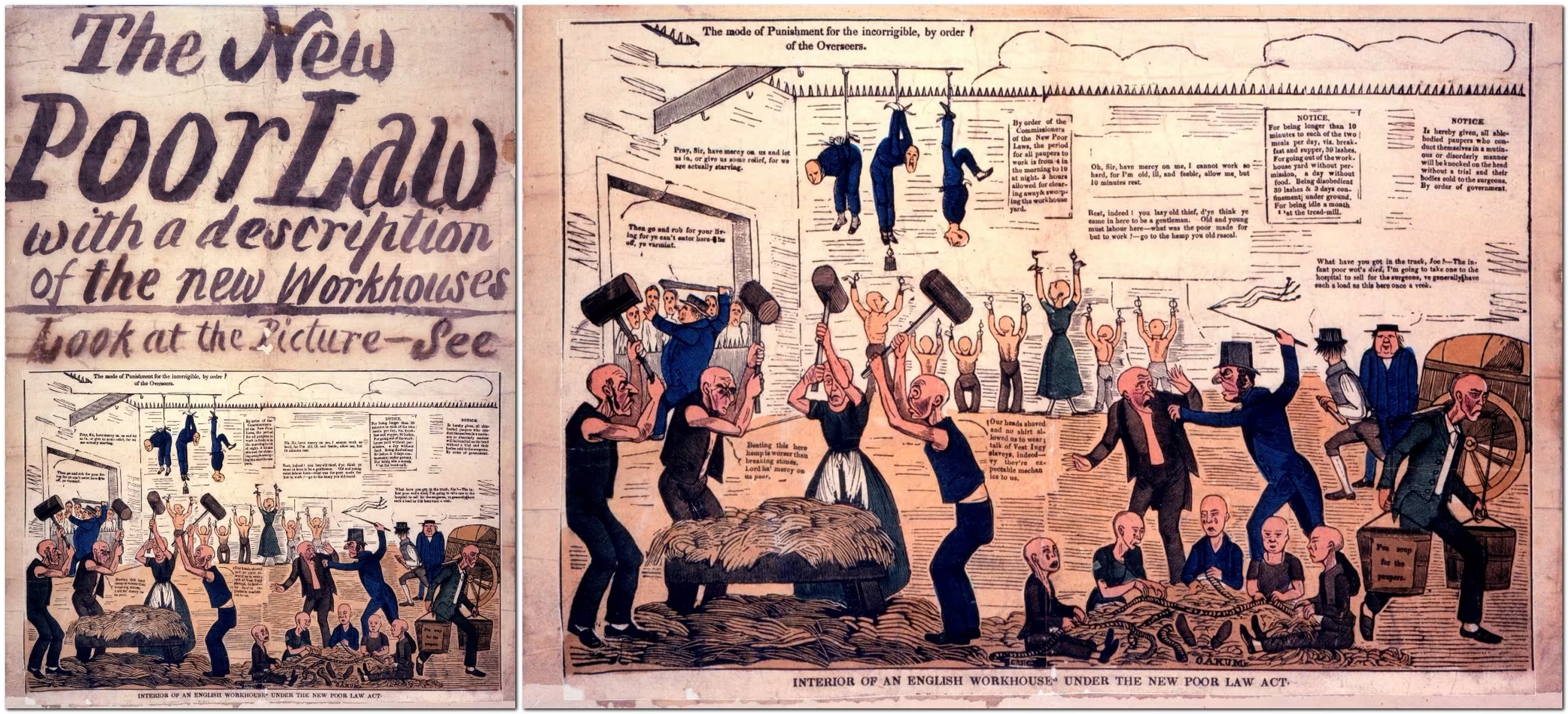
The most radical section of the paper has had almost no coverage. Anyone who has claimed Universal Credit under “Seeking Work” conditions for more than twelve months, more than 330,000 people on Reform’s own count, would be required to work twenty hours a week in a placement assigned by their local council: street cleaning, park maintenance, library shelving, school crossing patrol, even electoral canvassing. The placement is explicitly not employment for the purposes of employment law, so no minimum wage and no employment rights attach to it, only an additional £30 a week on top of existing benefit. Failure to attend, poor performance or what the paper calls on-the-job misconduct triggers what it describes as the full, non-time-limited revocation of benefits: not a temporary sanction, but the permanent loss of support.
Reform’s paper is unusually candid about why this has failed twice before. It names the 2013 Supreme Court case that struck down Iain Duncan Smith’s Mandatory Work Activity scheme for giving ministers too much discretion, and acknowledges that every previous version of compulsory work for benefits, John Major’s Project Work, Tony Blair’s New Deal, the Coalition’s own scheme, ran into the same wall. Its solution is not to fix the legal design. It is to remove the wall. Reform states plainly that it will leave the European Convention on Human Rights and repeal the Human Rights Act specifically to prevent the courts from doing to this scheme what they did to the last one, and would legislate within its first hundred days to make participation a legal duty for councils, who face the loss of central funding if they refuse to comply. Whatever view one takes of workfare as policy, withdrawing from the human rights framework in order to insulate a single welfare programme from judicial challenge is a constitutional decision of the first order, and it arrives in this paper as a footnote to a spreadsheet.
It is also, on Reform’s own figures, a strikingly small contributor to the £50 billion target. The scheme’s net fiscal impact starts at £48 million in its first year and does not reach £1 billion until the 2030s, a rounding error against the totals claimed elsewhere in the same document. The reward for reopening one of the most contested legal battles in modern British welfare policy is, by the party’s own arithmetic, marginal.
There is a second, quieter mechanism buried deep in the appendices. Reform proposes a commission to revise how the Consumer Price Index is calculated for the purpose of uprating working-age benefits, targeting a reduction in measured inflation of 0.6 percentage points a year. The paper is explicit that this compounds: benefits roughly 0.6 per cent lower than they would otherwise have been in year one, 1.2 per cent lower in year two, and onward from there. No vote is required to cut a benefit by a fixed percentage each April. Adjusting the ruler by which it is measured achieves the same result more quietly, and for longer.
British Welfare for British Citizens

Disability was not the only front in Jenrick’s £50 billion package. At a press conference in London this morning, Reform confirmed it would strip almost all welfare from foreign nationals, including European Union citizens holding settled status under the post-Brexit Withdrawal Agreement. Universal Credit, Housing Benefit, Pension Credit, Jobseeker’s Allowance, Child Benefit, free childcare and disability benefits would all close to non-British claimants, with exemptions held back only for contributory state pensions, the War Widows Pension and Armed Forces compensation. The rules would apply retroactively to existing claimants, not only new ones. Anyone who has lived and worked in the country for 25 years would keep their state pension but lose everything else, and would instead be invited to apply for citizenship. In a household where only one partner is British, that partner alone would remain eligible for support, yet their non-citizen spouse’s income and savings would still count against the household’s eligibility threshold, a household penalised twice over.
Reform’s own figures put more than 1.3 million foreign nationals on Universal Credit as of February 2026, up from around 900,000 in 2022, and the paper claims £55 billion has been paid to foreign citizens through Universal Credit or its equivalent since April 2022. Restricting eligibility to British citizens is projected to save around £21 billion a year by 2030, the fifth year of the scheme, of which £13 billion comes from Universal Credit alone.
There is a catch buried in Reform’s own maths, and to its credit the party has not tried to hide it. Stripping benefits from EU nationals in Britain means tearing up the social security provisions of the Withdrawal Agreement, the same treaty that currently protects British pensioners and claimants living across the EU. Reform’s paper sets aside a £500 million contingency for the cost of Britons abroad losing their equivalent rights and returning home to claim welfare, and states outright that this figure assumes only 10 per cent, roughly 130,000, of the 1.3 million British citizens living in the EU would do so. Set against the party’s own estimate that around 1.05 million people in Britain would be affected by the reverse policy, that is an eight-to-one asymmetry, built into Reform’s own model rather than alleged by its critics. It is a bet that Britain, which EU nationals have moved to in far greater numbers than Britons have moved the other way, has considerably more to claw back than to lose.
The response from Westminster has followed predictable lines, though not without substance. A Labour spokeswoman called the £50 billion figure “fantasy economics,” built, she said, on stripping support from disabled people. Rachael Maskell, the York Central MP who led the rebellion against her own government’s PIP cuts last year, said the plan shows Reform “do not want disabled people to play a full role in our society.” The Conservatives’ Helen Whately dismissed it as a “half-baked” attempt to distract from Farage’s donation controversy. Whately’s charge is politically self-serving, since her own party spent years tightening the same system without ever proposing to abolish PIP outright. But it points to something real: even the architects of a decade of austerity understood that the cost of disability is not the same as the cost of unemployment, and that confusing the two produces bad policy dressed up as courage.

There is a political irony here sharp enough to draw blood. Research published by the anti-poverty charity Trussell found that nearly six in ten Labour constituencies most at risk of falling to Reform sit in the top third of areas in England and Wales for reliance on health-related benefits. Trussell’s policy director, Helen Barnard, has warned that cutting disability benefits “will simply push more people to the doors of food banks.” These are the former mining towns, the deindustrialised coastal seats, the places where chronic illness is not an anomaly but the afterlife of the industries that broke the bodies working in them. Reform’s target voter and Reform’s target casualty are, disturbingly often, the same person.
It would be wrong to say the paper contains nothing but punishment. It commits an extra £1.85 billion a year to cognitive behavioural therapy, physiotherapy and employment support, genuine investment rather than pure withdrawal. The fraud and error figures it cites are real: the Office for Budget Responsibility puts the Universal Credit fraud and error rate at 8.5 per cent, and the paper points to a real 2024 case in which five people were convicted of nearly £54 million in fraudulent claims. Expanding counter-fraud enforcement to 9,000 officers is the least contestable part of the entire package, and probably the part likeliest to survive contact with a different government.
There is a silence in the document worth noting too. Reform gives welfare fraud an entire section, a named court case and 9,000 new enforcement officers, a real problem, but a modest one next to a much larger one the paper never mentions. HM Revenue and Customs’ own figures, published this June, put the total UK tax gap, the difference between what is legally owed and what is actually collected, at £59.2 billion for 2024/25, close to the entire £50 billion Reform hopes to save from welfare by 2030.

Analysis of HMRC’s own data by tax justice campaigners shows the amount going uncollected from the wealthiest two per cent of taxpayers has grown sharply over the same period. Making Welfare Work does not contain the words tax avoidance, tax evasion or tax gap once in fifty pages. A paper built on the principle that everyone should pay their fair share finds room to describe, in exhaustive detail, how the sick, the disabled and the foreign-born must prove theirs. It finds none at all for how the wealthy might be asked to prove theirs.
It also undercuts its own rhetoric in one telling place. Its foreword insists that British people have not become 77 per cent sicker in the eight years since 2018, the precise rate at which the incapacity benefits caseload has grown, and treats that gap as proof the system is broken. Yet a few pages later, in its own account of how the caseload grew, the paper explains that judges have progressively widened the legal test for PIP eligibility, allowing the physical symptoms of psychological conditions to count toward mobility awards and loosening what counts as an “intermittent” condition. That is a story about case law and assessment criteria evolving over a decade, not a story about the nation’s health collapsing. The paper’s own evidence undermines the very headline it uses to justify the policy built on top of it.
Even the reinstated two-child benefit cap, saving a projected £2.9 billion a year, comes with a destination already attached: the paper states the funds are pre-committed to Reform’s Save Our Pubs policy. Money withheld from larger low-income families is earmarked, in the same document, for the subsidy of licensed premises. It is the kind of detail a party writes down without noticing how it reads.

There is also an unresolved fracture built into the plan by the constitution it operates within. PIP is devolved to Scotland, so Holyrood could simply decline to adopt Reform’s version of it. But the paper is explicit that if Scotland does not follow suit, Scottish claimants would receive a lower Health Security Allowance than claimants in England and Wales, to avoid duplicating Scotland’s own devolved disability payment, and would not be eligible for a Disability Support Account at all. Scottish claimants lose either way: less generous devolved support if Holyrood holds the line, or a UK-wide Reform government’s version of it if it doesn’t.
This is where the plan reveals its true ancestry, and it is older than any of the parties now arguing over it. The nineteenth century Poor Law rested on a doctrine its architects called “less eligibility”: support for the destitute had to be worse than the meanest paid work, tested where necessary by requiring labour in exchange for relief, so that nobody would choose it over a wage. The workhouse and the parish chapel gates were where that doctrine met the people it governed, sorting the “deserving” poor from the rest by the harshness of what was offered them. Reform’s plan does not merely evoke that history. In the Welfare to Work scheme it is, in mechanism, the same test: unpaid or nearly unpaid labour, administered locally, withdrawn from anyone who does not comply, and now, uniquely, defended in advance by withdrawing from the very human rights framework that stopped the last three attempts at it. The architecture has changed from stone to spreadsheet. The instinct underneath it has not moved an inch since 1834.
Britain’s disability benefits bill is large because Britain’s ill health is widespread, a legacy of deindustrialisation, insecure work, an overstretched NHS and decades of underinvestment in social care, alongside the genuine expansion of legal eligibility that Reform’s own paper documents. None of that is the fault of the people claiming PIP. Savings that push people out of work and into poverty do not vanish from the public accounts. They resurface as NHS demand, as homelessness, as family breakdown, paid for in currencies that never appear on a Treasury spreadsheet but are borne all the same, and borne hardest by the people least able to afford them.
A welfare state that abandons the majority of disabled people to councils, insurers and compulsory labour, and narrows the circle of who counts as British enough to be helped, is not a welfare state in any sense the term has held since Beveridge. It is a return to the parish relief system it was built to replace, the same message delivered in more technical language: you are on your own, unless you are sick enough, or British enough, to count.
The workhouse never went away. It has simply learned to speak in the language of savings and incentives, and this week it found the paperwork to make compulsory labour legal again. It is waiting at the chapel gates for the next Chancellor brave enough to call cruelty by its proper name.
Note to self…Reform mentioned nothing on tax evasion or avoidance…