They asked for teachers. The Republic sent riot police.
A protest that began because nobody was standing at the front of the class. Two weeks later, mass arrests, school closures and riot police exposed a deeper argument about public services, authority and the French state.
It began with an absence. On 18 September, pupils at the Lycée Saint-Exupéry in Créteil, in the Val-de-Marne, walked out because several teaching posts in their school had nobody standing in them. Not a slogan, not a manifesto. A timetable with holes in it.
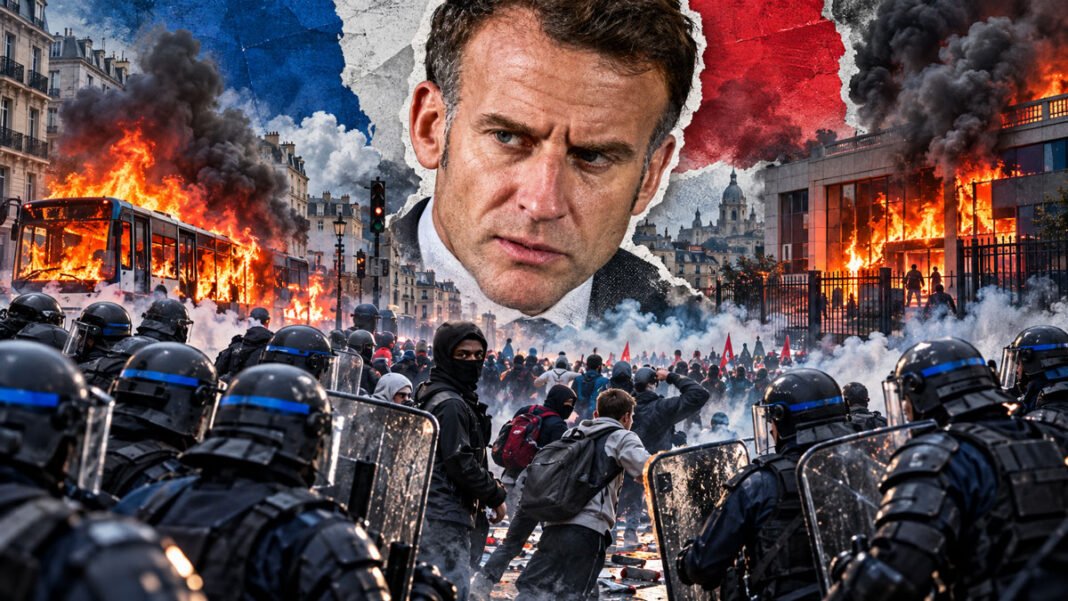
Two weeks later, on Thursday 1 October, the French interior ministry reported 1,949 arrests in a single day, most of them teenagers aged between fifteen and eighteen. It put the number of injured police and gendarmes at 305. By its own count, 1,027 schools were affected, with blockades at 222 of them. Around 400 lycées were ordered to shut on the Friday and teach at a distance, and every prefect in France signed an order banning people from gathering outside the gates of a closed school. Nearly 3,000 pupils have been detained since the movement began.
That is what happened to a complaint about missing teachers.
Let us be clear about the other half of the ledger, because the easy version of this story is no use to anyone. The violence has been real and some of it has been vile. In Nantes, fire destroyed the entrance hall of the Lycée Nelson-Mandela. In Marseille, at a different school that happens to share the Créteil lycée’s name, Saint-Exupéry, hundreds of young people surrounded a fire engine that had arrived to deal with a blaze, drove the crew off and set the vehicle alight. Headteachers have been assaulted. The education minister, Édouard Geffray, said 65 staff and 170 pupils had been hurt since the movement started. Burning a school is not a demand for a school. Nobody on the left should pretend otherwise, and those who torched that fire engine have handed the government the only argument it had.
But a government is judged by what it does with the grievance underneath, and here the timing is almost insolent. On the same day that Prime Minister Sébastien Lecornu convened his emergency crisis cell at the interior ministry, his government presented the 2027 finance bill. Education spending rises by about 1.2 billion euros. And 1,588 teaching posts are removed.
Geffray’s defence is not stupid, and it deserves to be stated properly rather than sneered at. Pupil numbers are falling. He argues that posts are being cut more slowly than enrolment, so average class sizes come down rather than up; that the primary ratio drops from 20.9 pupils per teacher to 20.6; that once the new recruitment reforms are counted, the overall staffing schema is positive by more than 3,200 posts; that last year’s cut was 4,000 and this year’s is far smaller. The government is not making savings on the young, he told reporters.
The children are not complaining about a national average. They are complaining about an empty chair.
This is the thing successive French governments have refused to measure honestly. In Seine-Saint-Denis, the parents’ federation FCPE calculated in 2019 that pupils lost around a fifth of their teaching hours to absences that were never covered, which across a school career adds up to something close to a full year of schooling. That was not a pressure group’s wild guess sitting on its own. The 2018 parliamentary report by François Cornut-Gentille and Rodrigue Kokouendo on the state’s performance in Seine-Saint-Denis described the same pattern of institutional retreat. Eight years on, the pupils of the Créteil academy are telling the Republic what the Republic’s own deputies already wrote down. The crisis is not headcount arithmetic. It is non-replacement, dilapidation, and the quiet national decision that some postcodes get a lesser version of the public service.
THE SEARCH FOR A CULPRIT
Faced with that, the government chose a different argument. Within hours of the crisis meeting, Lecornu’s entourage briefed that the intelligence services regarded the movement as a manoeuvre organised by La France Insoumise and what it called its ultra-left proxies. Le Figaro reported a note from the Paris police prefecture describing a strategy of inflaming the situation by the most radical union and political structures ahead of national elections. Journalists noted LFI figures at the gates: Louis Boyard at Créteil from 21 September, Bastien Lachaud at Aubervilliers, Antoine Léaument elsewhere. Jean-Luc Mélenchon rejected the charge flatly, insisting his movement backs non-violent methods and that the mobilisation is self-organised. The pupils’ union that actually called the blockades, the Union Syndicale Lycéenne, says through its president Ryad Rani that it is acting against the institutional and social violence young people have endured for nine years.
Both things can be true. Left-wing MPs turned up at a protest, which is what opposition politicians do, and the anger they turned up to was not manufactured by them. It was manufactured in a classroom with no teacher in it. An intelligence assessment relayed anonymously by the prime minister’s office is not evidence that thousands of sixteen-year-olds were conjured out of nothing by a party polling in the twenties.
Then came the part that should trouble anyone who cares about liberty rather than about which tribe is currently misbehaving. Bruno Retailleau, the Republicans’ presidential candidate and a former interior minister, told BFMTV-RMC that the question of banning LFI now arises, adding that it would be very difficult in law but that he was putting it into public debate. Marine Le Pen wrote on X that these were riots organised by professionals and supervised by LFI deputies. Eric Zemmour offered that impunity is the fuel of the riot. François-Xavier Bellamy called the movement a laboratory of chaos rather than a schools protest.
THE EMERGENCY NOBODY HAD TO DECLARE
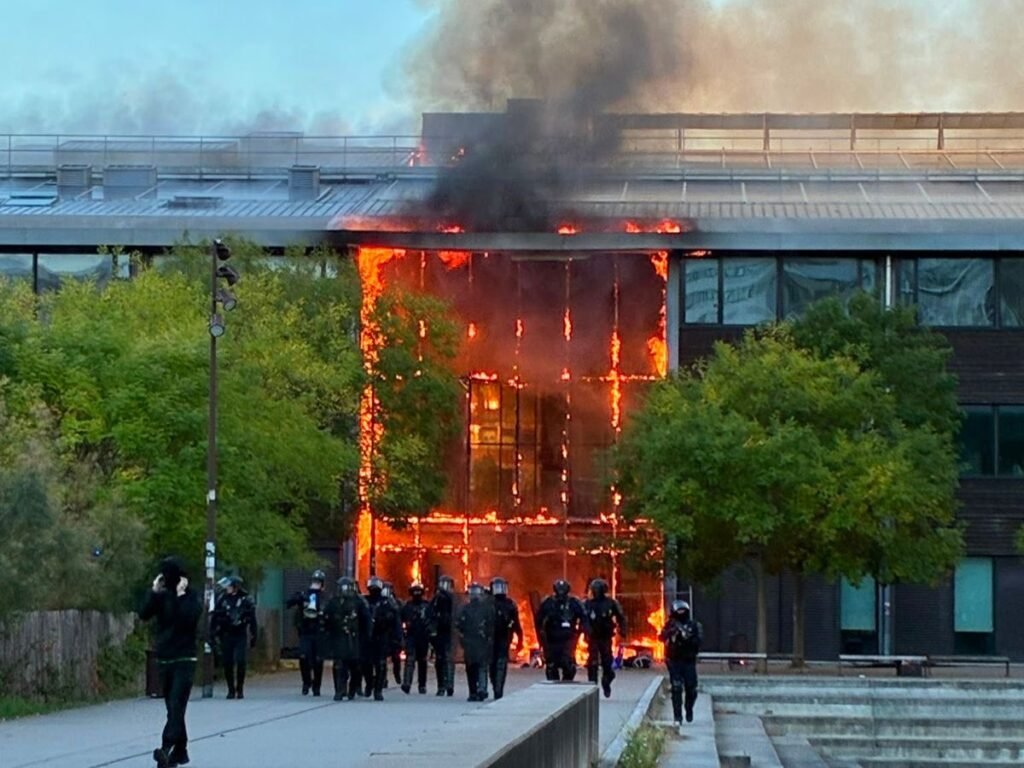
Out on the English-speaking internet, the demand has escalated further into calls for martial law in France, circulated alongside unverified clips of burning buses and masked youths, amplified by accounts such as Visegrád24 and Remix News, and framed around the ethnic origins of the children involved.
Two things need saying about that. The first is that martial law does not exist in French law. What exists is the state of siege under Article 36 of the Constitution, descended from the law of 1878, which hands civil authority to the military, and the state of emergency under the law of 3 April 1955, written to hold down Algeria and later used in 2005 and after 2015. Neither has been declared.
The second is that the state did not need them. Without any emergency being proclaimed, prefects have banned assembly outside schools nationwide, the justice minister Gérald Darmanin convened the senior prosecutors by video link to coordinate the penal response to the arrests, the Paris police prefect referred the elected politician Bally Bagayoko to the courts for incitement, and close to 3,000 minors have passed through police custody in a fortnight. France has reached the destination without needing the vehicle. That is the lesson of the past twenty years of French emergency legislation: exceptional powers do not stay exceptional, they get absorbed into ordinary administrative practice until nobody notices they were ever extraordinary.
As for the claim that this is a riot of foreigners rather than a revolt of French schoolchildren, watch how fast a story sets like concrete. In Marseille, the regional authority initially stated that the head, his deputy and two colleagues at the Lycée Victor Hugo had been assaulted and doused with petrol. Le Figaro and France 24 subsequently reported that the two were splashed inadvertently while protesters were filling containers near a bin they were trying to ignite. Still ugly. Still not what went round the world. The corrected version never travels as far as the original, which is precisely why the original gets published.
WHAT WOULD COUNT AS AN ANSWER
So here is the test, and it is not complicated. The interior ministry has already opened internal investigations into the handling of three pupils, which is the minimum, not a favour. The education ministry met the pupils’ organisations and the parents’ associations on Friday, which should have happened a fortnight ago at Créteil. What follows must be measurable: publish the non-replacement figures school by school, so that parents can see exactly how many hours their children have lost; staff the schools where the hours are actually missing rather than congratulating the national average; and drop the talk of outlawing an opposition party, which in a country seven months from a presidential election is not a security proposal but a political one.
The teenagers who blockaded their gates in September were not asking for a revolution. They were asking who was going to teach them on Monday morning. They still have not been told.
A state that can find a riot squad for every school gate but not a teacher for every classroom has already made its choice. The children simply read it back to them, out loud, in the street.