Dover Protest Shows the Horse Has Bolted on Migration
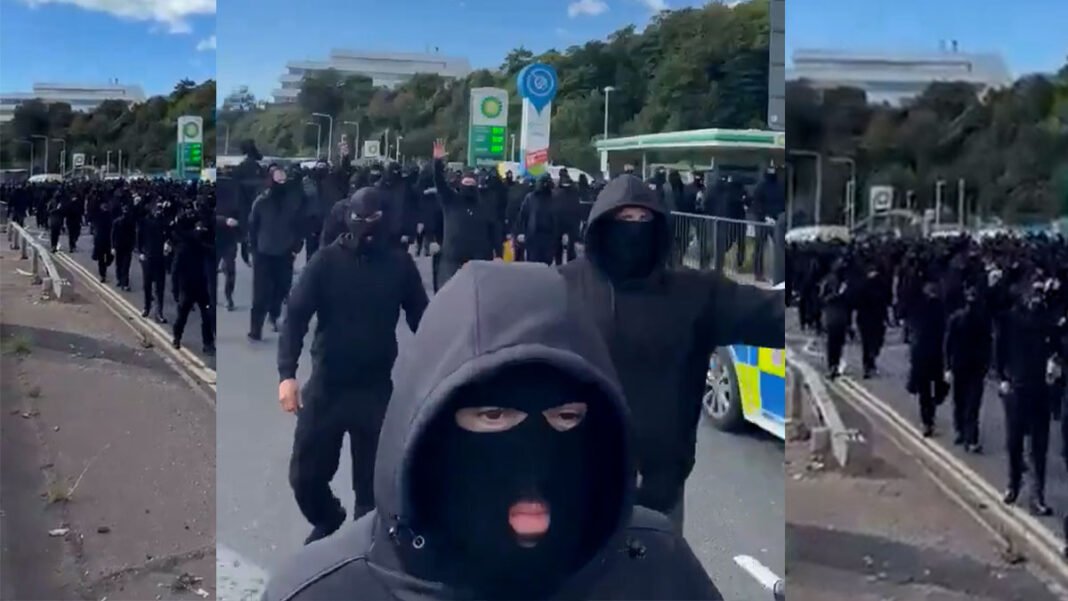
Masked men blocked the Port of Dover today, hundreds of them, chanting “stop the boats.” No arrests were made. But the real story is twenty years of broken migration promises, a change allocated by price to the poorest communities, and a country that was never asked. The horse has bolted.
Masked men in black closed the Port of Dover this morning. Several hundred of them, faces covered, moved into the A20 before dawn and stayed for the best part of a day, chanting “whose streets, our streets” and “send them back” while four miles of traffic sat behind them and Kent Police, by their own account, did nothing but watch. No placards. No banners. No arrests. By early afternoon most of them had walked to Dover Priory and taken a train out of a town they’d never named a demand for. A local councillor called it what it looked like: several hundred men who had loaded into rental vans overnight and driven to the coast with a plan.
Reduce that scene to a policing story and you’ll miss what it actually is. It is the visible tremor of a fault line that has been opening under Britain for twenty years, and the fault line was not put there by the men who stood on the A20 today.
Small Boat Crossings are Down: But the Change Has Already Happened

It’s a case of Flow and the Stock…
The government’s defence arrived before the roads had even cleared. Mike Tapp, Dover’s own Labour MP, wanted the country to know that small boat crossings are down 40 per cent on last year, official figures confirm it, and that whoever blocked his town’s roads this morning almost certainly didn’t know that.
He’s right about the number. He’s wrong about what it proves. A falling rate of new arrivals is not the same thing as an undone change, and the confusion between the two is the single most dishonest trick in this entire debate. Population change is a stock. Crossings are a flow. You can slow the flow to a trickle and the stock, the accumulated decade of arrivals, settlement, hotel contracts and housing allocation that has already happened, does not reverse itself by a single day. Shutting the stable door when the horse has bolted has never once, in the history of stable doors, produced a horse. It has produced a farmer congratulating himself on the door.
That is the argument the political class keeps making to itself, and it is the argument that keeps losing.
Nobody Voted for This
Here is what should trouble you more than any masked man on the A20: no government in twenty years has told the country the truth about what its own migration policy would do, and every time it has guessed, it has guessed catastrophically wrong in the same direction.
In 2004, when eight former Eastern Bloc states joined the European Union, the Blair government’s own commissioned estimate put likely arrivals from those countries at around 13,000 a year. Roughly half a million came. In January 2010, David Cameron told the BBC’s Andrew Marr he would cut net migration from the hundreds of thousands to the tens of thousands, a promise he repeated in the 2015 Conservative manifesto even after his own director of strategy had warned him it was undeliverable while Britain remained inside the EU’s free movement rules. Net migration that year came in at 333,000, more than three times what he had now promised the country twice at a general election.

Then Brexit, sold on a single phrase, take back control, delivered a post-Brexit points-based system that oversaw the highest net migration figures this country has ever recorded, peaking at 900,000 in the year to mid-2023.
Three governments. Three broken promises. Not one of them Labour’s alone, and not one of them an accident anybody was ever held to account for.
That is not a story about racism, and it is not a story about culture. It is a story about consent, asked for repeatedly and betrayed repeatedly, by governments of every colour, while the people doing the betraying kept using the language of control precisely because they knew control was what the country wanted and precisely because they had no intention of delivering it.
Allocated by Price

Here is the part almost nobody in Westminster wants to say out loud, because it doesn’t fit either side’s script. The change that followed wasn’t distributed across Britain. It was allocated, and it was allocated by price.
Asylum dispersal housing, the flats and terraces where people are settled for the long term rather than parked in a hotel, goes wherever accommodation is cheapest, because the three private contractors who run the system, Clearsprings Ready Homes, Mears Group and Serco, are paid to source it and are answerable to their margins first. A parliamentary inquiry found they deliberately avoid procuring housing in more expensive areas to protect that margin. The result sits in the numbers: deprived local authorities host an average of 25 asylum seekers for every 10,000 residents, affluent ones host 5.5. Blackpool, England’s most deprived borough, currently houses 230 people in dispersal accommodation. Bath houses two. Cambridge, York and Stratford-upon-Avon host none at all.
Analysis of Home Office figures found close to a quarter of all supported asylum seekers concentrated in just ten local authorities, nine of them among the poorest in the country. Andy Burnham said: the poorest parts of Britain cannot be left carrying, alone, a change the whole country was told was a national policy.
This is not an argument about who arrived. It is an argument about who was made to carry it, and the answer, every time, is the same postcode that carried deindustrialisation, and carried austerity, and is now being asked to carry this too, while Windsor, Wokingham and Mid Sussex were largely spared the asking.
It Was Never About Race. It Was About Class

There is a comfortable liberal answer to all of this, and it is worth stating fairly before it gets dismantled. Migration has contributed real value to Britain in specific, measurable places: the NHS, social care, parts of construction and food processing would each look very different without it. Small boat crossings are, in gross terms, a small fraction of total migration, and people fleeing war are not the same as people undercutting a labourer’s day rate. Treating them as one undifferentiated mass is its own kind of dishonesty. All of that is fair, and none of it answers the question this piece is actually asking, and none of it licenses the lazy, imported line that immigrants built this country. They didn’t. That is an Americanism, borrowed wholesale from a country that tells itself it was built by arrivals because it needs a founding myth that isn’t a monarchy. Britain was built by its working class, by hand and by brain, in coal and steel and cotton and clay, generation after generation, whatever passport its members carried at the time. The credit belongs to the labour, not to the border anyone crossed to supply it.
The question is not whether migration has value. It is who was asked, who benefited, and who was handed the bill without a vote. Andy Burnham’s own answer, that every postcode must take its fair share, deserves to be taken seriously and to be seen clearly for what it actually fixes. It fixes distribution. It does not fix consent. Spreading an unasked-for burden evenly across the country is not the same thing as the country having agreed to carry it, and a fairer division of something nobody voted for is still something nobody voted for. The answer to who paid the bill is not a race, and it was never a race. It is a class. The same working class communities whose factories were exported in the 1980s and whose wages were undercut by free movement after 2004 are the same communities whose towns absorbed the accommodation contracts after 2015, because they were the only postcodes cheap enough to profit from. A grievance that specific, that consistently aimed at the same people for forty years, is not xenophobia looking for an excuse. It is a class correctly identifying that it keeps being asked to pay for decisions it never made, and now being offered a fairer split of the bill instead of a vote on whether to pay it at all.
Saxony-Anhalt’s Warning

Germany votes this weekend in Saxony-Anhalt, and the polling has the AfD on 40 to 41 per cent, potentially enough for an outright majority in that state’s parliament. If it happens, it will be the first time since 1945 that a party Germany’s own domestic intelligence service classifies as confirmed far-right extremist has been handed a state government by the ballot box rather than taken it by force. Not the Bundestag. Not a coup. A regional election, decided by voters, many of them in places that have spent fifteen years watching wages stagnate while a governing class in Berlin managed the politics of migration rather than the substance of it.
Germany’s AfD is polling at 41%, and it’s not about extremism; it’s about failure…
That is the honest version of the century comparison, and it doesn’t need Weimar or 1933 to make the point. It needs one plainer fact: a decade of wage stagnation, unlike anything this country has recorded in over two hundred years, combined with a political class that would rather monitor extremism than answer the grievance feeding it, is exactly the vacuum that produces this outcome. Saxony-Anhalt did not elect fascists because German voters woke up cruel. It is poised to elect them because nobody serious offered those voters anything else for long enough that the offer stopped mattering.
Dover, Again
What happened on the A20 this morning is a symptom, not a strategy, and the men responsible for it were never going to be the ones capable of diagnosing the disease correctly. Women who told a local councillor they felt frightened walking their own streets, and port workers who couldn’t leave a night shift, paid the immediate price for a fault line that has nothing to do with either of them and everything to do with twenty years of dishonesty from people who will never once have to live with what it costs. Frightening a woman on her own street is still frightening a woman on her own street, whatever the men doing it believe they’re defending, and nothing here excuses it.
And some readers will say a frightened woman on a road is a small thing next to a woman actually attacked, and they’ll be right to say it. In April this year, three men, Abdulla Ahmadi, Ibrahim Alshafe and Karin Al-Danasurt, were convicted at Hove Crown Court of raping a woman on Brighton beach while filming it. All three had arrived by small boat and were living in Home Office asylum accommodation. Alshafe’s asylum claim had been refused the day before he committed the attack. Sit with that single fact rather than the horror around it, because it’s the one that actually indicts something. The state had already made its decision. It had already said no. And the man it said no to remained in Britain, in its own accommodation, for a day longer, and used that day to commit a rape. That is not a fact about migrants. It is a fact about a state that processes a refusal and then does nothing whatsoever to enforce it, and calls the gap between those two things a system.
Ask the harder question before you settle for condemning the men on the A20 and calling it a day. A state that broke the same promise three times under three governments, then policed this morning’s result with vans and patience rather than a single arrest, and that had, in Alshafe’s case, already refused a man’s claim and then simply let him stay: what exactly did it think was eventually going to happen, on a road, on a beach, or anywhere else it kept choosing not to act?
The absence of a single arrest, on a road blocked for most of a day in Britain’s busiest port, is not evidence of a state that has this in hand. It is evidence of a state that has spent twenty years managing disorder rather than answering the question that keeps producing it, and today it simply managed another one, the same way it has managed every one before it, by waiting for it to leave on the next train.
Of course, there is nothing new about masks or the paramilitary theatre of the street. Britain has already normalised the sight of large masked political crowds taking over public space. The danger is what happens when different factions learn that anonymity, numbers and disruption carry little immediate cost.
The saying goes, “Nobody voted for this”. Slamming the door shut now will not bring the horse back to the stable: it will only leave the same political class standing on the threshold, wondering why the voters are no longer listening.

Support The Tribune
INDEPENDENT. READER-FUNDED. AD-FREE.
If you value this article, help keep The Heartlands Tribune publishing independent journalism without intrusive advertising or corporate sponsors.
Choose your monthly amount
Secure payment via GoCardless
SOURCES & FURTHER READING
KentOnline: Large group of balaclava-wearing protesters target area around Port of Dover
ITV News Meridian: Dover port returns to normal after masked ‘Stop The Boats’ protest blocked roads
CNN: Masked men block traffic to UK’s Port of Dover in apparent anti-immigrant protest
CNN: Germany’s far-right AfD is poised for power in Saxony-Anhalt
CBS News: Could the AfD become Germany’s first far-right party to lead a state since WWII?
UK in a Changing Europe: Closing asylum hotels, what will the policy mean in practice?
The Spectator: Where do asylum seekers actually live in Britain?
IBTimes UK: Andy Burnham defends plan to spread asylum seekers across Britain
GB News: Migrant hotels, the areas that could be forced to ‘play their part’
YouGov: Britons have a more negative view of immigration in 2026 than in 2016
British Future: Immigration Attitudes Tracker 2026
TUC: UK workers will miss out on £3,600 in pay this year
Economics Observatory: Why has it taken so long for stagnant pay to become central to UK politics?
Daily Express (Pressreader): Cameron knew his migration pledge was unachievable
A short history of the net migration target
ITV News Meridian: Three asylum seekers found guilty of raping woman on Brighton beach
Hounslow Herald: Three asylum seekers convicted of ‘callous’ gang rape on Brighton beach
GOV.UK: Understanding behaviours and expectations in the UK, a guide for asylum seekers