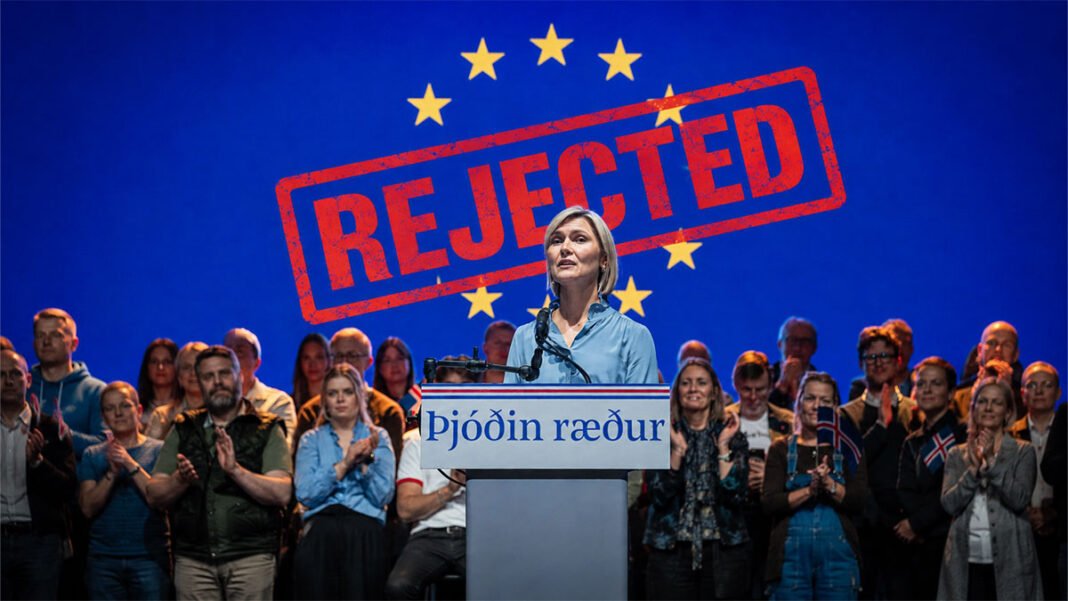
Iceland’s EU Referendum: A No Vote for Sovereignty, Not Isolation
Iceland voted No to EU accession talks by 52.8% – a rejection of technocratic management in favour of democratic self-determination. The vote was about cod, community, and the right to govern the commons. Britain’s coastal towns learned this lesson too late.
Cod, community and the right to govern the commons
In the early, grey hours of Sunday morning, as the final ballots were tallied across the wind-scoured peninsulas of Iceland, a quiet, historic refusal was delivered to the political establishment of Europe. By a margin of 52.8 per cent to 47.2 per cent, the people of this island nation of 400,000 turned their backs on elite consensus and voted No to reviving accession talks with the European Union. Outside the neat, prosperous avenues of Reykjavik, the lone enclave to return a Yes majority, the vote was not merely close; it was a decisive, territorial assertion of self-determination by working-class people against technocratic management.
The narrative crafted in Brussels and echoed by Iceland’s own Foreign Minister, Þorgerður Katrín Gunnarsdóttir, was one of inevitable capitulation to fear. In the run-up to the vote, Gunnarsdóttir took to international outlets like Reuters to plead her case, insisting that in a crumbling global order, small nations cannot afford to stand alone. They pointed nervously at Russia’s aggression and Donald Trump’s erratic, imperial posturing toward neighbouring Greenland, asking how the only NATO member without a standing army could dare to exist outside a major power bloc.
It is a familiar, suffocating argument. We are routinely told by technocrats that sovereignty is a luxury of the past, an outdated sentimentality to be traded away for the protective canopy of a supranational bureaucracy. But the working people of Iceland, particularly those in the coastal fishing towns and rural heartlands, saw through the false bargain. They understood that shelter inside the European machine comes with an invoice, and that invoice is written in the loss of democratic control over their own lives, their own waters, and their own economic destiny.
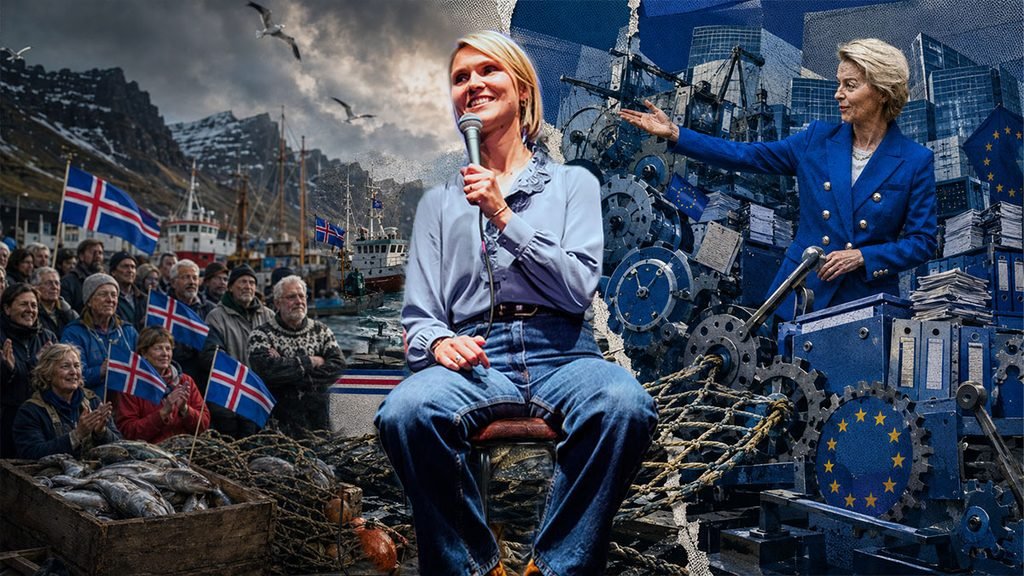
To understand why a nation would reject the promised stability of the world’s largest trading bloc, you must look past the anxieties of foreign ministers and examine the lived reality of those who actually produce the nation’s wealth. For decades, the debate over Europe in Iceland has not been about abstract geopolitical chess; it has been about cod, community, and the right of a nation to govern its own commons.
The European Union’s Common Fisheries Policy was sold to the continent as an environmental safeguard, a rational scheme to prevent the tragedy of the commons playing out across shared seas. In practice it has functioned as a mechanism of redistribution, moving quota steadily away from small coastal fleets and toward large, capital-intensive operators with the lobbying weight to shape the rules in Brussels committee rooms. Icelanders did not need to be told this in the abstract. They had a working example next door. Scotland’s east coast towns and the fishing ports of Devon and Cornwall spent four decades inside that policy watching their boats, their quotas and finally their communities hollowed out by decisions made in negotiating rooms they were never permitted to enter. Whatever one thinks of Brexit, and reasonable people can think many things about it, the destruction of Britain’s independent coastal fishing economy under the Common Fisheries Policy is not a matter of serious dispute. Icelanders, whose entire modern national story is bound up with the Cod Wars they fought and won against Britain’s own trawler fleets in the 1950s, 60s and 70s, understood exactly what surrendering control of their waters would eventually cost.
To surrender the North Atlantic fisheries to a foreign bureaucracy would be to sign the death warrant of Iceland’s coastal towns.
There is a deeper irony buried in this story, and it deserves to be dragged into the light. Iceland’s first application to join the EU, back in 2009, was not a considered act of statecraft. It was a panicked reflex, submitted in the wreckage of a banking collapse that had been caused by precisely the kind of unaccountable, transnational financial capital that European integration exists to serve and protect. Iceland’s answer to that crisis was not, in the end, absorption into a larger bloc. It was the opposite. The country imposed capital controls that would have been illegal inside the single market, let its failed banks go bankrupt rather than bailing out foreign bondholders, and twice held referendums, in 2010 and again in 2011, in which its own citizens flatly refused to accept a foreign-negotiated deal to repay British and Dutch depositors through the Icesave dispute. Iceland recovered anyway. It recovered by holding its own institutions to account rather than surrendering that power to someone else’s.
That history should sharpen rather than soften the argument now. Because when opposition leader Guðrún Hafsteinsdóttir told CNN, in the final days of this campaign, that Iceland’s cost-of-living crisis was not a problem Brussels would solve, and that these were problems Icelandic politicians must solve, she was not simply making a debating point. She was restating the single lesson this small nation has learned twice in seventeen years: that the people who inherit the consequences of a decision are the only people who should be trusted to make it. Former Prime Minister Katrín Jakobsdóttir put the same instinct more plainly still at a No campaign rally days before the vote, telling reporters she believed Iceland was simply better off outside the EU. It is not an isolationist position. It is a democratic one, and the distinction matters enormously.
The pro-EU camp was not entirely composed of continent-facing liberals. Many genuine workers voted Yes in the hope that European integration might break the back of domestic cartels, stabilise the volatile Icelandic króna, and lower the crushing cost of living that weighs on every working-class family in the country. They looked to EU not out of love for Brussels, but out of a desperate desire for relief from local monopolies.
Yet, trading domestic oligarchs for supranational technocrats is no solution at all. The price of that temporary currency stability is the permanent surrender of the democratic levers required to build a genuinely fair society. Once a nation gives away its regulatory power, its monetary flexibility, and its natural resources to an unaccountable commission, it can no longer reorient its economy to serve the public good.
The vote in Iceland is a sharp, necessary rebuke to the prevailing orthodoxy of managed democracy. It proves that working people, even when subjected to intense fearmongering about global unpredictability, still value the fundamental right to govern themselves. They rejected the idea that security can only be purchased through submission.
Real security does not come from hiding beneath the cloak of a distant empire, whether managed from Washington or Brussels. Real security is built from within: in protected natural commons, strong local economies, robust public services, and an unyielding commitment to democratic accountability. The people of Iceland have remembered what the political class in Westminster and across Europe has so conveniently forgotten: that a nation which surrenders its self-determination in exchange for comfort will eventually find itself with neither.
Some may call this isolationism. But when a free people refuse to surrender their waters, their laws, and their democratic birthright to a market-driven bureaucracy, that is not isolation. That is independence…

Support The Tribune
INDEPENDENT. READER-FUNDED. AD-FREE.
If you value this article, help keep The Heartlands Tribune publishing independent journalism without intrusive advertising or corporate sponsors.
Choose your monthly amount
Secure payment via GoCardless