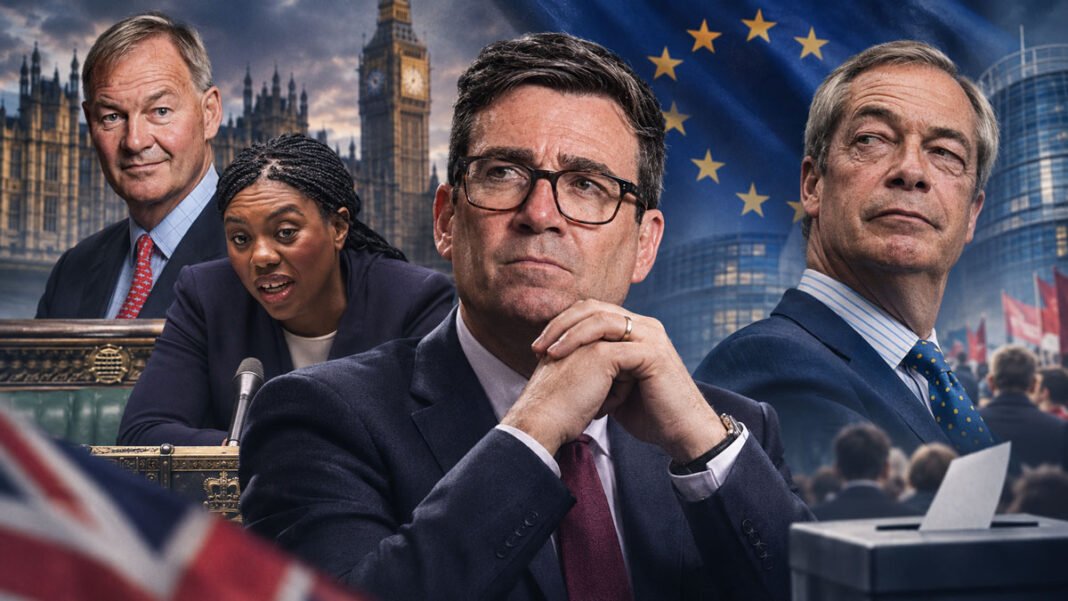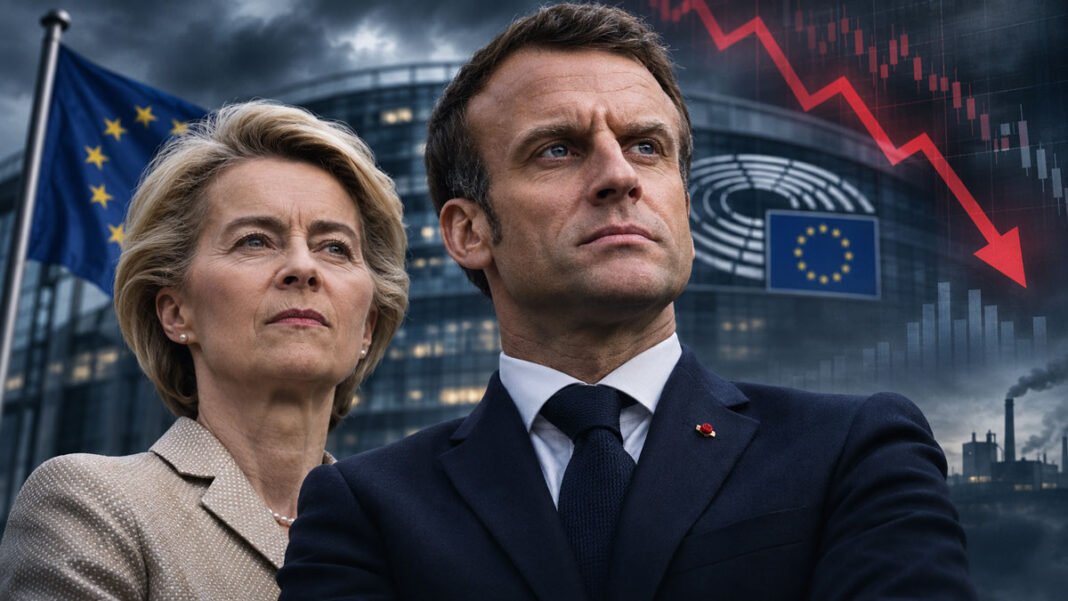
Andy Burnham spent last week in Brussels selling European integration as Britain’s route to prosperity. This weekend, France’s national statistics office confirmed that the continent’s second-largest eurozone economy is shrinking.
When the Sums Fail, Only the Dogma Remains
Last week in Brussels, Prime Minister Andy Burnham clasped hands with European Commission President Ursula von der Leyen and European Council President António Costa at the second joint UK-EU summit to proclaim a historic reset with Europe. This weekend, France’s national statistics institute INSEE published its revised third-quarter national accounts, confirming that the French economy contracted by 0.2 per cent between July and September. Following a decline in the second quarter, Europe’s third-largest economy has officially slid into technical recession.
“Last week, Andy Burnham was selling closer EU integration as the road to economic prosperity. This week, France officially entered recession. EU membership is no guarantee of prosperity. The economic case for rejoining must stand on evidence, not ideological conviction.”
Place those two events side by side, because together they strip a decade of British political theatre down to its bare frame. For ten years, the liberal establishment has insisted that Britain’s economic stagnation is a self-inflicted wound caused solely by leaving the European Union, and that prosperity waits patiently across the Channel for any prime minister brave enough to crawl back. Now we have a Prime Minister openly entertaining the path back in, and at the exact moment he makes the pitch, one of the bloc’s founding pillars is shrinking.
When the economic reasoning fails so publicly, we are no longer dealing with an economic argument. We are dealing with ideology.
The Prospectus and the Balance Sheet
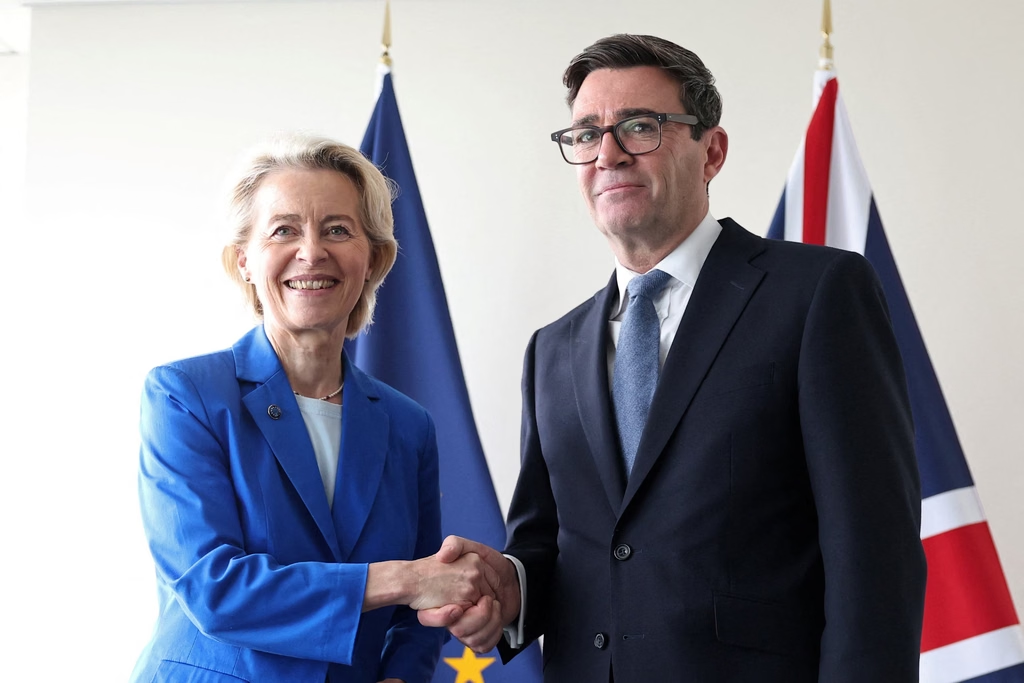
At the Brussels summit on 20 November, Burnham concluded negotiations on three agreements: a common sanitary and phytosanitary zone for food and agricultural standards, the linking of carbon emissions trading schemes, and a youth mobility scheme offering 100,000 visas. Having told Labour’s conference in September that Brexit had “done more harm than good” and suggested that going “all the way” back into the EU was among the options on the table, the Prime Minister spent Monday afternoon in the House of Commons insisting that rejoining without a referendum would be “unthinkable”. By Thursday, his Scottish Secretary, Douglas Alexander, said the quiet part out loud, describing the reset treaties as a “floor not a ceiling” and declaring that Britain had been a “cork bobbing on the tides of history” outside Brussels.
Look, then, at the ceiling they are reaching for. INSEE’s detailed results show that French gross domestic product fell by 0.2 per cent in the third quarter, double the initial estimate of 0.1 per cent. Business investment deteriorated sharply, falling 0.9 per cent after a 0.5 per cent drop in the previous quarter. Investment in industrial goods tumbled by 1.8 per cent, while construction spending fell by 0.9 per cent. Meanwhile, France’s public deficit is poised to hit 5.5 per cent of GDP this year, the highest in the euro area, amid spiralling borrowing costs and political paralysis. Marie Leclair, head of INSEE’s national accounts department, admitted bluntly at Friday’s briefing that “one can say we have a recession.”
Since the United Kingdom formally departed from the European Union on 31 January 2020, the eurozone’s three largest economies have been caught in a recurring cycle of contraction. Germany, the bloc’s industrial anchor, suffered the pandemic downturn of 2020, slipped into a technical recession across the winter of 2022 and 2023, and endured two consecutive full-year contractions in 2023 and 2024
before limping through 2026 with near-zero quarterly growth. Italy was battered by a historic 2020 slump, contracted again at the close of 2022, and has once more stalled in the third quarter of 2026.
France, meanwhile, suffered the 2020 collapse and has now slid back into recession in the second half of 2026 after INSEE confirmed a 0.2 per cent contraction in the third quarter, leaving the EU’s three core economies with at least five distinct recessions or full-year contractions between them in under seven years of British independence.
It seems the single market is not a fountain of youth. It is an ageing, low-growth bloc trapped behind high energy costs, rigid fiscal rules and falling industrial investment. Selling closer alignment or eventual re-entry to the British working class as a guaranteed route to growth requires ignoring the actual balance sheets of the countries already inside.
“Joining a club whose leading members are stuck in the same neoliberal cul-de-sac does not rescue Britain from stagnation. It merely internationalises the excuses for it.”
The Honest Case for Alignment, and Where It Breaks
Fairness demands that the pro-European argument be stated at its strongest before it is dismantled. Geography is stubborn. The European Union remains Britain’s nearest large trading partner, and the border friction erected after 2020 has imposed genuine costs on British manufacturers, food exporters and touring musicians. Nobody serious pretends that customs declarations at Dover are a source of national wealth, or that small firms enjoy filling out extra paperwork.
That concession is real, and it explains why practical trade facilitation is uncontroversial. Where the argument collapses is in the leap from easing border checks to surrendering democratic control over the British economy.
The deeper malaise afflicting Britain is not a shortage of regulatory alignment with Brussels. It is forty years of deindustrialisation, privatised utilities, financialised housing, chronic underinvestment and a tax system rigged to shield unearned wealth while squeezing wages. Every single one of those pathologies thrives inside the European Union. France enjoys full membership, frictionless access to the single market and the euro, and it is still watching its industrial investment contract while its government borrows heavily just to stand still. Joining a club whose leading members are stuck in the same neoliberal cul-de-sac does not rescue Britain from stagnation. It merely internationalises the excuses for it.
Why Westminster Needs a Brussels Alibi

To understand why Andy Burnham is reaching so eagerly for the European lifebelt, look at what rejoining offers a British political class that has run out of ideas. Burnham entered Downing Street in July posing as the northern outsider who would break the Westminster consensus and stand up for the industrial heartlands. Within months, he has discovered what every prime minister before him discovered: governing a broken economic model requires either confronting entrenched corporate power or finding someone else to blame.
Confronting capital is hard. Rejoining Brussels is easy.
For decades, the European Union served the British establishment as a constitutional alibi. Inside the single market, ministers could tell the working class that public ownership of rail, energy or water was complicated by competition directives, that state aid to save a steelworks in Redcar or Scunthorpe was barred by treaty rules, and that downward pressure on construction and manufacturing wages from unrestricted labour mobility was simply the price of modern Europe. The market ruled, the treaties locked the doors, and British politicians collected their salaries while explaining that their hands were tied.
The legal architecture of Burnham’s reset tells the same story. Ministers are using a framework bill enabling dynamic alignment with European rules without normal parliamentary votes, paired with a ten-year termination clause designed to bind future governments. That reveals the real purpose of the exercise. It is not about empowering the working class. It is about locking future parliaments so tightly to supranational rules that democratic votes at home can never again disturb the economic settlement.
Govern Britain Instead

There is a reason the post-industrial towns of the North and the Midlands voted to leave in 2016, and it was never because working-class voters failed to understand spreadsheets. It was because they understood, from bitter lived experience, that an economic order built for City financiers and multinational supply chains had nothing left to offer them. Ten years on, those towns do not need another decade of constitutional trench warfare over Brussels, nor do they need their Prime Minister spending his political capital chasing phantom growth from a recession-hit continent.
If Andy Burnham wants prosperity, he does not need a plane ticket to Belgium. He holds a parliamentary majority and the sovereign instruments of the British state right now in Whitehall. Let him rule out any further surrender of legislative sovereignty through dynamic alignment, abandon the campaign to drag Britain back into the single market, and use public money to rebuild the real economy at home. He can take energy, water and rail back into public ownership so households and factories are no longer bled dry by private monopolies. He can direct a serious industrial strategy, training apprentices and rebuilding domestic steel and manufacturing rather than outsourcing strategic capacity abroad. He can launch a programme of council house building on the scale achieved after 1945, creating secure homes and well-paid unionised trades that no foreign downturn can take away.
A confident socialist government uses the power of the state to build prosperity at home. A timid managerial one begs for admission to a shrinking club and calls the surrender statesmanship.
When a politician insists on boarding a sinking ship and calls it a rescue mission, he is no longer reading the compass; he is reciting a creed.
Enjoyed this read? I’m committed to keeping this space 100% ad-free so you can enjoy a clean, focused reading experience. Crafting these articles takes a significant amount of research and heart. If you found this helpful, please consider a “small donation” via PayPal or GoCardless to help keep the lights on and the content flowing. Every bit of support makes a huge difference.

Referenced Sources & Official Data
INSEE (27 November 2026): Detailed Q3 2026 French GDP and National Accounts
House of Commons Library (27 November 2026): UK-EU Summit November 2026 Briefing
The Guardian (26 November 2026): Details of two treaties at heart of Andy Burnham’s EU reset