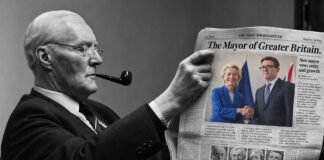
The Brexit right calls Brussels a socialist superstate. The Remain left calls it the worker’s friend and points just a little naively at internationalism. The treaties say otherwise. Last Friday Andy Burnham agreed that British food law will follow EU rules MPs won’t vote on, and the old Bennite warning about democracy is no longer just history.
Both the British left and the British right have invented a European Union to suit their own convenience. Neither version survives contact.
“The Right sees red flags in Brussels. The Left overlooks the small print.“
The Brexit right calls Brussels a socialist superstate. The Remain left calls it the worker’s friend and mistakes a corporate single market for internationalism. Both have fallen for the same piece of branding, and Andy Burnham is counting on neither side reading the small print.
Sometimes it is hard not to despair at the sheer scale of British ignorance about the European Union, an ignorance shared in equal and opposite measure by the Left and the Right.
Spend ten minutes listening to our national debate, and you begin to wonder whether the confusion is deliberate. Few political institutions in modern history have been marketed more successfully, or understood less, than the EU. The sleight of hand begins in the title itself. “The European Union” sounds as though it speaks for an entire continent, yet it consists of just 27 member states out of the 44 countries in Europe. Even the name is a piece of public relations, claiming ownership of a geography it does not represent.
That is only the beginning of the illusion. On one side of the British argument sit self-proclaimed socialists and progressives, faithfully defending an institution built from the ground up around private competition and the free movement of capital. On the other sit conservatives and Brexiteers with the audacity to denounce that exact same institution as the “EUSSR”, a red-tinged superstate bent on collectivising Lincolnshire. Both cannot be right. As it happens, neither is.
What makes the spectacle truly maddening is that searching the internet costs nothing, and neither does reading the treaties. Remarkably few people on either side seem to have tried. Had they bothered, they might have noticed what is happening right now: last Friday, 20 November, Prime Minister Andy Burnham returned from a summit in Brussels having agreed that British food law will dynamically follow European rules that MPs at Westminster will never vote on. The old warning about surrendering democratic control to a capitalist bloc is no longer a history lesson. It is happening again in plain sight.
A Constitution Written for Capital

Start with the foundations, because that is where the European Union keeps its real politics.
The Treaty on the Functioning of the European Union is about as far removed from communism as a legal text can be. It prohibits restrictions on the movement of capital, not only between member states but between member states and the rest of the world (Article 63). It declares state aid that distorts competition incompatible with the internal market (Article 107). It subjects public enterprises to strict market competition rules (Article 106). Defenders of the bloc often point to Article 345, which says the treaties are neutral on who owns property, as proof that socialism remains entirely possible inside the club.
It does not settle the matter at all. A British government inside the EU could own the railway. What it could not easily do is run that railway as an instrument of national economic planning, pour public money into it in ways Brussels judged to distort competition, or shield it from private rivals. Public ownership is permitted on paper. Using that ownership to plan an economy in the interest of the working class is another matter entirely.
That is not communism. It isn’t socialism either. It is a market order written into treaty law, with competition as its organising principle and capital as its most mobile citizen.
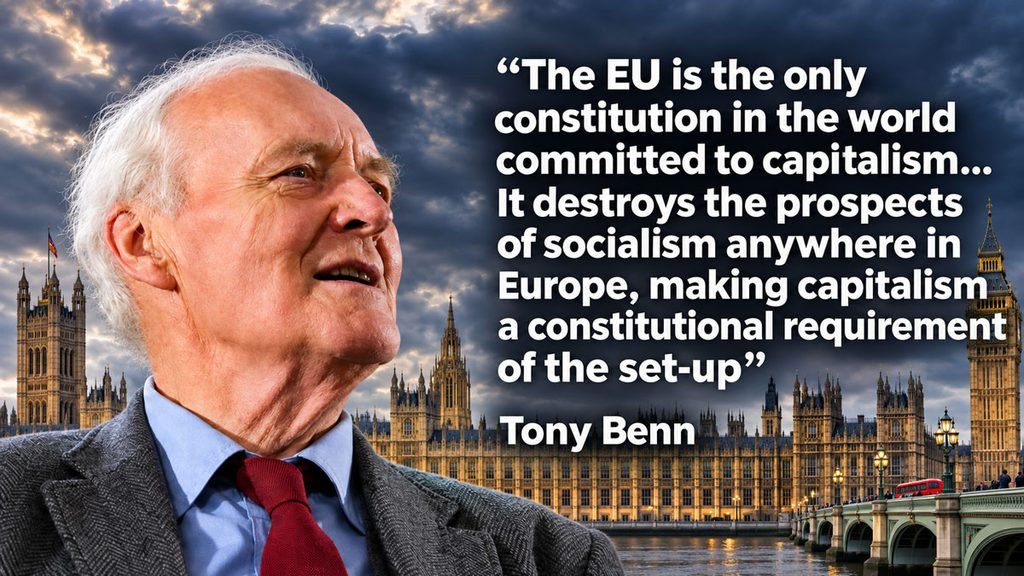
Tony Benn’s verdict, quoted on the left ever since, was that “the EU had the only constitution in the world committed to capitalism”. Most constitutions set out how power is won and lost and leave the economic argument to the voters. The EU’s treaties settle much of that argument in advance. Look at what happened to Électricité de France, nationalised in 1946 and for half a century the dominant supplier of the country’s power. A European directive in 1996 required the market to be opened, and after years of French resistance it was, one tranche at a time, until in 2007 every household had to be offered a choice of private suppliers. When Brussels found that the French state had waived a tax bill for its own company, it ordered EDF to hand back €1.37 billion. France could own EDF, and in 2023 took it entirely back into public hands. What France could no longer do was decide, through its own elected government, how its own public company should serve its own people.
Yes, the EU has employment protections and social legislation. So did Britain before 1973, and so does Britain now. The national minimum wage came from Westminster, not Brussels. Having workers’ rights doesn’t make an economic system socialist. Capitalism has always made reforms when organised labour forced them on it, and taken them back when that force weakened. The rights that matter most were won here, by trade unions, in this country’s own political struggles.
Built by Tories, Sold to the Left
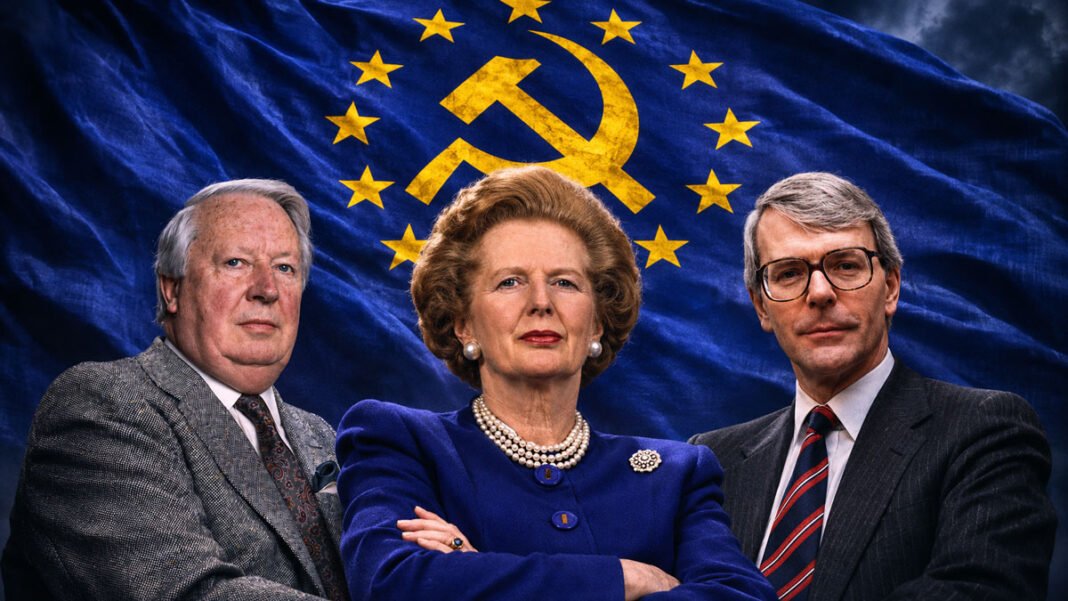
“Never forget the three British architects of our place in the modern European Union…
Edward Heath took us into the European Economic Community, Margaret Thatcher laid the foundations of the Single Market, and John Major signed the Maastricht Treaty, creating the European Union. All three were Conservative prime ministers.”
For those on the Right who still see a hammer and sickle flying over the Berlaymont building, a brief acquaintance with their own party’s history would save them a great deal of embarrassment.
It was a Conservative Prime Minister, Edward Heath, who took Britain into the European Economic Community in 1973. It was Margaret Thatcher who campaigned enthusiastically for a Yes vote in the 1975 referendum. It was Thatcher’s government that signed the Single European Act in 1986, the very treaty that constructed the deregulated single market she had championed. And it was John Major’s government that signed the Maastricht Treaty in 1992, creating the European Union itself.
Three Conservative prime ministers, three decisive steps towards integration. Does anybody seriously believe Heath, Thatcher and Major were smuggling in socialism? They knew exactly what they were building: a continental market for goods, services and capital, protected by law from the interference of elected governments.
Thatcher’s famous Bruges speech in 1988 wasn’t a change of heart about the market. It was alarm at what came with it. That same September Jacques Delors had gone to the TUC in Bournemouth and promised a social Europe. Battered by a decade of defeats at home, the British labour movement listened, and much of the left has been loyal to Brussels ever since. It was an understandable choice. It was also the moment the left began giving up its own critique of the European project.
Democracy Means the Power to Change Things
That earlier critique was principled, materialist and owed nothing to Margaret Thatcher.
Tony Benn, Peter Shore, Barbara Castle, Dennis Skinner and Michael Foot understood a basic truth that latter-day progressives have forgotten: socialism is impossible without democracy, and democracy means very little if elected governments cannot change the economic system.
Benn was not an anti-European by reflex. He arrived at his position through constitutional principle, and the route he took matters. By 1970 he was pressing a sceptical Labour leadership to put membership to a referendum. By 1975 he had become the leading voice of the Out campaign, squaring up against Margaret Thatcher on the other side. That year Benn wrote to his Bristol constituents to tell them plainly that, as their MP, he could no longer guarantee them that laws affecting their lives could be changed by the Parliament they elected.
His argument went to the heart of working-class power. If the working class elects a government to take essential industries into public ownership, direct public investment into neglected regions or reorganise the economy for social need rather than private profit, that government must possess the legal authority to carry out its programme. Handing decisive economic powers to institutions that British voters cannot remove in a general election does not advance internationalism. It places the commanding heights of the economy beyond democratic reach.
The institutional machinery tells the exact same story. The European Parliament is the Union’s only directly elected body, yet it cannot formally propose a single piece of legislation. That right belongs almost exclusively to the European Commission, whose members no voter anywhere in Europe elected. The Parliament can amend, reject or, in extremis, dismiss the Commission, but the legislative agenda is written elsewhere. Meanwhile, monetary policy for the eurozone sits with the European Central Bank, independent by treaty of every government and every electorate it governs.
Michael Foot put it better than anyone during that 1975 campaign:
“People didn’t fight for the vote just to have the fun of electioneering; they wanted to see that the vote that they used at the ballot box could change things, stop things, alter things, remove governments when necessary. That’s one of the principal reasons for having a vote, but that’s not going to happen if we stay in the market, if we become enmeshed in the whole of their machinery and apparatus, because what will happen then is that you can go and have an election in this country, in which we vote out the government here, but you won’t be voting out all the governments that meet in Brussels to decide what’s going to happen to us!”
Forty years later, Greece learned what Foot meant. In January 2015, Greek voters elected Syriza on an explicit mandate to end ruinous austerity. Within days, Commission president Jean-Claude Juncker told Le Figaro: “There can be no democratic choice against the European treaties.” Over the following months, the European Central Bank choked off liquidity to Greek banks until, at the end of June, they were forced to close their doors. In July, mere days after the Greek people voted No to the creditors’ bailout terms in a national referendum, their government capitulated and signed a deal widely judged harsher than the one voters had just rejected. Foot’s warning had been tested on a living electorate. Greeks could vote out the government in Athens. They could not vote out the institutions in Brussels and Frankfurt that decided what happened to them.
British ministers have always found comfort in outsourcing their responsibilities. A politician who can shrug and say “Brussels won’t allow it” never has to explain to voters why he lacked the courage to try. Foot and Benn saw that convenience for what it was: an escape from democratic accountability dressed up as international cooperation.
Rule-Takers Without a Vote
None of this would matter much if the European question were closed. It is not. It has returned like a spectre, stalking the forums of social media and the decaying corridors of Westminster alike, and it arrives with the one certainty modern politicians never fail to deliver: a broken promise. When Andy Burnham campaigned for the Makerfield seat, he pledged not to reopen the Brexit debate. Now, barely months into office, he has torn that pledge up.
At the Brussels summit on 20 November, Andy Burnham and the EU’s leaders sealed agreements on food checks, youth mobility and emissions trading. Burnham called it a landmark. He also conceded that the deal was not enough for the long term, having already put full membership back on the table at Labour’s conference in September.
The practical case for the food agreement is real and deserves to be stated fairly before it is answered. British exporters have struggled with border checks, paperwork and costly delays since 2021, and small producers have carried the heaviest burden. Nobody on the Left should pretend that trade friction is imaginary, or that easing it carries no economic benefit.
The constitutional price, however, is just as real. Under the sanitary and phytosanitary arrangements agreed in principle last year, British food law is to be dynamically aligned with EU rules. As one industry guide puts it, new laws will apply in the UK without MPs being able to vote on them. In place of a vote there will be “decision-shaping”, the right to be consulted. And Britain is to recognise the Court of Justice of the EU as the final arbiter of EU law in the areas covered.
That isn’t Rejoin. In one respect it is worse. A member state at least sits in the Council when the rules are made. A country that aligns dynamically follows rules it had no vote on, interpreted by a court it can’t appeal to and enforced by a body its electorate can’t remove. It is exactly what Foot described: an election here that can’t touch what is decided there.
Read the Treaties, Not the Slogans
Politics becomes impossible when words lose their meaning, and few subjects in British public life have been more deliberately confused than this one.
If Andy Burnham and his ministers want closer regulatory alignment with the European Union, or intend to take Britain back into the single market and the bloc itself, let them stop hiding behind soft talk of “resets” and “European values”. Let them put the constitutional trade-off honestly to the British people in a clear, binding vote, rather than smuggling rule-taker status through Parliament a sector at a time.
If the British Left wants to rebuild a serious movement for public ownership, industrial renewal and working-class power, it must stop mistaking a corporate single market for a comrade. And the Right should stop calling the most successful free-market project in European history a communist plot.
You can support European cooperation without supporting political integration. You can believe in international solidarity without surrendering democratic control. And you can oppose the EU from the Left without sharing a single premise with those who oppose it from the Right.
The European Union is neither a communist conspiracy nor a socialist paradise. It is a capitalist political and economic union. Calling it something else won’t change a single word of its treaties, and no British election can change them either.
Enjoyed this read? I’m committed to keeping this space 100% ad-free so you can enjoy a clean, focused reading experience. Crafting these articles takes a significant amount of research and heart. If you found this helpful, please consider a “small donation” via PayPal or GoCardless to help keep the lights on and the content flowing. Every bit of support makes a huge difference.