The Morning Star Is Right About Capital. It Is Wrong About the Border.
The Morning Star says immigration controls always serve the boss. Marx said something more complicated, in the very letter Wilkes quotes.
On 6 August, the Morning Star published a substantial reply to an argument I have made repeatedly in these pages: that the unrestricted movement of labour can serve capital as surely as the unrestricted movement of goods, by expanding the available workforce, weakening bargaining power, and letting employers import workers rather than invest in wages, training and the people already here. Roy Wilkes named me, named this publication under its former title of Labour Heartlands, and went back through Marx, Lenin, the Comintern and the history of immigration controls to argue that the socialist tradition stands against my position.
Our disagreement lies somewhere harder than either of us first admitted: what happens when capital is free to move production, money and labour across borders, while the working class is told that controlling even one of those movements is morally beyond the pale?
Britain has just supplied a practical answer.
In 2025, some 15,723 doctors trained in British medical schools applied for specialty training in the NHS. So did 25,257 doctors trained overseas. Between them they were chasing 12,833 posts. More than two thousand British graduates judged appointable, who had passed everything, who had cost the public purse the better part of half a million pounds each to produce, were offered nothing at all.
The British Medical Association went to war over it. Resident doctors struck in December. The government blinked, and on 5 March this year the Medical Training (Prioritisation) Act received Royal Assent after being driven through the Commons in a single sitting day. NHS England’s June figures show what it did. Offers to non-prioritised applicants fell from 2,168 to 163 in one recruitment cycle. For the first time, every GP training place in the country went to a UK graduate or to someone already working in the health service.
That was a migration control. It was demanded by a trade union, drafted by a Labour government, and welcomed by the people it protected. No detention centres, no dawn raids, no British ICE. Nobody was deported. A rule was written about who gets first call on a publicly funded training place, and the careers of two thousand young doctors were saved by it.
I raise this because Roy Wilkes, writing in the Morning Star, argues that no such thing is possible.
THE GENEROUS PART

Wilkes has done something the British left rarely bothers with. He read an argument he disagreed with, named the man making it, and answered it at length. He names me, he names this publication under its former title of Labour Heartlands, and he reaches for Marx on the Irish, for Lenin, for the Comintern and for the Chinese Exclusion Act. That deserves a reply rather than the usual scrap.
It deserves one all the more because a good deal of it is correct.
He is right that deindustrialisation, not immigration, gutted the towns I write about. The mills and the pits did not close because of arrivals at Dover. They closed because capital discovered it could break production into pieces and reassemble them wherever labour was cheapest and least organised, and because a British state that could have stopped it chose not to.
He is right that the small boats coverage is theatre, wildly disproportionate to its share of the numbers, and useful chiefly to politicians who would rather discuss anything at all than the price of a two bedroom flat.
He is right that scapegoating is the oldest management technique there is, and that a workforce arguing about accents is a workforce not arguing about pay.
I have written all of this myself, more than once. Our disagreement is narrower than his framing suggests, and a great deal more interesting.
TURIN AND KRAGUJEVAC
Here is where his argument comes apart, and it comes apart on his own strongest ground.
Wilkes treats the movement of capital and the movement of labour as opposites. Capital, he says, keeps the reserve army penned in the southern megacities through border controls, so removing those controls would loosen its grip. Outsourcing is the enemy. Migration is the remedy.
Go and look at a car factory.
Stellantis built 475,090 vehicles in Italy in 2024, the lowest figure since 1956. Passenger car output fell by 46 per cent. Production at Mirafiori in Turin, the birthplace of Fiat, collapsed by 70 per cent, and around 2,400 workers were put on furlough at roughly 1,100 euros a month against a normal 1,600. Its chief executive at the time, Carlos Tavares, explained publicly that building the Alfa Romeo Junior in Italy rather than Poland would have added something like 10,000 euros to the retail price. He was not being coy. The differential is the strategy.
Now look at Kragujevac in Serbia. As Mirafiori stutters through shutdown after shutdown, the Serbian plant is running twelve-hour shifts across Saturdays and Sundays to meet demand for the Fiat Grande Panda, and has taken on hundreds of extra staff. Its workforce of around 4,500 includes roughly a thousand workers brought in from Italy, Spain, Turkey, Morocco, India, Pakistan and Nepal.
Capital moved the plant to a low wage country, and then imported labour into it from four continents.
This is not outsourcing versus migration. It is one firm, in one quarter, using both levers on the same balance sheet. The Italian worker on furlough in Turin and the Nepali worker on a twelve-hour shift in Kragujevac are being managed by the same people according to the same logic. Wilkes has correctly identified one hand and then argued that the other hand is our friend.
THE SENTENCE THAT GIVES THE GAME AWAY

He answers me directly, and in answering me he hands over the argument...
Capital as a whole, he writes, does not want open borders. It wants something more precise: “Employers only want those limited numbers of migrants who meet their precise needs.”
Quite so. That is not a refutation of my position. That is my position, stated by Roy Wilkes, and stated rather better than I stated it.
If employers obtain the quantity, the category and the terms of labour they require, then migration policy is being written to specification. Someone does the writing. And we can name them, because they publish.
Britain now operates a Temporary Shortage List, live since July 2025, granting visa access below the normal skill threshold to occupations judged important to the government’s Modern Industrial Strategy. From the middle of this year, employer bodies must file approved workforce plans to keep their occupations on it. A Labour Market Evidence Group can advise restricting visas where a sector is deemed over reliant on foreign labour. Engineering technicians are in. Construction trades are in. Chefs and butchers are out. Care workers were shut off entirely.
That is not a border. It is a procurement system. Employers state requirements, government converts them into Immigration Rules, and the composition of the British working class is adjusted accordingly.
Wilkes has examined this machinery and concluded that because it is selective rather than open, it cannot be serving capital. The selectivity is the service.
THE EXPERIMENT WAS RUN, AND THATCHER SIGNED IT

There is a version of this argument in which we cannot know what unrestricted labour movement does to wages, because it has never been tried.
It has been tried. For two decades. Across a continent.
The Single European Act was signed in 1986 by Margaret Thatcher, who then championed the eastward expansion of the Community into the former Soviet bloc. Dennis Skinner, who watched the whole thing from the green benches and set it down in his memoir, put the purpose plainly: “The Single Market’s main aim was to supply cut-price workers to capitalism.”
He was not describing a conspiracy. He was describing a design brief. Free movement of labour was one of four freedoms, and the other three were capital, goods and services. It was never a workers’ charter that capital reluctantly tolerated. It was a single mechanism with four settings, and the wage differential between Wigan and Wroclaw was not an unfortunate side effect of it. It was the operating principle. Asparagus was cut in Norfolk at Polish rates because that is what the system was for, and a Fiat is assembled in Poland rather than Turin for precisely the same reason.
The left spent thirty years defending one setting on that machine while attacking the other three, and called the arrangement internationalism.
THE QUOTE THAT ISN’T THERE

Wilkes builds the historical spine of his case on California in the 1870s. Denis Kearney whipped up anti-Chinese agitation that fed into the Chinese Exclusion Act of 1882. The American writer Henry George demolished Kearney’s arguments in an 1880 essay, and Wilkes tells his readers that Karl Marx “warmly welcomed” the piece and “agreed wholeheartedly” with George’s position.
That did not happen.
Marx’s actual verdict on George survives, in a letter to Friedrich Sorge dated 20 June 1881. George, he wrote, was “theoretically… utterly backward.” He accused him of understanding nothing about the nature of surplus value, dismissed his land tax as the work of a “panacea-monger,” and, reaching for the very kind of writing Wilkes praises, remarked that George’s article on California showed nothing but a talent for what Marx called “Yankee-advertising.” A theorist filing a rival somewhere just above snake oil is not a comrade shaking his hand.
There is a second claim doing even more work in Wilkes’s argument: that the state’s exclusion of Chinese labour is what strengthened the employers and dragged wages back down by 1898. On his own source, California’s daily wage rose to $2.42 after exclusion in 1884, then fell to $1.59 by 1898, below where it started. Wilkes reads that fall as proof that a repressive state weakens the working class whenever it acts. He does not ask what else happened to America between 1884 and 1898.
Quite a lot happened. Through the 1870s California’s wages sat above the rest of the country partly because the state was still cut off, a Gold Rush economy trading at a premium behind a wall of distance. That wall came down in 1885, when the Santa Fe line broke into Los Angeles in direct competition with the Southern Pacific, triggering a rate war that opened California to the cheap, mass-produced goods of eastern factories. Local industry now had to compete on national terms or close. Then in 1893 the country fell into the worst depression it had yet known: more than fifteen thousand businesses and hundreds of banks failed, several of the very railroads that had opened California to the national market went down with them, and unemployment climbed past one worker in five.
Wages fell across the whole of the United States in those years, in states that had never heard of Denis Kearney and excluded nobody. If a repressive state acting against migrant labour is what drove wages down, the effect should appear only where that state acted. It appears everywhere, because the actual cause was a national depression, not a Californian statute.
Capital does not need a compliant state to weaken workers. An oversupplied labour market does that on its own, whether the surplus arrives on a boat from Guangdong or is manufactured by a banking collapse in New York. Scarcity is what gives workers leverage. Panics, monopolies and unregulated competition are what take it away, and open borders stop none of the three.
MARX SAID BOTH THINGS, IN THE SAME LETTER
Wilkes reaches for the letter of 9 April 1870 to Sigfrid Meyer and August Vogt, in which Marx describes the English worker’s hatred of the Irish worker as a division deliberately cultivated by the ruling class, the secret of English capital’s power.
He is quoting a real letter and quoting it accurately. He is also quoting the second half of a paragraph.
Read the sentence immediately before it. Marx writes that Ireland constantly sends its surplus population to the English labour market, and that this “forces down wages and lowers the material and moral position” of the English working class. That is not an aside. It is the premise. The antagonism Marx goes on to describe is manufactured, yes, but it is manufactured on top of a real material injury that Marx names first and does not deny.
Marx held both propositions at once, and any honest reading has to hold them too. The wage effect is real. The racial hatred built on top of it is a weapon aimed at stopping workers from acting on that wage effect together, against the employer who engineered it. Take away half of that and you get either the Reform UK position or the Morning Star position. Marx held the whole of it.
Nor is the canon as settled as Wilkes suggests. In 1907 the Second International met at Stuttgart and condemned in terms the employers’ importation of cheap labour used to break workers’ organisations and depress wages. Its answer was not exclusion by race. It was the outlawing of coercive contract labour, minimum wages, shorter hours, and migrant workers organised into unions on equal terms. Same movement, same century, different conclusion.
ASK CESAR CHAVEZ

If the claim is that every immigration control in history has been a racist instrument wielded by white workers against black and brown ones, then there is a name that has to be answered.
Cesar Chavez led the Delano grape strike from 1965 and marched to Sacramento in 1966. He fought to end the Bracero programme precisely because it delivered captive, deportable Mexican labour to growers at a price they set. And in 1969 he marched through the Imperial and Coachella Valleys to the Mexican border, alongside Ralph Abernathy and Senator Walter Mondale, in protest at growers importing undocumented workers to break his strike.
A Mexican American union leading a mostly Mexican membership, demanding that the state stop the flow of workers being used against them. Not one part of that is explicable within Wilkes’s framework.
And I will state the rest of it, because leaving it out would be the same trick I have just accused him of. The UFW reported undocumented strikebreakers to the immigration service. It ran what it called the Illegals Campaign. In 1973 it strung a wet line along the Arizona border near Yuma, and men under the direction of Chavez’s cousin Manuel beat people who tried to cross. Dolores Huerta objected to the language in the room and was slapped down. It is an ugly episode and I am not going to launder it.
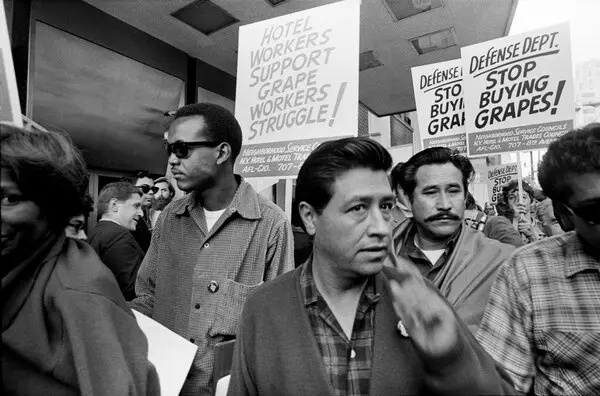
But consider what it actually demonstrates. When there is no lawful, democratic, accountable control of who enters a labour market, and organised workers can see with their own eyes that they are being undercut, they do not shrug and reach for a leaflet on international solidarity. They go to the border themselves, and it turns violent, and the people who get hurt are the poorest workers on the crossing.
The wet line is not an argument against border control. It is a picture of what fills the vacuum where border control should be. Wilkes proposes to make that vacuum permanent and universal, and calls it internationalism.
WHAT ROY WILKES IS ACTUALLY PROPOSING

Roy Wilkes does not stop at humane treatment or equal rights, both of which I support and have argued for repeatedly. He proposes abolishing the status of illegality altogether, so that everyone enjoys full civil and employment rights regardless of how they arrived. And he proposes that once the grouse moors and the great estates are in common ownership, Britain could comfortably sustain ten times its present population.
Ten times. Something close to seven hundred million people on these islands.
I do not say this to sneer. I say it because his readers deserve to see the proposition whole. This is not a case for better managed migration against a cruel alternative. It is a case for no immigration enforcement of any kind, resting on a land settlement no British government has attempted since the Conquest.
There is also a shadow over his historical analogy that he does not acknowledge. He praises the emigration of seventy million Europeans between 1850 and 1920 as a safety valve that relieved wage pressure at home. Those Europeans went overwhelmingly into colonies and settler societies. The valve opened onto other people’s land.

Whatever lesson we take from that century, it cannot be a template for today. The Aboriginal peoples of Australia, the Māori of New Zealand and the indigenous nations of North America already paid the price for Europe’s so-called safety valve.
THE THING HE GETS EXACTLY BACKWARDS
Follow his deepest argument through to the end. If labour can move without restriction to wherever capital has settled, capital sets the price of labour on a single global market. The wage floor is not London’s. It is Dhaka’s. Bernie Sanders understood this long before it became unsayable.
Exit is not solidarity. It is the individual escape of the fortunate few from a condition the many cannot escape, and it leaves the employer’s power entirely intact, because the employer never needed a passport in the first place. Ask the man on furlough in Turin whether the Nepali worker in Kragujevac has weakened Stellantis.
The answer to capital’s mobility is not workers’ mobility. It is control of capital. Capital controls, public ownership, sectoral bargaining, industrial planning, training our own people, and a state with the nerve to use all five. Every one of those requires a political community with a border around it, because that is the only unit in which anyone has ever made capital do what it did not wish to do.
Wilkes says there is only one way to defend a border, and that is to turn the state’s repressive apparatus on fellow workers. The Medical Training Act says otherwise. It defended a labour market with a rule about who gets first call on public investment, and it did so because a union asked. Controls need not mean raids. Insisting that they must is a counsel of despair, and it hands the entire terrain of border policy to Nigel Farage, who will use it in ways neither of us wants.
That is my quarrel, in the end. Not that his position is too generous. That it surrenders the argument.
The left cannot demand a planned economy and then declare the single largest input to that economy off limits to planning. It cannot campaign to nationalise water while treating the number of people drinking it as a question no decent person asks. Workers in this country need homes, and 172,420 children were living in temporary accommodation last June, and every serious housing plan begins by knowing how many households there will be.
Roy Wilkes and I want the same employer in the dock. We disagree about whether the working class is permitted to hold a lever.
A border is not a weapon aimed at workers. It is one of the very few levers workers have ever got their hands on. Which is precisely why we keep being told it is beneath us to touch it.
Enjoyed this read? I’m committed to keeping this space 100% ad-free so you can enjoy a clean, focused reading experience. Crafting these articles takes a significant amount of research and heart. If you found this helpful, please consider “a small donation” to help keep the lights on and the content flowing. Every bit of support makes a huge difference!

SUPPORT INDEPENDENT JOURNALISM
The Heartlands Tribune is ad-free and reader-funded. No proprietor, no advertisers, no press office briefing us on what to think. If this piece was worth your time, a small donation keeps the lights on and the arguments coming. Support the Tribune.