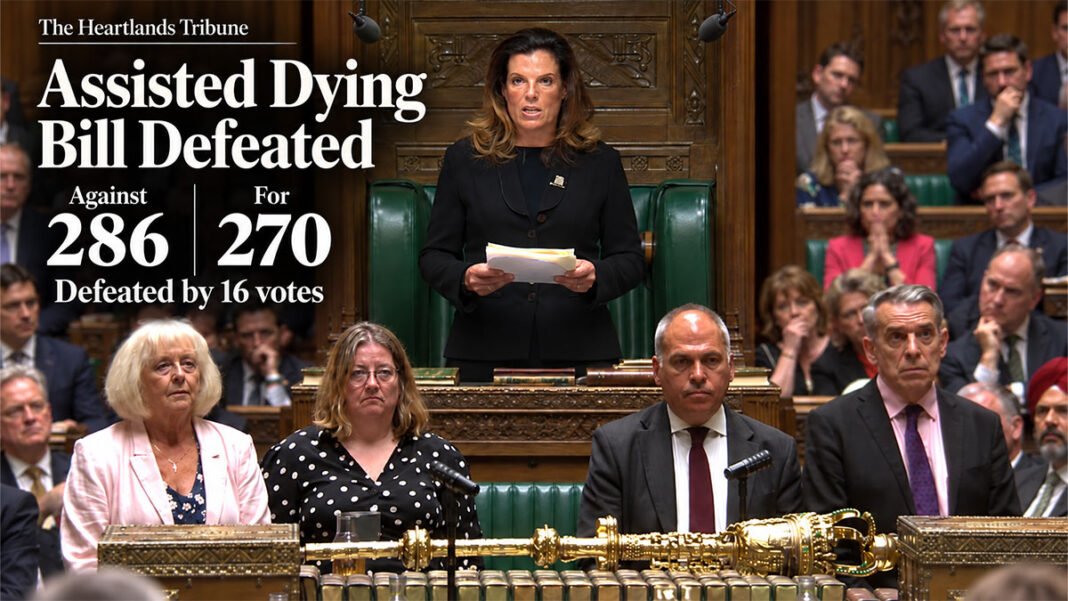
MPs have defeated the assisted dying bill by 286 votes to 270, a majority of 16. Support fell by 44 as Andy Burnham faced his first big Commons test.
MPs rejected a fresh attempt to legalise assisted dying on Friday, defeating the Terminally Ill Adults (End of Life) Bill by 286 votes to 270. Support for the bill fell by 44 MPs on last year’s vote. Three Labour opponents, including a minister who resigned after her own terminal diagnosis, said the result reflected a bill that was “unsafe and unworkable”, not a change of heart on the principle.
MPs voted on Friday to reject a fresh attempt to legalise assisted dying in England and Wales, defeating the Terminally Ill Adults (End of Life) Bill by 286 votes to 270, a majority of 16, after a debate lasting more than four hours in the House of Commons.
The result brings to an end, at least for this Parliament, a two-year campaign to change the law. MPs had twice backed the legislation before: at second reading in November 2024, by 330 votes to 275, and at third reading in June 2025, by 314 votes to 291. Both times the bill, sponsored then by the Labour MP Kim Leadbeater, went on to the House of Lords. Both times it stalled there. An unprecedented number of amendments from peers meant it ran out of parliamentary time before the 2024 to 2026 session ended, and the bill fell without becoming law.
It returned to the Commons on Friday under a different sponsor. Lauren Edwards, the Labour MP for Rochester and Strood, drew a high place in this year’s private members’ bill ballot and reintroduced the legislation, unchanged, on 17 June. The bill would have allowed adults in England and Wales with fewer than six months to live to apply for an assisted death, subject to approval from two doctors and an expert panel. That panel replaced an earlier safeguard, a sign-off from a High Court judge, which had been stripped out and replaced at committee stage in 2025.
The swing in the numbers tells its own story. The proportion voting against barely moved, down from 291 last year to 286 this time. What collapsed was support for the bill itself. Just 270 MPs backed it on Friday, a fall of 44 on the 314 who voted for it in June 2025.
Burnham’s Assisted Dying Abstention: His First Big Test
The vote was the first major free vote of Andy Burnham’s premiership, and it exposed how much has changed since MPs last considered the bill. Burnham became prime minister on 20 July, taking over from Sir Keir Starmer after Labour’s local election losses in May and mounting pressure over the government’s direction. Starmer voted for the bill in June 2025, while keeping the government officially neutral. Burnham chose not to vote at all, telling colleagues in a letter that he did not want to “unduly influence the debate” as prime minister and that it should remain “a genuinely free vote”.
Burnham had indicated in the past that he supported the principle of assisted dying. But in the weeks before Friday’s vote he told MPs he believed the funding of palliative care needed to be fixed before Parliament could properly consider legalising it, a position that put him closer to the bill’s opponents than its sponsors, even from the sidelines.
“MPs have voted against this bill because it wasn’t an abstract debate but a decision about a real bill that was unsafe and unworkable.”
Three Labour MPs who voted against the bill, Ashley Dalton, Dame Meg Hillier and Jess Asato, issued a joint statement after the result was announced. “This is not a moment for celebration,” they said, adding that they understood “the deep concerns of so many people across the country who have campaigned hard for a change in the law”. They said none of the relevant royal medical colleges, professional bodies or experts would attest to the bill’s safety or workability, and that the government’s priority should now be to “fix our NHS and sort out social and palliative care before we even consider introducing assisted dying”.
Dalton’s opposition carried particular weight. The West Lancashire MP resigned as a health minister earlier this year and is undergoing chemotherapy for stage four metastatic breast cancer. She told the Commons that people with terminal diagnoses had been “scaremongered” into believing their deaths would be horrific, and that it was often impossible to say with confidence how long someone actually had left to live. “I don’t know how long I will live,” she said. “It could be months. It could be years.” She called the bill “unsafe and unworkable”.
She was not alone in raising doubts about prognosis. Dr Zubir Ahmed, the Labour MP and cancer surgeon, told the House that six-month estimates were an unreliable basis for a life-or-death decision. “When I am asked to prognosticate as to whether someone has six months to live or not,” he said, “I am as often wrong as I am right.”
The Royal College of Psychiatrists had already raised what it called serious concerns about safeguarding people with mental illness under the bill. Archbishop Richard Moth, the Archbishop of Westminster and leader of the Catholic Church in England and Wales, called the legislation “wrong in principle” and “deeply flawed”, and the Archbishop of Canterbury, Sarah Mullally, also opposed it. Earlier in the bill’s passage, the Labour MP Peter Lamb switched from abstaining to opposing it outright, telling constituents in Crawley that the legislation was being pushed forward “in the shadow of a funding crisis in the hospice sector, with hospices closing or being scaled back across the country”.
Palliative Care Funding and the Assisted Dying Bill Vote Result
For the bill’s supporters, the defeat was a bitter one. Lauren Edwards said the result was “hugely disappointing”, not for herself, she said, but for “the many thousands of terminally ill people and their loved ones who were given hope when the Commons voted for this bill last year”. She argued that support for the principle of assisted dying remained as strong among MPs as before, and that Friday’s objections were about process, not principle. “A minority in the House of Lords used procedural devices to block it and MPs baulked at insisting that they do their job,” she said. “Assisted dying will come in this country, as it is already doing all across the world, but not soon enough.”
Jess Phillips, the Labour MP and a supporter of the bill, said afterwards that she was “devastated”. Claire Hazelgrove, another Labour MP, used her speech to describe her mother’s death from a rare blood cancer, saying she had died alone under what Hazelgrove called “the harmful status quo”, and that “not all pain can be palliated”.
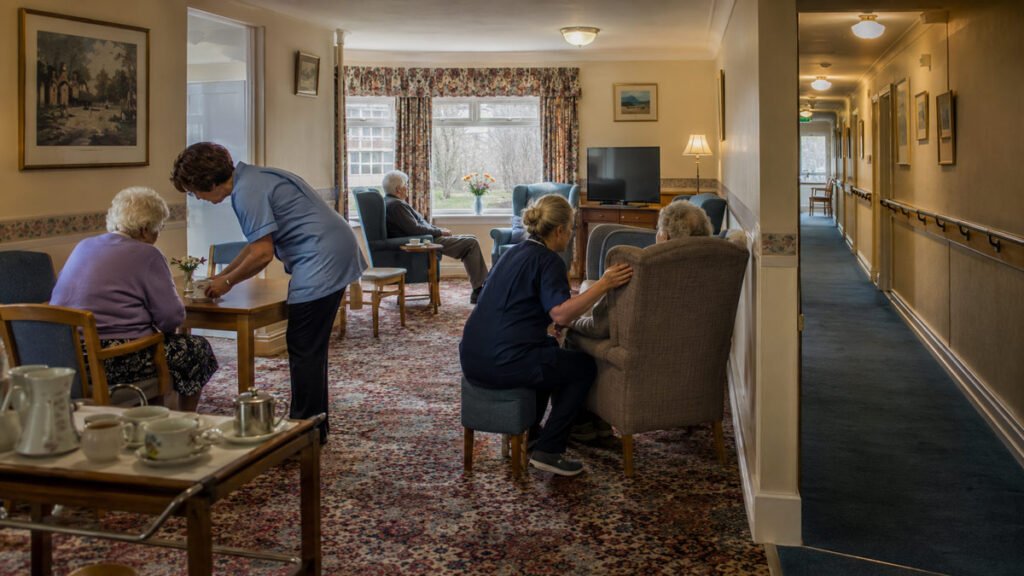
What the vote leaves unresolved is the thing almost every MP who spoke on Friday, whichever way they voted, agreed on: that palliative and social care in England and Wales is not what it needs to be. Opponents of the bill used that gap to argue reform was premature. Its supporters used the same gap to argue that people are already suffering and dying badly for want of choice. Burnham, who abstained on the bill itself, is the one now left holding the argument he made from the sidelines, that the funding has to be fixed. He no longer has the option of leaving that question to the next parliamentary vote. There may not be another one for years.
“Assisted dying will come in this country, as it is already doing all across the world, but not soon enough.” Lauren Edwards MP, sponsor of the bill, speaking after its defeat.
“But for others, they are saying…first, let’s give life a chance, with better social care.”