Two crypto billionaires just handed one party more money in two days than every party in Britain raised together during the entire campaign that decided the last election. The man now in Downing Street spent this summer arguing against exactly this kind of politics. Then his own paperwork told a different story.
Reform UK’s £72m Donation in 48 Hours Exposes Broken Democracy
£72 Million in 48 Hours: Reform’s Billionaire Backers and the Slow Sale of British Democracy
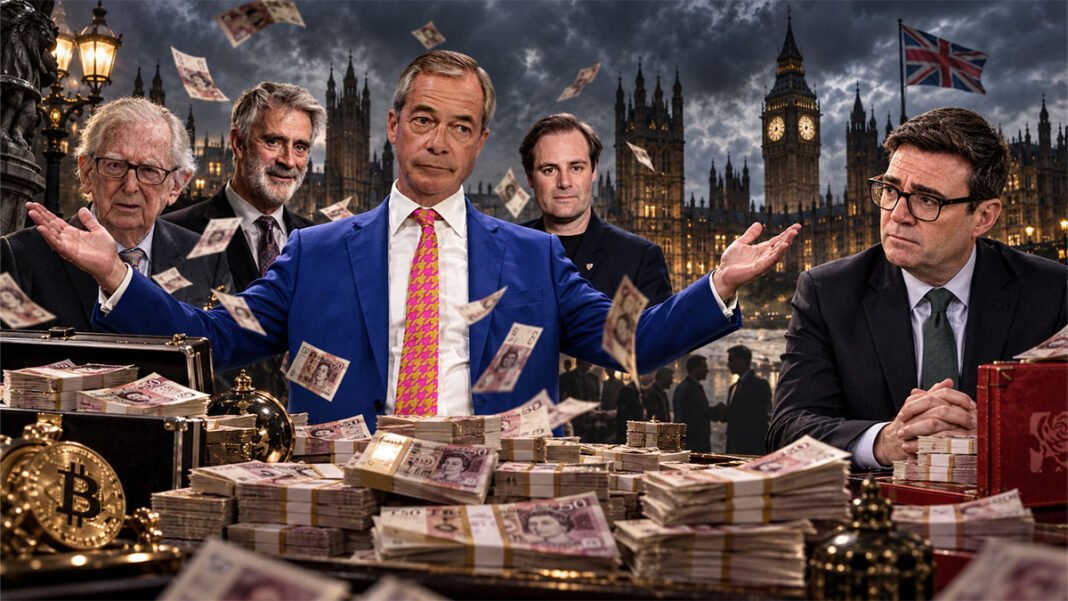
Every political party in Britain, combined, reported £15.2 million in donations during the entire five-week campaign that decided the 2024 general election, the strictly regulated “pre-poll” period when parties must declare weekly. This week, two men gave one party almost five times that in two days. Across the whole of 2024, the year the country actually voted, every party in Britain raised just shy of £100 million between them. Ben Delo and Christopher Harborne needed 48 hours to hand Nigel Farage’s Reform UK nearly three quarters of that sum, on their own, with no election even called.
On Friday, the cryptocurrency trader Ben Delo gave Reform thirty-six million pounds, the largest single donation any UK party has ever received, saying he wanted “a fair fight and a level playing field.” On Saturday, Harborne, until then Reform’s biggest backer, matched it pound for pound. Asked why, he skipped Delo’s language about democracy altogether. His “competitive spirit,” he said, had inspired him to match it. Farage thanked them both, saying the party could now “fight that election on a level playing field.” Nobody involved used the phrase seventy-two million pounds without also reaching for the word fair.
Reform currently holds eight of the House of Commons’ 650 seats. Its deputy leader, Richard Tice, gave a clearer account of what the money actually buys than either donor did, telling LBC it would let the party “employ campaign managers… in almost every constituency across the country.” That is not levelling a playing field. That is buying one, outright, before a single vote has been cast in the next election.
Remember who is doing the buying. Delo made his fortune co-founding BitMEX, a cryptocurrency exchange that let traders move enormous sums with barely a check on who they were or where the money had come from. In 2022 he pleaded guilty in the United States to failing to implement anti-money laundering controls at the platform, and was pardoned last year by Donald Trump. A man once convicted over an exchange with too few defences against dirty money is now, alongside Harborne, the single largest financial backer of a British political party, at the exact moment that party is under criminal investigation for how it handles its own.
Days before Delo’s donation, the Metropolitan Police confirmed a criminal investigation into Reform UK over allegations it broke the law barring foreign donations, after an undercover documentary by Channel 4 News and the investigative outlet Verbatim filmed two of Farage’s most senior aides discussing how a reporter posing as the British son of a wealthy American backer might funnel money into the party’s accounts, or pay for private polling instead. Farage was in the room for part of that conversation. Both aides resigned within days. Farage has called the sting entrapment and denies Reform has ever taken illegal foreign money. A separate parliamentary standards inquiry is examining an undisclosed personal gift worth around five million pounds that Farage received from Harborne, who had already put some fifteen million pounds into the party before this week and has now gone past fifty million pounds of his own giving. None of this has been proven in court.
Parliament shelved the donation cap days before the money arrived

Farage Oysters, wine, and a £32,500 secret
Parliament had a chance to stop exactly this, and shelved it days before the money arrived. After Nathan Gill, Reform’s former member of the European Parliament for Wales, was jailed for more than ten years for taking bribes to make pro-Russian statements, an independent review led by Philip Rycroft recommended a £100,000 annual cap on donations from British citizens abroad and a ban on cryptocurrency donations, both in force since March. Those rules only bite on donors based overseas. Neither Delo nor Harborne needed to worry: both are now UK residents. The Labour MP Stella Creasy tabled an amendment that would have closed that gap entirely: a hard cap of £100,000 on donations from any individual or company, resident or not. Polling for the Good Law Project found 92 per cent of voters back a limit like it. Last week, Creasy withdrew the amendment after ministers promised to tackle mega-donations through a new taskforce. Days later, two men gave seventy-two million pounds to one party in under 48 hours. Duncan Hames of Transparency International UK had already warned what would happen: without a cap on size, “the door remains open to anyone wealthy enough to walk through it.”
None of this makes Reform’s underlying complaint baseless. Incumbency carries advantages no spending cap touches: broadcast access, press relationships, decades of accumulated name recognition, all of it scaled to seats already held rather than votes cast or standing in the polls. A party stuck on eight seats despite regularly leading national surveys has a real grievance there.
But that is not the grievance seventy-two million pounds in two days is correcting. A party whose senior aides were filmed discussing how to route a foreign backer’s money through an invented son, whose leader faces a standards inquiry over an undisclosed personal gift, and whose deputy leader has already had donations flagged to the National Crime Agency, is not an underfunded outsider levelling an unfair contest. It is a party drowning in cash from the same two men who supplied more than sixty per cent of its funding last year. That is not a broader base of support. It is the same narrow one, with more zeros.
Labour took £4m from Quadrature: Same game, different party

None of this should let Labour off the hook, and we have never pretended otherwise. In September 2024, in the one-week gap between Rishi Sunak calling the general election and the start of the reporting period that would have forced immediate disclosure, Starmer’s Labour accepted four million pounds from Quadrature Capital, a hedge fund structured through the Cayman Islands with holdings in Northrop Grumman, Lockheed Martin, and other arms and fossil fuel firms. As we reported at the time, it was the largest single donation Labour had ever taken, timed to slip past the one week of scrutiny that might have embarrassed the party before polling day.
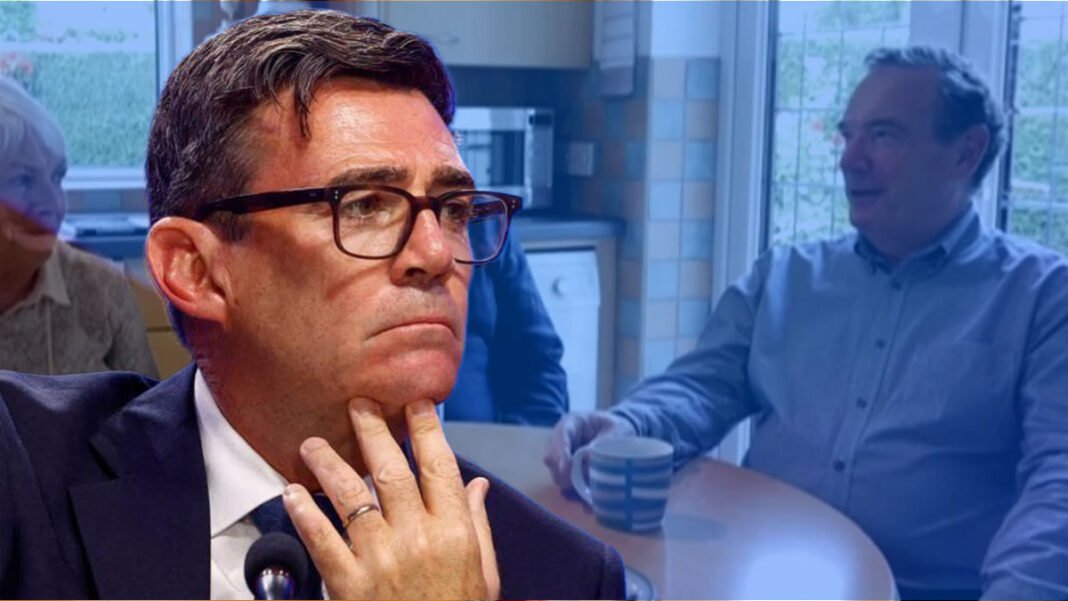
His successor has since done a version of the same thing, closer to home. Before entering Downing Street, Andy Burnham built part of his reputation on opposing exactly this kind of politics, arguing publicly, as recently as June this year, for a cap on large donations to curb the influence of wealthy backers. He made the same complaint back in 2010, when he said his own party’s leadership contest had been distorted by big money. Weeks after his June intervention, Burnham’s first register of financial interests as Prime Minister showed close to three hundred and fifty thousand pounds in gifts and donations behind his own leadership campaign, including thirty-five thousand pounds from his former Manchester night-time economy adviser Sacha Lord, twenty-five thousand from the former Autoglass chief executive Gary Lubner, fifty thousand from a production company owned by a television executive and Labour donor, more than twenty-two thousand from Labour Together, since renamed ThinkLabour, and a sixteen-thousand-pound staff secondment from the accountancy firm Ernst and Young. None of it was illegal, and all of it was eventually declared through the proper register, the same way any MP’s outside support must be. But “eventually” is doing a lot of work in that sentence: the money arrived, and did its job, months before the public had any way of knowing where it came from. It surfaced only once Burnham had already won. He has separately been accused of failing to declare a £6,600 VIP hospitality trip to Japan within the required time, an allegation he has yet to resolve with the parliamentary standards commissioner.
Set the three stories side by side and the pattern is unmistakable. Starmer took millions from an offshore hedge fund and the public found out about it only once the moment it might have cost him votes had passed. Burnham took hundreds of thousands from wealthy individuals and a corporate secondment and the public found out about it only once the moment it might have cost him the leadership had passed. Delo and Harborne handed Reform seventy-two million pounds in a system with no cap at all, and told everyone immediately, because unlike the other two, they had nothing to hide and no reason to wait. Three parties, three different mechanisms, one identical outcome: the public learns who paid for power only after the question of who holds it has already been settled.
The public learns who paid for power only after the question of who holds it has already been settled.
America shows where unlimited money leads with 96% of races won by biggest spender

America shows where unlimited money leads…
This is the trajectory worth worrying about, because Britain is not the first country to travel this road. In the United States, where individual and corporate money has flowed into elections with almost no ceiling since the Citizens United ruling in 2010, the pattern is no longer disputed. Independent analysis by the watchdog OpenSecrets has repeatedly found that the better-funded candidate wins the overwhelming majority of Congressional races, sometimes above 90 per cent of House contests in a single cycle, and that sitting incumbents, who attract the most donor money by far, are re-elected at rates in the nineties election after election. Money does not guarantee a win every time. But across enough elections, in enough seats, it stops looking like an input to democracy and starts looking like its precondition.
There is an old saying that covers this without needing a single statistic: he who pays the piper calls the tune. Nobody writing a cheque this size, whether it is Ben Delo, Christopher Harborne, Lord Sainsbury, or a hedge fund based in George Town, is doing it for the pleasure of watching democracy flourish. They are buying proximity to power, and the tune that gets called afterwards tends to be theirs, not the electorate’s. That is the real cost sitting underneath every one of these donations. It is not simply that rich men can buy elections. It is that the politicians elected this way owe their position to people who are not the voters who put them there, which means the people meant to be represented, the ones paying for all of this in the end through their taxes, their rent and their falling wages, increasingly are not. Britain does not need to become America to see where that road leads. It only needs to keep walking down it at the current pace.
Harborne says seventy-two million pounds between two men was inspired by nothing more than competitive spirit. Nine in ten voters say they want a cap on exactly that kind of spending. Parliament chose the billionaires’ instinct over the country’s, and two prime ministers in a row have shown they can live with a similar arrangement for themselves. Until that changes, elections in Britain will keep being decided by whoever pays first, and governed, afterwards, by whoever they were really paying for.

Support The Tribune
INDEPENDENT. READER-FUNDED. AD-FREE.
If you value this article, help keep The Heartlands Tribune publishing independent journalism without intrusive advertising or corporate sponsors.
Choose your monthly amount
Secure payment via GoCardless
Sources
- Electoral Reform Society: How big donors fund our political parties (£15.2m pre-poll total)
- Electoral Commission: Political parties accept almost £100m in donations in 2024
- LBC: Crypto-billionaire Christopher Harborne matches record £36m Reform UK donation
- Yahoo News UK: Farage’s Reform UK secures second £36m donation from cryptocurrency tycoon in two days
- ITV News: Crypto tycoon donates record £36m to Reform UK
- CNN: Reform UK police launch criminal investigation over donations law
- MHCLG: Coverage of Government response to the Rycroft Review
- Good Law Project: Political funding – Stella Creasy bids to close donations loophole
- Byline Times: ‘A Cap on Donations Is Not Anti-Union, It Is Anti-Oligarchy’
- Transparency International UK: Political donation reforms duck the big question about big money
- openDemocracy: Labour given £4m from tax haven-based hedge fund with shares in oil and arms
- The Heartlands Tribune (2024): Selling Out – Labour Given £4m From Tax Haven Hedge Fund
- UK Fact Check: Burnham declares £345,000 in donations, weeks after backing a cap on big money
- GBNews: Andy Burnham handed £350k in donations months before entering No10
- GBNews: Andy Burnham accused of breaching Commons rules after failing to declare £6,600 VIP party
- OpenSecrets: Spend big, win big – 96% of U.S. House races won by the biggest spender