Bailed and Remanded: What Fairford and Basingstoke Tell Us About Justice Before Trial
We were told a bomb plot had been foiled beside an American airbase in the Cotswolds. A day and a half later, the suspects were free, the cordon was shrinking and the public was left with nothing but briefings.
Two bail decisions came within a single week.
On Friday, a 37-year-old roofer named Daniel Thomas, known to his supporters as Danny Tommo, appeared at Basingstoke Magistrates’ Court. He pleaded not guilty to criminal damage after allegedly slashing a boat in the Channel with an emergency responder on board. He also denied refusing to give police the PIN to his phone. He was refused bail and sent to prison to await trial.
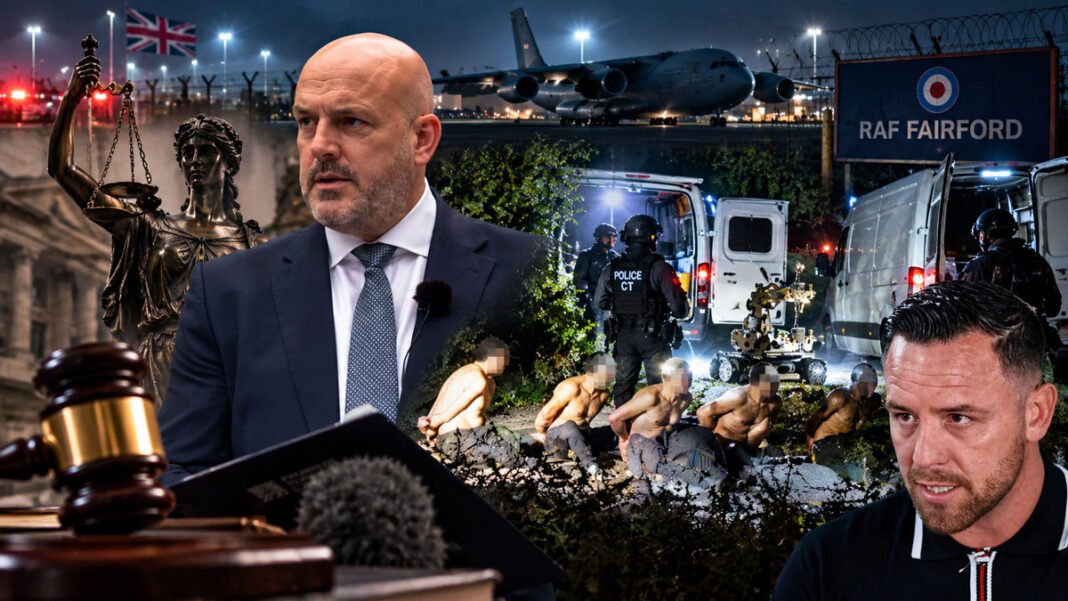
On Monday, five young men from London, arrested in the dead of night beside an RAF base used by American bombers, were released. They had been held on suspicion of Explosives Act offences and preparing a terrorist act. Assistant Commissioner Laurence Taylor, head of Counter Terrorism Policing, told reporters outside New Scotland Yard that they were leaving custody on police bail under “stringent conditions”.
Many readers will look at those two outcomes and conclude the system has its thumb on the scale. The feeling is understandable. Honesty requires us to say the cases are not the same. Thomas has been charged, and a court judged whether he should wait for trial behind bars. The Fairford five have not been charged. Police released them because, for now, they either lack the evidence to charge or the grounds to ask a court for more time.
That distinction matters. It also opens a more troubling question than the one being shouted on social media.
WHAT WAS IN THE VANS?
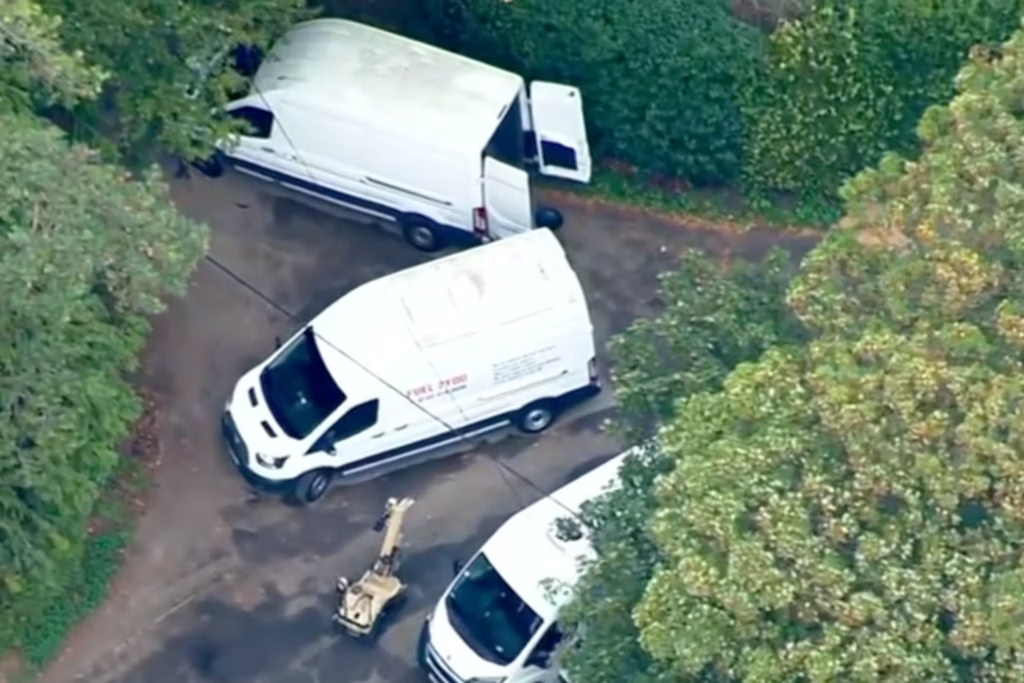
On Sunday the country watched aerial footage of a bomb disposal robot circling three white vans near the village of Whelford. Two had their rear doors open. Large black objects lay scattered around them. Reporters near the perimeter fence heard what sounded like two controlled detonations. At least 85 homes were evacuated.
By Monday afternoon every suspect was walking free, the cordon was being scaled back and residents were being told they could go home. Police have still not said what, if anything, was in those vans.
Plenty of people will be exasperated by this, and they are entitled to be. For a day and a half the public was invited to believe that a serious bomb plot had been stopped on the edge of the Cotswolds. The authorities’ own conduct since then tells a smaller story. Suspects in a live plot to bomb an airbase are not usually back on the streets within 36 hours. Either the evidence is thinner than Sunday’s headlines suggested, or the state is asking us to trust it without showing why.
Either there was a viable explosive device, or there was not. The public is owed the answer.
If there was a working device, releasing five men without charge after so short a time is extraordinary, and ministers should explain it. If there was not, the country deserves to know why Sunday’s story looks so different by Monday. Bail in national-security cases is not unheard of: in a separate case, the husband of Labour MP Joani Reid and two other men were bailed after being arrested by counter-terrorism officers on suspicion of spying for China. What is unusual is the distance between the drama of the operation and the modesty of its result.
WHO HAS BEEN BRIEFING, AND WHY?
Before anyone had been charged, the Daily Telegraph reported that police are understood to suspect Iran as the most likely state actor. The Iranian Embassy in London “categorically” rejected the claim. Defence Secretary Wes Streeting then said the farmer who raised the alarm “had a partial picture”. She had tried the base’s own hotline, got no answer, dialled 999, and later told the BBC the authorities had “dropped the ball”.
Context matters here. In March, Keir Starmer, then Prime Minister, allowed US strikes on Iranian missile sites to be launched from Fairford. A government that has tied British soil to an American war has an obvious interest in a story about Iranian aggression on English soil. That does not make the story false. It means the story should be tested in a courtroom, not settled by anonymous briefings to friendly newspapers.
ONE LAW, FOR EVERYONE
The principled answer to Basingstoke is not to demand that the Fairford men be locked up. It is to insist on the same standard for everyone. The presumption of liberty before trial belongs to a far-right activist accused of slashing a dinghy and to five Londoners picked up near an airbase. Those who want the state to show its evidence in one case should want it in the other. The left forgot this once. The right is forgetting it now.
Thomas’s lawyers will apply again at Portsmouth Crown Court. The Fairford investigation continues. In both cases the question is the same, and it is the only one that should matter: what can the state prove?
Justice is judged on evidence, not headlines, and nobody should be jailed or cleared by press briefing.