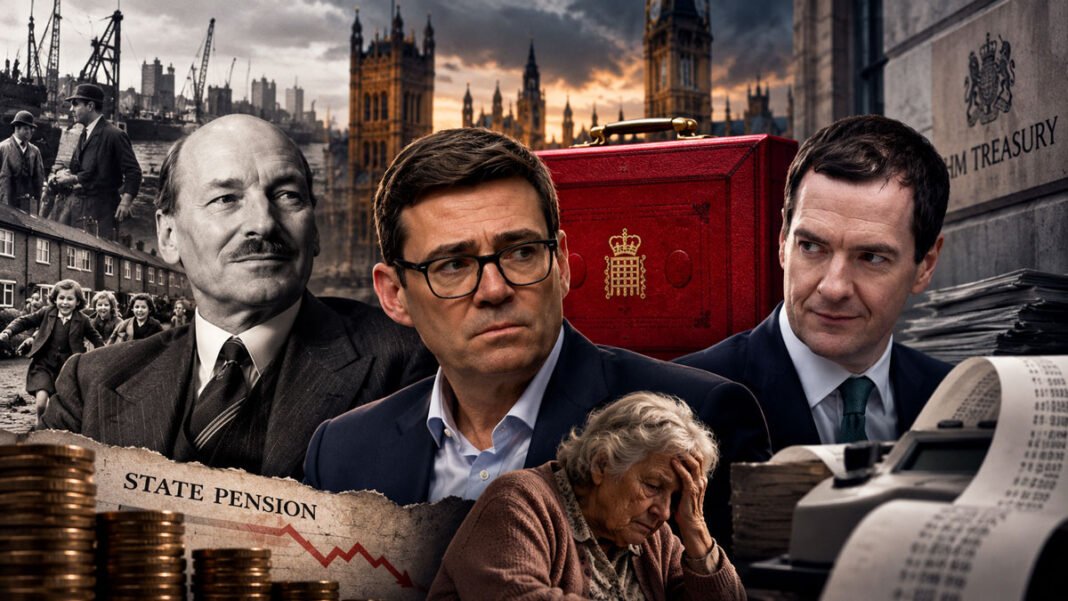
Andy Burnham’s Pension Plan: The Cost of Social Care
Andy Burnham broke with forty years of orthodoxy on water, energy and housing. Then he asked pensioners to pay for his National Care Service, because the one orthodoxy he would not break was the Treasury’s.
Andy Burnham stood in Liverpool on Tuesday, a few miles from the docks where his grandfather drove a lorry for Tate & Lyle, and gave the most radical speech a Labour leader has delivered to conference in a generation. He named the wrong turns of the last forty years in five blunt words: “Deindustrialisation. Deregulation. Privatisation. Austerity. Brexit.” He promised to repeal what he called “Margaret Thatcher’s ideological ban on public ownership of water companies.” He announced a publicly owned Great British Grid, the biggest council house building programme since the post-war years, and an end to Right-to-Buy on the new homes built with public money.
The hall rose, and it had reason to. For anyone who spent the last decade watching Labour treat public ownership as an embarrassing relative, it was a remarkable thing to hear.
Then he reached social care, and the speech turned on itself.
Burnham’s case for a National Care Service is sincere and personal. He described his gran Kitty’s engagement ring being pulled from her finger and stolen in a care home, and her modest savings being taken to pay for care “not worthy of the name.” He spoke to the care workers who looked after his dad, “caring for other people’s parents on poverty pay,” and apologised on behalf of his profession. Nobody who heard it could doubt he means it. Then he told the country how he would pay for it: “It will be fully funded, and not through borrowing.” Earlier he had already committed himself: “I will stick to our fiscal rules to get borrowing and debt down.”
Once those two doors are shut, the money has to come from somewhere, and Burnham found it in the pockets of the old.
THE DEAL ON THE TABLE
The triple lock raises the state pension each April by whichever is highest: inflation, average earnings growth, or 2.5 per cent. Burnham will keep it until the end of this Parliament, as Labour’s manifesto promised. From April 2030, if Labour wins again, the pension “will continue to rise every year at least by prices or 2.5%,” and “will hold its value relative to earnings over time.”
The annual guarantee of keeping pace with wages goes. In its place is a phrase: “over time.” Over five years? Ten? Measured by whom, against which index, with what legal force? The speech doesn’t say. A pensioner deciding how to vote in 2029 is entitled to know, because “over time” is the gap through which their income will leak.
To be fair, Burnham did not dress this up. “I accept I may pay a political price,” he said, and spoke of ripping off the plaster. That is more honest than Thérèse Coffey’s suspension of the earnings link in 2021, announced as a one-off and sold as common sense. But candour about a bad trade doesn’t make it a good one.
The trade buys remarkably little. Helen Miller, director of the Institute for Fiscal Studies, told Sky News the change would raise “relatively small amounts, in the hundreds of millions over the next parliament” and would not pay for universal social care, which she said would need “much more substantive tax rises”. Labour’s own projections are grander: £15 billion a year by the end of the 2030s and £50 billion a year by 2050.
Those figures give the game away. The savings grow year after year for one reason only: the state pension falls further behind where it would otherwise have been. Every pound “saved” is a pound a pensioner does not receive. The IFS calculates that had the new system been in place since 2011, spending on the state pension would be about £9 billion lower today. That £9 billion isn’t an abstraction. It is the gas bill, the food shop and the bus fare of millions of people who have nothing else to live on.
Every pound “saved” is a pound a pensioner does not receive.
A REPAIR, NOT A BONUS
The triple lock is often described as a lavish gift to a pampered generation. The history says otherwise.
In 1980 Margaret Thatcher’s government broke the link between the state pension and earnings. For three decades afterwards, the basic pension rose only with prices while wages pulled away, and its value fell to around a sixth of average earnings. In 2000, after a year of low inflation, Labour’s Treasury awarded pensioners a rise of 75p a week. Older readers still remember it, and not fondly.
Labour’s own Pensions Act 2007, following Adair Turner’s Pensions Commission, promised to restore the earnings link. The coalition brought in the triple lock in 2011 partly to make up for lost ground. Fifteen years of catching up haven’t undone thirty years of falling behind, and Britain’s standing among its peers shows it.
The OECD’s most recent Pensions at a Glance, published last November, compares what a worker on average earnings with a full career can expect in retirement as a share of their take-home pay. Across the developed world, the net replacement rate from mandatory schemes averages 63.2 per cent. Britain’s figure is 54.2 per cent, and that already counts the workplace pensions of auto-enrolment. Strip those away and the picture worsens. The House of Commons Library finds that on the state pension alone, the UK provides a lower level of pension than most other advanced economies relative to average earnings, and that Britain devotes a smaller share of its GDP to state pensions and pensioner benefits than most of them too.
So British pensioners are not the cosseted exception of the developed world. They sit well down its table. The earnings guarantee is the one mechanism that has been slowly lifting them, which is exactly why it matters. Remove the ratchet now and you are not trimming a luxury. You are reopening a wound that barely closed.
The public seems to understand this. A poll conducted before the speech found 53 per cent supported keeping the triple lock and 13 per cent supported ending it. Sharon Graham of Unite called it the “wrong lever to pull at this point”. Nigel Farage, never one to miss a gift, accused the Prime Minister of “launching an offensive against our elderly”. When Burnham hands Reform its best attack line of the autumn, Labour should ask whether the Treasury’s rules are worth the price.
WHO PAYS, AND WHO INHERITS
There is a harder question beneath the arithmetic. Who gives something up, and who gains?
Burnham’s care service will be free at the point of use, and it will protect “people’s homes and their savings.” For the poorest pensioners, there’s a genuine gain: no more care charges taken out of a state pension that barely covers the week. That deserves credit, and the Tribune gives it.
But the largest prize, the protection of property and savings from care costs, goes to those who own property and have savings, and to their children who stand to inherit. The cost, a weaker pension formula for the rest of their lives, falls hardest on those who own neither: the retired cleaner, the former bus driver, the woman who spent twenty years caring for relatives and has a patchy contribution record to show for it. For them the state pension is not a supplement. It is the whole income.
So the flat-rate pension of the asset-poor is quietly thinned to protect the estates of the asset-rich. A Labour government should not design a social contract that way.
THE MONEY QUESTION

Why does it have to be this way? Because Burnham, having taken on the water companies, the energy market and Right-to-Buy, chose not to take on the one institution that shapes everything else: the Treasury’s view of money.
Britain issues its own currency. It is not a household that must earn a pound before it can spend one, and it cannot run out of the money it creates. When the government spends, it puts pounds into the economy; when it taxes, it takes them out. The real questions are different ones. Is there enough labour, skill and physical capacity to do what we want? Will spending push up prices because those resources are already in use?
The obvious objection deserves a straight answer. In September 2022 Liz Truss announced unfunded tax cuts, gilt yields spiked, pension funds nearly collapsed, and the Bank of England had to step in. Doesn’t that prove the markets rule?
It proves something narrower. Truss poured unfunded tax cuts, mostly benefiting the wealthiest, into an economy where inflation was already above 10 per cent. She did so without any independent forecast, after sacking the Treasury’s most senior official, while pension funds were running leveraged bets on gilts that turned a sell-off into a crisis. The markets punished chaos and the wrong use of money at the wrong moment. They did not prove that a sovereign country cannot pay its carers. The same Bank of England bought £875 billion of government bonds through quantitative easing, much of it during a pandemic, without Britain going bankrupt. Money was found when the establishment decided it mattered.
So we come to the real constraint on care, and it isn’t money. It’s people. Social care has tens of thousands of unfilled posts, because the work is skilled, exhausting and paid at or near the minimum wage. The limit on building a National Care Service is how many trained, fairly paid carers we can recruit and keep. The answer is to spend: on wages, on training, on sectoral pay bargaining that makes care a career rather than a stopgap. Burnham himself argued that better care will save the NHS money through fewer ambulance call-outs, fewer A&E admissions, and fewer people stuck in hospital beds. That is the language of investment. It shouldn’t depend on shaving pensions.
Where spending does risk inflation, taxation has a role, and it should fall on unearned wealth and property gains, not on the flat-rate income of the poorest pensioners.
1945, AGAIN

Burnham reached for history. “In 1945, we had the vision to win the peace,” he said, and later: “In 1945 we had the Beveridge Report. We need something similar now.”
He is right to invoke it, and it condemns his financing. The Attlee government built the NHS in 1948 while carrying a national debt more than twice the size of the entire economy. There was no fiscal rule declaring the health service “fully funded and not through borrowing.” There was a country with its factories, its workers and a clear idea of what it wanted to build with them. The debt was dealt with through growth, full employment and time, not by taking from the old to care for the old.
Burnham told the hall that the British Right “gave away” control in the first place, and he listed what they sold: “Homes. Water. Energy. Transport. Care.” Care was on the list. He wants to bring it back into the common wealth, and he should. But you cannot rebuild the common wealth while accepting the rulebook of those who sold it.
You cannot rebuild the common wealth while accepting the rulebook of those who sold it.
WHAT LABOUR SHOULD DO
The fix doesn’t require abandoning the National Care Service. It requires honesty about where the money comes from.
Keep the annual earnings guarantee on the state pension, or replace “over time” with a statutory commitment that is precise, measurable and enforceable. Treat the National Care Service as national infrastructure, like the grid Burnham intends to build, and fund it through the public purse as such. Pay and train carers properly, and let the savings to the NHS that Burnham himself predicts flow back into care. Where restraint is needed to manage inflation, ask it of concentrated wealth, not of people who have only the state pension.
Burnham says his generation of politicians was “too cowardly to fix something as basic as the care we give to each other.” He is right, and he has more courage than most. But this deal doesn’t show courage. Courage would mean confronting the Treasury, not the pensioner.
You cannot build Attlee’s Britain with Osborne’s calculator.