
Pat McFadden chose a Saturday to announce that the taxpayer will cover the wage bills of Lidl, Boots and hundreds of other employers for six months at a time. On Tuesday, Alan Milburn is expected to recommend taking sickness and disability benefits away from the under-25s. These are not two stories. They are one policy, with the money flowing up and the conditions flowing down.
It’s “Corporate Welfare” Dressed up as “Youth Opportunity”
Governments don’t save their proudest announcements for Saturdays. Pat McFadden, the Work and Pensions Secretary, put out his news on 14 November: the Jobs Guarantee will go nationwide from the end of the month, after trials in six areas with high unemployment. It came three days before Alan Milburn’s review into youth inactivity is due to land, and at the end of a week in which the papers reported that the review would recommend ending Personal Independence Payment and the health element of Universal Credit for 18 to 24-year-olds.
On paper, the scheme is simple. If you are 18 to 24 and have been on Universal Credit and out of work for 18 months, the state will find you a job and pay for it. That means up to 25 hours a week at the minimum wage for six months, with the employer’s National Insurance and minimum pension contributions included. From April, the qualifying period drops to 12 months. Ministers want 90,000 young people through the door by March 2029. The Office for National Statistics last counted 981,000 young people not in education, employment or training.
The case for it deserves a fair hearing, because it is not nothing. For a young person who has spent a year and a half being processed by a jobcentre, a wage is better than a sanction. A payslip is better than a warning letter. The scheme comes with support before and during the placement, and charities such as the YMCA have welcomed it. Labour has some history here, too. Gordon Brown’s Future Jobs Fund, set up in 2009, was scrapped by David Cameron as expensive and badly targeted. When the Department for Work and Pensions evaluated it in 2012, it found the opposite: a net gain to society of about £7,750 per participant. Subsidised jobs can work.
The question is which kind of subsidised job, and who it is really for.
The Subsidy Behind the Shop Counter
Jobs under the Future Jobs Fund had to carry an element of community benefit. Its independent evaluation complained that this made it hard to involve private firms. McFadden’s scheme has fixed that “problem” by going the other way. Its model isn’t Brown’s Future Jobs Fund. It is Rishi Sunak’s Kickstart: six months, 25 hours, minimum wage, young people on Universal Credit. When the National Audit Office looked at Kickstart in 2021, it found the department did not know whether the jobs were good ones or whether they would have existed anyway. Before the scheme had even begun, the DWP itself assumed only half the economic output would be genuinely additional, and it accepted the figure could be as low as 30 per cent.
“Lidl is guaranteed a free worker; The young get the trial period.
This is the point Labour has chosen not to answer. Lidl and Boots already hire young people to stack shelves, staff tills and work in warehouses. That is their business. When the state pays every penny of a young worker’s wages, National Insurance and pension for six months, plus an onboarding payment of up to £250, one question decides whether the scheme is a public good or a gift. Would that shift have existed anyway? If it would, the taxpayer has not created a job. It has bought one that was already there and handed the saving to the employer.
“If it would, the public purse has not created a job. It has bought one that was already there and handed the saving to the employer.”
The government will say there are safeguards, and there are. The guidance limits how many participants any one employer can host. But a limit on numbers is not a limit on churn. Nothing in the scheme obliges a firm to keep anyone on when the subsidy ends. Six months later the next cohort arrives, the cost to the firm is again nothing, and the young person who has just learned the job is back at the jobcentre with a reference and a gap where a career should be. Twenty-five hours a week at the minimum wage is part-time work, and the state is guaranteeing part-time, temporary work and calling it a guarantee.
A Paper Plaster Over a Structural Wound
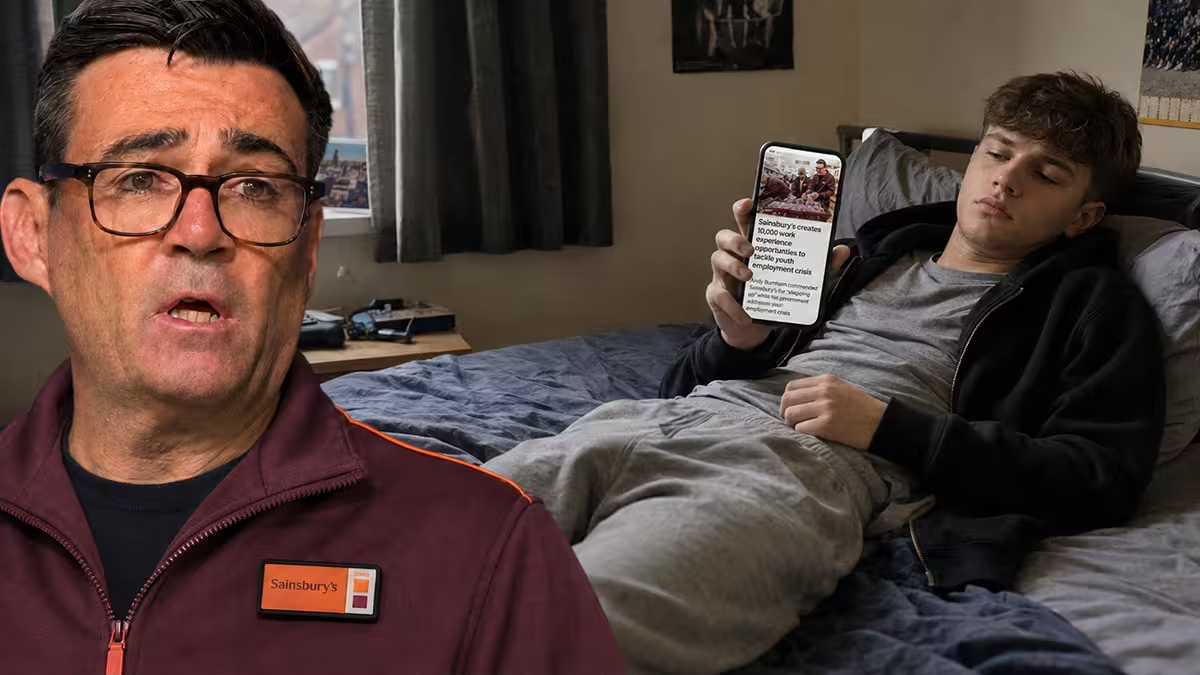
Ministers and their defenders will argue, with some sincerity, that long-term youth unemployment is a scar that deepens with every passing month. They will point out that 981,000 16-to-24-year-olds are currently not in education, employment or training, and that getting a young person out of the house, onto a rota and into the rhythm of a workplace is infinitely better than leaving them isolated on Universal Credit. A six-month placement at Boots or Cera, the argument goes, puts a line on a CV, builds confidence and gives a teenager a foot in the door that might otherwise stay locked.
That is the best case for the scheme, and it deserves to be stated plainly. Nobody disputes that idleness corrodes a young life, or that a first job can be a turning point.
Yet the argument collapses the moment you test the government’s own arithmetic against the scale of the crisis. Nearly one million young people are locked out of work and education right now, yet McFadden’s flagship scheme aims to place just 90,000 young people by March 2029. That is 90,000 temporary, part-time placements spread over nearly three years to answer an emergency affecting nearly a million lives. It is a paper plaster laid over a structural wound. In deindustrialised towns from Teesside to the Welsh valleys, the problem is not that young people lack the confidence to work a 25-hour minimum-wage shift. The problem is that half a century of economic abandonment stripped their towns of secure, well-paid industries and replaced them with low-wage service work and precarious rotas.
Now look at the second half of the policy, the half that wasn’t announced on a Saturday.
According to reports from Milburn’s own interview with The Times, his review will propose that 18 to 24-year-olds, including existing claimants, lose PIP and the health element of Universal Credit. They would get a youth allowance at the standard Universal Credit rate instead, with separate provision for the extra costs of disability. Further reports say Downing Street is considering whether the same “participation first” principle should apply to adults over 25. None of this is policy yet. But the direction is plain, and the Jobs Guarantee has already been built to fit it. From April 2027 the scheme opens to young people on the health element of Universal Credit, on what ministers describe as a voluntary basis.
Today it is voluntary. The point of building the route is that it can later be made compulsory. That is an inference, and I mark it as one. But a government that is weighing up removing the health payment and a scheme that offers the health claimant a subsidised retail placement are two halves of the same design. The young disabled person gets the conditions. The employer gets the money.
That is the shape of the whole thing. The carrot goes to the corporation and the stick goes to the claimant. Lidl is guaranteed a free worker. The 20-year-old with an anxiety disorder is guaranteed a review of whether he deserves his benefits.
The Brussels Squeeze

There is another pressure coming, and it arrives in Brussels on Friday. Andy Burnham goes to the UK-EU summit on 20 November hoping to agree a youth experience scheme, letting under-30s live, work and study on either side of the Channel. The government wants a cap of about 50,000 a year. Some EU states want up to 500,000, and others want no cap at all. The haggling is over how wide to open the door, not whether to open it. Many of those coming will be after the same entry-level jobs in shops, bars and hotels that the Jobs Guarantee is meant to open to our own long-term unemployed. Ministers will call it reciprocal: the borders are open both ways. So look at who actually goes through them. Young Britons do travel, but they go where English is spoken. In a single year, nearly 49,000 Britons went to Australia on youth mobility visas, about five for every Australian who came here. When Britain was in Erasmus, students from poorer homes made up barely a fifth of participants against almost a third of the student body.
Then add the classroom. In June, an independent inquiry found that just 36 per cent of white British pupils on free school meals get a grade 4 in English and maths GCSE, half the rate of pupils not on free school meals. GCSE language uptake is more than 20 points higher in the most affluent state schools, and schools serving poor communities find it hardest to hire language teachers. The kids on the council estates don’t speak French. Their German is left wanting, and Italian is something Bananarama once sang about Robert De Niro. A scheme that lets a graduate from Lyon with fluent English compete for a job in Leeds, while the lad from the estate can’t compete for one in Lyon, isn’t reciprocity. It is a one-way door with a two-way sign on it.
There is another way, and Britain once knew it well. For most of the last century, councils built homes with their own workforces, their direct labour organisations, and those yards trained apprentices who stayed for decades. Margaret Thatcher’s government forced them into competitive tendering from 1980, and they withered. If the state is going to pay 100 per cent of a young worker’s wages, it has every right to ask who owns what that worker produces. A public works guarantee would put young people to work building council homes, insulating cold houses, staffing care services and restoring parks, as full apprentices with a trade at the end of it. Then the public would own the result, not a supermarket’s shareholders.

Pat McFadden has spent the past year lecturing Labour MPs about fiscal discipline and demanding that the welfare bill be brought to heel. Yet when private corporations want their wage bills subsidised by the state, the Treasury purse strings loosen overnight.
McFadden could start tomorrow with three changes. Firms taking subsidised workers should have to offer a permanent contract at the end or pay part of the subsidy back. Retention figures should be published employer by employer, so the public can see who keeps their young people and who simply rotates them. And no young person’s disability support should be cut on the strength of a placement scheme with no record yet of lasting jobs.
A guarantee that ends after six months is not a guarantee. Lidl gets the guarantee. The young get the trial period.
Enjoyed this read? I’m committed to keeping this space 100% ad-free so you can enjoy a clean, focused reading experience. Crafting these articles takes a significant amount of research and heart. If you found this helpful, please consider a “small donation” via PayPal or GoCardless to help keep the lights on and the content flowing. Every bit of support makes a huge difference.

[heartlands_support]