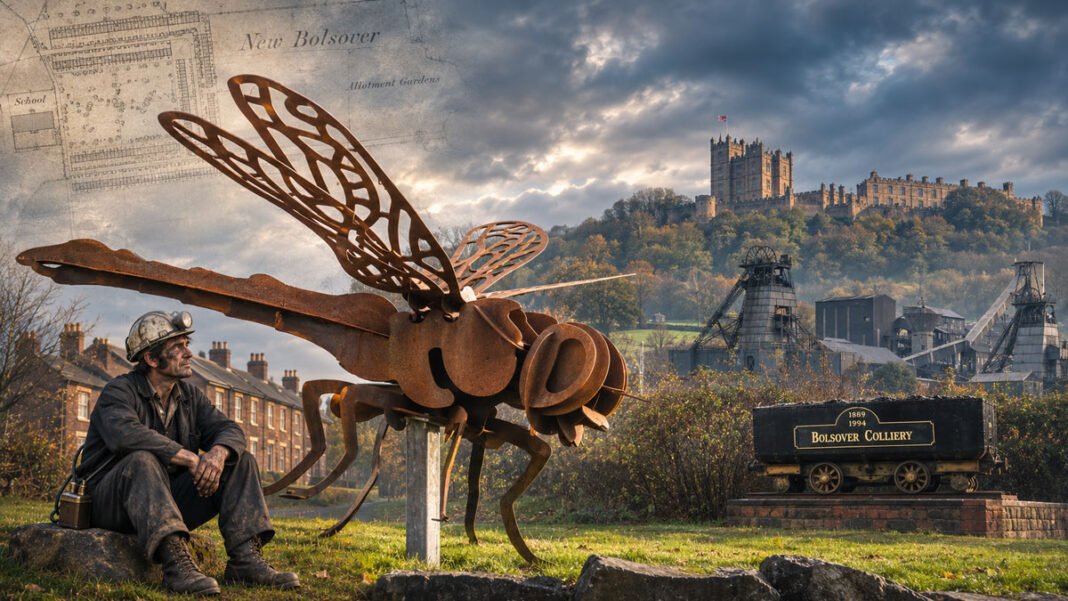
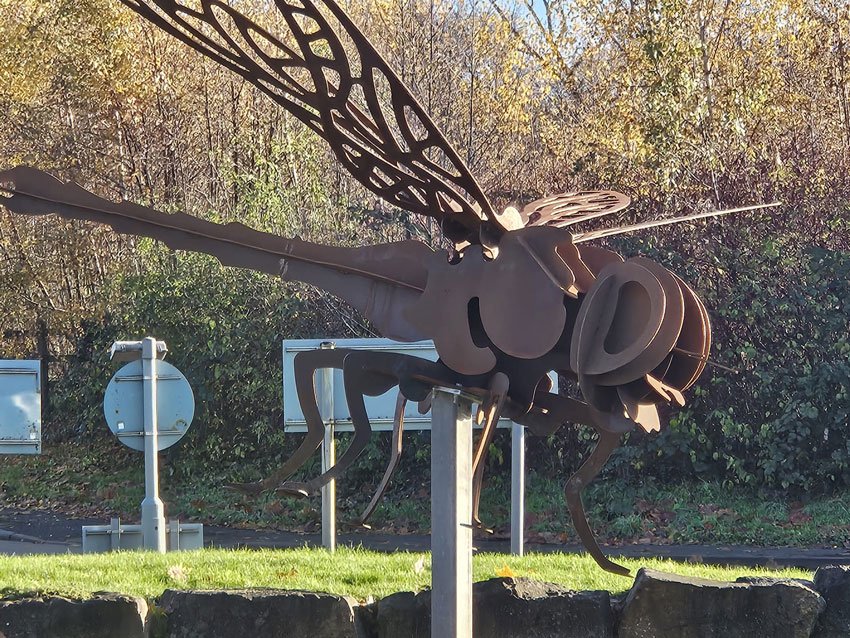
The Bolsover Dragonfly: A new sculpture at the entrance to Bolsover celebrates a prehistoric fossil, Whalleyala bolsoveri, found by local miners and forged by Derbyshire students. It is a fine monument. It is also a reminder of everything stripped from the coalfields, and how little Westminster has put back.
The Dragonfly on the Roundabout: What Bolsover Remembers and What London Took
I travel to Bolsover every Sunday morning. It is a little Derbyshire town steeped in history, from the magnificence of Bolsover Castle perched on its ridge to the New Bolsover Model Village, built between 1891 and 1896 by the Bolsover Colliery Company for its coal miners. You can still read the old social contract in the brickwork of that village: two hundred sturdy terraced houses laid out with a park and pubs, designed around the plain premise that the men who dug the coal deserved a community that worked. Now, as you enter the town at the roundabout linking Intake Road, Riverside Way and Chesterfield Road, a new feature adds to that feeling. Rising in forged steel above the traffic is the Bolsover Dragonfly.
It is an arresting piece of work, unveiled this November and forged by local students through Engineered Learning, a Derbyshire organisation founded by Dan Read that has supported around 600 young people since 2011. Bolsover District Council granted planning permission in June, with the project backed by the UK Shared Prosperity Fund. On a grey Sunday morning, watching the steel wings catch the Derbyshire light, it is impossible not to feel a quiet surge of pride. Young working class hands made this. They made it to honour the men who worked seven hundred metres beneath their feet.
Yet if you stay with the story of the Bolsover Dragonfly for more than a minute, the warmth gives way to a sharper, older truth about Britain.
A Miner’s Find: Dismissed by the Board, Taken by London
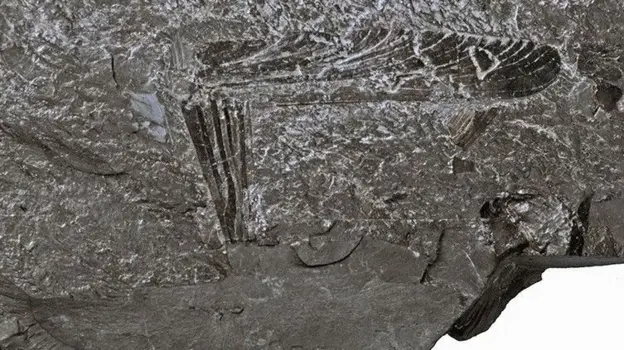
The story begins in the late 1970s, deep in the dark of Bolsover Colliery. A miner named Malcolm Spencer spotted something unusual in the roof of a tunnel 700 metres below the surface. He prised away the piece of mudstone and passed it to his colleague Terry Judge, who knew a bit about fossils. Judge passed it up the chain to the geologists at the National Coal Board.
Their expert looked at it and declared it “not of interest”.
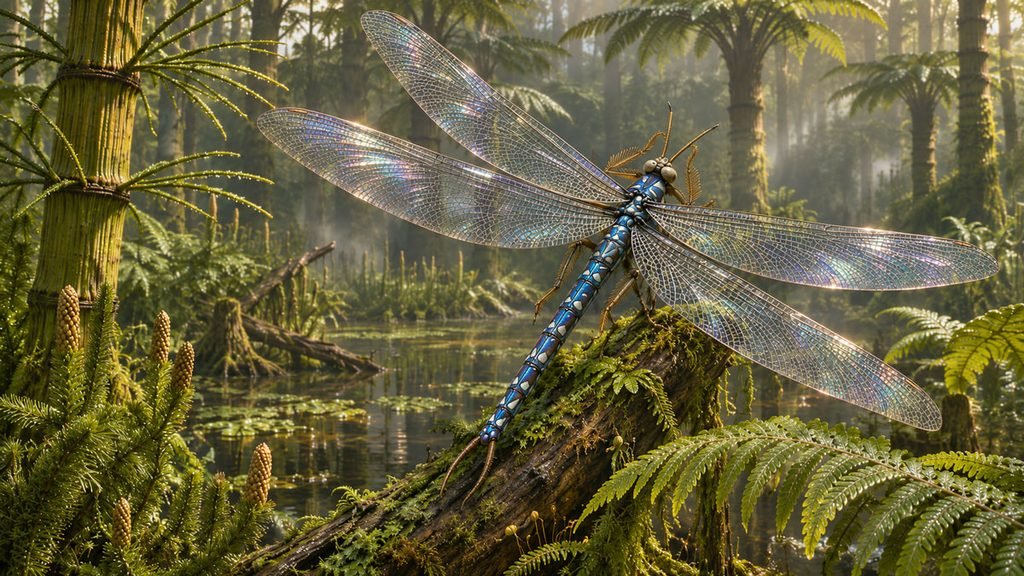
That single sentence deserves to be carved into the plinth of the roundabout. A working class miner, kneeling in the dust of a coal seam, recognised a piece of natural history that a salaried expert waved away. Fortunately, the stone was still sent on to the Institute of Geological Sciences, where Paul Whalley saw it for what it was: the fossilised wing of a giant Carboniferous dragonfly, 300 to 350 million years old. Soon after, Malcolm’s colleague, the late Graham Ball, unearthed a second specimen. The first, later named Whalleyala bolsoveri, had a wingspan of 17.4 centimetres; the second, Arctotypus diluculum (formerly named Tupus diluculum), stretched to half a metre, making it the top flying predator of the ancient coal swamps.
When the news went up on the colliery notice board, it travelled to Radio Sheffield, the Evening Standard, and then around the world. Malcolm Spencer, now 81, was there this month in his mobility vehicle, a miniature keepsake dragonfly resting in his basket, to see the sculpture unveiled alongside Graham Ball’s daughter and granddaughter.
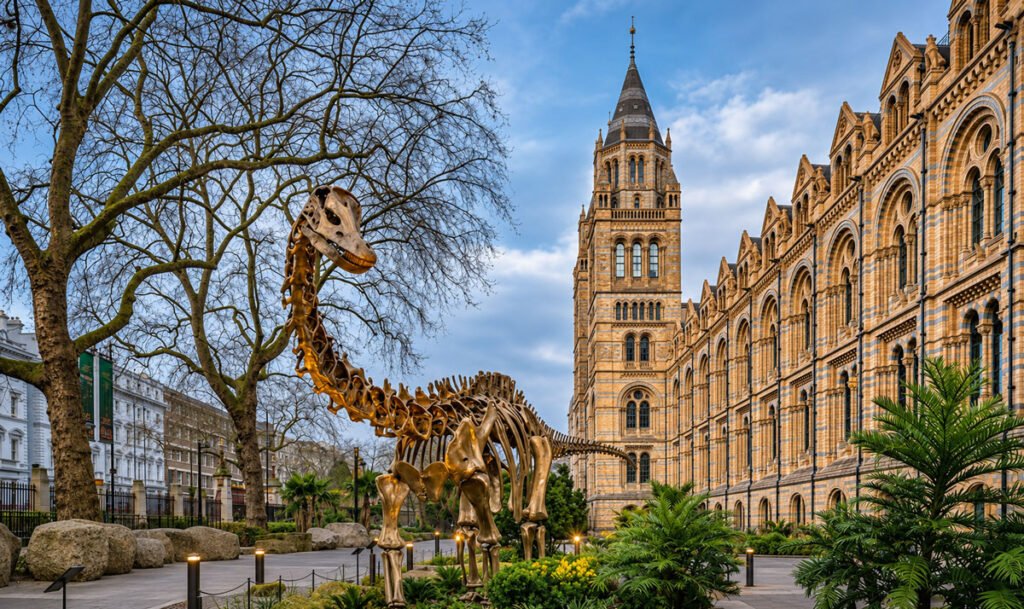
And where are the fossils themselves? They are not in Bolsover. They are not in Chesterfield or Derby. Apart from a brief loan back to the region in 2012, both specimens sit in the Palaeontology Department of the Natural History Museum in London.
It is the oldest arrangement in British life, reduced to a single museum case. The coalfields produce the wealth, the energy, and even the prehistoric wonders. The capital stores them, curates them, and charges the provinces for the privilege of remembering what they once had.
Engineered Learning Keeps Bolsover’s Skills Alive
There is a temptation, when writing about former mining towns, to treat public art as a cynical distraction, a coat of paint brushed over a closed pit. That objection deserves to be taken seriously, because northern towns have endured decades of cosmetic regeneration schemes that delivered banners and plaques while real wages fell. In this case, however, cynicism misses the most important part of the story.

Engineered Learning did not hire a London consultancy to drop a piece of corporate metalwork onto a Derbyshire junction. They put tools into the hands of local students like Dylan and Mckyla and taught them how to forge something permanent.
In a country where successive governments have treated vocational education as an afterthought and left nearly a million young people outside education, employment, or training, that matters. It proves that the industrial skill of the Derbyshire coalfields did not vanish when the pits closed. It was simply locked out of the economy.

When you give working class teenagers a workshop, a mentor, and a purpose, they build things that last. The tragedy is that organisations like Engineered Learning have to scrape together short-term grants from pots like the UK Shared Prosperity Fund to do what a serious industrial state would fund permanently with public money.
Bolsover’s Heritage Needs Secure Jobs, Not Just Art
The miners found the dragonflies. The students built the monument. The future of the town remains unfinished.
A sculpture on a roundabout is a fine way to honour the past. It is not a substitute for a future.
The Bolsover Colliery Company built New Bolsover Model Village because it needed a stable, housed, healthy workforce. It was paternalistic capitalism, certainly, and no sane socialist pines for the pit owners. What we do demand is the return of the material security that organised labour fought for and won inside those industries: secure jobs, permanent apprenticeships, council housing, and public investment that does not evaporate the moment a Treasury funding stream closes.
Westminster is always happy to celebrate working class heritage once the working class power that produced it has been safely buried. Ministers love a pit wheel on a grass verge. They love a plaque, a trail, and a ribbon-cutting ceremony. What they will not tolerate is a northern town with its own industrial base, its own publicly owned utilities, and a generation of young people who do not have to leave their home county to earn a living wage.
If the government wants to honour Malcolm Spencer, Graham Ball, and the students who forged their discovery in steel, it should stop treating Derbyshire as an open-air museum. Put permanent public money into technical colleges and local workshops. Rebuild the manufacturing, housing and energy industries that can offer a teenager in Bolsover a career rather than a zero-hours contract. And while ministers are at it, send at least one of the dragonflies home.
The Bolsover Dragonfly flew over a world of swamps long before there was a Parliament in Westminster, and its steel likeness will outlast the ministers who currently ignore the towns that built this country.
London kept the fossil, and left Bolsover the statue. It is time the heartlands demanded the living wage and the investment that goes with the wings.
Enjoyed this read? I’m committed to keeping this space 100% ad-free so you can enjoy a clean, focused reading experience. Crafting these articles takes a significant amount of research and heart. If you found this helpful, please consider a “small donation” via PayPal or GoCardless to help keep the lights on and the content flowing. Every bit of support makes a huge difference.