The Listening Tour: Burnham’s Grand Débat And The Racket He Will Not Name
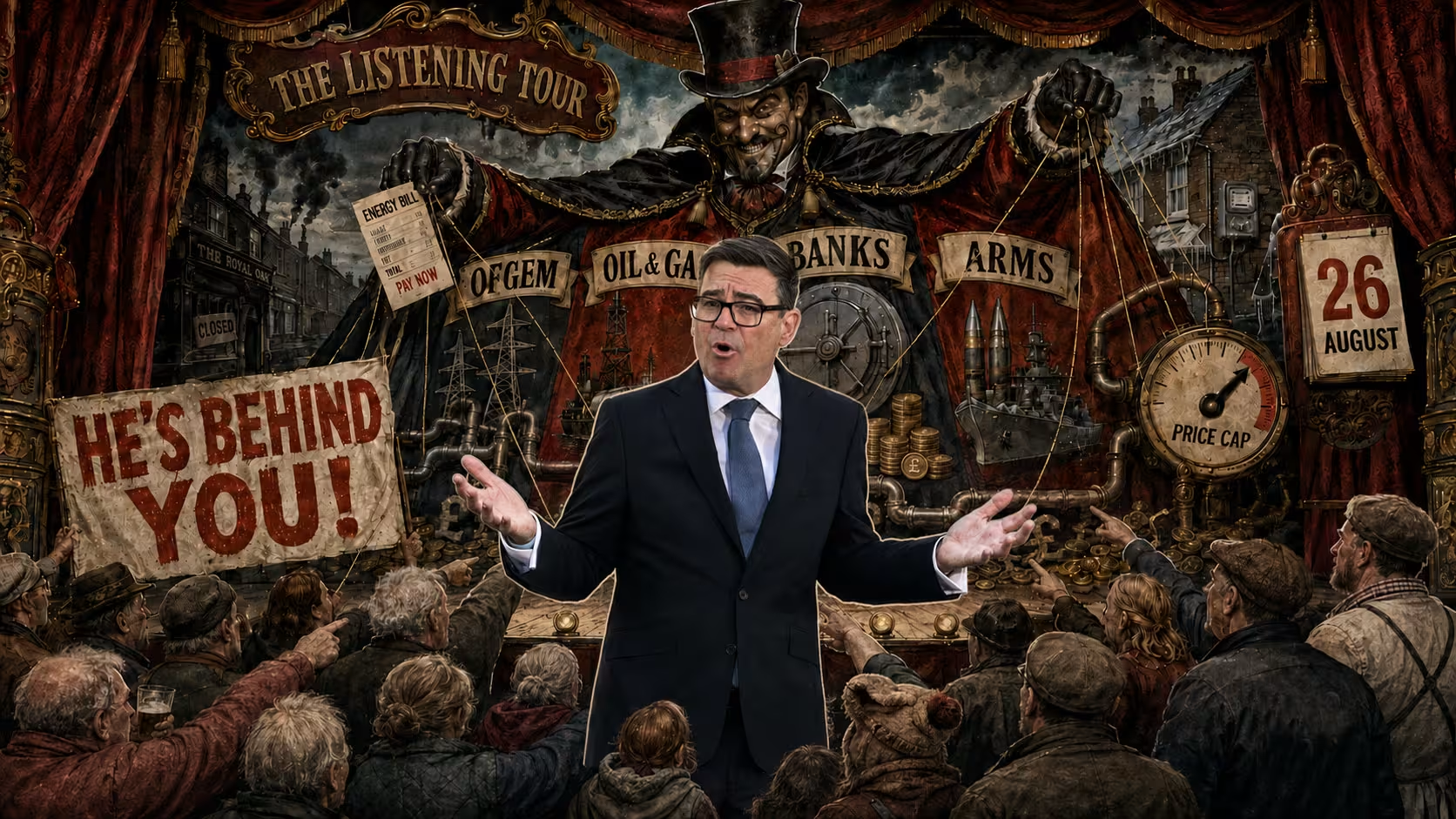
Andy Burnham, the new Prime Minister, is spending August touring the country to ask why life costs so much. On 26 August, Ofgem will answer for him.
There is a particular sound a government makes when it has decided to do nothing. It is the sound of listening.
For the rest of this month, the Prime Minister will be moving between market squares, community centres and small business premises, and officials say he will be in “listening mode” as he travels the country to discuss the cost of living. A spokesman promises he will be “getting out of Westminster and meeting people where they are”. The declared subjects are hidden fees, rip-off pricing, tired high streets, everyday hassle. It will all feed into a ten-year plan.
We have seen this exact performance before, and it is worth remembering how it ended. In January 2019, with the gilets jaunes into their ninth weekend, Emmanuel Macron opened his Grand Débat National with a long open letter to the French people. More than ten thousand meetings were held and close to two million contributions gathered. An impressive machine, and a bounded one. Macron had ruled out restoring the wealth tax before the listening began, which is to say the central demand of the people doing the shouting was excluded from the conversation convened to address their shouting. The conclusion, when it arrived, was that the French were exasperated by taxation. The consultation discovered precisely what the consultation had been built to permit.
Burnham’s version has the same architecture, and a tighter deadline.
He does not need to be told what is wrong. He ran Greater Manchester for nine years, and he has had a decade of constituents and small traders telling him, in words of one syllable, that it is the energy companies. He said so himself on television before he had the job. Which is what makes the timing so telling: on 26 August, four days before the tour ends, Ofgem publishes the price cap for October to December. The listening stops. The bill lands. Nothing said in a Wigan shopping precinct in the third week of August will move that number by a single penny, and every person arranging the photographs knows it.
Cost of profit crisis: the name they won’t use

So let us call the thing by its real name, because the name we have been given is a lie of omission.
This is not a cost of living crisis. It is a cost of profit crisis, and that distinction is the whole argument. A cost of living crisis is weather. It happens to you. Nobody is responsible, nobody can be blamed, and that is exactly why the phrase has outlasted four prime ministers. A cost of profit crisis is different. It has beneficiaries. They file accounts. And we can name every one of them.
You can see it for yourself if you just follow a pound out of a working class pocket and watch where it stops.
It goes into a gas bill, and a share becomes profit for a company that owns the pipe. It goes into a water bill, and a share becomes a dividend for a fund in Toronto or Abu Dhabi. It goes into a mortgage payment, and a share becomes a bank’s lending margin. It goes into a shopping trolley, and a share ends up with BlackRock or Vanguard, who own slices of nearly everything on the shelf and the shelf itself. At every link somebody takes a cut, and every cut is booked as success, reported as strong performance, and returned to shareholders.
And here is the part nobody in Westminster wants said aloud: those shareholders are not all in Riyadh. Some of them are in Surrey. On 31 July the FTSE 100 closed at a record high of just under 10,970, driven by oil and mining shares rather than any improvement in the British economy, with energy stocks up more than 15 per cent across the month. AJ Bell forecasts £88.8 billion of FTSE 100 dividends this year and around £40 billion of buybacks.
That index is not an abstraction. It is the middle class pension. It is the ISA, the SIPP, the workplace scheme, the savings account paying decent interest because the Bank of England is holding rates up to fight the very inflation the war created. A comfortable household in the Home Counties has watched its grocery bill rise and its portfolio rise faster. The markets love chaos. Chaos is priced in, hedged, and distributed upwards.
Which is why, when Burnham says the country is struggling, you have to ask which country he means. There are two of them now, and one is having a rather good year.
The other one is where the wheels keep turning and the bills keep climbing. The pint costs more because the brewery’s energy costs more, the pub’s uncapped business tariff costs more, and the wholesaler’s diesel costs more. The loaf costs more for the same reasons. There is no separate food crisis, no separate housing crisis, no separate high street crisis. There is one crisis with one shape, and the shape is extraction.
The energy accounts: £56bn in profits, 86p in relief

If that sounds like an accusation, then let us open the accounts, because this is a crisis that leaves receipts. And since energy sits underneath everything else, start there.
BP reported an underlying replacement cost profit of $5.7 billion for the second quarter, against $2.4 billion in the same quarter last year. Across the Atlantic the numbers stop being results and become records. Chevron posted the largest quarterly net profit in its history at $12.1 billion, while Exxon’s $14.5 billion and Shell’s $10.8 billion were their best quarters since the onset of the war in Ukraine. Chevron’s chief executive Mike Wirth told CNBC the company was “firing on all cylinders, which is good, because the world needs it”.
Now, the industry’s trade body will stop you there. Those are global profits, it says, not British ones, and only UK operations count. Fair enough. Use their measure. In the first three months of the war with Iran, energy firms made around £3 billion on their UK operations alone, which is £102 of profit taken from every household in this country in a single quarter. Not from Texas. From the meter in your hallway.
And that is only the loud money. Closer to home the extraction is older and duller, which is exactly why it survives unnoticed. Centrica’s half-year operating profit of £497 million was actually down on last year, and that tells you how normalised this has become. The running total is what matters. Researchers for the End Fuel Poverty Coalition put British Gas and Centrica profits since privatisation forty years ago at more than £56 billion, while Scottish Power’s owner Iberdrola took £909 million from its UK network monopolies in six months.
That word, monopolies, is the one to hold on to, because it shows you where the money is really taken. Common Wealth has been through the price cap and found roughly a quarter of every household energy bill is profit. Break it down and the shape appears. Ofgem allows retail suppliers a margin of 2.5 per cent. Network companies averaged pre-tax margins of 37.3 per cent, licensed generators 32 per cent.
So the extraction is not where you were told to look. It is not in the shop window at British Gas, the bit that faces competition and takes the abuse. It is in the pipes and the wires: regulated monopolies with no rivals, customers who cannot leave, and a rate of return set by a regulator. Ofgem does not fail to stop those margins. Ofgem awards them.
And beneath even that sits the rule nobody will touch. Britain prices every unit of electricity at the cost of the most expensive generator running at that moment, which is nearly always gas. The wind farm off the Yorkshire coast costs the same to run today as it did in January. But when a missile closes a shipping lane four thousand miles away, that wind farm is paid the war price anyway. Which is why British households pay more for electricity than every country in the European Union bar Germany, while paying 28 per cent less than the EU average for gas.
“Everyone in the chain protects their return. The household is the only participant with nobody left to pass it on to. That is the whole system in a single sentence.”
From the meter to the till: they’re all taking their cut
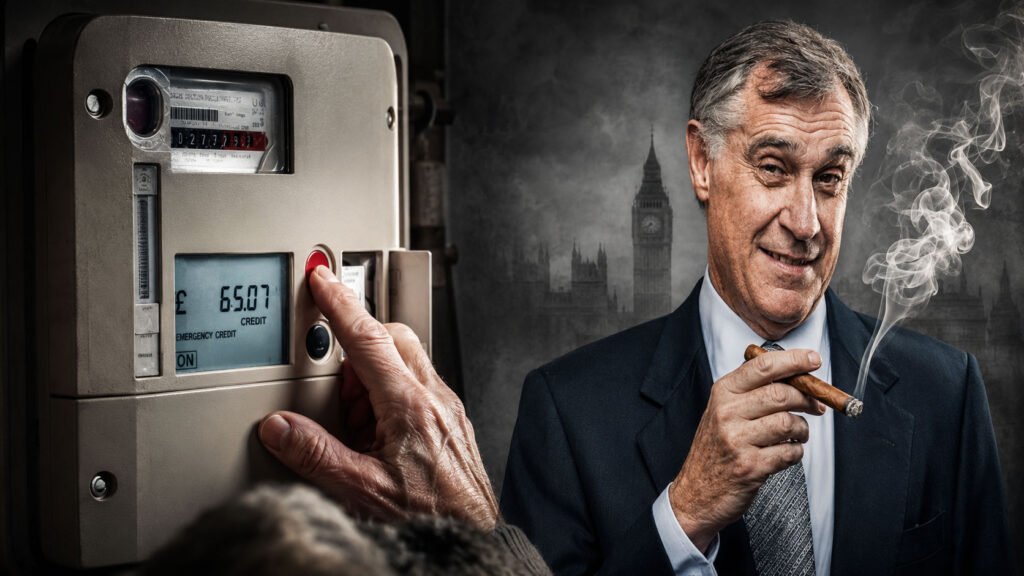
This extractive model reaches well beyond the energy meter, which is what makes a tour about hidden fees close to insulting. Once you have learned to read the pattern in your gas bill, you start seeing it everywhere.
Water runs the identical model with a captive customer and no exit. Around £78 billion has been paid out of the English water companies in dividends since privatisation, against £190 billion spent on infrastructure over the same period. We covered the endgame of that at Thames Water yesterday and will not repeat it. The point is simply this: a family in arrears to a water company and a family in arrears to an energy supplier are not suffering two misfortunes. They are paying two instalments of the same rent.
The same logic runs through the banks. War raises oil, oil raises inflation, inflation keeps interest rates high, and high rates are the raw material of a lending margin. In the first half of this year Barclays, NatWest and Lloyds booked roughly fourteen billion pounds between them, and all three sent large sums straight back to shareholders. Some of that is investment banking rather than your overdraft, and it should be said. But deposit margins widen when rates stay high, and rates stay high because a war has put a premium on gas. The shock that empties the meter fills the vault.
And it ends, as it must, at the checkout, where the profits are real but the margins are genuinely thin, which is the whole point. Tesco returned £2.4 billion to shareholders last year and has started another £750 million buyback, on an operating margin a little over four per cent. The grocers are not the villains. They are the transmission belt. Every energy cost, haulage cost, packaging cost and bank charge enters the supply chain and comes out again at the till, and the family standing at the till has no margin at all.
Which brings us to the heart of it. Everyone in the chain protects their return. The household is the only participant with nobody left to pass it on to. That is the whole system in a single sentence.
War is a racket, and Britain is paying for it

Now, at this point you might reasonably say that none of this is anyone’s fault, that it is all just the war, forces beyond any government’s control. Let me stop you there, because that excuse is the oldest one in the book, and it is always convenient for the same people.
Smedley Butler, twice awarded the Medal of Honor, published a short book in 1935 with a title that has never needed revising. He meant something exact by it. The men who fight and the people who pay are never the men who profit, and the profit is not an accident of war but one of its dependable products.
You can see it if you look at what these wars actually built. The energy crisis did not start with Russian tanks. By October 2021, four months before the invasion, wholesale gas had risen around 250 per cent in a year and thirteen British suppliers had already gone under. The invasion did not light the fire. It gave the fire a name that nobody in Westminster would have to answer for.
And what the Ukraine war built, in the end, was a market. The United States is now the largest LNG exporter on earth, and supplied 93 per cent of the entire growth in global supply in 2025. Europe more than tripled its American imports between 2021 and 2025 and takes two thirds of its LNG from the United States this year, with forecasts of 80 per cent of EU imports by 2028. We broke a dependency on Russian pipelines and bought a dependency on American tankers, priced on a spot market, at rates set by other people’s emergencies.
Now watch the second war do the identical work. Roughly a fifth of the world’s oil and a fifth of its LNG passes through the Strait of Hormuz. The strait closes, European gas hits a three year high, British bills rise 13 per cent in July, and in the very same quarter Chevron records the largest profit in its history and its American production hits an all time high of 2.08 million barrels a day.
So there is nothing mysterious here. The interruption of one country’s exports is the pricing power of another’s. It is a supply curve, and men in offices drew it on purpose.
And lest you think the beneficiaries are all overseas, some of them sit in our own parliament. Research for the End Fuel Poverty Coalition, given to the Morning Star, found at least seven lords and one baroness whose holdings in Equinor, Chevron, Shell and others rose after the shock, with Lord Agnew of Oulton’s Equinor stake up by around £28,000 in the first hundred days.
None of this is hidden, and none of it is popular. Survation found 74 per cent of the public believe it is morally wrong for companies to profit from a war driven energy crisis. Hold that figure next to the tour for a moment. Three quarters of the country have already completed the listening exercise and sent in their answer. What is missing in Westminster is not information. It is appetite.
86p a week: the measure of this government’s ambition
And appetite is exactly what the government’s response can be measured in, because it arrives in coins.
The centrepiece is the removal of the 5 per cent VAT on domestic electricity for six months from 1 October. That is worth around £45 a year off the average bill, which is 86 pence a week. A pint of milk. Gas keeps its VAT, and gas is where the increase is coming from, so Channel 4’s FactCheck ran the arithmetic and found that combined bills will still rise by roughly £49 a year once the 24 per cent gas increase is counted. The relief is smaller than the rise it was announced to answer.
Then there is the bus fare, and here the history matters, because the press release does not carry it. The £2 cap was introduced by the Conservatives in January 2023. Rachel Reeves raised it to £3 from January 2025. Burnham now restores the £2 fare, backed by £454 million, funded in part by converting international climate grants into repayable loans, and it does not begin until 1 January 2027. Not this winter. Next winter. The family shivering through the January that follows October’s price cap will be paying the £3 fare this government set.
Nobody is lying to you here, and that is what makes it worse. They are doing the sums in public, in the open, and trusting that you will not do them too.
Five things a government that meant it would do
So what would a government that actually meant it do? Nothing exotic. Five things, all of them available now, none of them requiring a single village hall.
Break the link between the gas price and the electricity price. Other countries have moved on this. Marginal pricing is a policy choice, not a law of physics, and it hands renewable generators a war premium they did nothing to earn.
Take the standing charge off the bill. It is a flat levy of roughly £300 a year, charged identically to a pensioner in a one bed flat and a household with a heated pool, and it is the most regressive line on any bill in Britain. Move those costs into general taxation, where they can be paid according to means.
Legislate a permanent social tariff, so that the poorest households stop depending on emergency payments announced in November and quietly withdrawn in April.
Cap business energy. The pub, the chip shop, the bakery and the corner shop have no protection whatsoever, and every pound they are overcharged reappears on the shelf behind them.
And then the thing he already believes. Burnham told Channel 4 News during the Makerfield campaign that we should put more things back under stronger public control, naming energy, housing, water and transport. He is now the one person in Britain in a position to do it, and his own programme rules out full public ownership of energy. There is no purer definition of a listening tour than a prime minister crossing the country to hear an argument he has already made and declined to act upon.
The tour will succeed on its own terms. There will be good photographs, warm quotes, and a ten year plan with something in it for everyone. Then on 26 August the cap arrives, in October the bills follow, and come January the fare will still be three pounds.
This country does not need to be asked. It needs somebody to act on the answer it gave years ago.
A government that spends August asking the country how it feels to be robbed has already decided not to catch the thief…