The Children of the Hydra: What Middlesbrough Tells Us About Britain
Nine people died in Middlesbrough this week: two police officers in a crash, a seven-year-old girl and her aunt in a fire. The national debate argued about Farage. The real story is fifty years of deindustrialisation, abandonment, and a wound that keeps growing.
Nine Dead in Middlesbrough – And London Is Arguing About Farage
Nine people are dead in Middlesbrough this week, and a great many of the nation’s loudest broadcasters spent that week arguing about Nigel Farage.
Start with the facts, because the facts alone should stop anyone in their tracks. In the early hours of Saturday 22 August, a Volkswagen Passat travelling the wrong way down the A66 at South Bank collided head-on with a marked police vehicle. Seven people died at the scene: PC Tom Clough, 38, and PC Matthew Blades, 37, along with five young men in the Passat, Cole Worthy and Theo Rae, both 17, Makai Saddington, 18, and Michael Robert Cahill and Jakub Matusiak, both 23.

On Wednesday, less than a mile away, a house fire on Birchington Avenue in Grangetown killed seven year old Valentina Foster and her aunt, thirty four year old Natalie McDonald. Two men have been arrested on suspicion of murder. On Thursday morning a car rammed the wall of an empty house in South Bank. That afternoon a thirty nine year old man was stabbed in Eston. Cleveland Police, already stretched thin, have called in two hundred extra officers from forces as far away as Northumbria and South Yorkshire, along with the National Crime Agency, to hold the town together.
That is the town James O’Brien invited his listeners to consider this week, under the title Why Middlesbrough Is Such A Dangerous Place To Live. He suspected the coverage would look very different “in modern Britain, in Brexit Britain, in the land that Nigel built” had the men responsible come from an ethnic minority background. O’Brien is an avowed and longstanding opponent of Brexit, and Brexit is exactly what he reached for, along with race, in a week when neither had anything to do with the deaths on the A66 or the fire on Birchington Avenue. Middlesbrough voted to leave the European Union by nearly two to one, 65.5 per cent, in a town where more than four in five residents identify as White.

Those two facts sit together uneasily with any theory that pins the vote on racial grievance rather than economic abandonment, because a straightforwardly White, working class town does not need a scapegoat of a different colour to explain why it voted the way it did. It needed, as the political economist Mark Blyth has argued of Brexit and its American cousin alike, a target for a working class backlash against decades of macroeconomic policy that had quietly declared their labour, their industries and their towns expendable. What we have everywhere, Blyth has said, are creditor-debtor standoffs, and Teesside has been on the losing end of that standoff since long before anyone had heard of Nigel Farage. Whether Reform’s leader has anything to say about this week’s events is frankly beside the point; the crash happened and the fire happened regardless of what he thinks. It was always easier to relitigate 2016 than to explain 2026.
Test his own theory against the calendar. In June, two brothers were jailed at Sheffield Crown Court after hunting down a rival with a car and, in the chase, running down sixteen year old Abdullah Yaser Abdullah Taleb, a boy who had fled war torn Yemen only months earlier and who, in the judge’s words, was simply “in the wrong place at the wrong time.” Zulkernain Ahmed was jailed for life for his murder, his brother Armaan for manslaughter.

In May, two men were jailed in Manchester after filming themselves inhaling nitrous oxide at speeds up to 139 miles an hour through a red light, killing fifty year old Sylvester Abayomi as he drove to work, then discussing whether to report the car stolen rather than call for help. Sylvester’s partner, Denise Doyle, told the court afterwards: “You left Sylv to die alone.” Under O’Brien’s own test, perceived ethnic minority background, both cases qualify. Neither drew a fraction of the national outrage visited on Middlesbrough this week, and I can find no public record of either James O’Brien or Nigel Farage devoting so much as a segment or a post to either boy.

That is not proof of a conspiracy of silence. It is proof that the dividing line was never race to begin with. It is whether a death can be folded into a pre-written argument about Brexit and racism. Abdullah and Sylvester do not fit that argument, and so almost nobody outside Sheffield and Manchester ever learned their names.
What actually links Zulkernain Ahmed, Armaan Ahmed, Uways Hussain, Usmon Mahmood and the young men currently terrorising Middlesbrough is not their background.
It is that every one of them is a child of the same hydra.
So let us listen instead to the people who have spent years living with the thing itself, rather than the people arguing about it from a studio.
Abandonment: What Middlesbrough Is Really Telling Us
What the Two Andys Got Right, and Where They Stopped
Andy Preston, Middlesbrough’s mayor from 2019 to 2023, put it in language that will not surprise anyone who has lived near it. He described small, chaotic drug crews rather than criminal masterminds, men in their twenties who are, in his own phrase, gormless and stupid, but they are dangerous. Middlesbrough, he said, carries the highest crime rate of any English town outside the City of Westminster, where the figures are inflated by tourists. Andy McDonald, the town’s Labour MP, reached for a different word entirely. What residents living in fear are experiencing, he told LBC, is terrorism, and he is right that the diagnosis cannot be simple. His own summary of the cause was blunt: no jobs, no guidance, no consequences.
Preston wants faster justice and a police force that, in his words, bosses the streets. McDonald wants the same swift response, plus a serious conversation about causes he does not fully specify. Between them they have identified the entire shape of the problem without once naming its origin. A criminal underclass did not spring from nowhere, and it did not spring from Brexit, and it did not spring from a radio phone in. It was built, over five decades, out of decisions taken a long way from Middlesbrough by people who never had to live with the consequences.
The First Abandonment
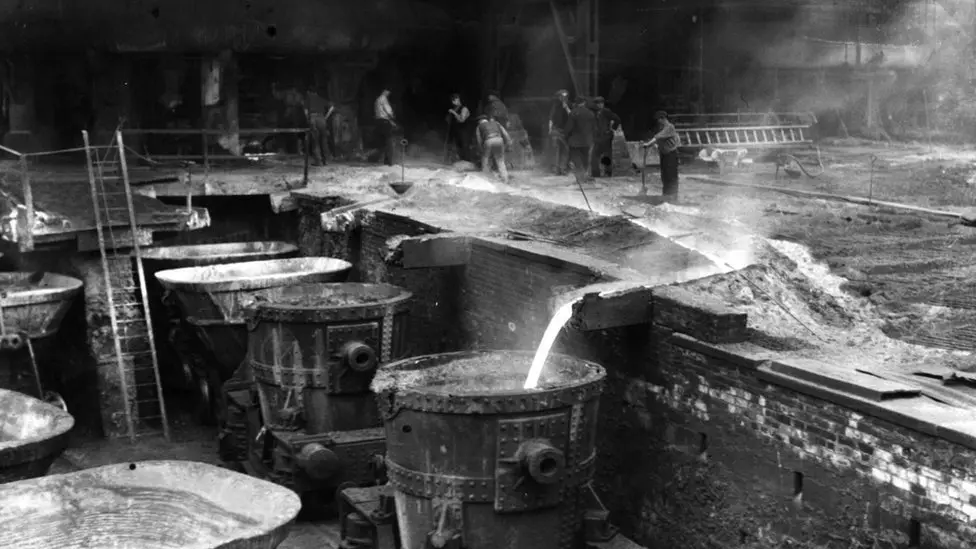
Teesside’s story starts with steel. The Redcar works, opened by Dorman Long in 1917, once supplied bridges from the Tyne to Sydney Harbour. By 2015 it was gone, its blast furnace and coke ovens closed for good with the loss of around two thousand direct jobs and thousands more in the wider supply chain. That closure was itself a repeat of an older story. Coal, shipbuilding on the Tyne, Wear and Tees, and heavy engineering across the North East had already been dismantled through the 1970s and 1980s as output shifted to cheaper producers overseas. What followed was supposed to be a second economy built on lighter industry, garment factories, food processing plants, meat packing lines, much of it staffed by women whose wages had kept working class households afloat once the men’s industries went. That replacement economy did not last either. Retailers chased the same cheap labour abroad that had already hollowed out the pits and yards, and by the 2000s those plants were closing too. Teesside was deindustrialised twice in one lifetime, and each time the compensation on offer was smaller than the last.
The Second Abandonment

Here is the part of the story that gets left out entirely, and I have watched it happen to men I grew up alongside. When the industries closed, workers were told, in effect, to get on their bike. Many did. They retrained as bricklayers, joiners, electricians, plasterers, went self employed, chased contracts up and down the country the way the old industries once offered a job for life. And what they found, particularly after 2004, was a labour market flooded with EU tradesmen willing to work the same jobs for less. The Migration Advisory Committee’s own modelling found only a modest effect on wages overall, but it also found low skilled workers from the newer EU member states earning around four per cent less than comparable British workers doing the same job, and construction was one of the sectors where EU labour became most heavily concentrated. Four per cent on a spreadsheet in Whitehall does not capture what it felt like on a building site in Stockton, watching a job you needed go to a man who would do it for less because he could live six to a house and send the rest home. The statistics and the lived experience do not fully agree, and that gap between the official picture and what people felt happening to them is not a footnote. It is the whole story. It is why so many post-industrial towns voted to leave the European Union, not out of hostility to any nationality, but because free movement was the second time in a generation that the market had been allowed to underprice their labour without anyone asking whether that was a price worth paying. Bradford, Oldham, Leicester and Birmingham, with their large British Asian populations, voted the same way for the same reason. This was never a white grievance dressed up as economics. It was a class grievance that the London commentariat has never quite forgiven the working class for having.
I grew up on the streets of Dunscroft and Stainforth, two small pit villages on the edge of Doncaster, and I know what abandonment looks like close up because I watched it happen from the inside. Stainforth South and Dunscroft Station Road have sat among the five most deprived neighbourhoods in the entire borough for years running, out of nearly two hundred. It was always a hard place. What it has become is something else. It was tough when I was a boy. It is hopeless now, and there is a difference between those two words that people who have never lived through it tend not to understand.

And this is not confined to old coalfield towns that wear their scars openly. I live now in Chesterfield, a small, quiet market town on the edge of the Peak District that most people would never think to mention in the same sentence as Middlesbrough, and I am watching the same disease take hold here in real time. This spring a sixteen year old boy was stabbed near his school on Storrs Road. In March, fourteen year old Finley Dawson was killed on an electric motorbike on Newbold Road, one more child in a national wave drawn to bikes that are illegal on the road precisely because nothing legal has been offered to them instead. This summer, gangs on and off electric bikes have been tearing through Queen’s Park, weaving between families and children on the cricket pitch, and it took the police the best part of an hour to reach two separate 999 calls about it.
Chesterfield sits on its own old coalfield, the same seams that once ran under Dunscroft and Stainforth, quietly hollowed out through the 1960s, 70s and 80s until there was nothing left to hollow. Nobody in Westminster thinks of Chesterfield as a crisis. That is exactly the point. The teeth do not care whether the town they land in has a reputation for trouble or a market square people call charming. They only care whether the ground has been sown.
Alienation, by Another Name
There is an old speech that explains all of this better than any minister has managed this week. In April 1972, a Clydeside shop steward named Jimmy Reid stood up in Glasgow University’s Bute Hall to deliver his address as the university’s newly elected rector, and the New York Times reprinted it in full, calling it one of the great speeches of the century. Reid’s subject was alienation, which he defined as the despair of people who felt like pawns of economic forces beyond their control, permanently shut out of decisions being made about their own lives. He warned that a society built the wrong way round could dehumanise people, make them insensitive and self-centred, and that those who refused to be pawns in that game would simply be filed away by the establishment as malcontents.
Reid was talking about shipyard workers facing redundancy. He might as well have been talking about a nineteen year old in a tracksuit in Thornaby who has never had a job worth keeping, whose father lost the same chance in a different decade, and who has learned, correctly, that nobody in Westminster is coming. That does not excuse a single act of the violence and intimidation Middlesbrough has endured this week. Nothing excuses ramming a car into a house, or torching a vehicle to settle a score, or the almost unthinkable cruelty of a fire that killed a seven year old girl. But if you want to understand why a criminal underclass grows rather than shrinks, Reid supplies the mechanism better than any Home Office press release: exclude people from any real stake in decisions about their own lives for long enough, and some of them will stop believing the rules were ever written for their benefit.
Swift justice treats the symptom, not the cause

Preston’s instinct, that consequences must come first and rehabilitation after, deserves to be engaged with honestly rather than waved away. He is not wrong that slow justice emboldens criminals and terrifies witnesses into silence, and a system where courts are backlogged for months does real damage to public confidence in exactly the way he describes. Nobody serious argues that intimidation of witnesses should go unpunished, or that a stabbing in broad daylight is a matter for sociology rather than a courtroom. Two hundred extra officers on Teesside’s streets this week were necessary, not optional, and the families who buried police officers this week deserve nothing less than a state that takes their killing with total seriousness.
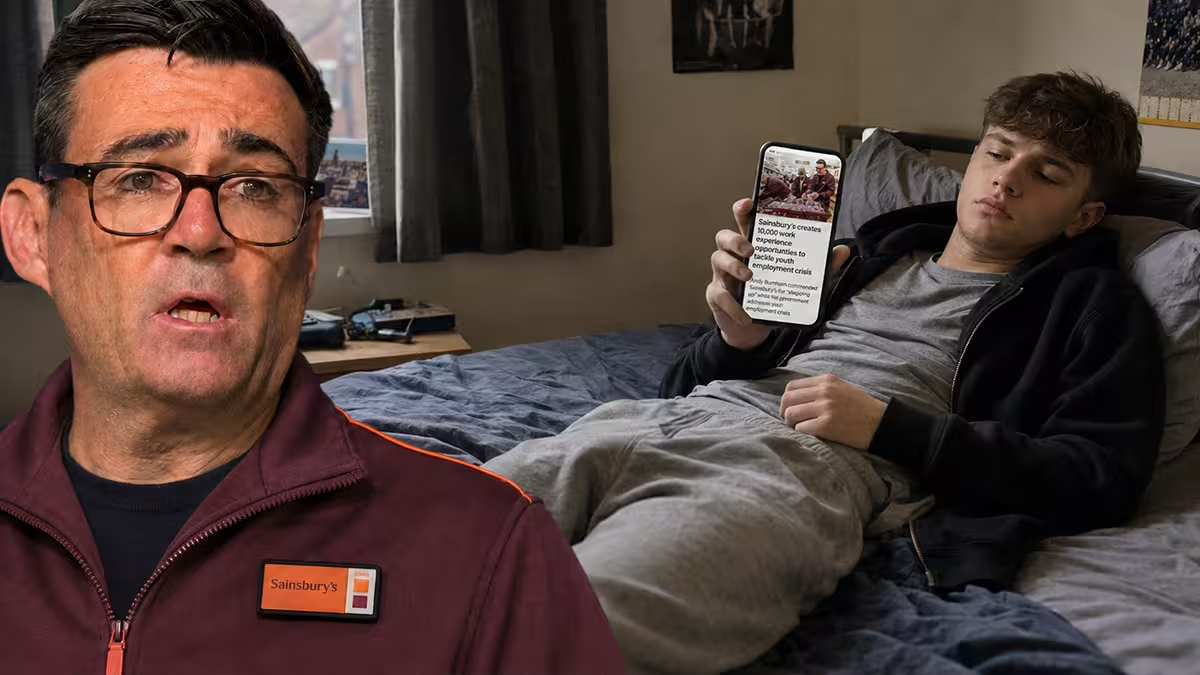
But swift justice treats the symptom at the point it has already become criminal. It says nothing about why Middlesbrough keeps producing the raw material for that criminality in greater volume than almost anywhere else in England, faster police response times will not rebuild a steelworks, and a longer sentence will not hand a nineteen year old the apprenticeship that never existed. This publication reported last week that nearly a million young people across Britain are not in education, employment or training, and that the government’s response was a work experience scheme at Sainsbury’s, launched from Downing Street by a prime minister whose leadership campaign had just received over £164,000 from the supermarket’s former chairman. A generation offered noticeboards instead of jobs, and workshops instead of housing, is not a Middlesbrough problem. Middlesbrough is simply where it is currently visible.
Breaking the Chain…

Britain has already run the experiment that would fix this, and it did not require billionaire donors or a talk radio segment to work. Clement Attlee’s government built 806,857 council houses between 1945 and 1951, in a country that had just spent six years bankrupting itself to win a war. Public building on that scale did two things at once: it gave people secure, affordable homes, and it gave tradesmen guaranteed, well paid, local work that no undercutting migrant labour market could touch, because the employer was the state and the contract was permanent. A council with its own construction yard training its own apprentices to build its own housing stock is not nostalgia. It is the only policy on record that has ever actually solved the problem Andy McDonald says he wants solved, and it does more for the causes of crime than any sentencing guideline ever will.
None of this is an argument for indulgence toward the men currently terrorising their own neighbours in Middlesbrough. It is an argument about what happens next if the state contents itself with punishment alone. Heracles learned this the hard way at Lerna. Every head he struck from the Hydra grew back as two, because a blade alone cannot kill a wound that keeps its root. The monster only died once his companion began cauterising each stump the instant the sword fell, burning the ground that would otherwise have regrown it. Middlesbrough’s own hydra was deindustrialisation, and in dying it sowed its teeth across the town, the closed yards, the shuttered high street, the flats with nothing left to save for. What grew from that ground is not a monster. It is a generation, and like the skeleton army that rose from Jason’s field in Colchis, they do not turn on whoever sowed them. They turn on each other, torching one another’s cars, ram-raiding one another’s houses over a debt or a slight, while the field that grew them goes untouched and ready to sow again. Arrest this crew and the ground remains sown. Another will rise to fight whoever is left standing, because the blade was never going to be enough on its own. It never has been. Only the cauterising was.
The ground is still sown. Somewhere else it is already growing.
The Story London Keeps Missing

James O’Brien’s audience, and much of the London commentariat with him, will move on from Middlesbrough within the fortnight, once the next segment presents itself. The more instructive response came from the man actually meant to be running the country. Speaking not from Middlesbrough but on a visit to South Wales, Prime Minister Andy Burnham offered his condolences and said “all of the support will be provided” to get to the bottom of what had happened. It was a decent enough sentence, and also roughly nothing, the kind of promise any prime minister can make about any town without saying a single word about why that town keeps needing rescuing. While broadcasters and politicians hurl chants at each other about what they have or haven’t said, the subject itself goes on being ignored. And that is the real failure sitting underneath this week’s horror: not a newsroom’s bias, real or imagined, but the fact that Middlesbrough is being covered as a single, freakish, local horror story rather than as one field among many that got the same seed.
Consett got it. Corby got it. Hartlepool, Bootle, Sunderland, the Doncaster coalfield towns I grew up in, and great stretches of the Welsh valleys, all sown from the same hand for the same reason, all left to grow whatever grows when a place is stripped of work and offered a supermarket work placement scheme in its place. Nearly a million young people across Britain are currently not in education, employment or training, a figure this publication reported only last week, and every one of that million is standing on ground that was sown decades before they were born. Middlesbrough did not fail on its own. It is simply the field that came up first this year.
Jimmy Reid closed his own address in 1972 with a line that has outlived every policy document written since: “A rat race is for rats. We’re not rats. We’re human beings.” Middlesbrough has spent fifty years being treated like the former. It buried two police officers, a woman and a child in the same week, and the loudest response from London was an argument about Farage. Rebuild what was taken, and the town rebuilds itself. Keep asking why the natives are restless while refusing to say what unsettled them, and Middlesbrough will not be the last place this happens. It will simply be the first one anybody bothered to notice.

Support The Tribune
INDEPENDENT. READER-FUNDED. AD-FREE.
If you value this article, help keep The Heartlands Tribune publishing independent journalism without intrusive advertising or corporate sponsors.
Choose your monthly amount
Secure payment via GoCardless
SOURCES & FURTHER READING
• ITV News: Two officers among seven killed in A66 crash
• ITV News: Families pay tribute to police officers killed in A66 crash
• Teesside Live: Grangetown fire, Valentina Foster and Natalie McDonald named
• Teesside Live: Middlesbrough MP says people are “not feeling safe”
• GB News: Middlesbrough MP says intimidation is “terrorism”
• LBC: “People are living in terror,” Middlesbrough MP slams unrest
• Yorkshire Live: Andy Preston on Middlesbrough’s “disorganised crime”
• Yorkshire Post: Burnham pledges more support for Cleveland Police
• Teesside Live: Middlesbrough’s Linthorpe ward, ten years on from the referendum
• Middlesbrough Council: local population diversity data
• Migration Observatory: the end of free movement and the low-wage labour force
• RealClearPolitics: Mark Blyth on “Global Trumpism” and the revolt against the creditor class
• Speakola: Jimmy Reid’s 1972 rectorial address, full text
• Yorkshire Post: SSI Redcar steelworks demolition, ten years on
• ITV News: Brothers jailed for killing Abdullah Yaser Abdullah Taleb
• CPS: Two men jailed over Sylvester Abayomi’s death
• GMP: Pair jailed after 130mph collision that killed Sylvester Abayomi
• Derbyshire Times: Schoolboy stabbed on Storrs Road, Chesterfield
• Derbyshire Police: Finley Dawson dies after Chesterfield e-bike collision
• Derbyshire Times: Concerns raised over youths on motorbikes in Chesterfield’s Queen’s Park
• GOV.UK: English Indices of Deprivation 2025
• The Heartlands Tribune: The Killer of Dreams
• The Heartlands Tribune: Free From Brussels
• The Heartlands Tribune: The Socialism of the Hearth
• The Heartlands Tribune: Jimmy Reid, ‘A Rat Race Is For Rats, We’re Not Rats’