Sir Keir’s Next Constituency Has No Voters
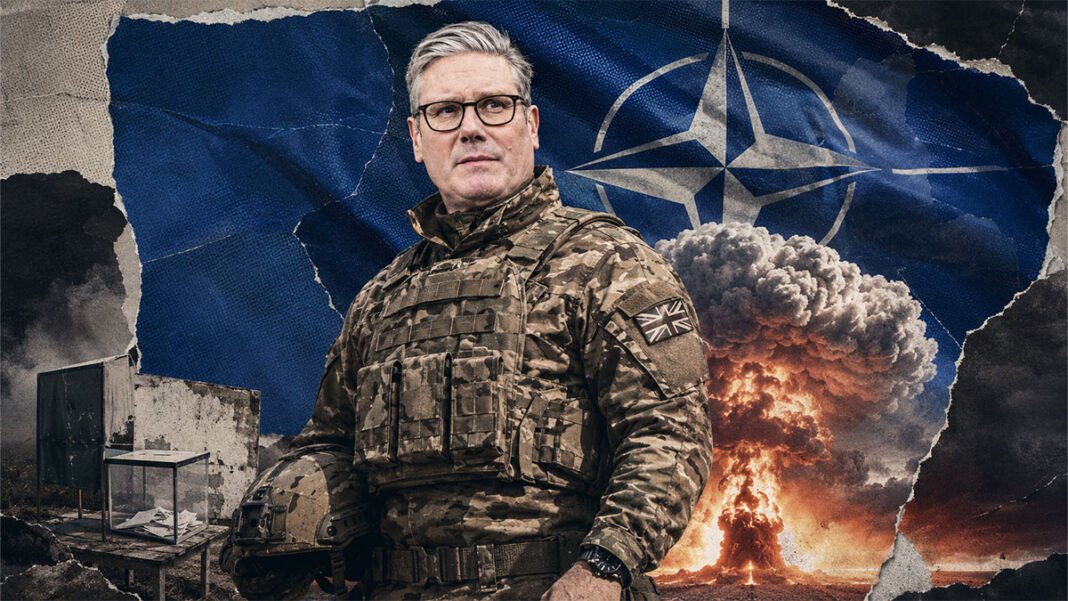
Keir Starmer is stepping down as MP for Holborn and St Pancras to focus on “international affairs.” Reports suggest he wants to be NATO Secretary General. He’s not retiring from power…he’s moving it somewhere the public can no longer reach.
Keir Starmer told the Camden New Journal he was ready to “pass the baton to a successor” in Holborn and St Pancras, the seat he has held since 2015. He explained that he now intends to focus on “international affairs including defence, security, trade and technology in a fast-changing world.” It read like a modest sentence about a quiet retirement. It was nothing of the sort. Starmer is not stepping back from power. He is stepping toward a version of it that no ballot paper can touch.
Three months earlier, when he resigned as Prime Minister, he stood beside Mark Rutte in Downing Street and called NATO “the single most successful military alliance the world has ever known.” Around the same time, the Observer reported that his allies were already making the case for him as Rutte’s successor, pointing to his standing at the G7 and his closeness to Volodymyr Zelensky. The post is not vacant. Rutte’s term runs to 2028, and any extension needs the consent of all thirty two member states. But the shape of the ambition was set before Starmer had even left Number 10, and this week’s announcement, defence, security, trade and technology, reads less like a retirement plan than a job application.
A Lust For Power

There is a precedent for what Starmer appears to be contemplating, and it is Tony Blair.
Blair demonstrated that leaving Downing Street need not mean leaving power. Within hours of stepping down as Prime Minister in 2007, he was appointed Middle East envoy for the Quartet of the United States, European Union, United Nations and Russia. From there he constructed something British politics had scarcely seen before: a post-premiership combining international access, consultancy, speeches, government advisory work and extraordinary personal wealth.
It became the Blair model. Public office supplied the contacts, authority and global recognition; private life monetised them.
The overlap was controversial even then. Blair served as a supposedly neutral Middle East envoy while simultaneously developing lucrative business relationships across the region, prompting diplomats and campaigners to question where diplomacy ended and private consultancy began. His political influence did not disappear when he surrendered his constituency. It simply moved beyond the reach of the electorate.
Nearly twenty years later, the machinery still bears his name. The Tony Blair Institute advises governments around the world and has become one of the most persistent advocates of digital ID in Britain, the very policy Starmer’s own government began rolling out as BritCard.
That is what makes Starmer’s declared interest in “international affairs” worth examining. He may not be following Blair into retirement at all. He may be following the path Blair pioneered: from elected national power into the far less accountable world of international institutions, security policy and global influence.
The constituency changes.
That Starmer is being spoken of in those terms at all tells you something about the kind of leader Labour actually elevated: one whose allies describe his talents as better suited to the world stage than to the country he was elected to run.
A Lust For War

The access remains. And at this moment there is a rush toward another European war, dressed as deterrence and moving faster than the evidence can keep up.
Brussels is not merely talking tougher. It is building the machinery for a permanently militarised continent. The EU’s Readiness 2030 programme envisages up to €800 billion in additional defence spending, with its SAFE instrument offering a further €150 billion in loans for joint procurement of drones, air defence and long range precision weapons. The European Council now describes Russia’s war against Ukraine as an “existential challenge” to the Union itself. And this is not a project running alongside NATO. The European Council states plainly that Europe’s capability build-up must proceed “in full coherence with NATO.” The two structures are fusing into a single continental security architecture, EU money and NATO command. Starmer’s attraction to NATO’s top job is therefore not a move away from European politics. It is a move toward the command deck of that emerging order.
On 1 September, Germany’s interior minister Alexander Dobrindt formally blamed Russia for an explosive-laden drone found near a Ukrainian cargo plane at Leipzig airport a month earlier, saying the method matched other Russian hybrid operations. Berlin closed Russia’s Bonn consulate and its Berlin cultural centre within hours. The next day, in Brussels, Ursula von der Leyen stood beside Rutte and went further still, calling it “an attack using military-grade material, carried out by Russian operatives on European Union soil.” Rutte agreed. “The evidence is clear,” he said, without saying what it was.
The EU’s foreign policy chief, Kaja Kallas, went further again, calling the incident an act bearing “all the hallmarks of state-sponsored terrorism.” Two days earlier, an unnamed NATO official had told Reuters that although Russia was stepping up hybrid activity, the alliance saw “no imminent threat of attack.” Within forty eight hours, calibrated caution had hardened into certainty, without a trial, an inquiry, or a single published piece of forensic material reaching the public in between.
Weigh that certainty against the last comparable case. When the Nord Stream pipelines were destroyed in September 2022, the instinctive assumption across Western capitals was that Russia had sabotaged its own gas link to punish Europe. Four years, two abandoned Scandinavian inquiries and one formal indictment later, German federal prosecutors allege the operation was carried out by a Ukrainian former army officer acting, they say, on behalf of Ukrainian state bodies, not the Kremlin. Zelensky says he has not yet seen the full case against his own country. Putin denies it too. The single fact that survives four years of investigation is this: the leaders who were absolutely certain in 2022 were wrong about who did it, and it took the better part of a war to find that out. In Leipzig, the same leaders reached certainty within days.
Starmer may yet be the face that launches a thousand wars, not by firing a shot, but by running the alliance that keeps them permanently on the table.
That should trouble anyone who has watched what “international affairs” meant in practice over the past two years. It meant a defence posture built on dependency rather than sovereignty, arms licences that kept flowing to a state accused of genocide in Gaza, and a domestic record of civil liberties reversals, jury trial restrictions, and a proscription the High Court itself ruled unlawful. A man does not improve on the world stage what he could not deliver honestly at home. He simply finds a stage with a smaller audience and no election at the end of it.
The Trilateral Thread

And here the Trilateral Commission is not incidental colour. It is the clearest key we have to how Starmer actually thinks about power. This publication has already documented, from the Commission’s own founding text, that its authors diagnosed Western democracies in the 1970s as suffering from “an excess of democracy,” and prescribed “some measure of apathy and non-involvement” as the cure. Starmer is a member of its European Group. So, until his own resignation this year, was Peter Mandelson, the man Starmer sent to Washington despite his documented ties to Jeffrey Epstein. This is not guilt by association. It is a matter of public record, drawn from the Commission’s own membership lists, and it describes an ideology, not a conspiracy: the belief that elected politicians are temporary and unreliable, and that continuity is better entrusted to people who never have to face an electorate again.
Holborn and St Pancras can sack its MP. NATO’s member states cannot be out-voted by anyone in Camden.
A defender of Starmer would say this is simply what senior politicians do, that Gordon Brown chaired global health initiatives and John Major took paid advisory work, and that wanting to stay useful after Downing Street is neither sinister nor new. That is fair as far as it goes. But running a nuclear alliance from Brussels is not advisory work, and the seat Starmer is eyeing carries more strategic weight than the one he is vacating in Camden. The scale of the move, from a backbench constituency of some seventy thousand voters to an office answerable to thirty two governments and none of their electorates, is exactly the shift the Commission’s own philosophy was built to normalise: politicians as passing custodians, institutions as the real seat of continuity.
An Older Warning
There is an older warning that fits this moment better than anything the Trilateral Commission ever published. In his farewell address in January 1961, General Dwight Eisenhower told the country to guard against the acquisition of unwarranted influence, whether sought or unsought, by the military-industrial complex. He was not a pacifist and not a critic of NATO. He was the man who built the alliance’s early command structure, and he still thought the arrangement dangerous enough to spend his last speech on it.
Look at what that arrangement now costs. NATO’s European members raised defence spending by 20 per cent in a single year in 2025, part of a commitment to hit 5 per cent of GDP by 2035, more than double the old target. Germany’s defence budget has doubled since 2021. Starmer pledged Britain’s own path to that 5 per cent figure before he had even left Downing Street. This is not a one off response to a single crisis. It is a permanent, expanding claim on public money, flowing to a defence industry whose order books lengthen with every summit, dressed in the language of deterrence.

There is a darker logic still beneath the numbers. The threat justifies the weapons. The weapons require the threat. Every unexplained incident, whether at an airport, a substation, or beneath the Baltic Sea, risks becoming evidence that still more weapons are required, regardless of who is ultimately found responsible. Von der Leyen has said as much herself: Russia, she told Danish cadets in March 2025, “is on an irreversible path to creating a war economy,” one that fuels its war in Ukraine while preparing for future confrontation with European democracies. The same logic applies closer to home. Eisenhower called this arrangement a threat to democracy in 1961, when the sums involved were a fraction of what they are now. Europe is now building it at continental scale, and Starmer wants to be the man who runs its command deck..
THE FACE THAT COULD LAUNCH A THOUSAND WARS

There is an old line about the face that launched a thousand ships. Keir Starmer may yet become the face that launches a thousand wars.
Not because anyone should imagine him sitting in Brussels personally ordering invasions across the continent. The danger is less theatrical, and therefore more serious. It is the possibility of placing a politician who embraced NATO expansionism, rising defence expenditure and the language of permanent strategic confrontation at the head of an alliance operating inside a Europe increasingly organised around preparation for war.
Starmer failed as Prime Minister, comprehensively, and the country’s judgement on that is already written into his approval ratings.
But failure at home need not end a career in the international system. Sometimes it simply changes the constituency.
A British voter could punish Starmer for freezing pensioners, restricting protest, curtailing civil liberties or pouring billions into defence. A NATO Secretary General faces no such reckoning. There is no constituency surgery in Brussels. No marginal seat. No ballot box into which an angry pensioner can place a cross.
And that matters because the institution Starmer reportedly covets now sits at the intersection of nuclear weapons, European rearmament, the Ukraine war and an expanding defence industry whose prosperity depends on governments remaining permanently afraid.
Eisenhower warned America about that arrangement sixty five years ago. Europe is now building it at continental scale.
For two years Keir Starmer asked Britain to trust him with power it could still, eventually, take back. His next job may be the first in his career where nobody gets to ask for it back at all.

Support The Tribune
INDEPENDENT. READER-FUNDED. AD-FREE.
If you value this article, help keep The Heartlands Tribune publishing independent journalism without intrusive advertising or corporate sponsors.
Choose your monthly amount
Secure payment via GoCardless
SOURCES AND LINKS
- Camden New Journal, “Exclusive: Sir Keir Starmer to step down as MP for Holborn and St Pancras” (1 September 2026)
- LabourList, “Former PM Keir Starmer to stand down as MP for Holborn and St Pancras”
- RTE, “Starmer to stand down as MP, triggers by-election”
- Yahoo News UK, “Keir Starmer ‘wants to be Nato secretary general’ after No10 exit, reports say”
- Novara Media, “Keir Starmer ‘Wants to Be Nato Chief’ After He Leaves No 10”
- RBC-Ukraine, “Starmer could lead NATO after stepping down as UK prime minister”
- The Spectator, “Why does Starmer think he could become Nato chief?”
- Tony Blair Institute for Global Change, “Digital ID: A Defining Step for Britain”
- BBC News, Germany blames Russia for Leipzig airport drone attack (1 September 2026)
- Euronews, “Von der Leyen pledges response to Russian hybrid attacks ahead of Rutte meeting” (1 September 2026)
- European Commission, “Statement by President von der Leyen with NATO Secretary-General Mark Rutte” (2 September 2026)
- Al Jazeera, “German prosecutors allege Ukraine ordered Nord Stream pipeline attack” (2 July 2026)
- National Archives, President Dwight D. Eisenhower’s Farewell Address (17 January 1961)
- NATO, “NATO Secretary General’s Annual Report shows significant increase in defence investment from Europe and Canada” (March 2026)
- NATO, “Defence investment and NATO’s 5% commitment”
- European Parliament Think Tank, “EU Member States’ defence budgets” (March 2026)
- GOV.UK, “UK to deliver on 5% NATO pledge as Government drives greater security for working people” (23 June 2025)
- The Heartlands Tribune, “From Rockefeller to Starmer: Mapping the Trilateral Network in the Epstein Files”
- The Heartlands Tribune, “The Crisis of Democracy: Sir Keir Starmer and the Trilateral Commission”
- The Heartlands Tribune, “The Baton and the Bill: Starmer Quits as MP”
- The Heartlands Tribune, “Starmer’s Age Verification: Trojan Horse For Digital ID”