War Is a Racket: They Sold Britain’s Security, and Now They Want Us to Buy It Back
UK energy security has been hollowed out over four decades. Now NATO warns Europe cannot fuel a major war, Britain is being asked to spend billions rebuilding the industrial resilience it surrendered.
On Thursday, on the sidelines of the United Nations General Assembly in New York, the Secretary General of NATO said something that should have shamed every minister in Whitehall.
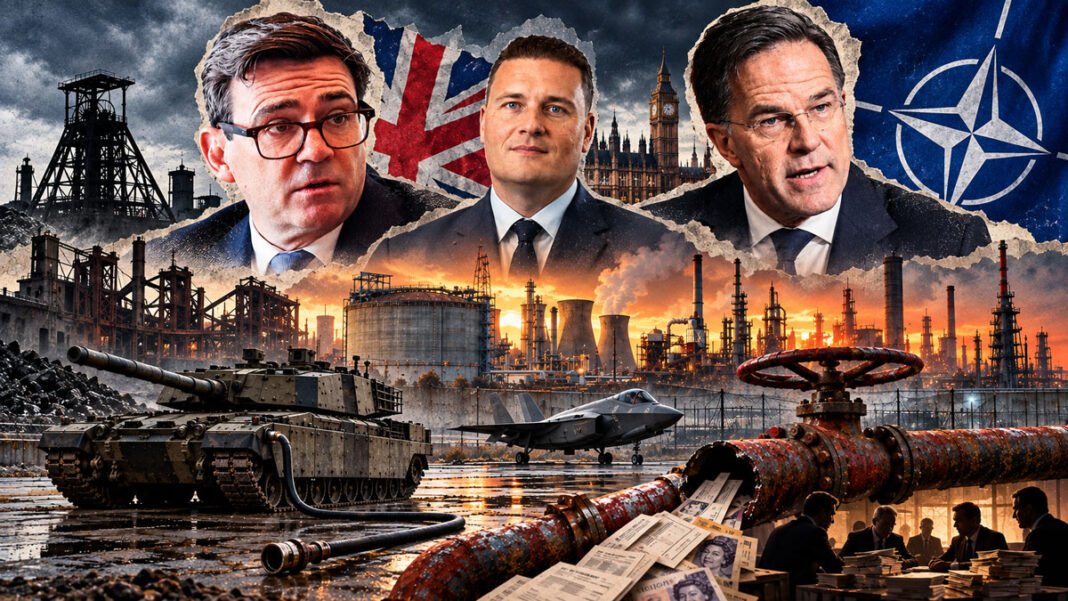
Mark Rutte told Bloomberg Television that no new refineries are being built in Europe and that existing ones are closing. If Russia attacked, he said, the alliance would need “massive amounts of diesel and other oil products for our F-35s, our fighter jets, for our tanks”. He called it “a big worry”.
It is more than a worry. It is a confession. And it deserves an answer from the people who made it necessary, because this vulnerability was not built in Moscow. It was built in Westminster.
In the 1970s Britain had 18 oil refineries. Today it has four. Grangemouth, Scotland’s only refinery, stopped processing crude in April 2025 and became an import terminal. Lindsey on Humberside closed that August after its owner, Prax, collapsed into insolvency. Both closures happened on this Labour government’s watch. What remains is Fawley, Humber, Pembroke and Stanlow, run by ExxonMobil, Phillips 66, Valero and Essar. Not one is in British hands. The fuel that would move a British tank now depends on the balance sheets of four foreign corporations and the goodwill of whoever sells us the diesel we no longer make.
That goodwill has limits. Rutte was answering a question about reports that Washington may ban diesel exports. Our closest ally might keep its fuel for itself. Rutte said the two issues were separate. For a country that imports what it once refined, they are the same issue.
Britain has seen this before.
How Britain Dismantled Its Industrial Security

Coal built the industrial revolution. It fed the furnaces, drove the railways and held entire working-class communities together. Conservative governments broke the miners in the 1980s. New Labour never reversed the damage. Kellingley, the last deep mine, closed in December 2015. Yet Britain kept buying coal, around 1.6 million tonnes last year according to government figures. The need shrank, but it never disappeared. We simply paid someone else to dig it, and let our coalfield towns rot.
Steel went the same way. Port Talbot’s blast furnaces went cold in 2024. When British Steel’s Chinese owners moved to close Scunthorpe in April 2025, Parliament was recalled on a Saturday to pass emergency legislation so the state could take control and stop Britain losing its last ability to make steel from scratch. The same establishment that told us the state had no business running industry discovered, with the furnaces about to die, that it had no choice.
That is the pattern, and it has held for forty years under every party. We were told public ownership was yesterday’s politics and that the market would supply our energy, steel, fuel and food more cheaply than we ever could. We were told a modern service economy had no need for smokestacks. The mines closed, the steelworks disappeared, the refineries shut, and ministers called it modernisation.

Now, the very politicians who oversaw this liquidation tell us the world has become an exceedingly dangerous place. Britain has committed alongside its NATO partners to raise defence and security spending to 5 per cent of national income by 2035. The public is being asked to provide staggering sums of taxpayer money to rebuild the very industrial resilience that was deliberately surrendered. The resulting state contracts, dividends, and share buybacks will flow straight back into the pockets of the same private interests that profited from running those assets down in the first place. The public paid for the destruction of its asset base, and now the public is expected to pay full price for its repair.
Nearly a century ago, Major General Smedley Butler of the United States Marine Corps saw this racket for what it was. Decorated twice with the Medal of Honour, Butler spent his career on the front lines of corporate empire before writing his classic 1935 indictment, War Is a Racket. His premise was devastatingly simple: ordinary working people provide the blood and the tax money, while a narrow circle of commercial interests harvests the windfall.
Negligence Dressed Up As Prudence
he defenders of the status quo will argue that the threats we face are real, that we cannot afford to wait for industrial reconstruction before rearming, and that refineries closed due to falling demand and rising carbon costs. They will claim that no government can stand in the way of global market forces.
The threat is real, but it is real precisely because our political class made it so. Britain stands utterly exposed because of the stewards we have endured. For four decades, governments of both major parties gambled with the foundation of the state. Their primary constitutional duty was to protect the people and the industrial base that keeps them secure. Instead, they bowed to financial markets and arms lobbyists, treating sovereign assets as inventory to be liquidated rather than a legacy to be safeguarded. They traded national self-reliance for offshore corporate profits, leaving our basic security in the hands of an unaccountable Epstein class.
A fighter jet without fuel is an expensive ornament. A tank without diesel is a monument.
In its own official call for evidence on the fuel sector, the government explicitly conceded that “we will need refineries in the UK for the long term.” Having written those words down, ministers sit back and watch the remaining plants die, hoping a foreign buyer or market miracle will save them. That is not statecraft; it is negligence masquerading as fiscal prudence.
This hypocrisy reaches into the core of how national security is defined. A government genuinely preparing for a volatile century would understand that security begins at home, with sovereign control over energy, steel, food, fuel, and borders.
Yet observe the glaring double standard. Returning through Dover, the British state exhibits ruthless efficiency when auditing a pensioner carrying an extra sleeve of cigarettes over her duty-free allowance. Meanwhile, thousands arrive across the Channel without identification, leaving border authorities scrambling to establish basic details after the fact. We aggressively police a holidaymaker’s suitcase while surrendering the vital infrastructure, steelworks, and refineries that keep the country functioning.
Then comes the final insult. The old free-market dogma suddenly evaporates when the customer is the Ministry of Defence. There is always public money for another missile contract, yet somehow never enough to preserve a refinery, a steelworks or the industrial communities that once made this country capable of supplying itself.
Funny how socialism becomes acceptable when the public is underwriting the arms industry.
Rebuilding British Energy and Industrial Security

If the political establishment wishes to speak credibly about national resilience, the public square must offer a clear, uncompromising set of demands. They are not radical; they represent the absolute baseline of what any serious sovereign nation requires:
- Direct Public Ownership in Refining: Take a decisive public stake in critical energy infrastructure, ensuring that fuel distribution during a crisis is governed by national necessity rather than a foreign boardroom’s quarterly profit margin.
- Redirect Strategic Spending: Divert the industrial share of the 5 per cent defence commitment away from management consultancies and shareholder dividends, funnelling it directly into sovereign steel, energy, agriculture, and heavy manufacturing.
- Enforce Strict Procurement Conditions: Mandate that every defence contract guarantees British workers, utilises British supply chains, and caps corporate profits whenever the customer is the public purse.
- Rebuild the Skilled Workforce: Launch a state-backed industrial training program to revive the engineering, metallurgy, and technical skills that were allowed to wither when the pits and yards were closed.
- Ministerial Accountability: Require every minister who invokes “national security” to account, on the public record, for their role in selling off the foundational infrastructure required to secure the nation.
A country that cannot forge its own steel, refine its own fuel, feed its own people, or secure its own borders is not made safe by signing more weapons contracts. It is simply transferring public wealth into private balance sheets.
They sold the nation’s security for a quick return, and now they expect the public to pay full price to buy it back. The answer from the public must be sharp and final: not on these terms.