Andy Burnham promised to protect people’s homes. Two days later, his own minister caught on the hop on live television and had to admit he’s not.
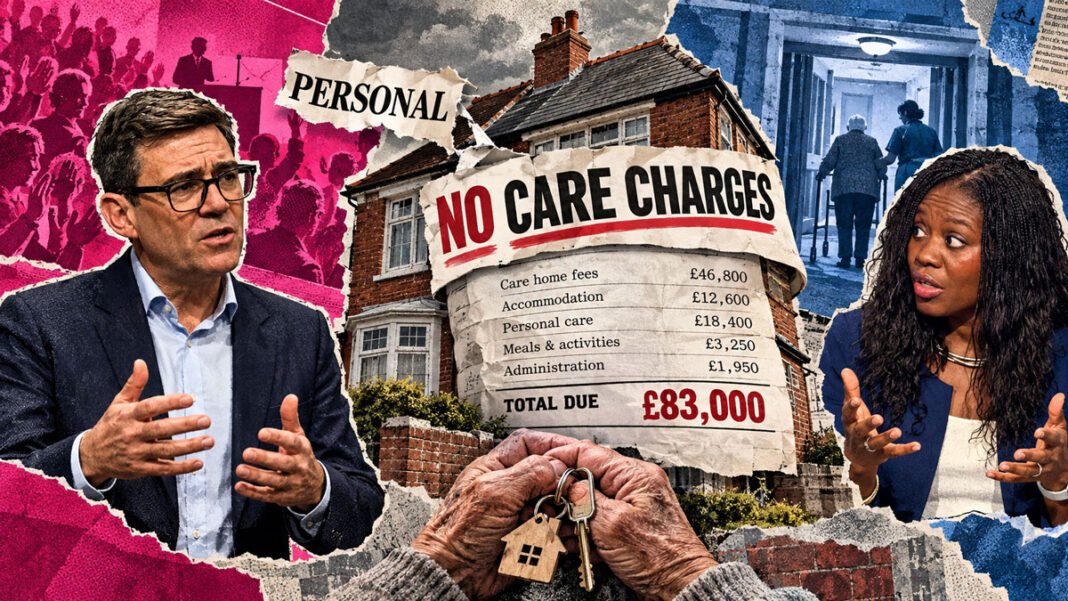
There is one word in the Government’s care announcement that will decide whether thousands of families keep the house they live in, and it is the word that went missing between the press release and the applause.
The word is “personal”…
The Downing Street statement of 30 September is careful, in the way these things always are. It promises “no personal care charges”. By the time Andy Burnham reached the climax of his speech in Liverpool, the adjective had quietly fallen away. “So this is the deal,” he told conference. “A state pension that rises every year. No care charges. And a high-quality National Care Service to give peace of mind in later life.”
No care charges. The hall rose.
He had earned the moment. He spoke about his gran Kitty, whose engagement ring was ripped from her finger and stolen in a care home, and whose modest savings were all taken to pay for it. He called his own generation of politicians “too cowardly to fix something as basic as the care we give to each other.” And he promised a service that would protect “people’s homes and their savings.”
Then, on Thursday night in Tottenham, Fiona Bruce pressed the Energy Secretary, Miatta Fahnbulleh, on what that sentence actually means. The answer arrived inside twenty seconds.
“It’s not going to be free,” Fiona Bruce said. People going into a care home “will still have to pay accommodation costs, which can be very hefty.” When the obvious conclusion was put to Fahnbulleh, that some people may therefore still end up having to sell their homes, she did not contradict it. She moved instead to the hope that free personal care would allow more people to stay in their own homes for longer.
That is a reasonable hope. It is not the promise that was made from the stage.
Free Personal Care: The £1,300-a-Week Bill That Remains
Personal care means help with eating, washing, dressing and using the toilet. That is the part the state proposes to pay for. Accommodation, food, heating and the rest of what a care home charges remains means-tested under the existing rules, and the Institute for Government notes that the No 10 press release explicitly rules out free “bed and board”.
Look at the proportions. Industry surveys put self-funded residential care in England at roughly £1,300 a week in 2026, and nursing care at about £1,500. In Scotland, where free personal care has existed since 2002, the weekly personal care payment for a care home resident is around £255. The state picks up a fifth of the bill and the family picks up the rest.
Scotland matters here, because Scotland is not a theory. It is the experiment already run. The Scottish Parliament’s own research service puts it without euphemism: because accommodation and living costs are not covered, “some people might be required to sell their home in order to fund their care home place, even if they are receiving free personal and nursing care.” Scotland has had this policy for twenty-four years and it has not stopped houses being sold. England’s version will not either, and no minister has claimed otherwise when asked directly.
Then there is who the promise is for. After the speech, Downing Street confirmed to Disability News Service that free personal care will apply only to those over 65. Working-age disabled people, who the Institute for Government reckons make up a little over 40 per cent of everyone receiving publicly funded long-term care, get nothing from this announcement. They must wait for Baroness Casey’s final report.
The National Care Service Will Not Start Before 2029
That report is due in summer 2027. The National Care Service itself will be introduced “in the next Parliament”, which is to say after the 2029 election. The money to pay for it comes from adjusting the state pension triple lock, and that adjustment does not begin until April 2030.
Which makes one line from Thursday night worth keeping. “I don’t think we can have another generation of politicians that candidly kicked this into the long grass,” Fahnbulleh said, defending a policy whose first payment, first legislation and first pound of funding all fall beyond the next general election.
The funding deserves attention too, because it is the most honest and least advertised part of the whole package. Downing Street estimates that trimming the triple lock will cut state pension spending by around £15 billion a year by the end of the 2030s, rising to £50 billion by 2050. Strip the presentation away and the arithmetic is this: older people will pay for their own care out of a smaller pension than they would otherwise have received. There is a serious case for that. It is not a gift, and it should not be sold as one.
Nor does any of it sit in a vacuum. On 29 July 2024, Rachel Reeves cancelled the £86,000 cap on care costs, along with the plan to lift the upper capital threshold from £23,250 to £100,000. That threshold has now been frozen for sixteen consecutive years. Community Care calculates that had it tracked prices since 2010, it would stand at roughly £36,400 today. The party now promising to protect your home is the party that scrapped the one mechanism Parliament had already legislated to limit what your home could be taken for.
The Difference Between Free Personal Care and Free Care
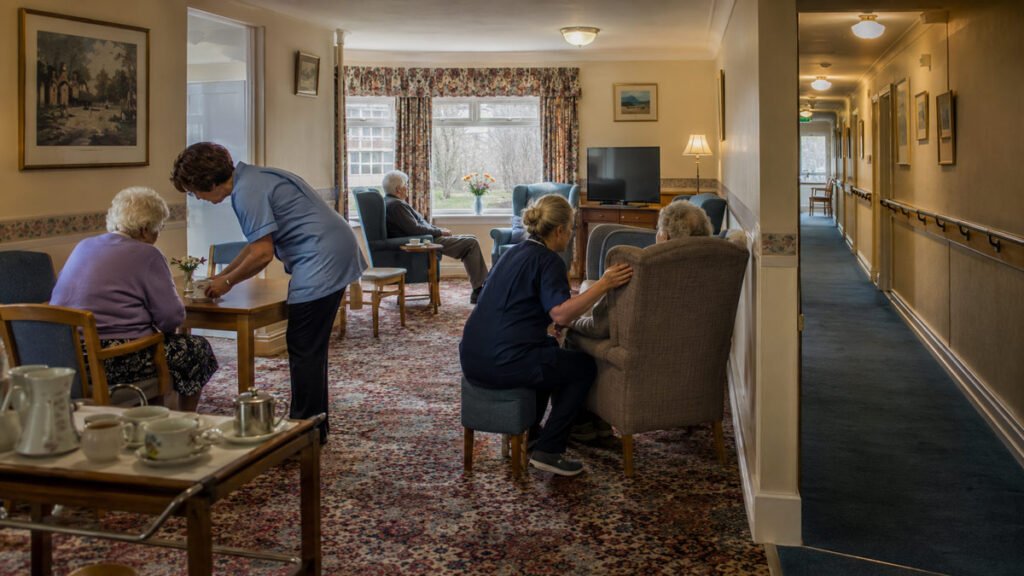
Be fair to Burnham, because fairness is what makes the criticism stick. He is right that the care system is broken and right that it is dragging the NHS down with it. Free personal care at home is a real improvement on nothing, and it will keep some people out of residential care altogether, which is both cheaper and kinder. He is the first Prime Minister in a generation to touch the triple lock in public, and he said plainly that he may pay a political price for it. He tried this once before, as Health Secretary in 2009, and watched the Conservatives bury it under a poster reading “death tax”. A braver offer than his predecessors managed is still a braver offer.
But the test of a political promise is not the warmth of the speech. It is the sentence a family can hold you to afterwards.
“Free social care” brings a conference hall to its feet. “Free personal care for the over-65s from the next Parliament, with hefty residential accommodation charges still means-tested against your house” does not. Both describe the same policy. Only one of them is true, and it was not the one delivered to the applause.
Orwell saw the mechanism clearly in 1946, writing in Horizon. Political language, he said, “is designed to make lies sound truthful and murder respectable, and to give an appearance of solidity to pure wind.”
Nothing here is a lie. Every clause in the Downing Street release will survive a fact-check. The deception, if that is the word, lives in the gap between a document written to be defensible and a speech written to be cheered, and in the confidence that only one of them will ever be read.
So let the Government say the full sentence, in public, with the adjective still in it. Let it publish the Casey timetable, the cost of including working-age disabled people, and the point at which a family home becomes safe. And let every one of us hold on to the small print, because the small print is the only part of this that anyone will ever be made to pay.
They have not abolished the care bill. They have only renamed the part they intend to pay.