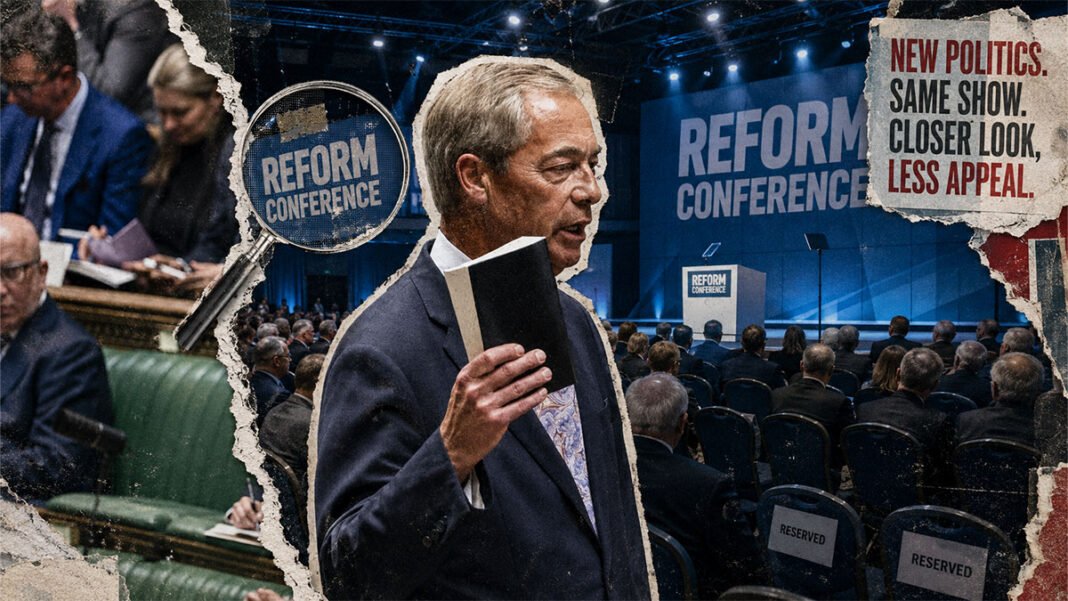
It Worked. Boom. Now Reform’s Populist Myth Is the One That’s Broken
Reform UK’s Nigel Farage was filmed by undercover reporters celebrating secret foreign donations: “It worked. Boom.” Two senior officials have stepped down. The party has been reported to the police. The populist myth of the insurgent outsider is broken.
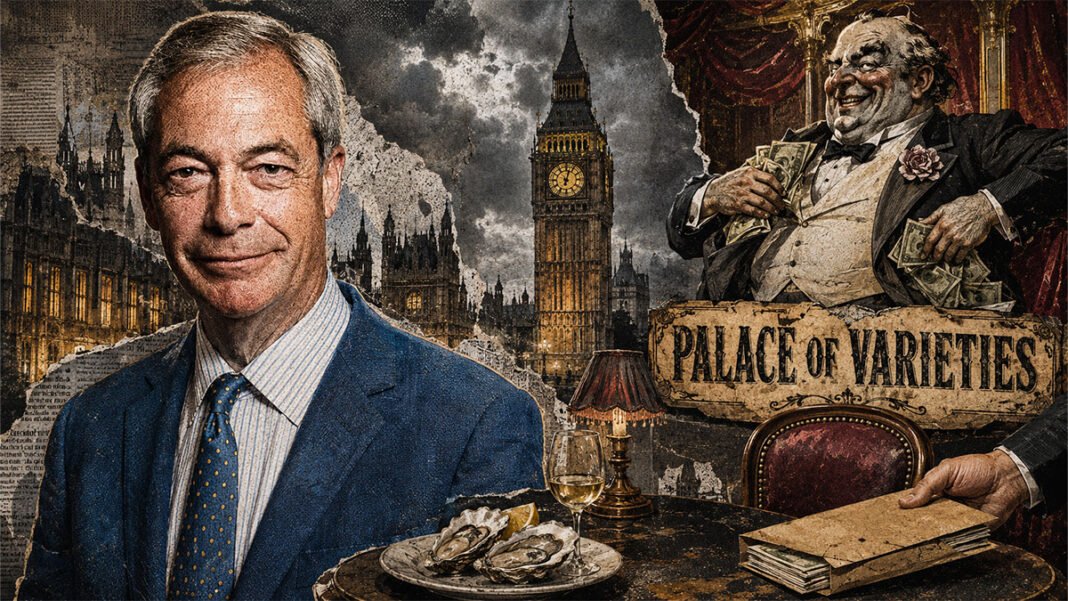
There is a scene in the Channel 4 footage that tells you almost everything you need to know about the state of British politics in 2026. Nigel Farage, the man who has spent three decades telling the working class he is one of them, sits over oysters and wine in his own constituency of Clacton, thanking a fictional American businessman for bankrolling his party. “It worked,” he says. “Boom.”
He was right. It did work. The polls his party quietly paid a stranger to fund made headlines in the spring, helped carry Reform into the local elections in May, and were presented to the public as independent evidence of the nation’s mood. What Farage did not know, as he raised his glass in Essex, was that the whole thing was a set-up. “William Lockwood” and his wealthy American father did not exist. They were undercover reporters working for Verbatim, an investigative outfit founded by journalists from the Centre for Climate Reporting, and their footage was verified and broadcast by Channel 4 News on the eve of Reform’s annual conference in Birmingham.
By Friday morning, two of Farage’s closest lieutenants were gone. Dan Jukes, his long-serving media aide, and James Orr, the party’s head of policy, had both stepped down “pending the outcome of an internal investigation.” Reform’s chairman, Lee Anderson, told Sky News there was “no chance” either man would return. The party has been reported to the Metropolitan Police and the Electoral Commission, not only by the Liberal Democrats but by Labour too, over what the Lib Dem MP Lisa Smart described in her letter to the Met’s specialist unit as “the acceptance and concealment of a donation from an impermissible donor.” A former chief executive of the Electoral Commission, Bob Posner, has gone further, telling Channel 4 the evidence points towards “serious criminal offences.”
Oysters, wine, and a £32,500 secret
Strip away the theatre and the facts are straightforward. Earlier this year, Orr and Jukes arranged for a US-registered company to fund three opinion polls commissioned by Reform, at a cost of £32,500. Under British law, that is not a grey area. Foreign companies are not a permissible source of political funding, and that prohibition covers research and polling just as much as it covers cash in an envelope. The public was never told the polls were paid for this way, nor that the party had gone looking for an “off the books” backer to do it. When the undercover team later raised the prospect of a further £500,000 donation, one of them made clear the money would be funnelled through the UK-based “son” so it looked domestic, even though it originated with the American “father.” That arrangement, first proposed by Jukes at an earlier meeting according to the Channel 4 investigation, is exactly the kind of concealment that section 61 of the Political Parties, Elections and Referendums Act 2000 exists to catch. Farage’s own reply to the offer, captured on camera, was simple: “thank you,” then “both of you, thank you.”
Reform’s response has been to attack the messenger. The party has dismissed the story as “a hoax perpetuated by foreign-funded, climate change activists posing as would-be party donors” and insists it operates “a robust vetting process for prospective donors approved by the Electoral Commission.” Farage told LBC on Friday morning that the party had “broken no laws” and had “not taken any dodgy money or anything like that whatsoever,” calling the operation “a clear case of entrapment.” The Metropolitan Police, for its part, has said only that it is “aware of media reporting” of a potential breach of the 2000 Act and will “assess this matter and any information provided.”
It is worth taking the entrapment argument seriously before dismissing it, because a free press does not get a free pass simply because its target is disliked. Undercover journalism using deception is a blunt instrument, and Ofcom has already had cause to examine a previous Channel 4 sting on Reform canvassers in Clacton. Deceiving people into saying things they would not otherwise say is a genuine ethical hazard, and the Tribune does not pretend otherwise.
In one of the recorded meetings with James Orr, the Head of Policy said the Commission was “completely useless” and boasted “we could easily get away with it”.
But entrapment is not what happened here, because nobody was tricked into breaking a law they did not already understand. Orr and Jukes were not goaded into inventing an illegal funding route on the spot. According to the Channel 4 reporting, Orr had told the undercover team earlier in the year that Farage “would not need to know” about the polling payments. That is the language of a man managing a paper trail, not one confused about the rules. In a separate recording, Orr went further, dismissing the regulator itself as “completely useless” and boasting that the party “could easily get away with it.” Nobody put those words in his mouth. The deception in this story was not the journalists pretending to be American donors. It was Reform’s own officials pretending, to the public and quite possibly to their own leader, that £32,500 of foreign money had never entered British politics at all.
The Party of the People: Funded by the People it Claims to Oppose
What makes this story more than a passing conference-week embarrassment is who it happened to. Reform UK’s entire political identity rests on the claim that it is the insurgent outsider, the party of the man in the pub against the man in Brussels, of the fishing village against the financier, of Clacton against Canary Wharf. That is the pitch. It is why Farage can stand in a working men’s club in a former mining town and be believed when he says the old parties sold their voters out.
The trouble is that the money behind the insurgency keeps turning out to be exactly the sort of money the insurgency claims to be against. This is not the party’s first funding controversy of the year. Farage is already the subject of a parliamentary standards investigation into a £5 million gift from the crypto financier Christopher Harborne, received shortly before Farage was elected to the Commons in 2024 and which he insists was a personal security gift that never needed declaring. The Tribune covered that case in July, when Farage compared the scrutiny to trial by ordeal. Since then, Harborne’s giving has only grown. Electoral Commission figures show a further £9 million from him in a single quarter this year, the largest donation ever made to a British political party by a living person, a sum that alone dwarfed the combined quarterly totals of the Conservatives, Labour and the Liberal Democrats. Reform was also the first British party to open its doors to cryptocurrency donations, courted Elon Musk over a rumoured nine-figure gift at Mar-a-Lago, and now finds its deputy leader, Richard Tice, fielding separate questions of his own over undeclared gifts.
And then there is the man who just resigned. James Orr is not some council-estate organiser who talked his way into Farage’s inner circle. He is an Oxford and Cambridge-educated philosopher of religion, a former City lawyer at Freshfields and Sullivan & Cromwell, appointed head of policy as recently as February, succeeding Zia Yusuf in a role that has now changed hands twice within a year. Reform sells itself as the party of people who feel unheard by a remote, credentialled establishment. Its head of policy, until Friday, was about as establishment as it is possible to be.
Tony Benn used to say there were five questions worth asking of anyone who wields power: what power have you got, where did you get it, in whose interests do you exercise it, to whom are you accountable, and how can we get rid of you. Reform’s answer to the second question, on this evidence, increasingly runs through Thailand-based crypto fortunes, offshore financiers and now, however briefly, a fictional American willing to hand over half a million pounds for the right kind of thank you. That is not a smear invented by a hostile broadcaster. It is the party’s own accounts, and its own recorded voice, telling the story.
The Rot in British Political Funding Runs Through Every Party

None of this should be read as Labour or the Liberal Democrats occupying the moral high ground, and this paper has never pretended otherwise. Labour has taken its own dark money too, most notably £4 million from Quadrature Capital, a tax-haven hedge fund with stakes in oil and arms that insisted the gift was “values-based, not political.” The rot in British political funding runs through every party that has held power or hoped to. What the PPERA foreign donation ban exists to protect is not any one party’s reputation. It exists to protect the basic democratic principle that only people entitled to a vote in this country, or companies genuinely rooted in it, should be allowed to pay for the arguments put in front of the electorate. That is not a partisan demand. It is the same sovereigntist instinct that objects to unelected foreign institutions setting British rules, applied with equal force to unelected foreign money buying British elections.
The Electoral Commission has said plainly that any attempt to evade the controls on donations is a matter for the police, not for a party’s internal review panel. Reform’s own investigation into itself, launched the same evening the story broke, will not settle what a criminal inquiry now must. Two resignations on the first morning of a conference is not accountability. It is triage.
There ought to be a donation cap that makes stories like this one structurally impossible rather than merely embarrassing when they surface. There ought to be an Electoral Commission with the enforcement teeth to match its warnings. And there ought to be a political culture, across every party, in which a man who postures as the voice of the overlooked does not need a fictional millionaire to remind him whose money he is actually spending.
Farage said it himself, on camera, raising a glass to a stranger who did not exist. It worked. Boom. He was talking about the polling. He might just as easily have been describing how the whole system now runs.

Support The Tribune
INDEPENDENT. READER-FUNDED. AD-FREE.
If you value this article, help keep The Heartlands Tribune publishing independent journalism without intrusive advertising or corporate sponsors.
Choose your monthly amount
Secure payment via GoCardless